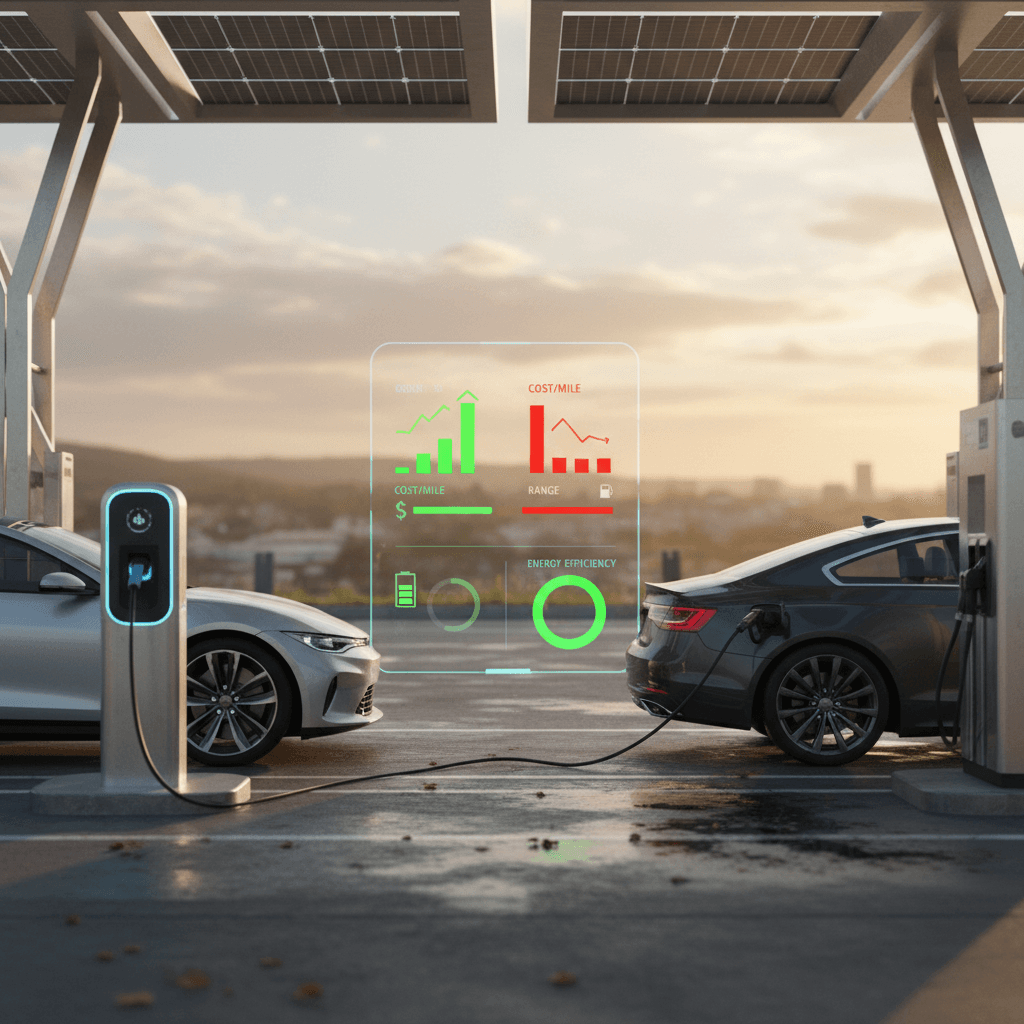
When you strip away marketing, range anxiety and the glow of giant touchscreens, what really matters is simple: how much does an electric car cost per mile to drive? The “electric car price per mile” is where EVs either make brilliant financial sense, or quietly drain your wallet.
What we’ll do in this guide
Why electric car price per mile matters more than MSRP
Sticker price gets all the attention, but running cost per mile is where electric cars quietly reshape your budget. A gas SUV that’s “cheap” to buy can cost you thousands more in fuel every year; a slightly more expensive EV can pay you back mile by mile in lower energy and maintenance costs.
Three big reasons to focus on cost per mile
Especially if you’re considering a used EV
You feel it every month
Batteries age, costs change
Used EVs can be a bargain
Rule of thumb
How to calculate electric car price per mile
There are two layers to your electric car price per mile. Think of one as the “fuel” and the other as everything else.
1. Energy cost per mile
This is the electricity you use to move the car, what replaces gasoline.
- Your EV’s efficiency (kWh per 100 miles or miles per kWh)
- Your electricity rate (¢ per kWh at home, work, public chargers)
- How much you rely on fast charging vs cheaper Level 2 home charging
2. Ownership cost per mile
This is everything that doesn’t come out of a charging cable:
- Depreciation (how fast the car loses value)
- Financing costs and interest
- Insurance and registration
- Maintenance and repairs (usually lower for EVs)
Combine the two and you get your all‑in price per mile.
Don’t chase a fake “$0.00 per mile” dream
Step 1: Work out your energy cost per mile
First, figure out how much electricity your EV uses and what you pay for that electricity. If you’ve ever calculated miles per gallon, this will feel familiar, just with kilowatt‑hours instead of gallons.
Quick U.S. energy numbers for 2025 (ballpark)
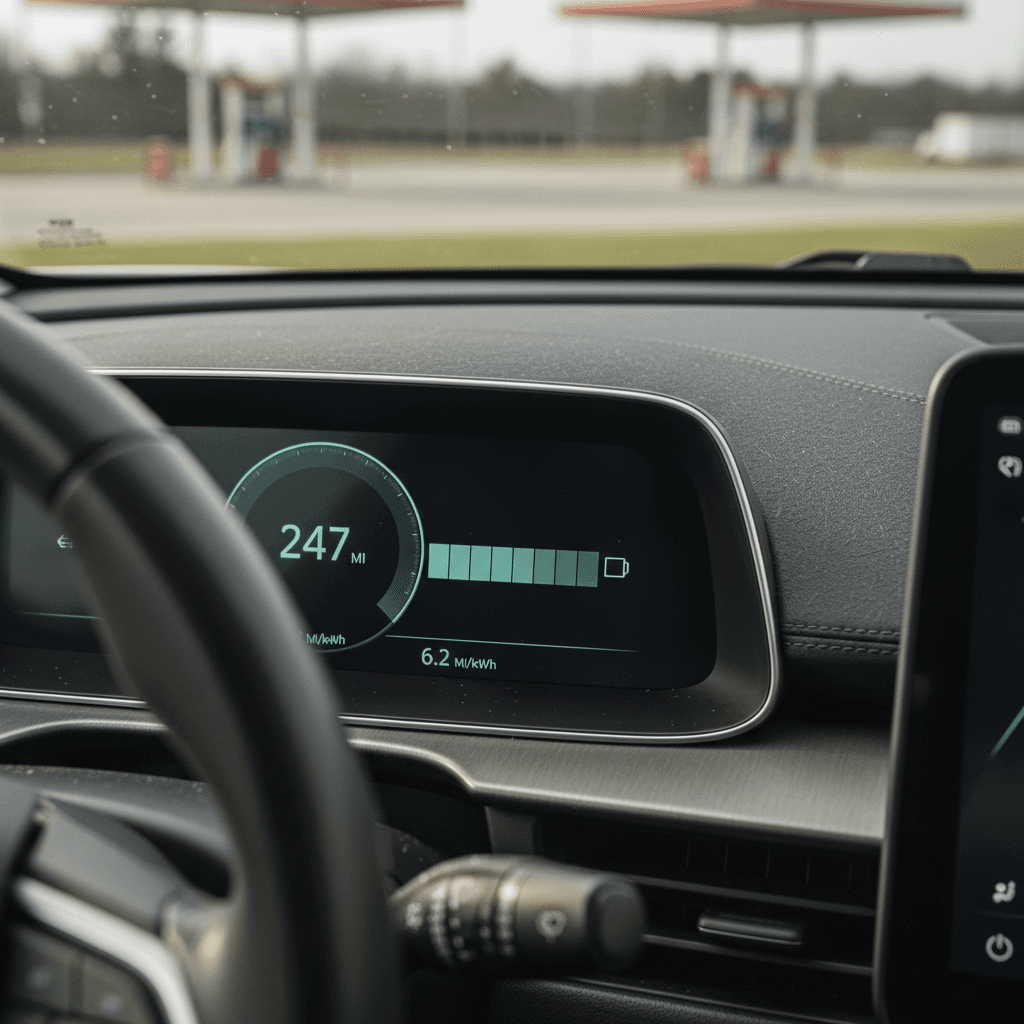
- Find your EV’s efficiency on the window sticker, in the owner’s manual, or on the in‑car efficiency screen. It’s usually given as kWh/100 mi or mi/kWh.
- Check your most recent electric bill for your “all‑in” rate per kWh, including fees and taxes, not just the headline rate.
- Multiply: (kWh per 100 miles) × (price per kWh) ÷ 100. That’s your energy price per mile when charging at home.
Shortcut formula
Fast charging changes the math
Step 2: Add ownership costs per mile
Energy is only half the story. Your electric car price per mile also includes what you pay to own the car in the first place. This is where used EVs can be quietly brilliant.
Turning ownership costs into a per‑mile number
Use your own numbers in this template to get a realistic EV cost per mile.
| Cost bucket | How to estimate | Example over 5 years | Per‑mile impact |
|---|---|---|---|
| Depreciation | Purchase price minus expected value after 5 years | $40,000 → $20,000 = $20,000 loss | $20,000 ÷ 60,000 = $0.33/mi |
| Financing | Total interest over term | $3,000 interest | $3,000 ÷ 60,000 = $0.05/mi |
| Insurance & fees | Use yearly total × 5 years | $1,600/year × 5 = $8,000 | $8,000 ÷ 60,000 = $0.13/mi |
| Maintenance & repairs | Use owner forums or your own service history | $1,500 total | $1,500 ÷ 60,000 = $0.025/mi |
Example assumes 12,000 miles per year over 5 years (60,000 miles).
Add those per‑mile figures to your electricity cost per mile and you get a realistic answer to the question, “What does this EV actually cost me every mile I drive it?”
Where Recharged fits
Ready to find your next EV?
Browse VehiclesElectric vs gas: cost per mile comparison
Let’s put two cars on the same road. One burns gasoline; one burns electrons. We’ll keep the numbers simple so you can swap in your own.
Energy cost per mile: EV vs gas example
Illustrative comparison using 2025‑style prices; use your local rates for real planning.
| Vehicle | Energy use | Fuel price | Cost per 100 miles | Cost per mile |
|---|---|---|---|---|
| Gas sedan | 30 MPG | $3.75 per gallon | 100 ÷ 30 × $3.75 = $12.50 | $0.125/mi |
| Efficient hybrid | 50 MPG | $3.75 per gallon | 100 ÷ 50 × $3.75 = $7.50 | $0.075/mi |
| Typical EV | 28 kWh/100 mi | $0.16 per kWh home rate | 28 × $0.16 = $4.48 | $0.045/mi |
| Fast‑charge heavy EV | 28 kWh/100 mi | $0.40 per kWh DC fast charge | 28 × $0.40 = $11.20 | $0.112/mi |
Assumes 12,000 miles per year; fuel only, no depreciation or insurance.
Takeaway from the table
How a used EV changes your price per mile
New EVs wear heavy depreciation for the first few years. That hurts the first owner’s cost per mile and quietly sets up an opportunity for the second owner. This is where used EVs, bought wisely, can be cost‑per‑mile monsters, in a good way.
Why used EVs often win on cost per mile
The sweet spot is a healthy battery and honest pricing
Depreciation already happened
Battery health is knowable
Less wear than a used gas car
But watch out for tired batteries
Real‑world EV cost per mile examples
Let’s run two simple, realistic scenarios so you can see how the numbers shake out. These are illustrations, not quotes, swap in your own values where they differ.
Scenario A: New EV, mostly home charging
- New compact EV, $40,000 purchase price
- Keep it 5 years, expect $18,000 resale value
- Depreciation: $22,000 → $0.37/mi over 60,000 miles
- Electricity: 28 kWh/100 mi at $0.16/kWh → $0.045/mi
- Insurance/fees/maintenance together: roughly $0.18/mi
All‑in price per mile ≈ $0.60 (60 cents) over that 5‑year window.
Scenario B: 3‑year‑old used EV from Recharged
- Original MSRP $50,000, you buy at $28,000
- Keep it 5 more years, expect $14,000 resale value
- Depreciation: $14,000 → $0.23/mi over 60,000 miles
- Electricity similar: ≈ $0.045/mi on home power
- Insurance/fees/maintenance: slightly lower than new, ≈ $0.16/mi
All‑in price per mile ≈ $0.44 (44 cents). Same miles, lower capital cost.
“The quiet financial superpower of a well‑bought used EV is that someone else paid for the expensive years. You just enjoy the cheap miles, provided the battery checks out.”
Practical ways to lower your EV cost per mile
Seven moves that make every EV mile cheaper
1. Charge at home whenever you can
Home Level 2 charging is usually the cheapest, cleanest fuel you can buy. Even if your utility rate looks high, it’s often a fraction of DC fast charging or gasoline on a cost‑per‑mile basis.
2. Use off‑peak or EV‑specific rates
Many utilities offer time‑of‑use plans or special EV tariffs. Charging after midnight or during off‑peak periods can instantly chop <strong>30–50%</strong> off your electricity cost per mile.
3. Keep your battery in its happy zone
Living at 100% charge and 0% charge ages batteries faster. Day to day, charging to around 70–80% and avoiding deep, hot discharges helps preserve range, and future resale value.
4. Avoid making DC fast charging a lifestyle
Road trips? Use it freely. Daily commute? Try not to. Routine DC fast charging is like living at the gas pump: fast but expensive, and a bit harder on the battery over time.
5. Watch your tires and alignment
Under‑inflated tires and bad alignment eat efficiency in any car. In an EV, that translates directly into more kWh per mile, and a higher price per mile for the same trip.
6. Right‑size your battery
If you mostly do city miles and have reliable charging, a smaller battery pack can mean a lower purchase price, less depreciation, and a better cost per mile than a giant long‑range pack you rarely use.
7. Start with a transparent used EV
A used EV with verified battery health, like those sold with a <strong>Recharged Score Report</strong>, lets you estimate depreciation and efficiency with far fewer question marks.
So… is an electric car worth it on a per‑mile basis?
If you care about cost per mile, and you should, electric cars are rarely the villain. On energy alone, they’re usually the hero: fewer cents per mile than gas, especially with home charging and smart utility plans. The real swing factor is what you pay for the car itself and how long you keep it.
Buy new and flip quickly, and your depreciation per mile will be high no matter what’s under the hood. Buy a healthy used EV, drive mostly on home power, and your electric car price per mile can undercut comparable gas cars by a wide margin, while giving you a smoother, quieter commute every single day.
If you’re ready to run the numbers on a real car instead of a spreadsheet example, browse used EVs at Recharged. Every vehicle includes a Recharged Score battery health report, transparent pricing, financing options, and nationwide delivery, so you can go from curiosity about cost per mile to actually driving those cheaper miles.