When you switch from gas to an EV, the single biggest day‑to‑day question is simple: what is the electric car fuel cost compared with filling up at the pump? The good news is that electricity is usually cheaper per mile than gasoline, often much cheaper, but the exact answer depends on where and how you charge.
Quick answer
How much does it cost to “fuel” an electric car?
Because electric cars don’t use gallons, it’s easy to get lost in kilowatts and kilowatt‑hours. The simple way to think about electric car fuel cost is this: you pay by the kilowatt‑hour (kWh), and your EV turns each kWh into miles of range. Your cost per mile is just your electricity price divided by your car’s efficiency.
- Most U.S. households pay roughly $0.13–$0.20 per kWh for electricity, depending on state and time of use.
- Many modern EVs get around 3–4 miles per kWh in mixed driving.
- So a typical home‑charged EV costs roughly $0.04–$0.06 per mile.
Shortcut formula
At a glance: typical 2025 EV fuel costs
Electric car fuel cost vs gas: cost per mile
Comparing electric and gas “fuel” costs works best on a cost‑per‑mile basis. For gasoline, you multiply fuel price by gallons used; for electricity, you multiply kWh price by kWh used. Then you compare miles driven for each.
Typical EV vs gas cost per mile (2025 conditions)
Illustrative comparison using common U.S. electricity and gasoline prices. Actual costs vary by region, driving style, and vehicle.
| Vehicle type | Energy price assumption | Efficiency | Approx. fuel cost per mile |
|---|---|---|---|
| Efficient EV, mostly home charging | $0.16/kWh residential | 3.5 mi/kWh | $0.05/mi |
| Less efficient EV, mix of home + public | $0.16/kWh home + some $0.40/kWh fast charge | 2.7 mi/kWh | $0.06–$0.09/mi |
| Efficient gas hybrid | $3.60/gal gasoline | 50 mpg | $0.07/mi |
| Typical gas sedan | $3.60/gal gasoline | 30 mpg | $0.12/mi |
| Large gas SUV | $3.60/gal gasoline | 20 mpg | $0.18/mi |
EVs usually cut fuel cost per mile by around half, and sometimes more, especially if you charge mostly at home.
Public fast charging can change the math
Home charging costs: breaking down your electric bill
For most EV owners, the lowest electric car fuel cost comes from charging at home. You’re paying your regular residential electricity rate instead of a marked‑up public charging price, and you can time charging for off‑peak hours if your utility offers time‑of‑use plans.
1. Know your kWh rate
Look at your electric bill for “$/kWh” or “¢/kWh.” In many parts of the U.S., that’s around 13–20¢. If you have a time‑of‑use plan, your overnight rate might be substantially lower than your daytime rate.
2. Estimate your monthly EV energy use
Multiply your monthly miles by your EV’s miles per kWh, then divide by 1000 to convert Wh to kWh. For example, 1,000 miles at 3.5 mi/kWh uses about 285 kWh.
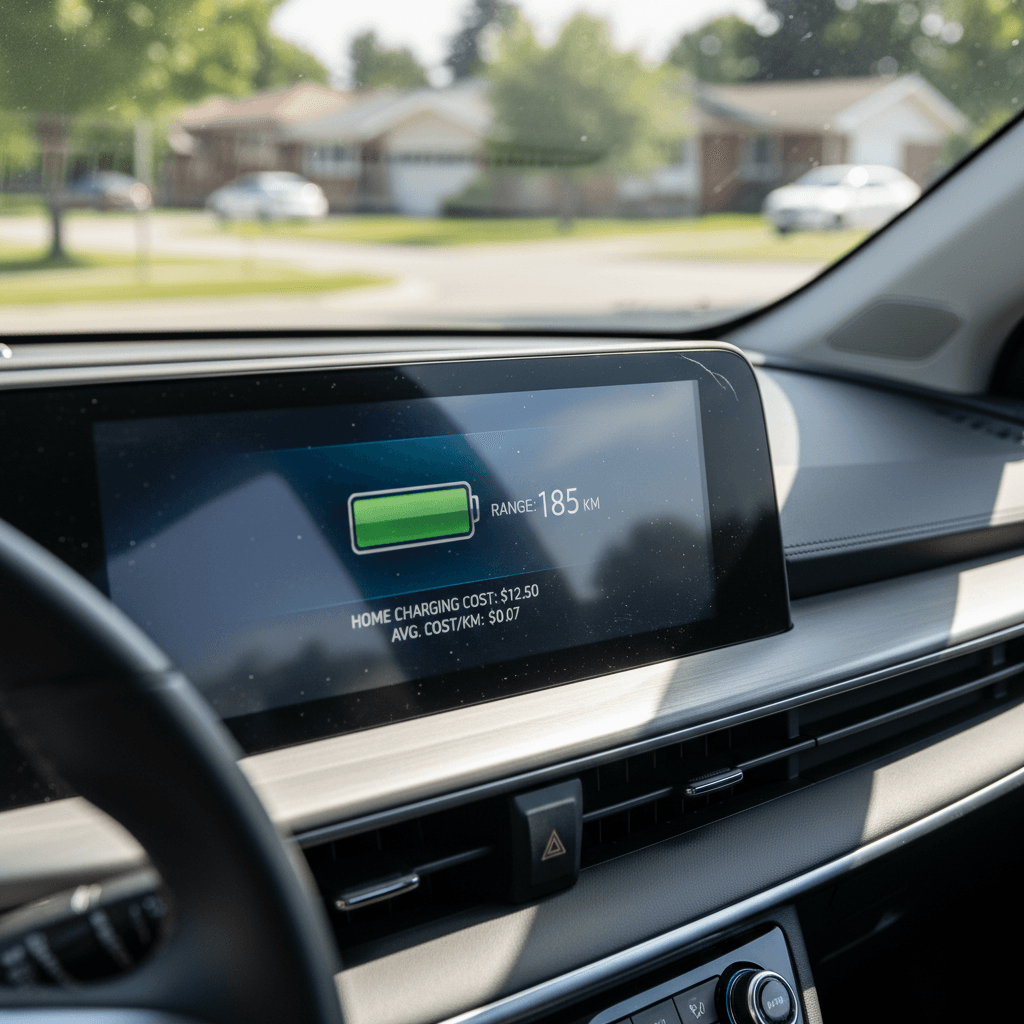
If you drive 1,000 miles a month and pay $0.16/kWh, using roughly 285 kWh for the car, you’d spend about $46/month on electricity for driving. Many households in gas cars easily spend that much, or more, on a single tank.
Will my electric bill explode?
Public charging costs: Level 2 vs DC fast
Public chargers work like fuel stations for electricity, but they come in two main flavors: Level 2 and DC fast charging. Both are more expensive than home power, but they serve different needs.
How Level 2 and DC fast charging affect your fuel cost
Use Level 2 when you can, DC fast when you need to.
Level 2 public charging
Often found at workplaces, parking garages, hotels, and shopping centers.
- Power: ~6–11 kW
- Pricing: frequently $0.20–$0.35/kWh or session/hour‑based
- Use case: topping up while parked for a few hours
DC fast charging
High‑power stations along highways and major corridors.
- Power: ~50–350 kW
- Pricing: often $0.35–$0.60+/kWh or per‑minute
- Use case: road trips and quick turnarounds
Networks & memberships
Major networks (Electrify America, EVgo, Tesla Supercharger for non‑Tesla EVs in some locations, and others) may offer discounted pricing with memberships.
Heavy fast‑charge users should compare membership plans carefully.
Beware per‑minute pricing on slow chargers
How battery size and efficiency change your fuel cost
Just like big, heavy gas SUVs tend to burn more fuel, larger or less efficient EVs use more electricity per mile. Your electric car fuel cost is directly tied to how many miles you get from each kWh.
Key factors that affect EV fuel cost per mile
Vehicle size and aerodynamics
Small, slippery hatchbacks and sedans often see 3.5–4.5 mi/kWh. Tall, boxy SUVs and trucks may fall closer to 2.3–3.0 mi/kWh, especially at freeway speeds.
Driving speed and style
Highway driving at 75+ mph, hard acceleration, and lots of short trips all increase consumption. Smooth driving at moderate speeds keeps your cost per mile down.
Climate and HVAC use
Very cold or hot weather reduces efficiency because the battery and cabin need more energy. Using seat and steering‑wheel heaters is often more efficient than blasting cabin heat.
Tires and cargo
Aggressive all‑terrain tires and heavy loads raise rolling resistance. Proper tire pressure and removing unnecessary cargo can recover a surprising amount of efficiency.
Look at EPA MPGe and kWh/100 miles
Real-world examples: popular EVs vs gas cars
Let’s put some simple numbers on the page. Assume home electricity at $0.16/kWh and gasoline at $3.60/gal. Your exact results will vary by region, but the ratios tend to look similar.
Illustrative monthly fuel costs at 1,000 miles
EVs here assume mostly home charging at $0.16/kWh. Gas vehicles use $3.60/gal. These are rounded examples, not quotes for specific VINs.
| Vehicle example | Efficiency assumption | Energy price | Approx. monthly fuel cost |
|---|---|---|---|
| Compact EV (e.g., Bolt EUV‑class) | 3.7 mi/kWh | $0.16/kWh | ≈ $43 |
| Mid‑size EV crossover (Model Y‑class) | 3.2 mi/kWh | $0.16/kWh | ≈ $50 |
| Large EV SUV or truck | 2.5 mi/kWh | $0.16/kWh | ≈ $64 |
| Hybrid sedan | 50 mpg | $3.60/gal | ≈ $72 |
| Gas sedan | 30 mpg | $3.60/gal | ≈ $120 |
| Gas SUV/truck | 20 mpg | $3.60/gal | ≈ $180 |
Even when you account for higher public charging rates on road trips, most drivers will see meaningful monthly savings on fuel with an EV.
The real story isn’t that EVs are free to fuel, they aren’t, but that they decouple your transportation budget from oil price shocks and gas station markups.
How to lower your electric car fuel costs
You can’t control every variable, but you have more influence over your electric car fuel cost than you might think. A few practical strategies can keep your per‑mile costs firmly in the “smiling at your old fuel receipts” zone.
Practical ways to cut your EV fuel cost
Focus on when you charge, how you drive, and which car you choose.
Use off‑peak rates
Ask your utility about time‑of‑use EV plans. Scheduling charging for overnight hours can shave several cents per kWh, which adds up quickly over thousands of miles.
Maximize home charging
Think of public DC fast charging like airport food: great in a pinch, not for every meal. Installing a Level 2 charger at home, often financed into your EV purchase, keeps your average fuel cost low.
Right‑size your EV
If you don’t tow or haul often, a smaller, more efficient used EV can dramatically reduce your fuel cost per mile while still covering daily needs.
Driving habits that keep your EV’s cost per mile low
1. Precondition while plugged in
Warm or cool the cabin while the car is still charging so you use grid power instead of battery energy once you start driving.
2. Use eco or efficiency modes
Most EVs offer drive modes that soften acceleration and optimize HVAC settings for efficiency without turning your car into a slow lane obstacle.
3. Plan charging on road trips
Use route planners that show charger speeds and prices. A slightly faster charger at the same price can lower your cost per mile by reducing idle time on per‑minute plans.
4. Keep tires inflated properly
Under‑inflated tires hurt efficiency in any vehicle. Check pressures monthly, especially with big temperature swings.
Where Recharged fits in
Ready to find your next EV?
Browse VehiclesElectric car fuel cost and used EVs
With a used EV, fuel costs depend not only on efficiency and electricity price, but also on battery health. A degraded battery won’t necessarily cost more per mile, but it can change how and where you charge.
Range and charging patterns
If a used EV has lost some range due to normal battery aging, you may need to charge a bit more often, especially on road trips. That can mean more time at public chargers, where per‑kWh prices are higher than at home.
Charging speed and degradation
Some older packs slow down DC fast‑charging speeds to protect the battery. That doesn’t increase the kWh used per mile, but it can make per‑minute pricing more expensive because you’re getting fewer kWh for each paid minute.
Why a battery health report matters
FAQ: electric car fuel cost
Frequently asked questions about electric car fuel cost
Key takeaways
When you peel back the acronyms and rate plans, electric car fuel cost comes down to a few basics: how efficient your EV is, what you pay per kWh, and how often you rely on public fast charging. For most drivers who can plug in at home, electricity is not just cheaper than gas on a per‑mile basis, it’s also more predictable.
If you’re considering a used EV, those fuel savings are one of the biggest levers in your total cost of ownership. The key is matching the right car to your charging reality and understanding its battery health up front. That’s exactly why Recharged pairs every vehicle with a transparent Recharged Score Report and expert EV guidance, from financing and trade‑ins to nationwide delivery, so you can enjoy lower fuel costs with fewer surprises.