If you’re weighing an electric car against a gasoline model, efficiency is where EVs quietly change the math. On paper, electric car efficiency vs gasoline isn’t even close, modern EVs convert far more of their energy into motion. But what you really care about is simple: How far will I go for each dollar I spend, and what does that mean over years of ownership?
Quick takeaway
Why electric vs gasoline efficiency matters now
For years, the main reasons to consider an EV were early‑adopter curiosity or environmental concerns. In 2025, with EV prices coming down and gas prices still volatile, efficiency has become a core financial question. A car is often the second‑largest expense in a household. Getting efficiency wrong by a few cents per mile can mean thousands of dollars over the life of the car.
- A typical gas car in the U.S. averages around 26–30 MPG, with many SUVs and trucks doing worse.
- Modern EVs commonly deliver 3–4 miles per kWh, which the EPA converts into roughly 90–120 MPGe for many models.
- Home electricity rates tend to move more slowly than gasoline prices, so your energy budget is easier to predict with an EV.
Tip for shoppers
How we measure efficiency: MPG vs MPGe vs kWh
Gasoline cars use miles per gallon (MPG). Electric cars use a few different metrics, miles per kWh, kWh per 100 miles, and MPGe (miles per gallon equivalent). Understanding the differences will help you compare apples to apples.
Three key efficiency metrics you’ll see
Once you know how to read them, comparing EVs and gas cars gets much easier.
MPG (gas cars)
Miles per gallon is how far you drive on one gallon of fuel.
- Typical sedans: 28–35 MPG
- SUVs & trucks: often 18–25 MPG
- Higher is better
Miles per kWh (EVs)
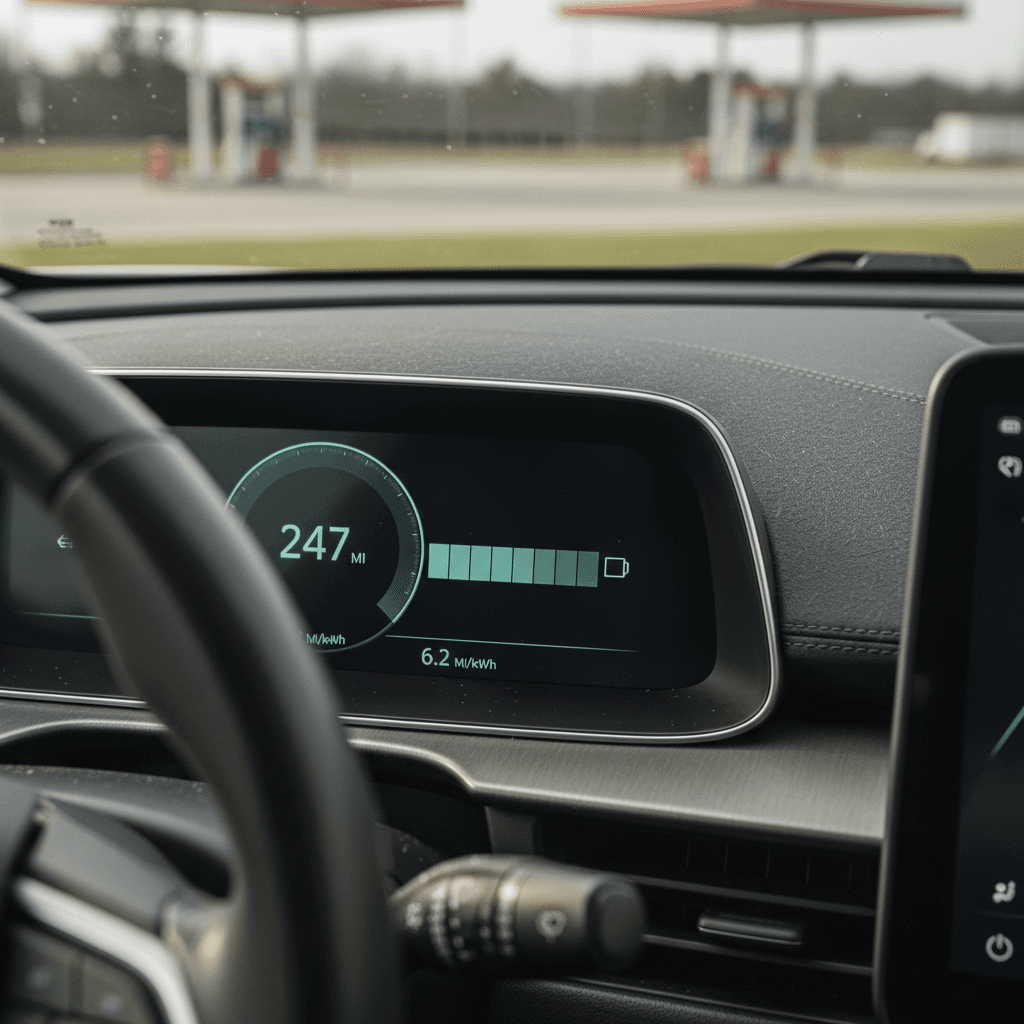
Miles per kilowatt‑hour shows how efficiently an EV uses electricity.
- Efficient EVs: 3.5–4.5 mi/kWh
- Larger EVs & trucks: 2.0–3.0 mi/kWh
- Higher is better
MPGe (both, for comparison)
Miles per gallon equivalent lets you compare gas and electric directly.
- EPA assumes 33.7 kWh = 1 gallon of gas
- MY 2024 EVs: about 53–140 MPGe
- MY 2024 gas cars & hybrids: about 9–57 MPG
Don’t confuse MPGe with cost
The headline numbers: EV vs gasoline efficiency in 2025
EV efficiency vs gasoline at a glance
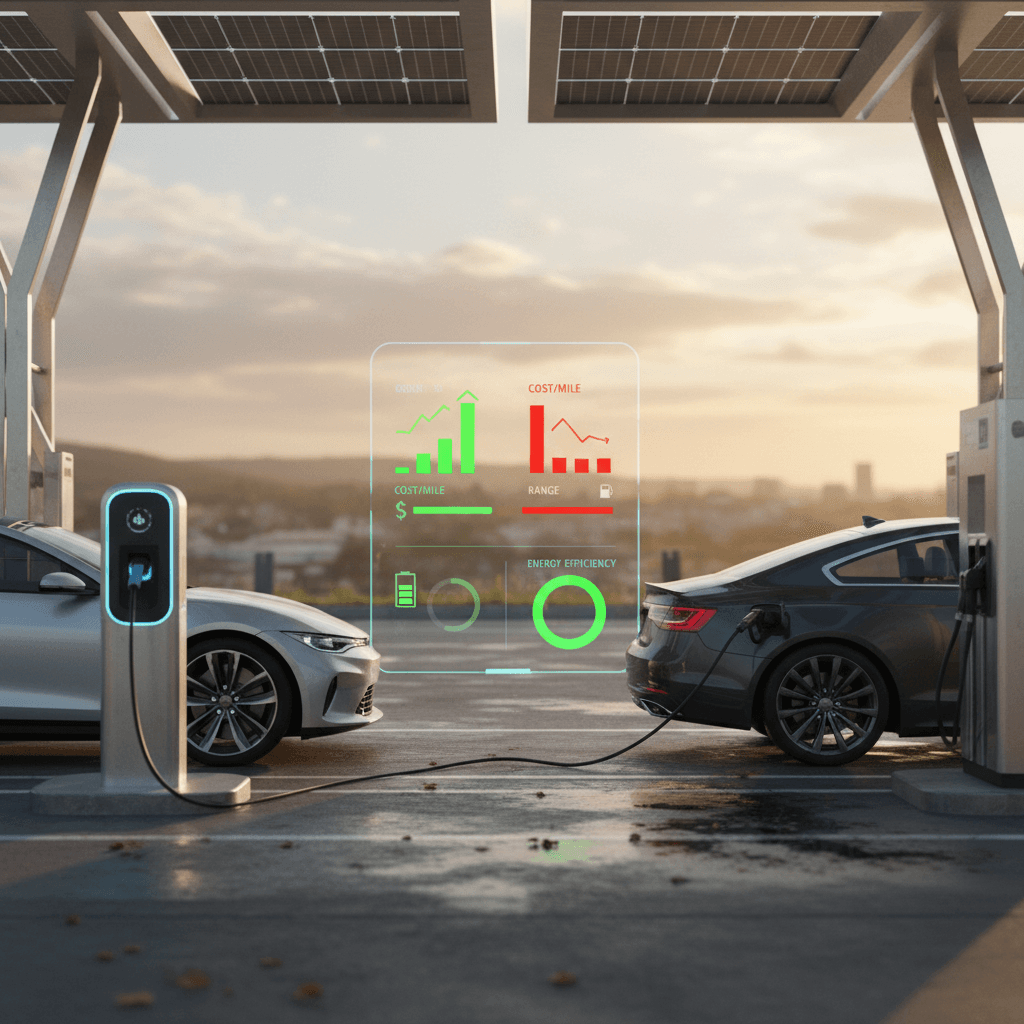
If you look strictly at energy conversion, EVs typically deliver about 2–3 times the MPGe of a comparable gasoline vehicle. That’s because an electric motor converts far more of its input energy into motion, while a gasoline engine sheds a big chunk as heat. On paper, efficiency is a landslide win for electric.
Real-world cost per mile: electricity vs gasoline
Energy efficiency only matters to you insofar as it affects cost per mile. In 2025, the “fuel” side of the equation looks like this for a typical U.S. driver who logs about 12,000–13,000 miles per year:
Average U.S. fuel cost per mile in 2025
Approximate national averages; your actual costs will depend on local gas and electricity prices and on the specific vehicle.
| Scenario | Typical vehicle | Energy efficiency | Energy price assumption | Approx. fuel cost per mile | Approx. annual fuel cost (12,200 mi) |
|---|---|---|---|---|---|
| Gas car | Gas sedan (30 MPG) | 30 MPG | $3.13/gal regular gas | ≈ $0.13/mi | ≈ $1,600 |
| Efficient EV – home charging | Compact EV (~4.0 mi/kWh) | 4.0 mi/kWh | $0.13/kWh home electricity | ≈ $0.03–0.04/mi | ≈ $600 |
| Mid-size SUV EV – home charging | EV SUV (~3.0 mi/kWh) | 3.0 mi/kWh | $0.13/kWh home electricity | ≈ $0.05–0.06/mi | ≈ $700–$800 |
| EV – heavy public charging | Mix of DC fast/public Level 2 | Varies | Public charging ≈ $0.30–$0.40/kWh | ≈ $0.11–0.15/mi | ≈ $1,350–$1,800 |
Home charging is usually where EV efficiency turns into clear savings. Relying heavily on public fast charging narrows the gap.
Fuel vs total cost
Home charging: where EV efficiency shines
- Lowest cost per mile, often half that of gasoline.
- Predictable electricity rates make budgeting easier.
- Perfect for daily commuting and local driving.
- If you can charge overnight, efficiency turns directly into savings.
Public charging: efficiency advantage shrinks
- Fast chargers often price close to the per‑mile cost of gasoline.
- You keep the environmental efficiency, but not always the fuel‑cost savings.
- Great for road trips and emergencies, not for all of your driving.
- If you’ll rely heavily on public charging, run the numbers carefully.
How to estimate your own cost per mile
City, highway and winter driving: who’s more efficient?
Electric and gasoline cars behave differently in city, highway and cold‑weather driving. Understanding this will keep the efficiency story from surprising you later.
Efficiency in different driving conditions
Both EVs and gas cars have strengths and weaknesses depending on how and where you drive.
Stop‑and‑go city driving
- EVs often do better in the city thanks to regenerative braking.
- Gas cars waste fuel idling at lights.
- For urban commuters, EVs’ efficiency advantage tends to grow.
Steady highway cruising
- Gasoline engines reach their stride at steady speeds.
- EVs use more energy at high speed due to aero drag.
- On long, fast highway trips, EV efficiency still beats gas, but by a smaller margin.
Cold‑weather operation
- EVs lose efficiency in the cold because heating draws directly from the battery.
- Gas cars take a hit too but use waste heat from the engine for cabin warmth.
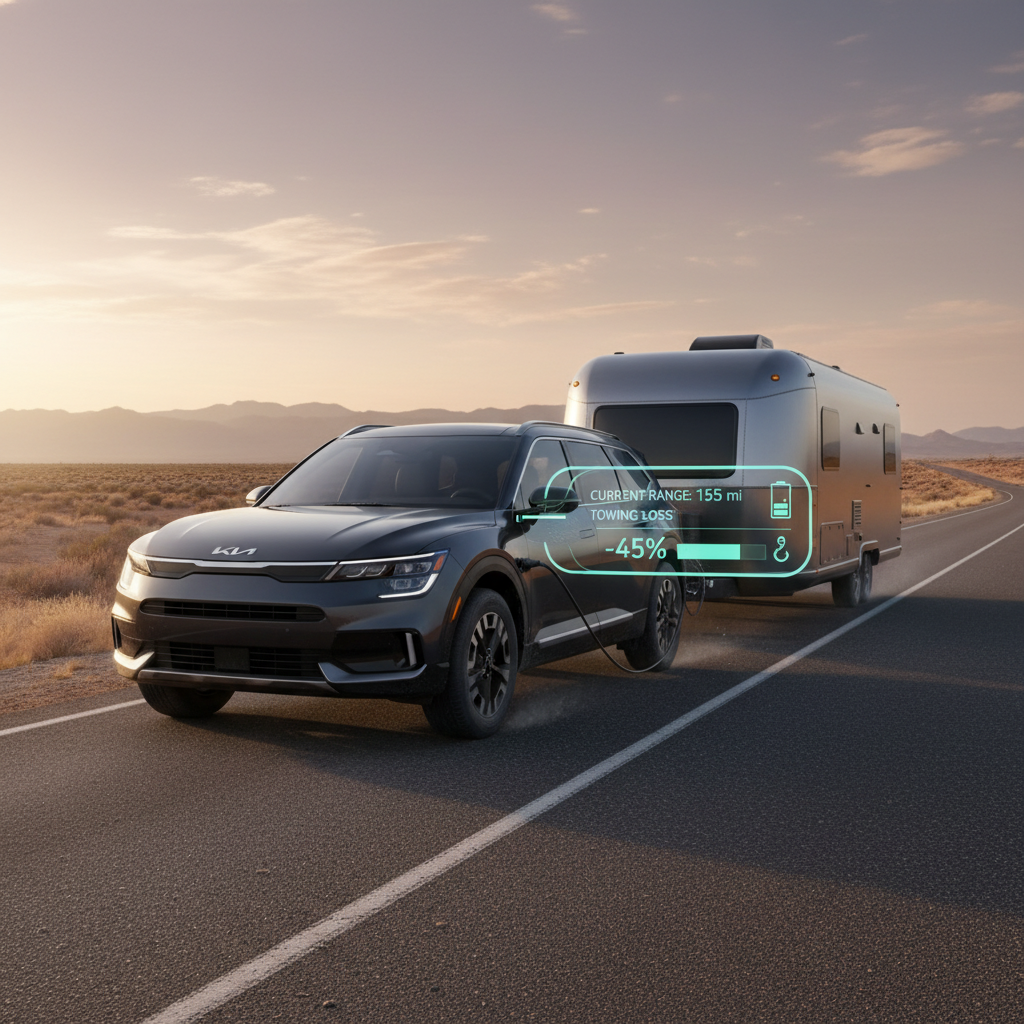
- Plan on reduced winter range with an EV, particularly for short trips.
Plan for winter range
Well-to-wheel environmental efficiency: beyond the tailpipe
Tailpipe emissions are easy to see, literally. But true efficiency also includes how much energy and pollution are involved before that energy reaches your car. That’s the idea behind well‑to‑wheel (or life‑cycle) analysis.
- Gas cars burn fuel in the vehicle, producing CO₂ and other pollutants directly at the tailpipe.
- EVs have no tailpipe emissions, but their electricity comes from a grid that still includes fossil fuels in many regions.
- EV batteries require energy‑intensive mining and manufacturing up front, but they pay that carbon “debt” down over years of efficient driving.
Big picture on environmental efficiency
From an efficiency standpoint, that means the same number of energy units, whether in a gallon of gas or a kWh from the grid, delivers more useful transportation and less wasted heat and pollution when it’s used in an electric vehicle.
Total cost of ownership: when efficiency saves real money
If you only compare MPGe and cost per mile, EVs look like runaway winners. But smart shoppers think like an accountant: purchase price, depreciation, financing, insurance, registration, fuel and maintenance all matter. Recent analyses in 2025 show a nuanced picture.
New vehicles: efficiency vs higher upfront cost
- New EVs often carry a higher sticker price than comparable gas cars, though the gap has been shrinking.
- That higher price can mean higher financing costs and insurance premiums.
- Fuel and maintenance savings don’t always erase the extra upfront cost within the first 3–5 years, especially if you drive fewer miles or can’t charge at home.
- Tax incentives and local rebates (where available) can tip the scales toward EVs.
Longer ownership: efficiency compounds over time
- The longer you keep a vehicle, the more your lower fuel and maintenance costs matter.
- Once a car is paid off, EV owners continue to enjoy lower operating costs while gas owners keep buying fuel and more frequent service.
- For high‑mileage drivers who charge at home, lifetime savings from EV efficiency can be substantial.
Watch depreciation and insurance
Used EVs: where efficiency really shines
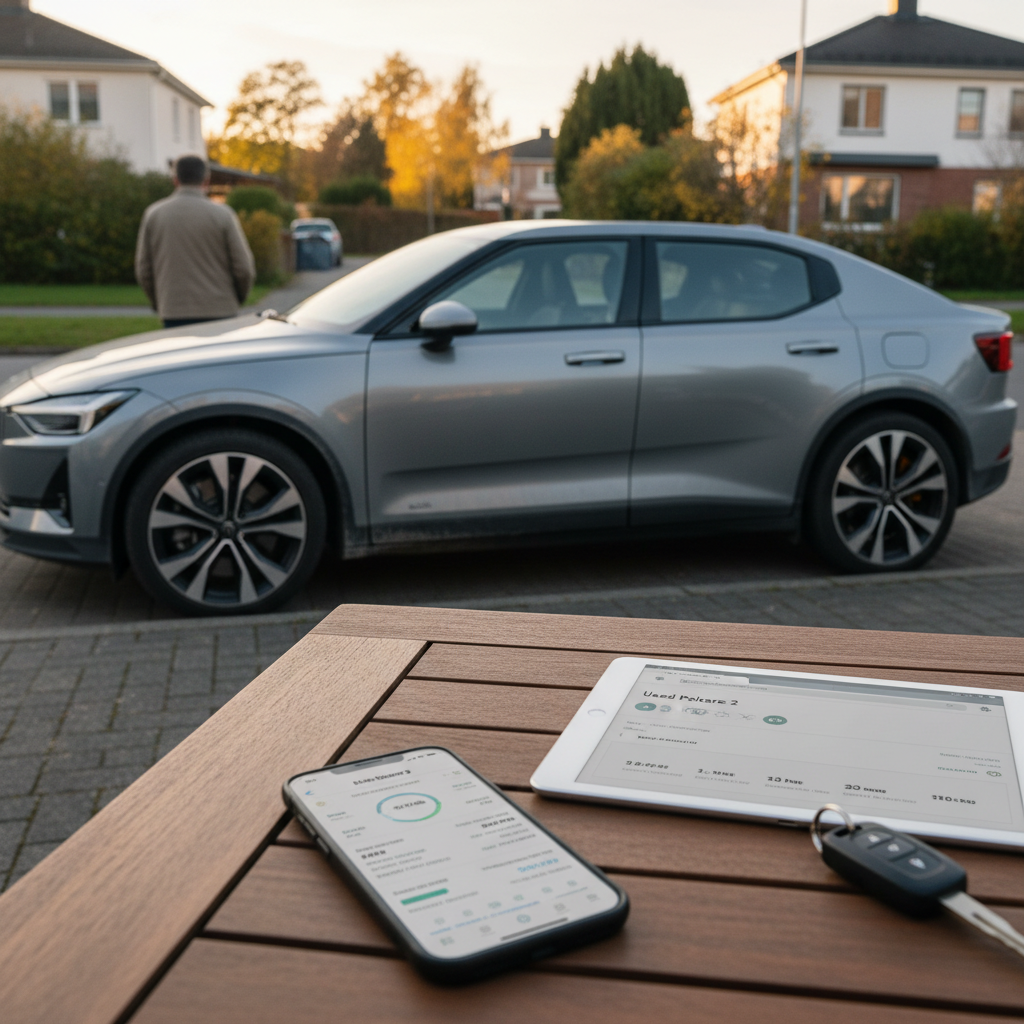
Here’s where the efficiency story becomes especially attractive for budget‑minded buyers: used electric cars. Early depreciation has already happened, yet you still inherit the EV’s strong energy efficiency and low routine maintenance. That combination can make a used EV a very cost‑effective choice compared with a similar used gasoline vehicle.
Why a used EV can out‑efficient a used gas car financially
You’re letting the first owner absorb the steepest part of depreciation while you enjoy the efficiency benefits.
Lower upfront price, same efficient hardware
- Many 3–6‑year‑old EVs sell at prices similar to or below comparable gas models.
- You still get electric motors that are far more energy‑efficient than engines.
- Routine maintenance stays minimal, no oil changes, fewer moving parts.
Fuel savings stack on top
- Even with some battery degradation, you usually keep a strong per‑mile cost advantage if you charge at home.
- Over 5–8 years of ownership, lower fuel and service bills can easily add up to thousands of dollars in savings versus a comparable gas car.
How Recharged helps you de‑risk a used EV
Checklist: how to compare an electric vs gas car for your situation
Step‑by‑step: compare electric car efficiency vs gasoline for yourself
1. Estimate your annual miles
Look at your past year’s driving or estimate realistically. The more you drive, the more an EV’s efficiency and lower fuel costs matter.
2. Check local gas and electricity prices
Grab today’s gas price in your area and your electricity rate from your utility bill. Use those instead of national averages when you run the numbers.
3. Look up real efficiency numbers
For gas cars, note the combined MPG. For EVs, note the miles per kWh and MPGe. Use official window‑sticker or EPA figures as a baseline.
4. Calculate cost per mile for each option
Divide your local fuel price by efficiency: gas price ÷ MPG, electricity rate ÷ mi/kWh. Multiply by your annual miles for an approximate yearly fuel cost.
5. Add realistic charging behavior
Be honest about how you’ll charge. Mostly at home? Mostly public fast charging? A mix? Adjust your EV cost per mile accordingly.
6. Consider ownership horizon and resale
If you plan to keep the car for 7–10 years, efficiency and maintenance savings carry more weight. If you trade every 3 years, watch depreciation and incentives closely.
7. For used EVs, demand a battery health report
Battery condition is central to preserving both range and resale value. With a Recharged Score Report, you can see verified battery health before you commit.
8. Test drive both in your real conditions
Drive an EV and a gas car on the same route, highway, city, maybe some hills. Watch the efficiency readouts and ask how each would feel on your daily commute.
FAQ: electric car efficiency vs gasoline
Frequently asked questions about EV vs gasoline efficiency
Bottom line: who wins on efficiency, EV or gasoline?
If you judge efficiency the way engineers do, how much usable motion you get out of a unit of energy, electric cars win decisively over gasoline. That advantage shows up in higher MPGe ratings, lower per‑mile energy use, and significantly lower fuel and maintenance costs when you can charge at home. Gasoline still has the edge in quick refueling and long‑distance convenience, but it can’t match the raw efficiency of an electric motor.
From a shopper’s point of view, the smarter question is, “Given how I drive and where I live, will an EV’s efficiency save me money?” If you drive a normal or high annual mileage and have reliable home charging, the answer is often yes, especially if you’re looking at a well‑priced used EV with a healthy battery. That’s exactly where a marketplace like Recharged is built to help: verified battery health, transparent pricing, and EV‑specialist support so you can turn efficiency on paper into real‑world savings.