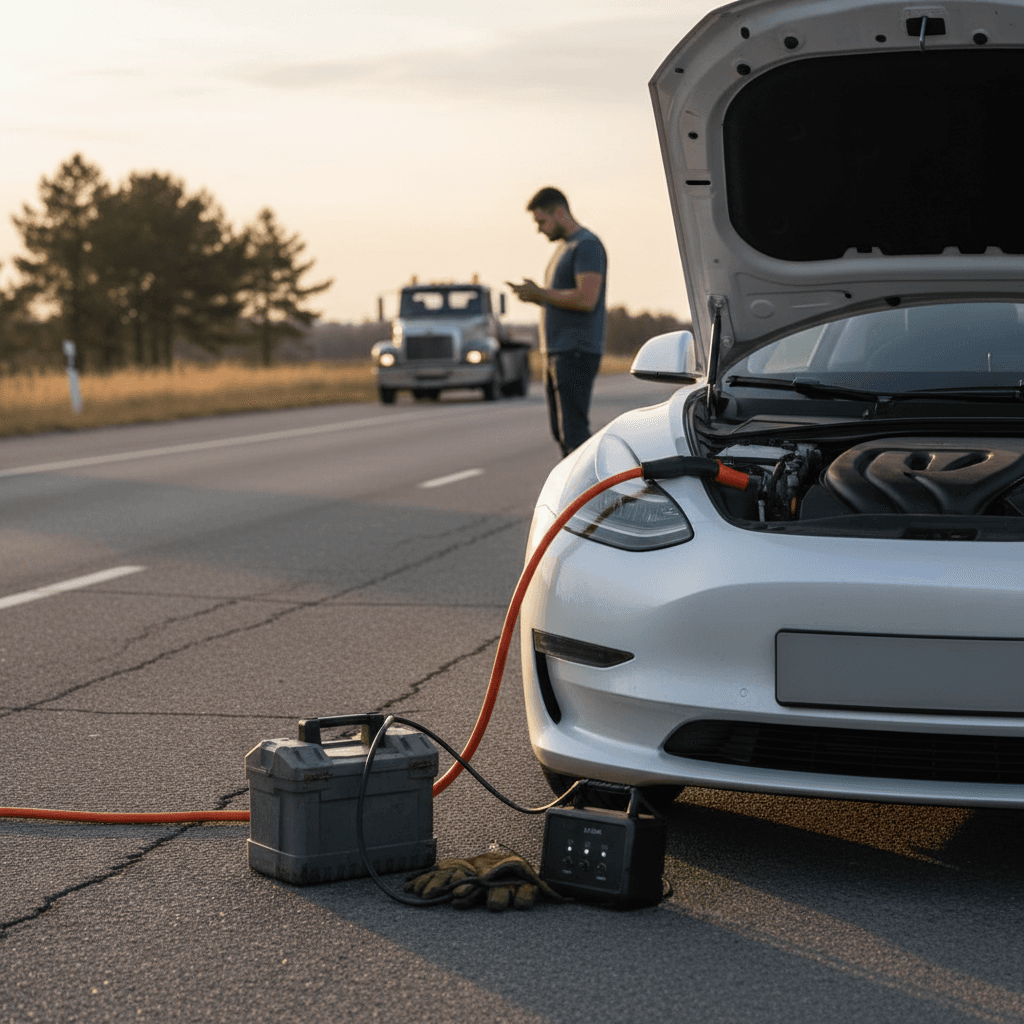
An electric car with a dead battery feels like a worst‑case scenario, especially if you’re stuck at the side of the road. The good news is that “electric car dead battery” can mean a few different things, and not all of them are expensive or permanent. This guide walks you through what to do right now, how to tell which battery is actually dead, and how to keep it from happening again.
Quick takeaway
First things first: stay safe and diagnose the problem
Immediate safety checklist if your EV dies
1. Get to a safe spot
If the car still has momentum, steer to the shoulder or a parking lot. Turn on hazard lights and set the parking brake.
2. Don’t try to push from live lanes
Stay out of traffic. If you can’t move the car yourself, call roadside assistance or emergency services.
3. Note what the dash is telling you
Look for messages like “12V battery low,” “Vehicle may not restart,” “Reduced power,” or “Battery level too low.” Take photos if you can.
4. Check what still works
Can you unlock the doors, turn on lights, or power the infotainment screen? That often points to which battery is in trouble.
5. Plug in if you’re near a charger
If you’re next to a public station or home charger, plug in immediately. Even a low‑power charge can stabilize systems long enough to move the car.
Safety first
Two batteries, two very different problems
1. The 12‑volt battery
This is the small battery, often in the front or rear trunk, that powers your EV’s computers, locks, lights, and safety systems. If it’s dead, the car may not "boot up," shift into gear, or even unlock electronically. This is similar to a dead battery in a gas car and can usually be jump‑started or replaced quickly.
2. The high‑voltage battery pack
This is the large pack made of hundreds of lithium‑ion cells that actually moves the car. If it’s depleted, you’ll see 0% range or warnings like “Battery level too low to drive.” This pack cannot be jump‑started. The only remedies are towing the vehicle and recharging or, in rare cases, repair or replacement.
Critical warning
If your EV won’t start: likely a dead 12‑volt battery
A surprisingly common scenario: you walk up to your EV, press the start button or step on the brake, and… nothing. Or you get error messages like “Systems shutting down” or “Vehicle may not restart.” In many cases, the big battery still has charge, it’s the 12‑volt battery that’s flat.
Common signs of a dead 12‑volt battery in an EV
These point to an electrical issue, not necessarily a failed drive battery.
Car won’t “turn on”
The car won’t go into Ready/Drive mode even if the main battery still shows plenty of range.
Locks and accessories glitch
Remote lock/unlock stops working, windows move slowly, or the infotainment screen won’t power up.
Warning lights everywhere
You may see multiple system faults or “12V battery low” messages before the car finally shuts down.
Good news for your wallet
Step‑by‑step: how to jump‑start an electric car’s 12‑volt battery
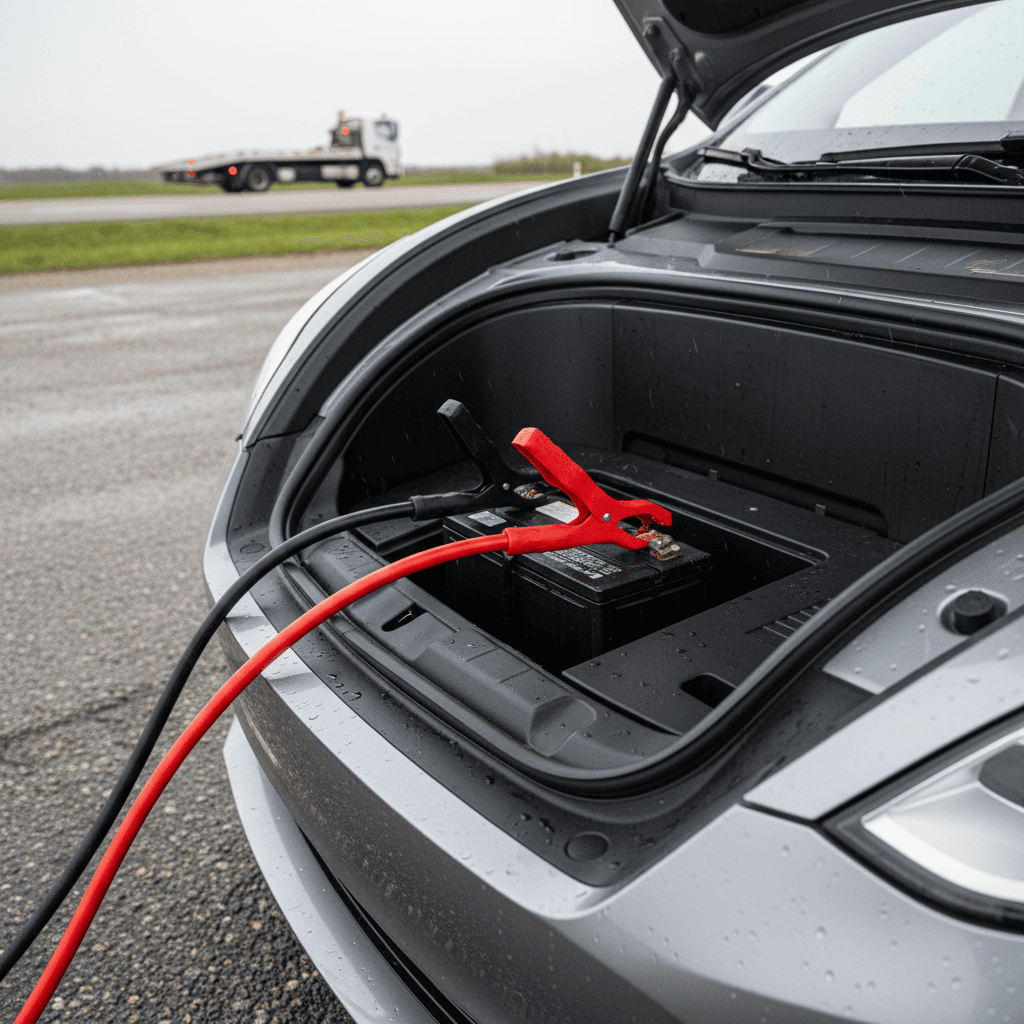
Jump‑starting the 12‑volt system in an EV is a lot like jump‑starting a gas car, but with extra care around the high‑voltage components. Always follow your owner’s manual first, since terminal locations and procedures vary by model.
- Park the donor vehicle (or position the portable jump pack) so cables reach the EV’s 12‑volt terminals. Both vehicles should be in Park with parking brakes set.
- Turn everything off in both vehicles, lights, climate control, infotainment, and remove the key or key card from the dead EV.
- Locate the 12‑volt battery or dedicated jump posts. These are often under a plastic cover under the hood or in the trunk. Look for clearly marked + (positive) and – (negative) points.
- Connect the red (+) cable to the positive terminal or jump post on the dead EV, then to the positive terminal on the donor vehicle or jump pack.
- Connect the black (–) cable to the negative terminal on the donor vehicle or jump pack, then to a recommended ground point on the EV (usually a bare metal stud or bracket, not the 12‑volt negative post unless your manual says so).
- Start the donor vehicle (if gas‑powered) and let it idle for a few minutes, or power on the jump pack per its instructions.
- With cables still attached, try to power up the EV. In most models you’ll press the brake and push the start button. Watch for it to enter Ready/Drive mode.
- Once the EV powers up, leave it “on” for at least 20 minutes so its DC‑DC converter can recharge the 12‑volt battery from the high‑voltage pack, then disconnect the jumper cables in the reverse order you connected them.
What not to do when jump‑starting an EV
If your EV shows 0% range or “battery depleted”
If the car powers on normally but shows 0% state of charge (or a message like “Battery level too low to drive”) and won’t shift into Drive, your high‑voltage pack is simply out of usable energy. That’s similar to running out of gas, an inconvenience, but not automatically a sign of a bad battery.
Your options when the high‑voltage pack is empty
What you can realistically do on the roadside.
If you’re near a charger
Roll or push the car (if it’s safe and allowed by the manufacturer) slowly toward a nearby Level 2 or DC fast charger. Even 5–10 minutes on a fast charger can give you enough range to move to a safer spot.
If you’re far from a charger
Call roadside assistance and request a flatbed tow to the nearest suitable charging station or your home charger. Some services offer mobile charging trucks that can add a few miles of range on the spot.
Do not try to “jump” the big battery
Dead electric car: is it 12‑volt or high‑voltage?
Use this quick comparison to figure out what kind of “dead battery” you’re dealing with.
| What you see | Most likely cause | What to do right now |
|---|---|---|
| No interior lights, no screen, doors won’t unlock electronically | Dead 12‑volt battery | Use manual key access if available, then jump‑start or call roadside assistance. |
| Car powers on, shows 0% and won’t shift to Drive | Depleted high‑voltage battery | Arrange a flatbed tow or mobile charging; do not attempt to jump main pack. |
| Warning: 12V battery low / Vehicle may not restart | Weak 12‑volt battery | Drive to a safe place, avoid shutting car off until there, then test/replace the 12‑volt. |
| Sudden loss of power with multiple error messages | Could be high‑voltage or other fault | Pull over safely, shut down if instructed, and call roadside or your dealer. |
When in doubt, treat it as a high‑voltage issue and call for professional help.
Towing an EV with a dead battery: what to know
Electric vehicles are picky about how they’re towed. Getting this wrong can overheat motors or damage the drivetrain, even if the car is completely powered off. When you call roadside assistance, it’s worth being very specific about what you’re driving and what you need.
Towing rules of thumb for a dead EV
Ask for a flatbed, not a hook-and-chain
Most EVs must be carried on a flatbed or lifted so none of the driven wheels touch the ground. Flat towing with the wheels spinning can damage the motor and gearbox.
Put the car in the correct tow mode
If the 12‑volt system still works, use the owner’s manual to enable Neutral, Transport or Tow mode so the parking brake releases safely.
If nothing powers on, let the pros handle it
Don’t try to drag the car with the parking brake engaged. A trained operator can use dollies or skates to move the vehicle without causing damage.
Choose a smart destination
Whenever possible, have the car towed directly to a known compatible charger or your home charging setup, not just the nearest lot. That saves you from needing a second tow.
Tip for used‑EV owners
After the emergency: check the battery’s health
Once you’re off the roadside and the car is charging again, take a moment to check whether this was a one‑off event or a symptom of a deeper battery issue. That’s especially important if you drive an older or used EV.
Simple battery health checks to do at home
These quick checks can signal whether you need deeper diagnostics.
Watch how fast it loses charge parked
A few percent overnight is normal. Big drops while parked could mean something is drawing power or the battery is aging.
Note range vs. original rating
Some loss of range over years is expected, but if you’re seeing dramatically less than similar owners report, it’s worth investigating.
Scan for hidden error codes
Many EVs store diagnostic trouble codes even after warnings disappear. A dealer or EV specialist can pull these and spot trends.
Where Recharged fits in
Ready to find your next EV?
Browse VehiclesHow to avoid a dead EV battery next time
Most dead‑battery incidents are preventable with a few simple habits. Think of it as basic battery hygiene, small changes that dramatically cut your odds of getting stranded.
Preventive habits that keep your EV from going “dead”
Keep your EV plugged in when parked at home
Modern EVs are smart enough to manage charging and battery conditioning. Leaving the car plugged in lets it top off and maintain the 12‑volt system automatically.
Avoid running down to 0% on purpose
Use most of your battery when you need to, but don’t treat 0% as a target. Planning to arrive with 10–20% in the pack gives you margin for weather, traffic, or detours.
Limit deep sleep for weeks at a time
If you’ll leave the car unused for weeks, store it at 40–60% and, ideally, keep it plugged in. Extended storage at very low or very high state of charge is harder on lithium‑ion cells.
Replace an aging 12‑volt proactively
If your 12‑volt is 4–6 years old or you keep seeing “battery low” messages, ask a dealer or EV‑savvy shop to test it and replace before it strands you.
Mind extreme temperatures
High heat and deep cold stress both batteries. When possible, park in a garage or shade and use preconditioning while plugged in so the pack warms or cools using grid power.
Buying a used EV? Worried about the battery?
If you’re shopping the used market, “dead battery” horror stories can be intimidating. The reality is more nuanced: many used EVs on U.S. roads still have strong packs, but you need real data, not just a range estimate on the dash, to know what you’re buying.
Questions to ask about any used EV
- Has the high‑voltage battery ever been repaired or replaced?
- How often is it fast‑charged vs. home‑charged?
- Has the car ever been run to 0% and towed multiple times?
- Are there any current or stored battery‑related error codes?
How Recharged reduces the guesswork
Recharged was built around one idea: EV ownership should be simple and transparent. Every vehicle we sell includes a Recharged Score Report with verified battery health, pricing tied to real‑world condition, and expert EV‑specialist support. We can also help with financing, trade‑ins, and nationwide delivery so you can shop confidently from your couch.
Electric car dead battery FAQ
Common questions about dead EV batteries
A “dead” electric car doesn’t always mean a dead electric car battery. In many cases, it’s a small 12‑volt issue that a quick jump or replacement can fix. Even when you’ve genuinely run out of range, smart towing and charging decisions can get you moving again with minimal drama. Whether you already own an EV or you’re looking at a used one, understanding the difference between the two batteries, and how to care for them, will keep you on the road and out of roadside horror stories.