When people ask about the electric car cost per mile, they’re usually trying to answer one question: “Is an EV actually cheaper to run than a gas car for the way I drive?” In 2025, with electricity prices climbing in many states, it’s a fair question, and the honest answer is, “Usually yes, but it depends on how and where you charge.”
Quick answer
How much does an electric car cost per mile?
Let’s start with a simple framework you can use for any EV, whether it’s brand-new or a used model you’re considering from Recharged. The electric car cost per mile on the energy side is basically:
- Your electricity price per kWh × energy used per mile (kWh/mile) = energy cost per mile
- Energy cost per mile × your annual miles = yearly “fuel” cost
Nationally, average residential electricity is hovering around the high teens in cents per kWh in 2025, but state averages range from roughly 11–12¢ in some parts of the Mountain West to well over 30¢ in California and Hawaii. That spread is why your personal EV cost per mile can look very different from your neighbor’s in another state.
Typical 2025 cost-per-mile benchmarks
Those benchmarks are ballparks, but they’re enough to see the pattern: EVs tend to win clearly on cost per mile when you can charge at home at a reasonable electricity rate. That advantage shrinks, or can even flip, if you rely heavily on expensive public fast charging in a high-cost electricity market.
Mileage matters
Key factors that change your EV cost per mile
The basic math is simple, but the real-world cost per mile depends on several levers you can actually control. If you’re shopping for a used EV, these are exactly the levers you want to think about.
6 main drivers of EV cost per mile
Understand these and you can predict your own numbers with surprising accuracy.
1. Your electricity rate
What you pay per kWh is the single biggest input.
- Low-cost states (around 12¢/kWh) make EVs extremely cheap to run.
- High-cost states (30¢+ per kWh) narrow or even erase the advantage versus a very efficient hybrid.
2. Where you charge
You’ll pay very different prices depending on location:
- Home Level 2 is usually cheapest and most predictable.
- Workplace or free public Level 2 can bring your energy cost close to zero.
- DC fast charging is convenient but much pricier per mile.
3. Vehicle efficiency
Just like gas mpg, EVs vary in how many miles they squeeze from each kWh.
- Efficient compact EVs: ~4 mi/kWh or better.
- Large SUVs and trucks: often < 3 mi/kWh.
4. Climate & driving style
Cold weather and fast driving both hurt efficiency.
- Winter heating can add 10–30% to energy use.
- Sustained high speeds (75+ mph) also eat into your miles per kWh.
5. Battery health
A healthy battery helps you use fast chargers less and stick to cheaper home charging.
- Good battery health = more usable range.
- Severely degraded packs can force extra fast-charging stops.
6. Ownership choices
Charging hardware and rate plans matter:
- Smart chargers can schedule charging for off-peak hours.
- Time-of-use electricity plans can cut your cost per kWh at night.
A simple rule of thumb
Example EV vs. gas cost per mile comparisons
Let’s put real numbers on this. Below are simplified scenarios designed to mirror common U.S. driving patterns in 2025. These are energy costs only, maintenance, insurance, taxes, and purchase price are separate, but they’re a big piece of your total cost of ownership.
Electric vs. gas: sample cost-per-mile math
Assumes $4.25/gal gas and 12,000 miles per year. Electricity prices reflect broad 2025 averages in lower- and higher-cost regions.
| Scenario | Vehicle type | Assumptions | Energy cost per mile | Annual energy cost |
|---|---|---|---|---|
| A: Home-charged EV, average-cost state | Electric | 3.5 mi/kWh, 17¢/kWh home rate | ≈ $0.05/mi | ≈ $600/year |
| B: Same driver, gas car | Gasoline | 30 mpg, $4.25/gal gas | ≈ $0.14/mi | ≈ $1,700/year |
| C: Efficient EV, low-cost state | Electric | 4 mi/kWh, 13¢/kWh home rate | ≈ $0.03/mi | ≈ $360/year |
| D: Larger EV SUV, high-cost state | Electric | 2.7 mi/kWh, 30¢/kWh home rate | ≈ $0.11/mi | ≈ $1,320/year |
| E: Efficient hybrid in high-cost state | Gasoline hybrid | 45 mpg, $4.25/gal gas | ≈ $0.09/mi | ≈ $1,080/year |
Your numbers will vary, but this table shows why charging at home in a moderate-cost electricity state is such a powerful savings lever.
In Scenario A vs. B, the EV is roughly one-third the cost per mile on energy compared with the gas car. Even in a higher-cost electricity state (Scenario D), a larger EV SUV is in the same ballpark as an efficient hybrid on energy cost, and still cheaper than a typical non-hybrid gas SUV.
Where used EVs shine
Ready to find your next EV?
Browse VehiclesHome charging vs. public charging cost per mile
How you charge can swing your electric car cost per mile from a slam-dunk win to “only slightly better” than gas. Here’s how the different options compare.
Home & workplace charging
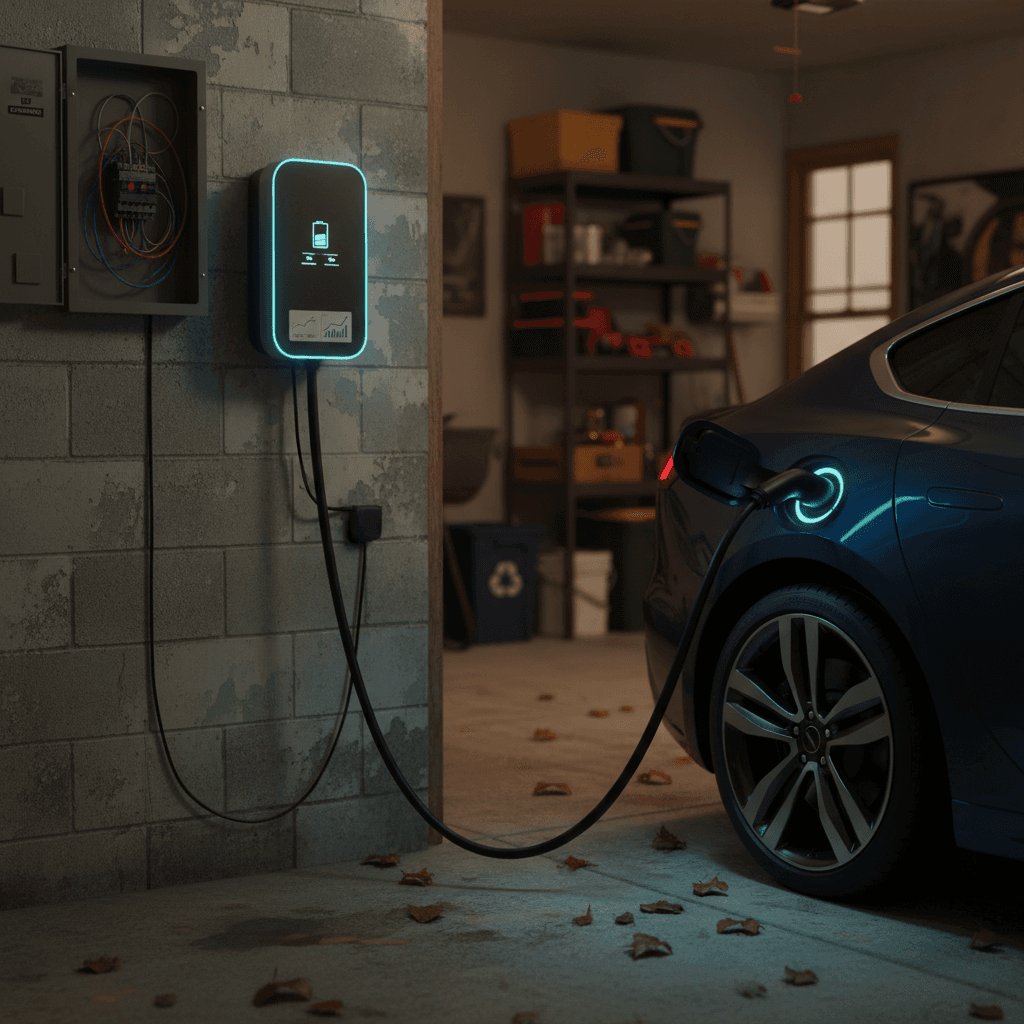
- Home Level 2 (240V) is usually the cheapest way to fuel an EV. You’re paying your residential rate, maybe less if you use a time-of-use plan.
- Level 1 (120V) from a standard outlet is slower but just as cheap per kWh; it simply may not add enough miles per day for some drivers.
- Workplace charging, especially when subsidized or free, can drive your effective cost per mile close to zero for your commuting miles.
Most EV owners who can charge at home do the vast majority of their charging there. That’s why home charging is the backbone of the EV cost-per-mile advantage.
Public DC fast charging
- DC fast chargers are the EV equivalent of a highway gas station: convenient, widely spaced, and priced accordingly.
- Rates are usually charged per kWh or per minute and can easily be 2–4× your home electricity rate.
- In many markets, this puts DC fast charging in the same cost-per-mile neighborhood as driving an efficient gas car.
Fast charging is an amazing tool for road trips and occasional top-ups, but if you rely on it daily, your electric car cost per mile can climb quickly.
Don’t build your budget around fast charging
How battery health affects your true cost per mile
Energy cost per mile is only part of the story. Over several years of ownership, battery health plays a quiet but important role in your true cost per mile, especially when you’re buying used.
Battery health and cost per mile
Why the pack’s condition matters more than most people think.
More range = more flexibility
A healthy battery preserves the car’s original range as much as possible.
- That means fewer stops on road trips, so you’re not paying premium fast-charging prices as often.
- In daily driving, it keeps you comfortably within your home-charging “bubble,” where energy is cheapest.
Degradation and resale value
Severe degradation (for example, a pack that’s lost 25–30% of its original capacity) can depress the car’s resale price.
- You’re spreading your purchase price over fewer useful miles.
- That raises your long-term cost per mile even if electricity stays cheap.
Where Recharged’s battery data helps
Used EVs and cost per mile: where Recharged fits in
When you’re evaluating a used electric vehicle, you’re not just comparing sticker prices, you’re comparing lifetime cost per mile. That includes energy, maintenance, and the price you pay today relative to the useful miles still ahead of the car.
1. Lower purchase price
A used EV will almost always cost less up front than a new one. If the vehicle still has solid battery health, you’re getting many of the same low cost-per-mile benefits at a significantly lower initial outlay.
2. Verified battery health
With Recharged, every car comes with a Recharged Score that includes battery diagnostics, not just odometer readings. That helps you estimate how long you can enjoy low operating costs before range loss becomes a consideration.
3. Expert-guided financing & trade-in
Because Recharged offers financing, trade-in, instant offers, and consignment, you can look at your EV purchase as a monthly cost-per-mile decision, not just a lump sum. Our EV specialists can help you compare different vehicles and scenarios side by side.
Putting it together
Checklist: reducing your EV cost per mile
Whether you already drive an EV or you’re shopping for one, you can actively manage your cost per mile. Use this checklist as a roadmap.
Practical steps to lower your electric car cost per mile
1. Lock in affordable home charging
If possible, install a Level 2 charger at home so most of your energy comes at your residential rate. Ask your utility about rebates or discounted EV-ready circuits.
2. Explore time-of-use (TOU) rates
Many utilities offer lower prices overnight. Set your EV or smart charger to automatically charge during off-peak hours so you’re paying less per kWh for the same miles.
3. Right-size your EV
If you don’t need a three-row SUV, consider a more efficient sedan or compact EV. Higher efficiency (more miles per kWh) directly cuts your cost per mile.
4. Use DC fast charging strategically
Reserve fast charging for road trips and true needs, not daily use. When you do fast charge, try to arrive with lower state of charge and unplug around 80% to minimize time, and cost, on the expensive part of the curve.
5. Drive with efficiency in mind
Smooth acceleration, moderate highway speeds, and smart use of climate controls can improve your miles per kWh more than you might expect, especially in winter.
6. Prioritize battery health when buying used
Ask for real battery health data, not just a dashboard guess. With Recharged, the Recharged Score makes this transparent so you can avoid vehicles with unusual degradation that might hurt your long-term cost per mile.
7. Think in miles, not just months
When comparing a used EV to a gas car, look at how many miles you expect to drive. For high-mileage drivers, even a few cents of savings per mile can overwhelm small differences in purchase price or interest rate.
Electric car cost per mile: FAQ
Frequently asked questions about EV cost per mile
Bottom line: what you should take away
When you zoom out, the story in 2025 is straightforward: for most drivers who can charge at home at a reasonable electricity rate, the electric car cost per mile is significantly lower than that of a comparable gas vehicle. Exactly how much lower depends on your local power prices, how efficient your EV is, and how often you lean on public fast chargers.
If you drive a lot of miles each year, those few cents of savings per mile add up to real money, especially when you pair low running costs with the lower upfront price of a well-chosen used EV. That’s where tools like the Recharged Score, clear battery health data, and EV-specialist support can turn a complicated comparison into a confident decision.
Run the numbers for your situation, be honest about how you’ll charge, and then choose the vehicle, and the seller, that gives you the clearest path to affordable miles. If that points you toward a used EV, Recharged is built to make that move simple, transparent, and cost-effective.