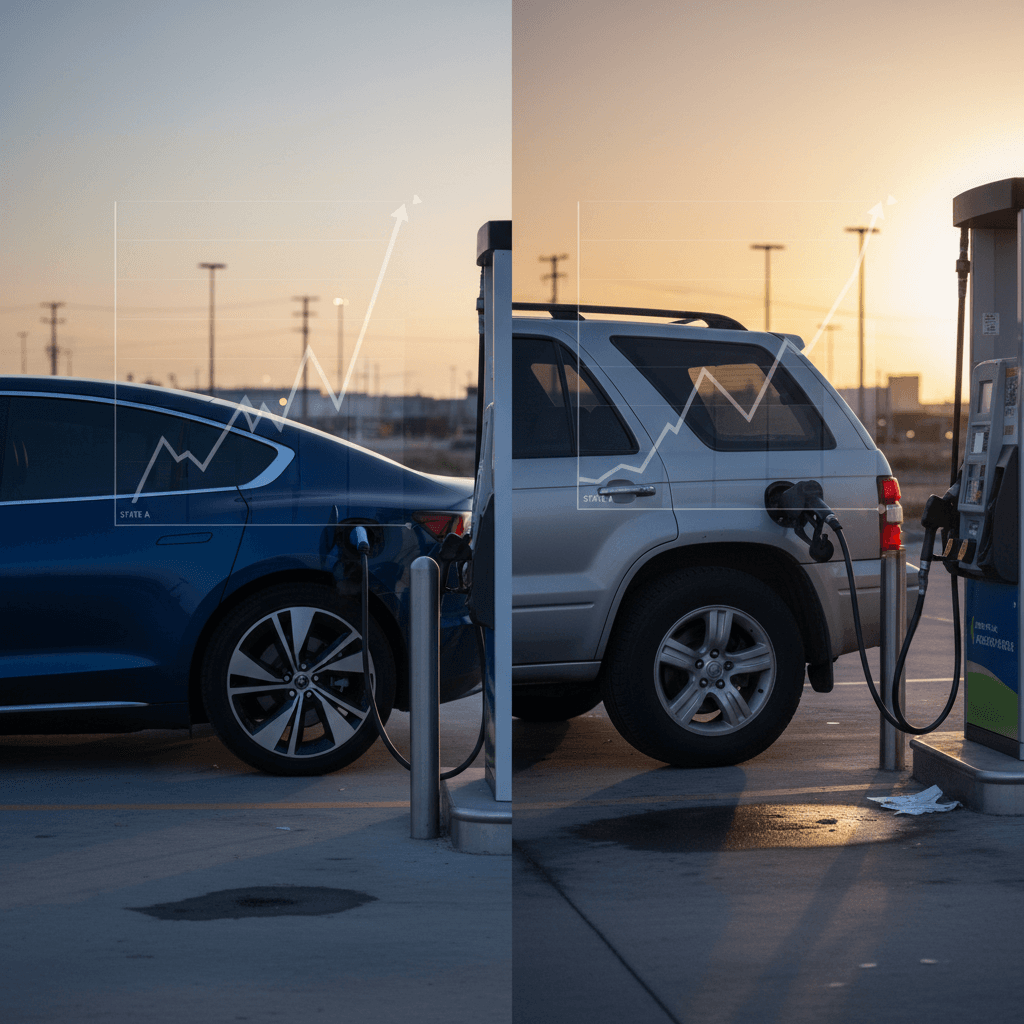
You already know an electric car is cheaper to fuel than a gas car in theory. But in the real world, costs depend heavily on where you live. Electricity in California is not electricity in Kansas, and $4 gas in New York feels different than $3 gas in Texas. This guide breaks down electric car charging cost vs gas fill-up by state in plain English, so you can see what you’d actually pay, and save, at home and on the road.
Key idea
Why EV vs gas costs vary so much by state
Two prices drive the whole comparison: cents per kilowatt-hour (kWh) for electricity and dollars per gallon for gasoline. Both are set largely at the state or regional level, and both have been moving targets over the last few years.
- Electricity rates: States like California, New England and Hawaii regularly see residential rates above $0.25 per kWh, while many Southern and Mountain states live closer to $0.12–$0.15 per kWh.
- Gasoline prices: As of early 2026, the U.S. average is around $4.00 per gallon, but California is well above $5 while parts of the Midwest and Great Plains hover closer to the low $3s.
- Taxes and fees: State fuel taxes range from roughly 15 to over 70 cents per gallon, and some states also add EV registration fees to offset lost gas tax revenue.
- Where you charge: Home charging at overnight rates is almost always cheaper than DC fast charging along highways, which often prices power closer to the “per gallon equivalent” of premium gas.
Don’t trust any single national average
Quick answer: how much cheaper is charging than gas?
EV charging vs gas at a glance (U.S. averages)
Those are broad strokes. To understand what this looks like in your state, you need to do a bit of math. The good news: it’s simple, and once you know the steps you can plug in any state’s prices, or even your exact utility rate, to get a realistic comparison.
How to compare EV charging cost vs gas in your state
Let’s build a simple, repeatable way to compare costs where you live. You don’t need a spreadsheet, just a few numbers you can grab from your utility bill and your favorite gas-price app.
Step-by-step: build your own EV vs gas cost comparison
1. Find your electricity price (¢/kWh)
Look at your last utility bill for the line that shows “$ per kWh” or “Energy charge.” Use the <strong>all-in price</strong> with fees if possible. If you can’t find it, most state averages are around $0.16–$0.18 per kWh right now.
2. Note your local gas price ($/gal)
Use AAA, GasBuddy, or your corner station’s sign. Use regular unleaded unless you know you must run premium.
3. Choose a realistic EV efficiency
Modern EVs average around <strong>25–30 kWh per 100 miles</strong>. To keep the math friendly, assume 28 kWh/100 miles (0.28 kWh per mile) unless you have a specific model in mind.
4. Choose a realistic gas car efficiency
A compact crossover or sedan today averages around <strong>30 mpg</strong>. If you currently drive something thirstier, plug that number in, it’ll only make the EV look better.
5. Calculate EV cost per mile
Multiply your electricity rate by kWh per mile. Example: $0.16 × 0.28 kWh/mile ≈ <strong>$0.045 per mile</strong> (4.5 cents).
6. Calculate gas cost per mile
Divide gas price by mpg. Example: $4.00 ÷ 30 mpg ≈ <strong>$0.133 per mile</strong> (13.3 cents).
7. Annualize the savings
Multiply each cost per mile by your annual miles (say, 12,000). The difference between those two totals is your yearly fuel savings from driving electric instead of gas.
Shortcut: gallons vs “electric gallons”
State examples where EVs win big
Instead of dumping a 50-row table on you, let’s walk through a few representative states. These are illustrative examples using recent averages for electricity and gas, plus the same 28 kWh/100 miles EV and 30 mpg gas car from our calculator above.
Sample states where EV charging crushes gas costs
Approximate home charging vs gas fuel costs for a 12,000‑mile‑per‑year driver, assuming 28 kWh/100 miles for the EV and 30 mpg for the gas car.
| State | Sample electricity rate (¢/kWh) | Sample gas price ($/gal) | EV “fuel” cost per year | Gas fuel cost per year | Approx. yearly savings |
|---|---|---|---|---|---|
| California | 26¢ | $5.30 | ≈$873 | ≈$2,120 | ≈$1,250 |
| New York | 22¢ | $4.40 | ≈$739 | ≈$1,760 | ≈$1,020 |
| Washington | 13¢ | $4.70 | ≈$437 | ≈$1,760 | ≈$1,320 |
| Illinois | 16¢ | $4.20 | ≈$538 | ≈$1,680 | ≈$1,140 |
| Massachusetts | 25¢ | $4.30 | ≈$840 | ≈$1,720 | ≈$880 |
These are simplified, rounded examples meant to show directional differences, not precise monthly bills.
Why cheap electricity + expensive gas is the EV jackpot

States where the EV advantage is smaller
In some parts of the country, particularly where electricity is relatively expensive and gas is relatively cheap, the EV advantage narrows, but rarely disappears.
Sample states where EV vs gas is closer
Approximate annual fueling costs with the same assumptions as above: 28 kWh/100 miles EV, 30 mpg gas car, 12,000 miles per year.
| State | Sample electricity rate (¢/kWh) | Sample gas price ($/gal) | EV “fuel” cost per year | Gas fuel cost per year | Approx. yearly savings |
|---|---|---|---|---|---|
| Hawaii | 35¢ | $4.80 | ≈$1,176 | ≈$1,920 | ≈$740 |
| Alaska | 26¢ | $3.80 | ≈$873 | ≈$1,520 | ≈$650 |
| Louisiana | 14¢ | $3.20 | ≈$470 | ≈$1,280 | ≈$810 |
| Oklahoma | 13¢ | $3.10 | ≈$437 | ≈$1,240 | ≈$800 |
| Utah | 12¢ | $3.20 | ≈$402 | ≈$1,280 | ≈$880 |
Even in higher‑electricity, lower‑gas states, EVs usually maintain a cost edge if you can charge at home.
Where EVs can look expensive: public fast charging only
Home charging vs public fast charging costs
When people argue on the internet about EV economics, they’re usually talking past each other because they’re assuming different charging habits. The difference between mostly home charging and mostly DC fast charging is night and day.
Typical cost range: home vs public charging
Numbers are directional U.S. ranges based on 2025–2026 pricing trends.
Home Level 2 charging
- Typical rate: $0.12–$0.22 per kWh (varies by state and time of day)
- Cost per 100 miles: roughly $3.50–$6.50 for many EVs
- “Gasoline equivalent”: like paying about $1.30–$2.20 per gallon
- Best for: Daily commuting, overnight charging, predictable routines
Public DC fast charging
- Typical rate: often $0.35–$0.60 per kWh, sometimes higher
- Cost per 100 miles: roughly $10–$18 for many EVs
- “Gasoline equivalent”: like paying about $3.50–$5.50 per gallon
- Best for: Road trips, occasional top‑ups, apartment dwellers without reliable home charging
Time-of-use rates can tilt the math further
Road trips: how charging costs compare to gas
On a long road trip, you’ll lean more on fast chargers and less on your cheap home electricity. That changes the equation, but not always in the way gas drivers expect.
Example: 1,000‑mile road trip in a gas car
- Car: 30 mpg gasoline crossover
- Fuel needed: about 33 gallons
- At $4.00/gal: ≈ $132 in gas
If you drive something thirstier, say 22 mpg, you’re up around $180 for the same trip.
Example: 1,000‑mile road trip in an EV
- Car: 28 kWh/100 miles EV
- Energy needed: about 280 kWh total
- If all at fast chargers at $0.45/kWh: ≈ $126
- If half at home (before/after) at $0.16/kWh and half at $0.45: ≈ $101
The more of the trip you can “bookend” with home charging, the better the economics look.
The fast-charging trap for apartment dwellers
Used EV buyers: what these costs mean for you
When you’re shopping the used market, fuel costs are part of the long game. A lightly used EV with healthy battery capacity can turn today’s higher purchase price into lower total cost of ownership once you factor in thousands of dollars of fuel and maintenance savings over several years.
How fuel costs shape used EV value
Why the “cheap to run” part matters more on a pre-owned electric car.
1. Battery health = real-world range & cost
2. Bigger gap in high-gas states
3. Maintenance stacks with fuel savings
Where Recharged fits in
Ready to find your next EV?
Browse VehiclesIf you’re trading out of a thirsty SUV or pickup, you can also use Recharged’s trade‑in and instant offer tools to roll your current vehicle’s value into a used EV, then enjoy lower fueling costs from day one.
FAQ: EV charging cost vs gas by state
Frequently asked questions
Bottom line: EV charging vs gas by state
The headline isn’t complicated: in 2026, charging an electric car at home is cheaper than filling a gas tank in every U.S. state. What changes from state to state is how big that gap is, and whether fast charging habits eat into your advantage. Cheap electricity plus expensive gas is the obvious home run. Expensive electricity plus cheap gas blurs the margins but rarely flips the script entirely.
When you zoom out to a 5‑ to 10‑year ownership window, especially on a well‑priced used EV with a healthy battery, the fuel savings become one of the dominant chapters in the story, right alongside depreciation and insurance. If you’re ready to see how that story looks for you, start browsing used EVs on Recharged, check the Recharged Score for battery health and projected range, and run the simple cost‑per‑mile math with your own state’s electricity and gas prices. The numbers will tell you, very clearly, whether it’s time to stop feeding a gas pump and start fueling from your own wall.