If you’re shopping for a used electric car in 2026, you’re walking into a storm of headlines about **EV tariffs**, especially on Chinese-built models, and you’re probably wondering: what does any of this actually do to **used EV prices** in the U.S. today? Are bargains about to disappear, or is this exactly when you should be looking for a deal?
Big picture
Why EV tariffs matter for used buyers
Tariffs sound like a problem for manufacturers and importers, not for people hunting a three‑year‑old crossover. But used prices don’t live in their own universe. They’re tethered to what’s happening in the new market: incentives, supply, demand, and in 2026, the cost of bringing cars into the country.
EV market snapshot: why tariffs arrive at a sensitive moment
Put simply, the EV market is **fragile right now**. Tax credits have come and gone, new‑EV sales have dipped, and used EVs are finally hitting dealer lots in serious numbers. Layer tariffs on top of that, and you get a market where the same policy can help one kind of used buyer and hurt another.
Quick primer: how tariffs actually move prices
1. Where tariffs apply
Tariffs are taxes on imports. For EVs, that typically means:
- Complete vehicles built overseas and shipped in
- Sometimes key components (like batteries) that raise build costs
Domestic production for the U.S. market isn’t directly tariffed, though it can still be influenced by retaliation or supply-chain shifts.
2. How that trickles down
An importer facing a 25–100% tariff has three unappealing choices:
- Eat the cost (lower profit)
- Raise new‑car prices
- Cut volume and shift production elsewhere
Whichever path they pick changes the balance between new and used prices in the real world.
Think in terms of substitutes
New EV tariffs today: what’s changing?
In the last couple of years, the U.S. has dialed tariffs up on a range of Chinese‑built vehicles and components, and floated broader tariffs on imported autos. Chinese brands are already under heavy scrutiny, and any new mass‑market Chinese EVs trying to enter the U.S. are staring at triple‑digit tariff rates in some proposals. Separately, existing tariffs on imported vehicles and steel and aluminum remain in place, keeping production costs elevated.
- Higher, targeted tariffs on Chinese‑built EVs and batteries, aimed at preventing a flood of ultra‑cheap imports.
- Ongoing tariffs on steel, aluminum, and some parts that nudge manufacturing costs up across the board.
- Political pressure for additional broad auto tariffs, creating uncertainty that makes automakers conservative about pricing and production.
Policy whiplash is real
5 main ways EV tariffs hit used prices
How tariffs could move used EV prices
Not every effect points the same direction, and that’s what makes this market tricky.
1. Floor effect from pricier new cars
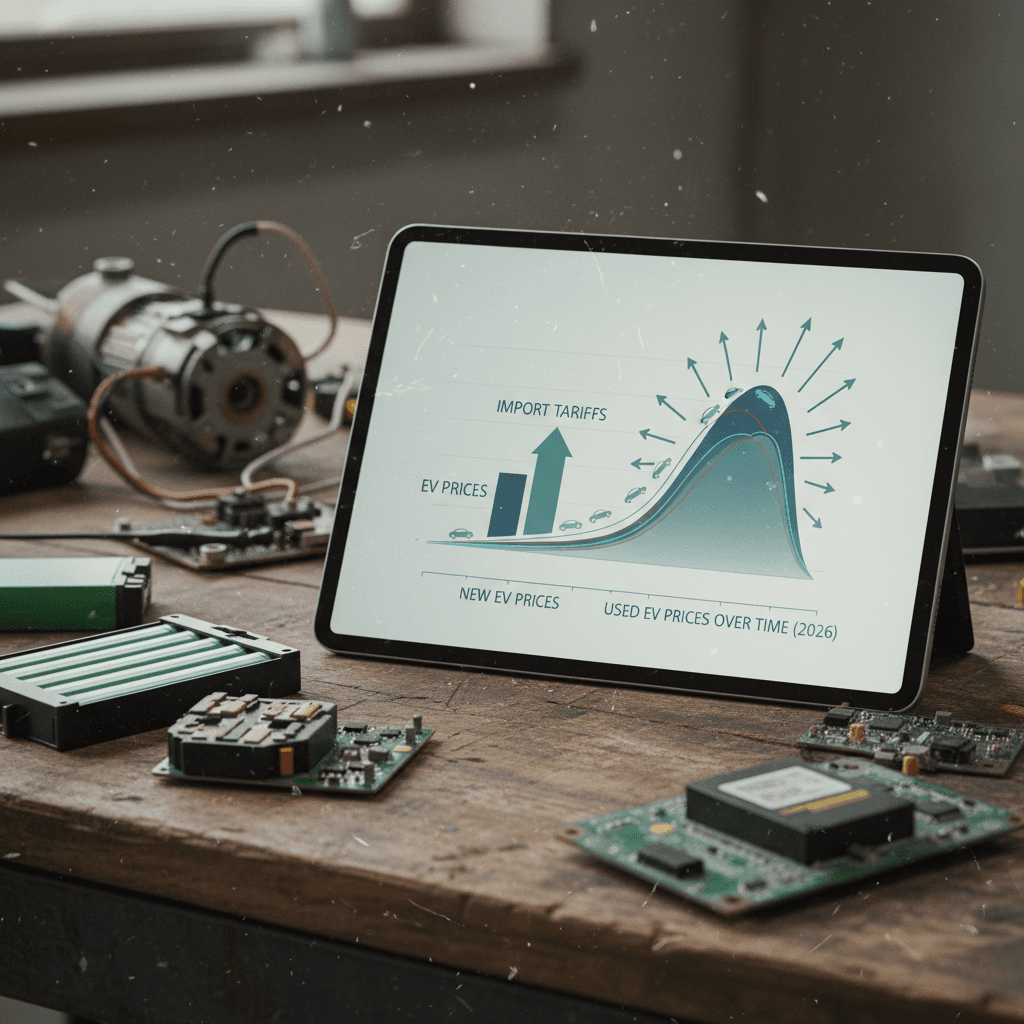
If tariffs lift new‑EV prices, used prices tend to follow with a lag. A higher new‑car MSRP sets a new ceiling, and raises the floor that used vehicles can sit on without being obvious bargains.
2. Fewer cheap imports, tighter supply
Tariffs can choke off low‑priced imported EVs that would have undercut used prices. That’s a relief for owners of mainstream models whose values were threatened by ultra‑cheap newcomers.
3. Depreciation shock for targeted brands
If tariffs hit one brand or country especially hard, perceived risk goes up. Buyers demand a bigger discount on those used EVs, accelerating depreciation even if the cars are solid.
4. Parts & repair costs
Tariffs on batteries and components can raise out‑of‑warranty repair costs. Savvy used buyers may price that risk in, especially on brands with limited U.S. service networks.
5. Financing & incentives
If higher new‑EV prices cool demand, lenders and dealers may get more aggressive on used EV financing. On the flip side, if policy shifts also kill used‑EV tax credits, that support disappears overnight.
The net effect depends on which of these forces dominates in your slice of the market. For a used Tesla Model 3, tariffs might be mildly supportive. For a future wave of Chinese‑branded EVs, tariffs could make used prices look more like a roller coaster.
Who pays more? Which used EVs are most exposed
Models likely to feel upward pressure
- Used EVs from non‑tariffed brands that compete with now‑pricier imports, for example, used U.S.‑built crossovers that sit in the same price band as hypothetical Chinese budget EVs.
- Well‑known, high‑trust models like Tesla Model 3/Model Y, Ford Mustang Mach‑E, Hyundai Ioniq 5, VW ID.4, which already dominate the used EV market and benefit when new‑car prices creep up.
- Vehicles with strong charging access, such as models that can use Tesla’s Supercharger network, which hold value better when new EVs become more expensive to step into.
Models at higher risk of volatility
- Future Chinese‑brand imports (BYD, MG, etc.) if they arrive in small numbers and face punitive tariffs, used buyers may demand big discounts to offset policy risk.
- Low‑volume niche EVs without deep dealer or service networks, especially if they rely on imported parts that get caught up in tariff disputes.
- Older EVs with shorter range from any market: if tariffs push buyers to stretch for newer, longer‑range cars, older short‑range models can see steeper depreciation.
What about used Teslas?
Scenarios: how much could used EV prices move?
No one can tell you exactly what a three‑year‑old Hyundai Ioniq 5 or Tesla Model Y will be worth in 2028. But you can think in **scenarios**. Here’s a simplified way to frame what tariffs might do to used prices over the next few years, remember, these are conceptual, not predictions.
Illustrative tariff scenarios and used‑price impact
These examples assume a mainstream compact crossover EV with a current new price around $45,000 and a comparable three‑year‑old used model at $30,000 today.
| Scenario | New‑EV environment | Illustrative new‑price change in 2–3 years | Illustrative used‑price effect |
|---|---|---|---|
| A. Tariffs stay high, imports limited | New imported EVs face steep tariffs; automakers pass much of the cost through. | +$5,000 to +$7,000 | Used prices for comparable models hold firm or rise modestly (for example, +$1,000 to +$2,000) as buyers trade down from more expensive new cars. |
| B. Tariffs negotiated down | Tariffs get trimmed after a few years; more imports arrive. | 0 to +$2,000 | Used prices stay flat or soften slightly as new‑car competition heats up. |
| C. Broader slowdown plus high tariffs | Economic slowdown and weaker EV demand collide with high tariffs. | +$3,000 to +$5,000 but on lower volume | Used prices diverge: high‑demand models hold value; weaker or niche models see bigger discounts as buyers get cautious. |
Scenarios are directional and simplified. Real‑world pricing will vary by brand, incentives, and the broader economy.
Don’t build your whole decision on a scenario
How to shop smart for a used EV during tariff turmoil
Used EV shopping playbook in a tariff world
1. Look past MSRP headlines
When tariffs hit, news coverage focuses on new‑car sticker prices. For you, the important question is: what does this do to **monthly cost** on a used EV, payment, energy, insurance, and expected depreciation?
2. Prioritize battery health over politics
Tariffs don’t change chemistry. A used EV with a healthy pack and solid range is still a better buy than a newer, tariff‑spooked model with a tired battery. Tools like the <strong>Recharged Score</strong> give you an objective read on real battery health.
3. Compare against realistic alternatives
Price your shortlist against a few anchors: a comparable gas SUV, a new EV with potential tariff drag, and another used EV in a different segment. If the used EV still pencils out on total cost, the tariff noise matters less.
4. Watch country of origin, but don’t panic
It’s reasonable to factor in where a car was built and how exposed it might be to future tariffs or parts issues. But balance that against fundamentals: reliability data, service access, and how widely the model is sold in the U.S.
5. Lock in transparent financing
Higher new‑car prices can push more buyers into the used lane, stiffening competition for the best cars. Getting pre‑qualified, ideally with no impact on your credit, lets you move fast when the right EV appears.
6. Buy from a data‑driven seller
In a choppy market, you want pricing anchored to <strong>real battery health and current market data</strong>, not guesswork. That’s exactly how platforms like Recharged price used EVs, so you’re not overpaying because someone misread the tariff tea leaves.
Tips for current owners and sellers
If you already own an EV, tariffs may feel like something happening to other people. But they can still change the math on when, and how, you sell.
- Monitor your model’s resale curve. Watch how similar cars are pricing on used‑EV platforms. If tariffs are lifting new‑car prices and your model is in demand, you might find resale values holding up better than you expected.
- Time your sale around policy milestones. When incentives or tariff rules change, you often get a rush of buyers just before a deadline and a lull after. If you have flexibility, aim for the busy side of that curve.
- Highlight battery health in your listing. In a market jittery about the future, concrete data is gold. A documented battery‑health report, like a Recharged Score, can justify a stronger ask price and speed up the sale.
- Consider trade‑in or consignment. A specialist used‑EV marketplace can expose your car to more informed buyers than a general classifieds site, which matters when policy headlines are scaring some shoppers off.
Leaning into the used boom
How Recharged helps you see past tariff noise
Tariffs and tax‑credit changes make great headlines and lousy decision‑makers. What you really need when you’re buying or selling a used EV is a clear view of the car in front of you and the market around it. That’s where Recharged comes in.
Why a data‑driven marketplace matters more when tariffs hit
Policy can change fast. Solid fundamentals don’t.
Verified battery health with Recharged Score
Every vehicle on Recharged comes with a Recharged Score Report that includes professionally gathered battery‑health diagnostics, range estimates, and charging history insight. That lets you compare a three‑year‑old Ioniq 5 to a four‑year‑old Model Y on more than just price and politics.
Fair market pricing in a choppy market
Recharged uses real‑time market data, model‑specific depreciation, and battery‑condition data to set transparent prices. When tariffs push new‑car prices up or knock incentives down, that information is baked into how vehicles are priced, so you’re not guessing.
Flexible ways to buy and sell
From financing and trade‑ins to instant offers or consignment, Recharged is built to handle the nuances of used EVs. Nationwide delivery and EV‑specialist support make it easier to chase the right car, even if it’s not on your local lot.
In‑person help if you want it
Prefer to touch and feel before you buy? Recharged operates an Experience Center in Richmond, VA, where you can get hands‑on with vehicles and talk through tariff questions, battery health, and ownership costs with EV‑savvy staff.
Pre‑qualify before you shop
EV tariffs and used prices: FAQ
Frequently asked questions about EV tariffs and used prices
Bottom line: should tariffs stop you from buying used?
Tariffs make for noisy politics and tricky product‑planning meetings in automaker boardrooms. For you, the used‑EV shopper, they’re one more background force to be aware of, not a reason to freeze. The real levers you control are what you buy, how you evaluate it, and who you buy it from.
If you choose a used EV with solid battery health, range that genuinely fits your life, and transparent pricing anchored in data rather than rumor, you’re in far better shape than someone trying to out‑guess Washington, D.C. And if you’d like a guide who lives and breathes this market, Recharged is built to help you compare options, understand trade‑offs, and step into EV ownership with your eyes wide open, tariffs and all.