If you’re wondering whether battery health affects EV resale value, the honest answer is yes, often more than any other single factor. For a used electric car, the pack is the most expensive component and the one that most directly determines how far the car will go on a charge. Buyers know it, lenders know it, and more and more dealers are pricing around it.
Key takeaway
Does battery health really affect EV resale value?
In today’s used EV market, yes, battery health meaningfully affects resale value. Appraisers and informed buyers look at three things first:
- How much usable capacity the battery still has (often reported as State of Health, or SoH)
- How that translates into real‑world range compared with the original EPA rating
- How much battery warranty remains, and whether it’s transferable to the next owner
Think of an EV battery the way you’d think of an engine and fuel tank wrapped into one. If an internal‑combustion car had a tired engine and a smaller fuel tank than advertised, you’d expect it to be discounted. The same logic applies here: less usable capacity and shorter range mean a lower price, all else equal.
What real‑world data shows about used EV batteries
The punchline: even though outright battery failures are rare, perceived and documented battery condition is driving how used EVs are priced in 2026.
How EV battery health is measured (and what buyers look for)
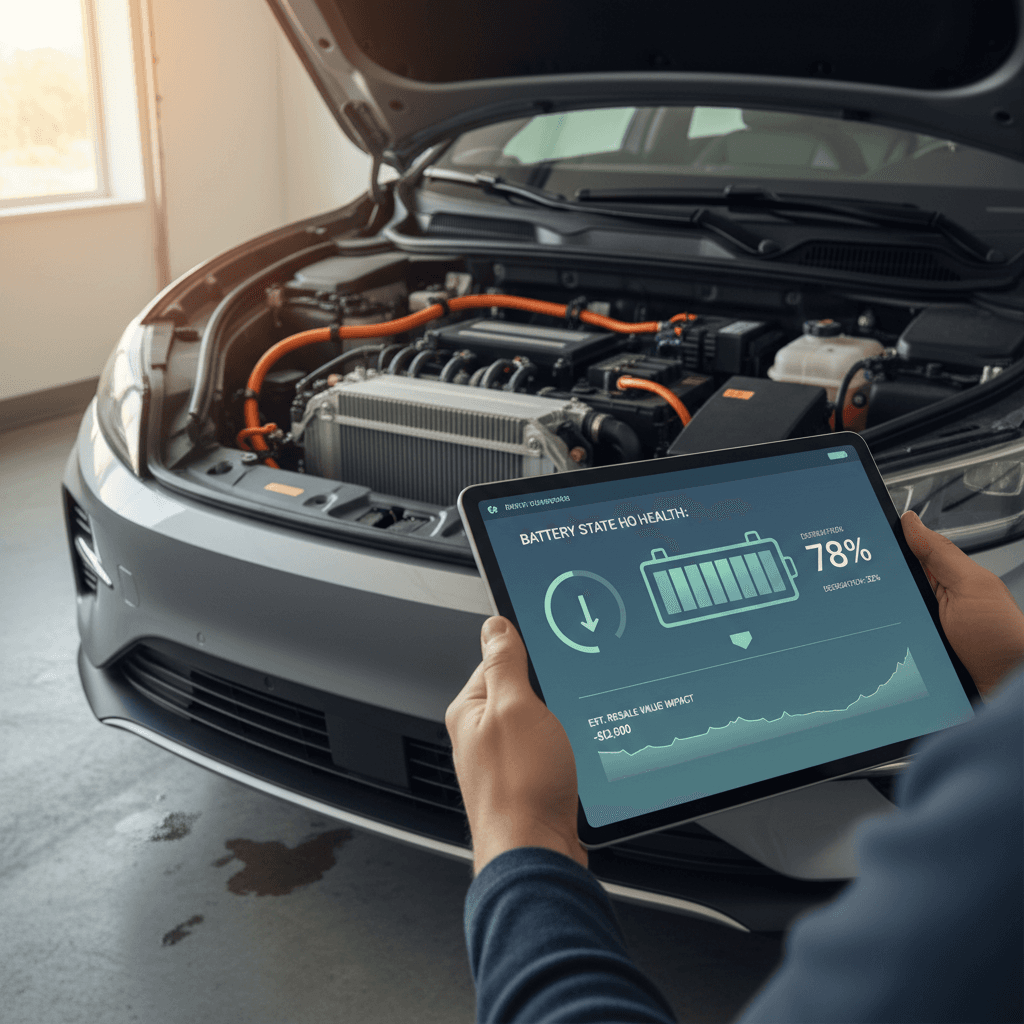
When people talk about EV “battery health,” they’re usually talking about State of Health (SoH), a percentage estimate of how much usable capacity remains compared to when the pack was new. A 90% SoH battery, for example, is estimated to hold about 90% of its original energy.
The battery health numbers that matter for resale
These are the metrics a savvy buyer, or buyer’s lender, will ask about.
State of Health (SoH)
SoH is the headline number for resale. A car that started with a 70 kWh pack and now effectively has ~63 kWh left would be reported at about 90% SoH.
Why it matters: It’s a shorthand for remaining life and range.
Real‑world range
Buyers compare today’s real‑world range with the original EPA rating.
Why it matters: A car that once did 250 miles but now manages 210 still feels usable; one down to 150 may need a noticeable discount.
Battery warranty status
Most EVs carry 8‑year battery warranties with a capacity threshold (often around 70%).
Why it matters: Remaining, transferable warranty can prop up value, and missing or non‑transferable coverage can hurt it.
A word of caution on dashboard estimates
Because of that variation, more OEMs and third‑party providers are offering formal battery health reports as part of used‑EV sales. At Recharged, every vehicle comes with a Recharged Score Report that includes verified battery health and range estimates, so both sellers and buyers can negotiate around facts instead of guesswork.
Why battery health can matter more than mileage for used EVs
In the gasoline world, shoppers obsess over odometer readings. With EVs, mileage alone doesn’t tell the whole story. Real‑world data from fleets and battery‑analytics firms shows that many high‑mileage EVs still retain strong battery health, while some low‑mileage cars have seen heavier degradation from poor charging habits or years of sitting at high state of charge.
High miles, healthy battery
Imagine a 5‑year‑old EV with 90,000 miles, used heavily for commuting but mostly charged on Level 2, rarely fast‑charged to 100%.
- Battery SoH: ~90–95%
- Real‑world range: still close to original rating
- Warranty: a couple of years left on the pack
Resale impact: Many buyers (and lenders) will see this as a solid, predictable car. The high miles matter less because the expensive part, the battery, still looks strong.
Low miles, tired battery
Now take a 7‑year‑old EV with just 35,000 miles that spent long periods parked at 100% charge in hot weather and was frequently DC fast‑charged.
- Battery SoH: maybe 80% or lower
- Real‑world range: noticeably below the original spec
- Warranty: close to expiration, or already out
Resale impact: Even with low miles, buyers will expect a discount to compensate for reduced range and a higher risk of future replacement.
The principle is simple: buyers don’t drive odometers, they drive range. If you’re selling an EV with a healthy battery and documented testing, you’re in a stronger position than someone with a lower‑mileage car but an uncertain or clearly degraded pack.
Real‑world examples: how battery health changes resale price
Because markets shift, it’s impossible to give a one‑size‑fits‑all dollar amount. But you can think in terms of bands. Here’s a simplified example for a popular EV that originally offered about 250 miles of range and now sells for around $22,000 in average used condition:
Illustrative impact of battery health on used EV pricing
Hypothetical example assuming similar age, trim, and cosmetic condition. Actual pricing varies by region and model.
| Battery State of Health | Approx. usable range vs. new | Buyer perception | Typical pricing impact* |
|---|---|---|---|
| 95–100% | 230–250 miles | “Feels basically like a new battery” | Baseline to +5% vs. average comps |
| 90–94% | 215–230 miles | “Normal, expected degradation” | In‑line with market; no special discount |
| 80–89% | 195–215 miles | “Usable, but we notice the loss” | Often discounted 5–15% depending on model |
| 70–79% | 170–195 miles | “Borderline for my commute/road trips” | Can require steep discounts or a niche buyer |
| Below 70% | Under 170 miles | “Might need a pack soon or become a city‑only car” | In some cases, value governed by battery replacement economics |
Battery health doesn’t change just value, it changes who’s willing to buy the car and how they plan to use it.
Why very poor battery health can crater value
On the flip side, an EV with excellent documented battery health can stand out in a crowded used‑car listing page, especially if most similar vehicles don’t disclose any battery information at all.
Other factors that interact with battery health
Battery health isn’t the only thing that shapes resale value, but it changes how the rest of the story reads. Some of the biggest interactions to keep in mind:
How other factors amplify, or soften, the impact of battery health
The same SoH number can mean different things depending on model, software, and market conditions.
Original range and segment
Losing 25 miles of range hurts more if the car only started with 150 than if it started with 330.
City runabout: Might still be perfectly usable at 80% SoH.
Road‑trip SUV: Buyers expect stronger batteries because long highway drives are the point.
Warranty coverage and transferability
Some brands’ battery warranties transfer fully to later owners; some limit certain benefits.
More transferable coverage often supports higher resale values, especially if SoH is borderline but still above the warranty threshold.
Charging history
Heavy DC fast‑charging and lots of time sitting at 100% can accelerate degradation for some chemistries.
When you can document gentle charging habits, buyers are more comfortable paying for a car they expect to age well.
Market and model reputation
Some EVs have built a reputation for robust batteries; others are known for faster degradation.
Good news: industry‑wide data is increasingly showing that most modern EV batteries are holding up better than early skeptics predicted.
Tip for owners of older EVs
How to check your EV’s battery health before you sell or trade in
If you’re thinking about selling or trading in your EV, you don’t want to walk in blind. Here are practical ways to understand your battery’s condition before anyone starts talking numbers:
Pre‑sale battery health checklist
1. Pull official battery data from the car
Many EVs will show some form of battery health or long‑term range data in their service menus or owner apps. It’s not always labeled “SoH,” but it may show estimated remaining capacity or range at 100%.
2. Use a trusted diagnostic tool or service
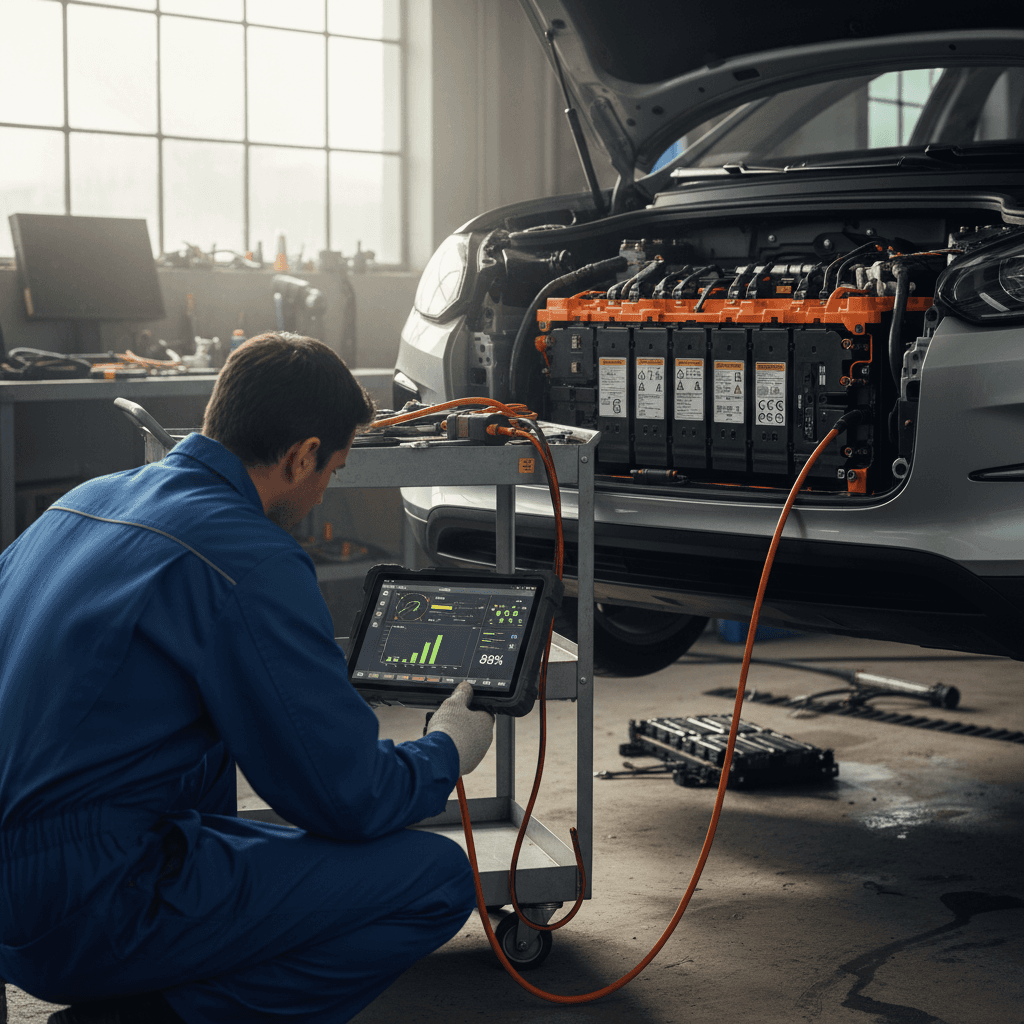
Third‑party battery‑analytics companies and some independent shops can run deeper tests that estimate State of Health, internal resistance, and cell balance. These reports are increasingly recognized in the trade‑in process.
3. Verify how your warranty treats capacity loss
Look at your battery warranty booklet or OEM website to see what’s covered. Most specify an SoH or range threshold (often near 70%) and a time/mileage limit, and most are transferable, but not all.
4. Document your charging and usage patterns
If you’ve mostly charged on Level 2 at home, avoided long periods at 100%, and haven’t abused DC fast charging, note that. A dealer or private buyer will see it as evidence your pack has been treated kindly.
5. Get a third‑party valuation that includes battery health
Traditional book values often assume “average” battery condition. A marketplace like <strong>Recharged</strong> that actually tests and scores the battery can give you a value that reflects your specific car, not just an average of the herd.
At Recharged, every vehicle we list gets a Recharged Score battery health diagnostic. That report goes to both sellers and buyers, which helps good cars command fair prices and makes it easier to sell an EV even if it has some expected, normal degradation.
Habits that protect battery health, and your future resale value
You can’t freeze your battery in time, but you can influence how quickly it ages. Many of the same habits that make your EV pleasant to live with also protect resale value by protecting the pack.
- Avoid sitting at 100% charge for long periods, charge to full shortly before you drive, especially in hot weather.
- Use DC fast‑charging when you need it, but don’t rely on it daily if a slower Level 2 option is practical.
- If your car has a charge‑limit slider, keep daily charging in the 70–90% window and reserve 100% for road trips.
- Park in the shade or a garage when possible; prolonged extreme heat isn’t friendly to batteries.
- Keep software up to date, since manufacturers sometimes tweak battery management and range estimates over time.
Good habits are profitable habits
How Recharged builds battery health into fair pricing
Traditional pricing books and auction lanes weren’t built for EVs. They assume a rough “average” condition and often treat every example of a given year, trim, and mileage the same. That’s a problem when a single component, the battery pack, can swing future usefulness by 20–30%.
Step 1: Test and score the battery
When an EV comes to Recharged, it doesn’t just get a visual inspection. We run a detailed Recharged Score battery health diagnostic that looks at pack capacity, balance, and performance, and we translate that into easy‑to‑understand range expectations for everyday use.
This goes beyond a generic dash reading so you’re not asked to take anyone’s word for it.
Step 2: Price the car around real data
We then factor that verified battery health into our pricing models, along with age, mileage, trim, and market demand.
- Sellers benefit because a strong battery can justify a stronger price.
- Buyers benefit because they’re not overpaying for a car with an unknown or below‑average pack.
Whether you’re trading in, selling via instant offer or consignment, or just browsing our inventory, every price is grounded in the same transparent approach.
Thinking about selling your EV?
FAQ: Battery health and EV resale value
Frequently asked questions
Bottom line: what battery health means for what your EV is worth
Battery health absolutely affects EV resale value, but not in a mysterious or unknowable way. A pack that still delivers most of its original range, backed by clear test data and a solid warranty story, supports stronger offers and an easier sale. A battery that’s clearly past its prime, or completely undocumented, forces buyers to price in risk and uncertainty.
If you’re an owner, the best moves are simple: take care of the pack, document its condition, and choose a selling channel that understands EVs. Recharged was built around that idea. Every used EV we buy or sell gets a Recharged Score Report with verified battery health, fair‑market pricing, and EV‑specialist support from the first appraisal to nationwide delivery. That way, you’re not just selling a used car, you’re selling a known quantity, and that’s what today’s EV buyers are most willing to pay for.