You’ve probably heard the line by now: “EV tires wear out faster than gas cars.” Like most viral car truths, there’s a grain of data, a dash of panic, and a whole lot of missing context. If you’re driving an electric car, or thinking about a used EV, tire wear is one of those quietly important details that can shape your real cost of ownership.
Key takeaway up front
Do EV tires wear faster than gas cars? The short answer
Yes, often
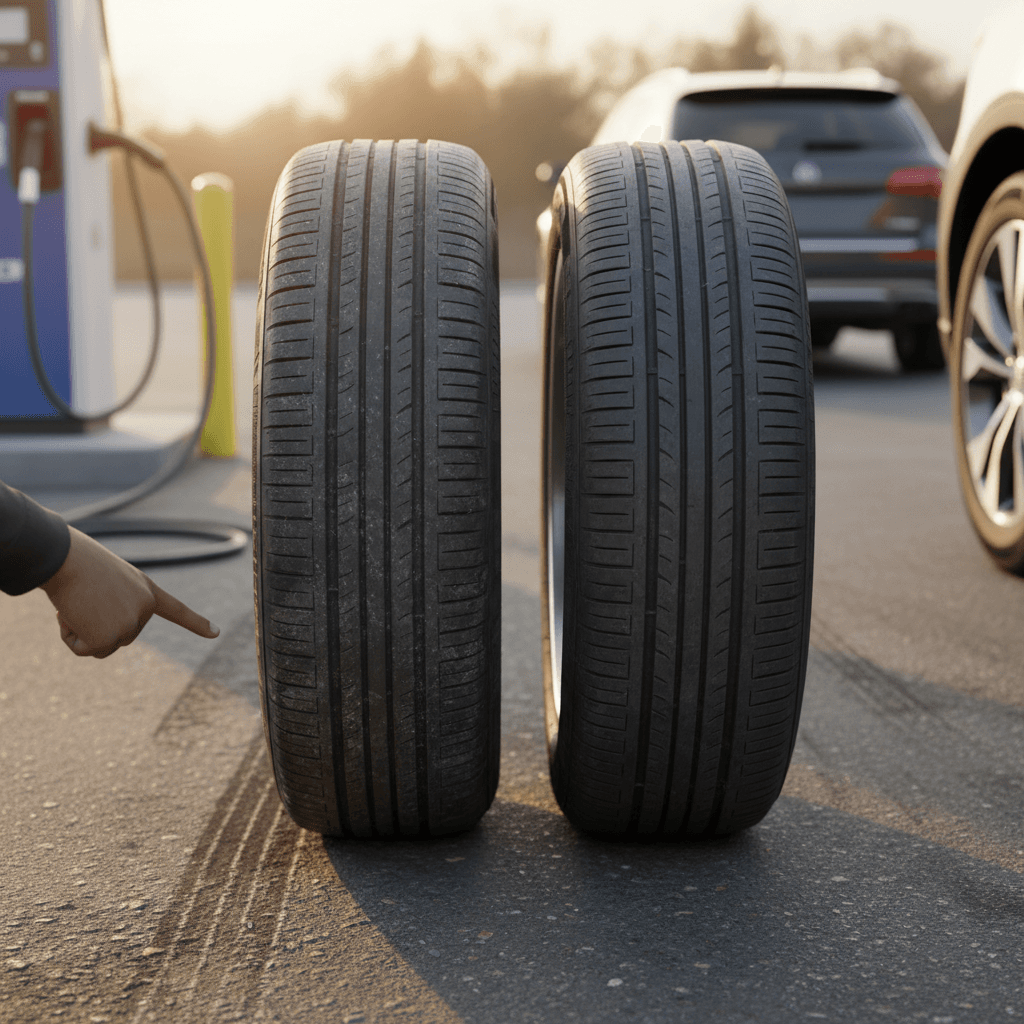
On average, modern electric vehicles do tend to wear through tires faster than comparable gas cars. Industry testing, tire makers, and real-world fleets consistently report about a 15–30% reduction in tread life for many EVs when they’re driven the same way as their gas counterparts.
But it’s not a law of physics
That headline number hides a messy truth: tire life on EVs is hugely sensitive to how and what you drive. A heavy, all-wheel-drive performance EV on soft rubber, driven like a sports car, will murder its first set of tires. A lighter commuter EV on efficient tires, driven smoothly and rotated on schedule, can see tire life surprisingly close to a similar gas car.
So yes, EV tires can wear faster than gas cars. But “how much faster?” and “does it matter?” depend on three big factors you actually influence: weight, torque, and how religious you are about maintenance.
EV tire wear vs gas cars by the numbers
Why EV tires can wear faster than gas-car tires
To understand why EV tire wear is different, picture what’s happening at the contact patch, a palm-sized patch of rubber doing all the work for a 4,500–6,000 lb vehicle.
Three main reasons EV tires work harder
The physics isn’t mysterious, just unforgiving.
1. Extra weight
Most EVs carry a large battery pack under the floor. That can make the electric version of the same model 20–30% heavier than the gas car. More mass means more load on each tire during every start, stop, and corner.
2. Instant torque
Electric motors deliver maximum torque almost immediately. That satisfying shove off the line? It’s also a mighty shearing force on the tire tread, especially if you like to launch away from every stoplight.
3. Noise and comfort demands
Because EVs are quieter, buyers notice tire roar. So OEM tires often use softer, low-noise compounds and foam liners, prioritizing grip and refinement over ultimate tread life. Great for feel, not so great for longevity.
Soft rubber, hard truth
Once you factor in weight, torque, and tire compound, it’s no surprise that an EV driven like a gas car will usually consume tires a bit faster. The trick is learning how much that matters for your specific use case, and how to tilt the odds back in your favor.
How much faster do EV tires wear in the real world?
Typical tire life: EVs vs similar gas cars
These are broad, real-world ranges assuming decent maintenance. Individual results will vary with driving style, roads, and tire choice.
| Vehicle type & driving style | Gas car tire life (mi) | EV tire life (mi) | Difference |
|---|---|---|---|
| Compact commuter, gentle driver | 45,000–60,000 | 38,000–50,000 | ~10–20% shorter on EV |
| Family crossover, mixed driving | 40,000–50,000 | 32,000–40,000 | ~20% shorter on EV |
| Performance sedan/SUV, enthusiastic driving | 30,000–40,000 | 20,000–30,000 | ~25–35% shorter on EV |
| Ride-share / delivery, mostly city | 35,000–45,000 | 28,000–38,000 | ~15–25% shorter on EV |
Think of these as weather forecasts, not promises from the tire gods.
In practical terms, that often means a tire that might last 40,000 miles on a gas car may be ready for retirement after 32,000–34,000 miles on an EV. On the other end of the spectrum, a dual-motor performance EV driven hard can chew through its first set close to 20,000–25,000 miles.
City vs highway: where EVs eat tires
What faster EV tire wear means for your wallet
Here’s where the myth machine kicks in. You’ll see scary anecdotes about $1,800 tire bills and shredded treads at 15,000 miles. Those stories exist, but they’re outliers. Let’s put realistic numbers to it.
Typical tire costs
- Gas compact / sedan: $500–$900 per set of four
- EV compact / crossover: $700–$1,200 per set for EV‑rated tires
- Large performance SUV: $1,000–$1,600+ per set, regardless of powertrain
Large wheels (20–22 inches), low‑profile sidewalls, and premium brands drive costs up more than the mere fact that the car is electric.
The “EV tax” in practice
Say a gas crossover goes 45,000 miles on a $900 set of tires. That’s 2 cents per mile.
If the comparable EV manages 36,000 miles on a $1,050 set, that’s just under 2.9 cents per mile.
You’re paying more per mile for rubber, yes, but most owners still come out ahead once you factor in lower maintenance and fuel costs versus a gas car over the same miles.
Where EVs quietly pay you back
EV-specific tires vs regular tires: does it matter?
Browse any major tire site and you’ll see a growing crop of rubber wearing little "EV" badges. That’s not just marketing. EV‑specific tires are quietly re‑engineered around exactly the challenges we’ve been talking about: weight, torque, and noise.
How EV-specific tires differ from regular tires
Same black circles, different priorities under the skin.
Built for higher loads
Many EV tires use reinforced constructions and higher load ratings to support heavier battery packs without overheating or deforming. You’ll see markings like XL (extra load) or HL (high load) on the sidewall.
Compounds tuned for torque
Rubber blends are tweaked to handle repeated high‑torque launches without scrubbing the tread off prematurely. The goal is a better balance of grip vs. wear under EV‑specific stresses.
Quieter by design
Many EV tires integrate foam liners and tread patterns that reduce road noise, which would otherwise stand out in a nearly silent cabin.
Efficiency-friendly
Low rolling resistance designs help preserve range, so you’re not trading all your efficiency away just to get decent tread life.
Should you always buy EV-rated tires?
7 ways to make your EV tires last longer
Practical habits that pay for themselves in rubber
1. Check tire pressure at least once a month
EVs are heavy, so running under‑inflated is a fast track to shoulder wear and heat build‑up. Use the pressure on the door jamb, not the sidewall max, and adjust for big seasonal temperature swings.
2. Rotate on time, maybe early
If your gas car rotated every 7,500–10,000 miles, consider <strong>6,000–7,500 miles on an EV</strong>, especially for front‑drive or rear‑drive setups that work their driven tires harder.
3. Dial back the full-throttle launches
That instant‑torque party trick is addictive, and expensive. Save the max‑power digs for special occasions. Smooth launches dramatically reduce tread scrubbing without making your EV feel slow.
4. Watch alignment and suspension wear
EV curb weights can accelerate wear in bushings and ball joints. If your EV starts to tramline, pull, or feel nervous over bumps, <strong>get an alignment check</strong> before the tires pay the price.
5. Choose the right replacement tire
Don’t shop only by price. Look for <strong>proper load rating, EV suitability, and treadwear warranty</strong>. A tire that costs $40 more but lasts 10,000 extra miles is a bargain.
6. Mind your speed and aggressive cornering
High speeds and big steering inputs multiply the forces your tires see. Even on the highway, backing off from 80 to 70 mph trims heat and wear, and helps your range.
7. Use the car’s tech to your advantage
Many EVs show <strong>live efficiency data and tire-pressure monitoring</strong>. If your Wh/mi suddenly jumps or a TPMS warning appears, that’s your cue to look for pressure loss, misalignment, or uneven wear.
Set a mileage reminder now
What EV tire wear tells you when buying a used EV
Tires are one of the fastest ways to read how a car has been driven. On a used EV, they’re also a free window into how realistic the previous owner’s range and cost claims really were.
- Even, healthy tread all around usually points to regular rotations, sane alignment, and a driver who isn’t destroying rubber at every stoplight.
- Heavily worn outer shoulders can suggest aggressive cornering, frequent fast on‑ramps, or chronic under‑inflation.
- Cupping or feathering may indicate worn suspension components or long‑ignored alignment issues, both more important on a heavy EV.
- Mismatched or cheap off‑brand tires on an otherwise nice EV can be a red flag about penny‑pinching maintenance. Ask why they’re there.
How Recharged bakes this into every car
When you’re comparing used EVs, fold tires into the math just like you would brakes on a gas car. A great‑priced EV that immediately needs $1,000 in tires isn’t necessarily a bad deal, but you should know that before you sign, not 600 miles into ownership.
The environmental angle: tire particles and heavier EVs
Lately you may have seen claims that EVs are "worse for the environment" because heavier weight causes more brake and tire pollution. As usual, the reality is more nuanced than the headline.
Tire particles are real, and not just an EV problem
All vehicles shed tiny bits of rubber and road material as the tires roll, accelerate, and brake. While heavier EVs can emit somewhat more tire particles than lighter gas cars, SUVs and trucks, regardless of fuel, are big contributors for the same reason: mass.
Zoom out to the full picture
When you include tailpipe emissions, upstream fuel production, and lifetime operation, EVs still typically come out cleaner overall than comparable gas cars. But yes, the industry is now paying more attention to low‑emission tire compounds and designs precisely because EVs have highlighted the issue.
What you can actually control
FAQ: EV tire wear vs gas cars
Frequently asked questions about EV tire wear
Bottom line: Should EV tire wear scare you off?
Electric cars do tend to work their tires harder than gas cars. Batteries add weight, motors add torque, and tire engineers have been told to prioritize grip, quiet, and range. The result is often a 15–30% haircut on tread life compared with a similar gas model, and a bit more money spent on rubber over the life of the car.
But that’s the whole story, not the horror story. You have enormous influence over how long your EV tires last, from pressure checks and timely rotations to how you use that instant torque. And when you zoom out to the full cost of ownership, EVs usually still come out ahead on maintenance even with slightly higher tire bills.
If you’re shopping for a used EV, factor tires into the deal the same way you’d think about brakes and belts on a gas car. Look closely at wear, budget realistically for a future set, and lean on tools like the Recharged Score Report so you’re not buying blind on battery health or tire life.
EVs haven’t rewritten the laws of physics, they’ve just made them more obvious. Treat your tires like the critical, consumable safety parts they are, and they’ll hold up their end of the bargain, whether there’s a gas tank or a battery pack on the other end of the chassis.