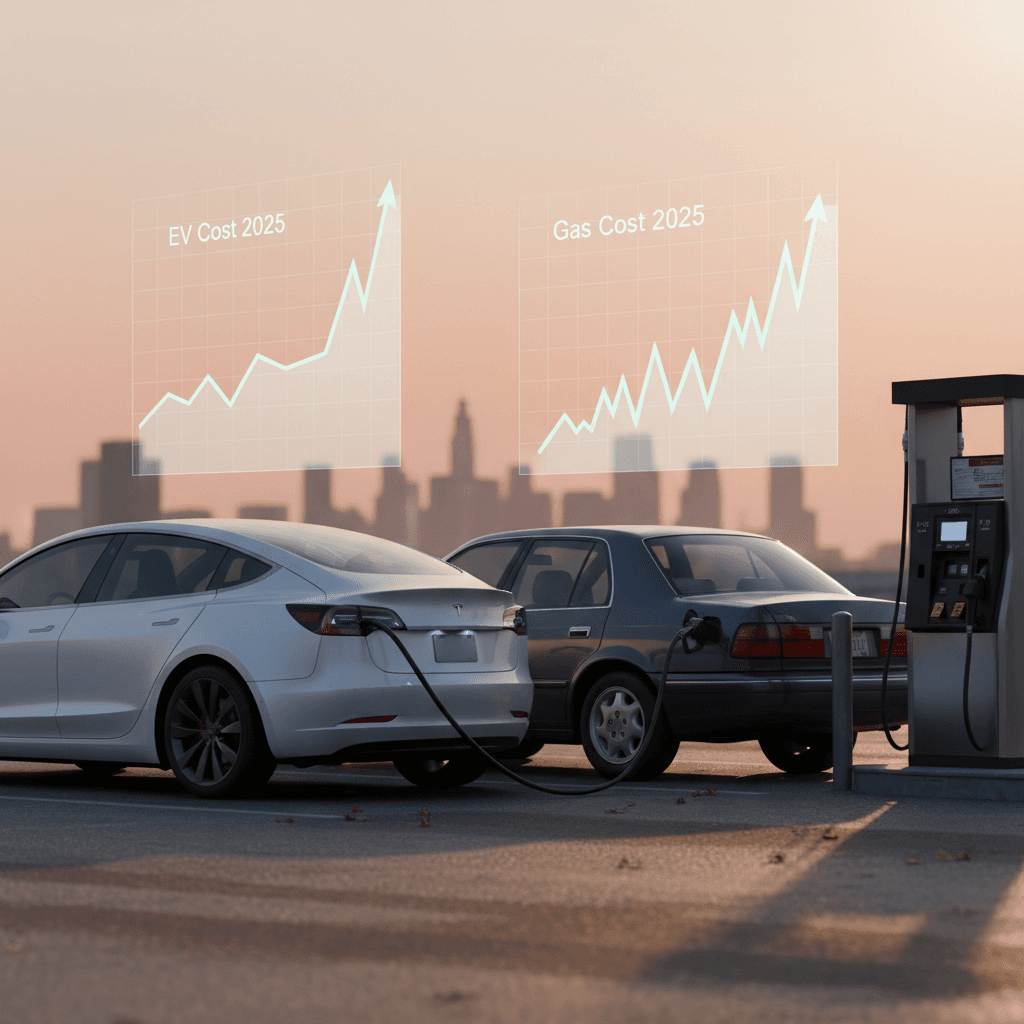
If you’re comparing the cost of a Tesla vs gas in 2025, you’re not alone. Electricity prices have climbed, gas isn’t cheap either, and EV incentives are changing. The headline is still true, Teslas are usually cheaper to fuel and maintain, but the details now depend heavily on where you live, how you charge, and whether you’re buying new or used.
Key takeaway in one line
Tesla vs gas: why costs look different in 2025
A few years ago, the math seemed simple: electricity was cheap, gas was expensive, and a Tesla won on cost almost every time. In 2025, both sides of the equation have moved. The national average residential electricity price is hovering around $0.19 per kWh, while average gasoline is roughly $3.15 per gallon, according to the latest AAA “Your Driving Costs” data. At the same time, new EVs still cost more up front than comparable gas cars, and federal tax credits are scheduled to end for many buyers in late 2025.
That’s why you now see headlines claiming EVs can be more expensive overall, even as the cost per mile to move the car is clearly lower. The right question isn’t “Is a Tesla cheaper than gas?” but rather “Under my driving pattern, energy prices, and purchase price, when does a Tesla pull ahead?”
Fast facts: Tesla vs gas costs in 2025
Quick answer: how much cheaper is a Tesla to drive?
EnergySage’s 2025 comparison of Tesla models against similar gas cars pegs average Tesla charging cost at about 6¢ per mile, versus roughly 16¢ per mile for gasoline. For a typical 12,000–15,000 miles per year, that’s $1,200 or more in annual fuel savings, if you mostly charge at home.
Over five years and 75,000 miles (the mileage AAA uses for its cost studies), that’s on the order of $6,000+ in fuel savings versus a comparable gas car. That savings helps offset higher purchase price, but it may or may not erase the entire gap depending on interest rates, incentives, and how aggressively you drive.
Think in cost per mile, not per fill‑up
Fuel cost per mile: Tesla vs gas
Step 1: Estimate Tesla electricity use
Most Teslas today use around 0.25–0.30 kWh per mile in mixed driving. We’ll use 0.27 kWh/mile as a realistic average for a Model 3 or Model Y.
If your electricity is $0.19/kWh, your home charging cost per mile looks like this:
0.27 kWh/mile × $0.19/kWh ≈ $0.051 per mile (5.1¢)
In low‑cost states at ~13¢/kWh, you’re closer to 3.5¢ per mile. In high‑cost states above 30¢/kWh, you might be at 8–9¢ per mile.
Step 2: Estimate gas car fuel use
Say you’re cross‑shopping:
- Tesla Model 3 vs a 30 mpg compact sedan
- Tesla Model Y vs a 25 mpg small SUV
At about $3.15 per gallon, the gas cost per mile looks like:
- 30 mpg car: $3.15 ÷ 30 ≈ $0.105 per mile (10.5¢)
- 25 mpg SUV: $3.15 ÷ 25 ≈ $0.126 per mile (12.6¢)
So even with today’s higher power prices, a Tesla still usually cuts your fuel cost per mile roughly in half, sometimes more.
Approximate 2025 cost per mile: Tesla vs comparable gas cars
Illustrative energy costs using typical efficiency figures and current energy prices. Your numbers will vary by state, model, and driving style.
| Vehicle pair | Energy use assumption | Energy price used | Approx. cost per mile |
|---|---|---|---|
| Model 3 vs compact sedan | Tesla: 0.26 kWh/mi, gas: 30 mpg | $0.19/kWh, $3.15/gal | Tesla ≈ 4.9¢, gas ≈ 10.5¢ |
| Model Y vs small SUV | Tesla: 0.28 kWh/mi, gas: 25 mpg | $0.19/kWh, $3.15/gal | Tesla ≈ 5.3¢, gas ≈ 12.6¢ |
| Model X vs luxury SUV | Tesla: 0.34 kWh/mi, gas: 20 mpg | $0.19/kWh, $3.15/gal | Tesla ≈ 6.5¢, gas ≈ 15.8¢ |
| Heavy truck (Cybertruck) vs gas pickup | Tesla: 0.70 kWh/mi, gas: 18 mpg | $0.19/kWh, $3.15/gal | Tesla ≈ 13.3¢, gas ≈ 17.5¢ |
Energy cost only, excluding maintenance and insurance.
Energy prices are moving targets
Home charging vs Supercharging costs
The per‑mile math above assumes you do most of your charging at home on a residential rate plan. That’s key. Home charging is almost always the cheapest way to run a Tesla. Relying heavily on Tesla Superchargers or other DC fast chargers can move your electricity cost closer to gas costs, especially in high‑priced markets.
How charging style changes your Tesla fuel costs
Three common patterns and what they mean for cost per mile.
1. Mostly home charging
Where you charge: 80–90% at home, occasional fast charging on trips.
Typical cost: 4–6¢ per mile in average‑cost states; 7–9¢ in high‑price states.
Best for: Owners with a driveway or garage who can install Level 2 charging.
2. Mixed home + public
Where you charge: ~50% home, 50% Supercharger/public DC fast charge.
Typical cost: Blended 6–10¢ per mile, depending on your local electricity and Supercharger rates.
Best for: Apartment dwellers with some workplace or off‑peak home charging access.
3. Mostly Supercharging
Where you charge: 70%+ at Superchargers or paid DC fast chargers.
Typical cost: 9–15¢ per mile, sometimes close to, or even above, a very efficient gas hybrid.
Best for: Only if you drive high mileage and value time savings more than pure cost.
Watch for time‑of‑use (TOU) rates
Maintenance, repairs, and battery costs
Fuel is only part of the story. EVs, and Teslas in particular, tend to win big on maintenance. No oil changes, fewer moving parts, and regenerative braking that reduces wear on brake pads all help. But you also have to think about out‑of‑warranty repairs and long‑term battery health, especially if you’re comparing a used Tesla vs a used gas car.
Where Teslas typically save, and where they don’t
Lower routine maintenance
You’re eliminating oil changes, transmission fluid, spark plugs, and a lot of exhaust and emissions hardware. Many owners see several hundred dollars a year less in basic service versus a gas car.
Fewer wear items
Regenerative braking means brake pads can last far longer than in a comparable gas car, especially if you drive mostly in city traffic.
Tires can cost more
Teslas are heavy and quick. They can go through tires faster than an economy gas sedan, and replacement tires are often more expensive.
Out‑of‑warranty repairs
When something big fails, air suspension, infotainment, or charging components, out‑of‑warranty costs can be high, just as they are on premium gas vehicles.
Battery health matters most on used cars
A healthy battery keeps your range (and resale value) up. A degraded pack or one that’s been fast‑charged aggressively can dent long‑term economics.
Battery replacement risk
Full pack replacements are rare in the first 8–10 years but can run into the five figures. It’s a low‑probability, high‑impact cost you can’t ignore.
How Recharged reduces battery guesswork
Ready to find your next EV?
Browse Vehicles5‑year total cost of ownership: side‑by‑side example
Let’s put some numbers together. These are illustrative figures using recent energy prices and typical market discounts on new vehicles in late 2025. Your situation will differ, but the exercise shows how fuel savings stack up against higher EV purchase prices.
Scenario A: New Tesla Model 3 RWD
- MSRP after typical discounts: ~$40,000
- Down payment: 10% ($4,000)
- Loan: 60 months at current market rates
- Annual miles: 15,000 (75,000 over 5 years)
- Energy cost: 5¢/mi (home charging heavy)
- 5‑year energy: 75,000 × $0.05 = $3,750
- Maintenance & repairs: Roughly $500/year = $2,500
Very rough 5‑year out‑of‑pocket (payments + energy + maintenance): often lands in the mid‑$50k range once you factor in finance charges, insurance, and taxes.
Scenario B: New gas compact sedan
- MSRP after discounts: ~$30,000
- Down payment: 10% ($3,000)
- Loan: 60 months at similar rate
- Annual miles: 15,000
- Energy cost: 10.5¢/mi (30 mpg, $3.15/gal)
- 5‑year fuel: 75,000 × $0.105 = $7,875
- Maintenance & repairs: $900/year = $4,500 (oil, brakes, more complex drivetrain)
Very rough 5‑year out‑of‑pocket: usually in the high‑$40k range, depending on financing and insurance.
In this simplified comparison, the gas car is cheaper up front and remains slightly cheaper to own over five years, even after you account for fuel and maintenance. But if you pay less than sticker for your Tesla, unlock state incentives, or keep the car longer than five years, the equation starts to tilt toward the EV, because the fuel savings keep compounding while the purchase premium is already sunk.
Why a used Tesla can flip the script
Used Tesla vs used gas car
The used market is where the cost of Tesla vs gas often becomes most compelling. Depreciation has already done its damage, and you’re choosing between vehicles that might be only a few thousand dollars apart in price, not five figures.
Example: 5‑year‑old used Tesla vs 5‑year‑old gas sedan
Illustrative numbers to show how fuel and maintenance stack up in the real world.
Used Tesla (e.g., 2019–2020 Model 3)
- Purchase price: Say $22,000 from a reputable seller.
- Annual miles: 12,000.
- Energy cost: 5¢/mi → $600/year.
- Maintenance: $500/year (tires, cabin filters, inspections).
- 5‑year energy + maintenance: ≈ $5,500.
Used gas sedan (similar age/segment)
- Purchase price: Maybe $18,000.
- Annual miles: 12,000.
- Fuel cost: 10.5¢/mi → $1,260/year.
- Maintenance: $900/year.
- 5‑year fuel + maintenance: ≈ $10,800.
Even though you paid $4,000 more for the used Tesla, you saved roughly $5,300 in fuel and maintenance over five years in this example. That’s why many cost‑conscious shoppers are moving to used EVs rather than new ones.
How Recharged helps on the used side
When does a Tesla not save you money?
- You live in a state with very high electricity prices (30–45¢/kWh) and do most of your charging at home on a standard rate.
- You rely heavily on Superchargers or other DC fast chargers at premium per‑kWh or per‑minute pricing.
- You drive very few miles per year (under ~7,000), so fuel savings are small relative to higher purchase price.
- You buy a new Tesla at full sticker, without incentives, while a gas competitor is heavily discounted.
- Insurance, registration, or parking costs are substantially higher for the Tesla in your specific market.
- You buy a poorly‑maintained used EV with undocumented battery health and end up paying for major repairs.
Don’t ignore total ownership costs
How to estimate your own Tesla vs gas costs
Build a quick Tesla vs gas cost calculator in 6 steps
1. Nail down your annual mileage
Look at your last year of driving (or odometer history). Use a realistic annual mileage number, 12,000–15,000 is common, but your situation may be higher or lower.
2. Find your local electricity rate
Check your latest power bill for the kWh rate, including delivery and fees. If you can, note both standard and off‑peak (TOU) rates.
3. Use real‑world efficiency numbers
For Teslas, assume 0.25–0.30 kWh per mile unless you know your exact average. For gas, use the EPA combined mpg for your target car, or better yet, owner‑reported figures.
4. Calculate yearly fuel/energy cost
Multiply your cost per mile by your annual miles for each car. This gives you yearly fuel cost, which you can then multiply by five or more years.
5. Add realistic maintenance estimates
For Teslas, budget several hundred dollars a year; for gas, closer to $800–$1,000 annually once out of warranty. If you’re looking at a specific used car, factor in tires and likely repairs.
6. Compare purchase and financing options
Price out both vehicles, including taxes, fees, and interest. On Recharged, you can see monthly payments and compare <strong>financing</strong> on a used Tesla vs other EVs to understand your true monthly outlay.
Want help running the numbers?
FAQ: cost of Tesla vs gas
Frequently asked questions about the cost of Tesla vs gas
The cost of a Tesla vs gas in 2025 isn’t a one‑line answer. Teslas still win on fuel and maintenance in most scenarios, especially if you can charge at home and drive a normal or high annual mileage. Gas cars still win on upfront price and can be cheaper over short time horizons or in very high‑electricity‑cost regions. The sweet spot for many shoppers is a well‑priced used Tesla with documented battery health, where the purchase premium is modest but the fuel and maintenance savings are real. If you’re ready to see how that math looks for you, explore used Teslas and other EVs on Recharged, run the payment and energy numbers side by side, and decide with confidence.