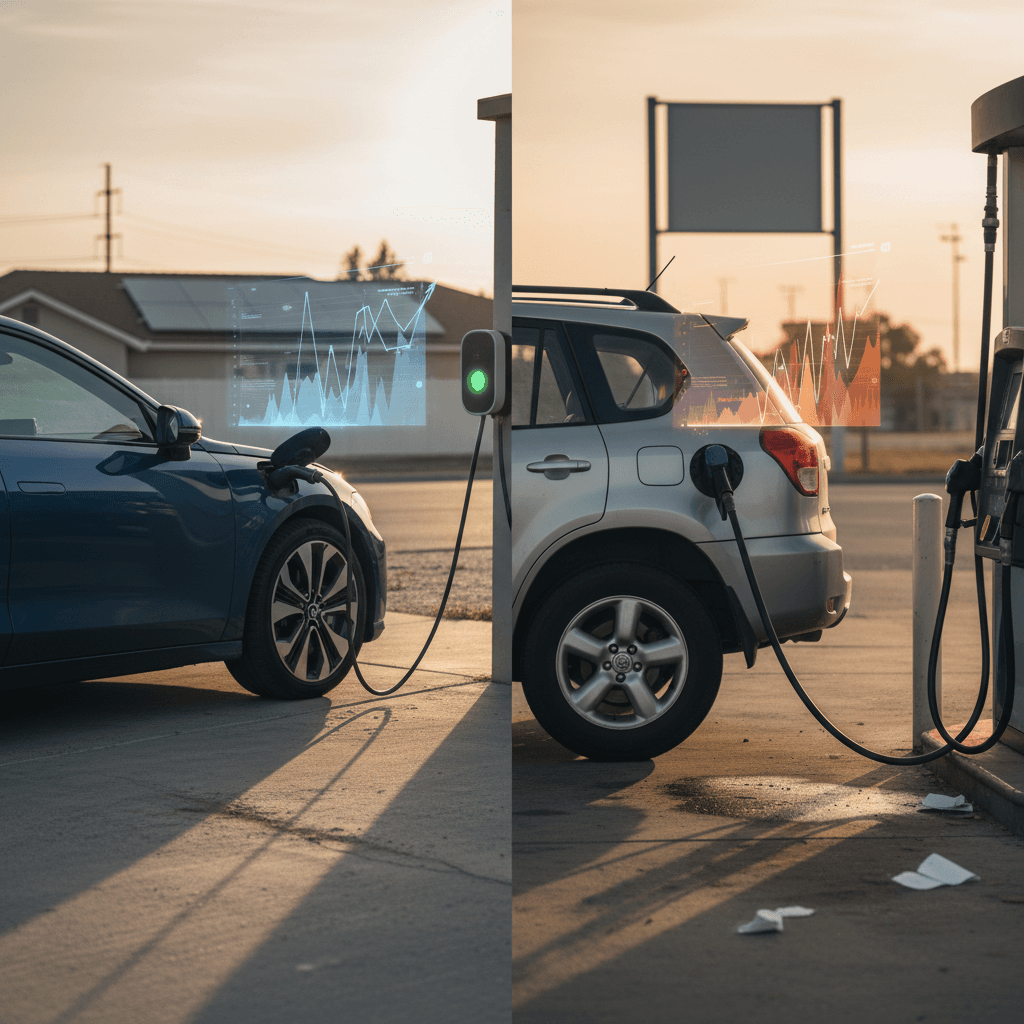
When you compare the cost of charging an electric car vs gasoline, you’ll see wildly different answers: “EVs are 4x cheaper” in one place, “charging is getting as expensive as gas” in another. The truth is more nuanced, but you can absolutely pin down what you’d pay per mile with a few simple numbers.
The big picture in 2025
Why EV vs gas cost comparisons feel confusing
If you’ve ever tried to compare EVs and gas cars, you’ve probably noticed that every chart seems to use different assumptions. Some compare cheap overnight home charging to peak-hour public fast charging. Others put a 50-mpg hybrid up against a 3-row electric SUV. No wonder the cost of charging an electric car vs gasoline feels slippery.
- Electricity prices vary a lot by state (roughly 12–42 cents per kWh in 2025).
- Gas prices also swing by more than $1 per gallon depending on where you live.
- EVs differ widely in efficiency (from ~2.3 to 4+ miles per kWh).
- Gas cars range from thirsty trucks at 18 mpg to hybrids at 50+ mpg.
- Home charging, workplace charging, and DC fast charging all have very different prices.
Compare on a per‑mile basis
Quick answer: what most drivers pay per mile
EV vs gas: typical U.S. cost per mile (2025)
Think of this as a national-average scoreboard for 2025. If you mostly charge at home on a typical U.S. electric rate and drive a reasonably efficient EV, you’re usually paying about half the fuel cost per mile of a conventional gas car. If you rely heavily on DC fast charging, or live somewhere with extremely expensive electricity, that advantage shrinks, but rarely disappears, especially when you factor in lower maintenance.
Step-by-step: how to calculate your EV charging costs
Let’s make this concrete. You only need three inputs to calculate what it costs to charge an electric car: your electricity rate, your EV’s efficiency, and how (and where) you charge.
4 steps to calculate your EV cost per mile
1. Find your electricity price per kWh
Grab your latest electric bill and look for the line that shows your total charge divided by total kWh. Nationally, residential rates average roughly <strong>$0.17/kWh</strong> in 2025, but states like California and Hawaii are far higher.
2. Look up your EV’s efficiency
Most EV window stickers list efficiency in <strong>kWh per 100 miles</strong>. Many compact and midsize EVs fall around 27–30 kWh/100 miles (3.3–3.7 mi/kWh). Heavier SUVs and trucks can be 40 kWh/100 miles or more.
3. Calculate cost per mile
Use this formula: <strong>Cost per mile = (kWh per 100 miles ÷ 100) × electricity price</strong>. Example: 28 kWh/100 mi and $0.17/kWh → (28 ÷ 100) × 0.17 = <strong>$0.048 per mile</strong>.
4. Adjust for your charging mix
If you use public fast charging some of the time, blend rates. Example: 80% home at $0.17/kWh + 20% DC fast at $0.40/kWh gives an effective rate of about $0.22/kWh. Plug that into the same formula.
Watch for fees and tiered rates
Example A: Mostly home charging
Assumptions:
- EV efficiency: 28 kWh/100 miles
- Home electricity: $0.17/kWh
- Charging: 90% home, 10% DC fast @ $0.40/kWh
Effective electricity price: (0.9 × 0.17) + (0.1 × 0.40) ≈ $0.19/kWh → cost per mile ≈ $0.053.
Example B: Heavy fast charging
Assumptions:
- Same EV: 28 kWh/100 miles
- Home electricity: $0.17/kWh
- Charging: 40% home, 60% DC fast @ $0.40/kWh
Effective price: (0.4 × 0.17) + (0.6 × 0.40) ≈ $0.31/kWh → cost per mile ≈ $0.087.
When EV “fuel” can match gas
How gasoline costs compare in 2025
Now let’s look at the gasoline side of the ledger. In 2024, average U.S. gasoline prices were about $3.30 per gallon, and forecasts point to about $3.10 per gallon for 2025. Prices still bounce around week to week and vary a lot by state, but $3–$3.25 is a reasonable planning number for most drivers right now.
Typical gas cost per mile at different mpg levels
Use this to compare to your EV calculations above.
| Vehicle type | Example mpg | Cost per mile at $3.10/gal | What this looks like in the real world |
|---|---|---|---|
| Thirsty SUV / truck | 18 mpg | $0.17 | Large body‑on‑frame SUV or full‑size pickup |
| Average gas car | 25 mpg | $0.12 | Typical midsize crossover or sedan |
| Efficient compact | 35 mpg | $0.09 | Smaller hatchback or compact sedan |
| Hybrid | 50 mpg | $0.06 | Non‑plug‑in hybrid compact or sedan |
Gasoline cost per mile at $3.10 per gallon (approximate national 2025 forecast).
Comparing this to our earlier EV examples, you can see why EV advocates talk about “fueling for the equivalent of $1–$1.50 per gallon” when charging at home. At $0.17/kWh and 3.5 miles per kWh, your EV’s cost per mile roughly matches a 50‑mpg hybrid, even before you count lower maintenance.
Three real-world driver scenarios
Instead of abstract averages, let’s walk through three common lifestyles. These are simplified, but they illustrate how the cost of charging an electric car vs gasoline can swing based on where and how you drive.
How different drivers experience EV vs gas costs
Same math, very different outcomes depending on your situation.
Suburban commuter
12,000 miles/year, garage, typical sedan
- EV: Mostly home charging @ $0.17/kWh
- Gas: 30 mpg sedan @ $3.10/gal
- Result: EV saves ≈ $450–$600/year on fuel.
Apartment dweller
10,000 miles/year, limited home charging
- EV: 40% Level 2 at work, 60% DC fast
- Gas: 30 mpg crossover
- Result: EV still often wins, but fuel savings may shrink to $150–$300/year.
High‑mileage driver
20,000+ miles/year, good home charging
- EV: 90% home charging, efficient model
- Gas: 25 mpg vehicle
- Result: Fuel savings can top $1,000/year, compounding over a few years.
Where EV economics shine
Beyond fuel: maintenance and total cost
Focusing only on the cost of charging an electric car vs gasoline misses another big lever: maintenance. EVs don’t need oil changes, have far fewer moving parts, and typically chew through brake pads more slowly thanks to regenerative braking. Gasoline cars, especially as they age, bring more frequent and expensive visits to the shop.
Typical EV maintenance
- No oil changes, spark plugs, or exhaust system repairs.
- Tire rotations and replacements (EVs are heavier, so tires can be a bit more expensive).
- Cabin air filter and brake fluid changes at multi‑year intervals.
- Occasional software updates, often over‑the‑air.
Many owners report spending just a few hundred dollars a year on routine care, especially in the first 5–7 years.
Typical gas car maintenance
- Oil and filter changes multiple times per year.
- Transmission service, spark plugs, belts, and hoses over time.
- Exhaust and emissions system repairs on older vehicles.
- Brake jobs more frequently (no regen to share the work).
For high‑mileage drivers keeping cars past 100,000 miles, these costs often exceed any fuel‑price advantage a gas car might have at the pump.
Battery health is the swing factor for used EVs
This is why Recharged includes a Recharged Score Report with verified battery diagnostics on every vehicle. When you shop for a used EV, you’re not guessing about battery health, you see transparent data up front, along with fair market pricing and side‑by‑side comparisons to similar EVs and gas cars.
How to lower your EV charging bill
Practical ways to cut your EV “fuel” costs
1. Use time‑of‑use or off‑peak rates
If your utility offers cheaper overnight electricity, schedule charging in your car or app so most energy flows when rates are lowest. It’s not unusual to shave 25–40% off your per‑kWh cost this way.
2. Max out home or workplace Level 2
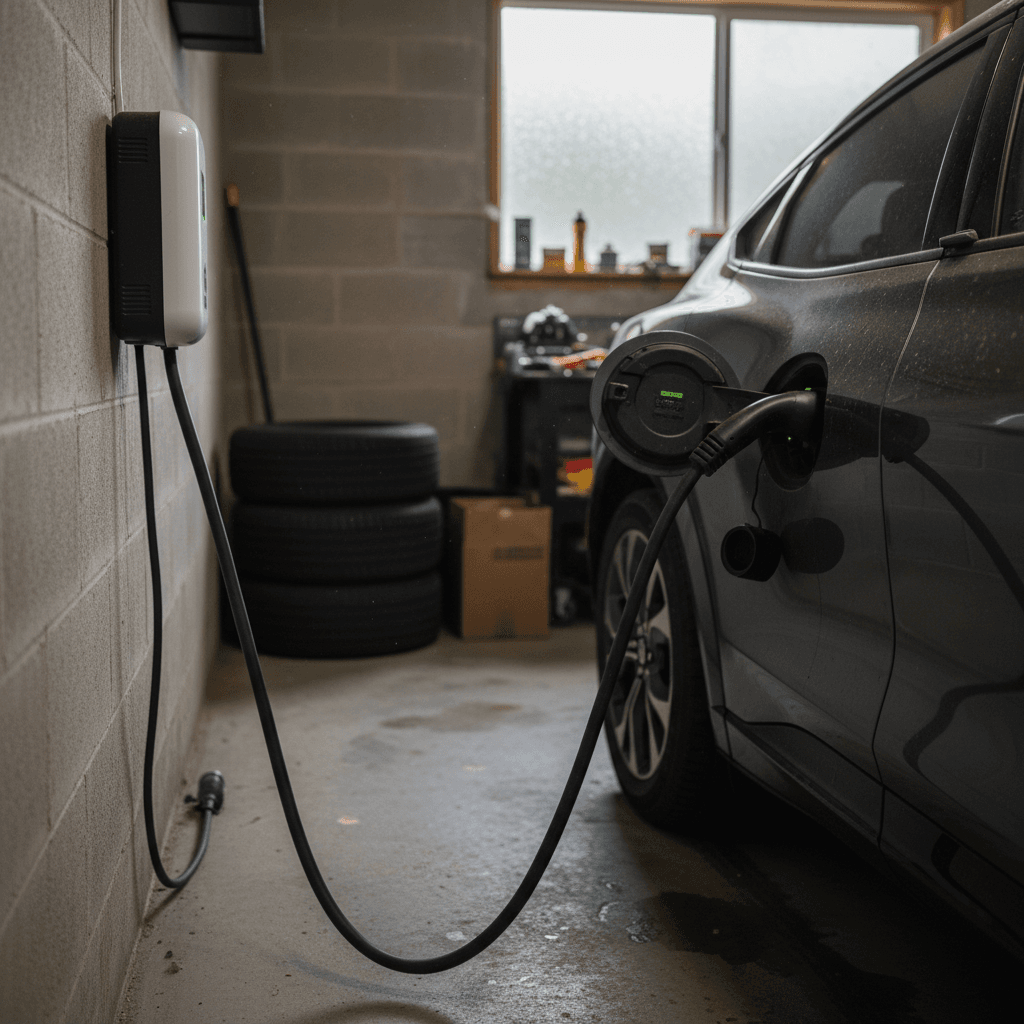
Every kWh you charge at home or work instead of on a highway fast charger effectively stretches your fuel budget. A basic 240V Level 2 setup at home often pays for itself over a few years of avoided public charging.
3. Choose an efficient EV
When browsing used EVs, pay attention to <strong>EPA efficiency ratings</strong>. A model that gets 3.8 mi/kWh instead of 2.7 mi/kWh is like jumping from a 25‑mpg SUV to a 35‑mpg sedan in gas‑car terms.
4. Plan around fast charging
Use DC fast charging for road trips and occasional top‑ups, not everyday fueling. Apps like PlugShare and automaker route planners help you minimize both price and time on long drives.
5. Keep tires properly inflated
Low tire pressure hurts efficiency in both EVs and gas cars. A few minutes with a tire gauge can save you money every month, especially if you drive a lot.
Think in total cost, not just fuel
Using Recharged to compare real EV running costs
If you’re cross‑shopping a used gas car and a used EV, the math can feel intimidating. At Recharged, we try to make this simple and transparent.
How Recharged helps you make the numbers add up
Beyond listing prices: real battery data, fair pricing, and EV‑savvy guidance.
Verified battery health
Every EV on Recharged comes with a Recharged Score Report that measures battery health and range, so you can connect efficiency and real‑world cost per mile.
Fair market pricing
We benchmark prices against the broader market, helping you see when a used EV is actually a good deal compared with similar gas cars.
Financing & trade‑ins
From financing and trade‑ins to instant offers or consignment, we help you structure a deal where lower EV running costs line up with a monthly payment you’re comfortable with.
Ready to find your next EV?
Browse VehiclesYou can shop fully online, get expert EV‑specialist support, and even have your car delivered nationwide, or visit our Experience Center in Richmond, VA if you prefer to kick the tires in person.
EV vs gas cost: FAQ
Frequently asked questions about EV vs gas costs
Key takeaways: when an EV saves you money
- On today’s typical U.S. rates, home‑charged EVs often cost about half as much per mile to “fuel” as comparable gas cars.
- If you rely heavily on DC fast charging, your EV fuel-cost advantage shrinks but usually doesn’t disappear, especially once you factor in lower maintenance.
- High‑mileage drivers with good home charging see the biggest savings, often hundreds to more than a thousand dollars per year in fuel alone.
- Battery health is the main long‑term variable for used EVs; transparent diagnostics like the Recharged Score Report help de‑risk that unknown.
- The smartest way to compare the cost of charging an electric car vs gasoline is to run your own numbers: your utility rate, your local gas price, and the specific vehicles you’re considering.
If you’re ready to move from rough rules of thumb to real numbers, take a few minutes to grab your electric bill, look up your current gas price, and compare a used EV on Recharged to the gas car you’re driving today. When you layer lower per‑mile energy costs, lower maintenance, and transparent battery health into a fair market price, the total picture often looks surprisingly compelling.