Colorado’s electric car charging network has gone from sparse to surprisingly robust in just a few years. By early 2025, Colorado ranked among the top ten states for public EV chargers, with well over 5,000 public charging ports and more being added every month. Today, in 2026, that growth is transforming how confidently you can commute along the Front Range or road‑trip through the Rockies in an EV.
Colorado’s charging boom in numbers
Colorado’s electric car charging network at a glance
Colorado EV charging snapshot (early 2026)
In practical terms, this means most daily driving along the Front Range is already well‑served by Level 2 stations and a growing number of DC fast chargers. The more challenging use case, winter weekend trips to ski country, summer camping deep in the mountains, or detours through the Eastern Plains, is exactly where Colorado is focusing new investment through programs like the federal NEVI (National Electric Vehicle Infrastructure) grants and the state’s DCFC Plazas program.
How to think about coverage
Where are Colorado’s EV chargers located?
Colorado’s charging network reflects where people live and travel. Most public chargers are in and around the Front Range, Denver, Boulder, Colorado Springs, Fort Collins, and their suburbs, with dense clusters at grocery stores, office parks, parking garages, and big‑box retailers. Mountain towns and key junctions now host fast‑charging “oases,” while more remote rural areas still have thinner coverage.
How Colorado’s charging network is distributed
Front Range density; mountain and rural gaps are narrowing
Front Range urban core
Where: Denver, Boulder, Aurora, Colorado Springs, Fort Collins and nearby suburbs.
- Highest concentration of Level 2 chargers at workplaces, multifamily housing, and retail.
- Multiple fast‑charging hubs near major interchanges and shopping areas.
- Good options for both overnight and top‑off charging.
Mountain towns & ski country
Where: I‑70 corridor towns like Golden, Idaho Springs, Frisco, Silverthorne, Vail, and Glenwood Springs, plus resorts like Breckenridge and Steamboat.
- Fast chargers focused near highway exits and resort parking.
- More Level 2 chargers at hotels, lodges, and public lots every year.
- Coverage is good on main corridors, but still sparse on smaller passes and side valleys.
Eastern Plains & Western Slope
Where: Smaller cities such as Pueblo, Grand Junction, Durango, plus towns along US‑50, US‑40, and other corridors.
- Fast chargers at select highway crossroads and travel centers.
- Level 2 stations at city halls, libraries, and local businesses.
- Gaps still exist, you may need to plan around single stations in long stretches.
Mind the edges of the map
Fast-charging corridors: I‑25, I‑70 and beyond
For most EV drivers, the backbone of the Colorado electric car charging network is a triangular set of fast‑charging corridors: I‑25 along the Front Range, I‑70 across the Rockies, and cross‑state routes like US‑50 and US‑40. State and federal funds are being poured into these highways to ensure that, eventually, you’re never more than about 50 miles from a DC fast charger on designated corridors.
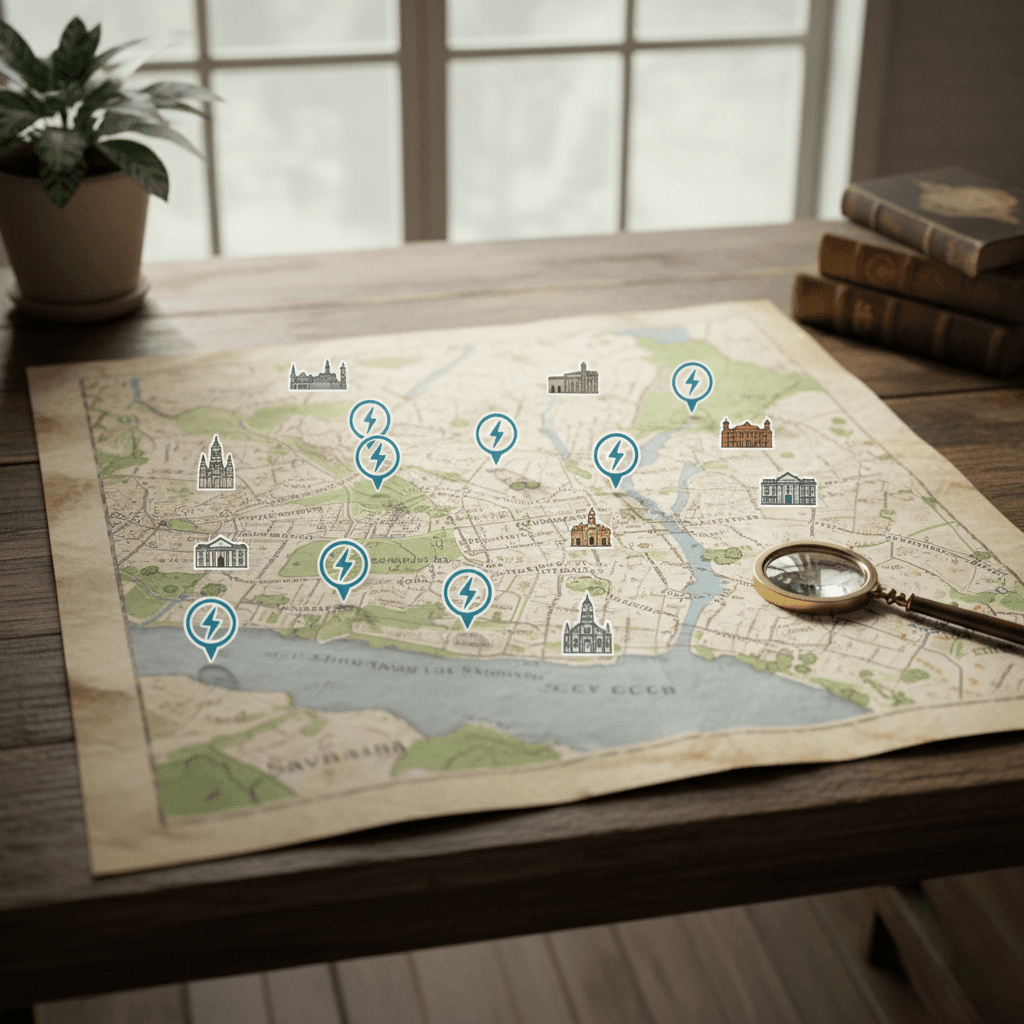
Key Colorado EV fast‑charging corridors
Major routes where you can realistically road‑trip an EV today, plus what to watch for.
| Corridor | Typical coverage today | Best for | Common watch‑outs |
|---|---|---|---|
| I‑25 (New Mexico–Wyoming line) | Frequent fast chargers from Pueblo through Colorado Springs, Denver, and Fort Collins; thinner but growing north and south of metro areas. | Daily commuting, Denver–Colorado Springs–Fort Collins trips, through‑state travel. | Busy stations at peak times; a few longer gaps north of Fort Collins and south of Pueblo. |
| I‑70 (Denver–Utah line) | Robust coverage from Denver into the mountains (Golden to Glenwood Springs); expanding further west toward Grand Junction and the Utah border. | Ski trips, mountain weekends, cross‑state drives. | Weather‑related closures, heavy ski‑weekend traffic, and dependence on a few key hubs. |
| US‑50 / US‑285 | Select DC fast chargers in hub towns; more Level 2 at civic buildings and lodgings. | Scenic mountain routes, access to Salida, Buena Vista, Gunnison, Montrose. | Longer distances between fast chargers; you may rely on overnight Level 2. |
| Eastern Plains corridors | Fast chargers mainly at interstate junctions and larger towns; coverage still patchy. | Cross‑country drives, regional work trips. | Single‑station towns; always have a Plan B and extra range buffer. |
Always check your car’s nav or a charging app for the latest locations and outages before a long trip.
Good news for ski‑country drivers
Best apps and tools to navigate Colorado’s charging network
A strong charging network only helps if you can actually find working stations with the right connector. In Colorado, you’ll want a mix of automaker apps, independent charging apps, and good old‑fashioned in‑car navigation to keep your trips smooth.
Essential tools to find Colorado EV chargers
Combine at least two sources for the most reliable picture
Your car’s built‑in navigation
Most modern EVs can:
- Show compatible stations along your route.
- Estimate arrival state of charge considering hills and weather.
- Precondition the battery before DC fast charging.
On Colorado’s steep grades and in winter cold, that last feature can make a big difference in charging speed.
Crowdsourced apps (PlugShare, A Better Routeplanner)
PlugShare is invaluable for Colorado because drivers report:
- Real‑world reliability of individual stations.
- Photos, tips about tricky parking or access.
- Nearby food, restrooms, and lodging.
Tools like A Better Routeplanner (ABRP) let you simulate trips across I‑70 or over remote passes with detailed energy modeling.
Network & retail apps
Apps from major networks and retailers, like Electrify America, EVgo, ChargePoint, and some grocery and hotel chains, let you:
- Start and stop sessions without swiping a card.
- See pricing and current availability.
- Save favorite locations for regular use.
Set “backup” chargers
What does it cost to charge an EV in Colorado?
Colorado’s electricity prices are middle‑of‑the‑pack nationally, and so are public charging costs. Level 2 public charging often runs a few dollars per hour, while DC fast charging is typically priced per kWh or per minute depending on the operator and your membership level.
Public charging costs
- Level 2 (240V): Often $1–$3 per hour in Colorado, which might add 15–30 miles of range per hour depending on your car.
- DC fast charging: Commonly around $0.25–$0.60 per kWh, or time‑based pricing that works out similarly. A 60 kWh top‑up might run $15–$30.
- Network memberships: Many providers offer lower per‑kWh rates or idle‑fee forgiveness in exchange for a monthly fee.
Home charging costs
- Standard residential rates: Even at average Colorado electricity prices, fully charging a midsize EV battery at home often costs less than a tank of gas.
- Time‑of‑use plans: Some utilities offer cheaper overnight rates; scheduling charging can significantly cut your cost per mile.
- Solar owners: If you have rooftop solar, your effective cost to charge at home can be far below public stations, especially over the life of the vehicle.
Watch for idle fees at busy sites
Planning Colorado road trips in an EV
Road‑tripping an EV in Colorado is absolutely doable in 2026, you just need to respect two things: terrain and temperature. Climbing to 10,000‑plus feet on I‑70 or heading into a surprise cold snap can eat into your range faster than you might expect.
Checklist for a smooth Colorado EV road trip
1. Model your route with elevation
Use your car’s navigation or a planner like A Better Routeplanner to preview energy use over mountain passes. Don’t assume flat‑land highway range applies to the Rockies.
2. Add extra buffer in winter
In sub‑freezing weather, plan to arrive at fast chargers with at least 15–20% remaining rather than pushing to single digits. Cabin heat and cold batteries both reduce range.
3. Target reliable hub stations
For I‑70 trips, aim for well‑developed charging hubs in places like Golden, Idaho Springs, Frisco/Silverthorne, and Glenwood Springs, which often have multiple fast‑charging stalls.
4. Book lodging with Level 2 charging
An overnight Level 2 charge at a hotel or rental home can save a daytime fast‑charging stop and gives you flexibility if a public charger is down or busy.
5. Confirm rural stations before you go
On routes across the Eastern Plains, Western Slope, or southern Colorado, check recent user check‑ins in PlugShare or your network app to confirm that single‑station towns are truly online.
6. Think about towing and roof boxes
If you’re towing a small trailer or using a cargo box for ski gear, you’ll use more energy. Build in additional buffer and consider stopping one charger earlier than you would otherwise.
Cold‑weather fast charging reality
Balancing home and public charging in Colorado
For most Colorado drivers, the ideal strategy is to treat home charging as the default and the public network as a safety net and road‑trip enabler. That’s especially true if you live along the Front Range and mostly commute or run errands. Even a modest Level 2 home charger can easily cover typical weekly mileage.
When home charging does the heavy lifting
- You have a driveway or dedicated parking spot where you can install a Level 2 charger.
- Your daily driving is under 60–80 miles, typical for Denver‑area commutes.
- You’re comfortable planning ahead for mountain trips a few times a year.
In this scenario, public chargers are mainly for road trips and the occasional top‑off while shopping.
When you’ll lean on the public network
- You live in an apartment or condo without dedicated parking or wiring for EV charging.
- Your job involves irregular routes across the metro or into rural areas.
- You sometimes park on the street in older neighborhoods.
Here, the growing public network, particularly in Denver, Boulder, and Colorado Springs, can still make EV ownership workable, but you’ll want to learn where the most reliable stations are in your daily orbit.
Thinking about a used EV?
Buying a used EV for Colorado’s charging reality
Colorado’s electric car charging network makes used EVs more viable every year, but not every model is equally suited to steep grades, cold temperatures, and long gaps between chargers. When you’re shopping used, especially if you’re coming from gasoline, you want a realistic picture of usable range, charging speed, and connector compatibility.
Key questions to ask before you buy a used EV in Colorado
Match the car to the network, not the other way around
Real‑world winter range
Ask how far the car can go on I‑25 or I‑70 on a cold day, not just the EPA number. A 250‑mile rating might translate to 150–180 miles heading uphill with skis and passengers.
DC fast‑charging speed
Look at the vehicle’s maximum DC fast‑charge rate and, more importantly, how long it sustains high power. Faster charging can shrink your stop from 45 minutes to 25 at busy I‑70 hubs.
Connector and adapter support
Most newer models in 2026 are moving to the NACS (Tesla‑style) connector, while older ones may rely on CCS. Understand what adapter support you’ll have for using Tesla Superchargers and other networks in Colorado.
How Recharged can help
Ready to find your next EV?
Browse VehiclesFrequently asked questions about Colorado’s EV charging network
Colorado EV charging network FAQ
Bottom line: How ready is Colorado for EV drivers?
Colorado isn’t perfect yet, there are still stretches of highway and rural regions where you’ll plan carefully, but the state has moved into the top tier nationally for public charging access. For many households along the Front Range, an EV is now just as practical as a gasoline car for daily driving, and far more pleasant on long mountain descents where regenerative braking shines.
If you’re thinking about a used EV, the question to ask is no longer “Will I be able to charge in Colorado?” but “Which EV best fits the way I use Colorado’s charging network?” That’s exactly where a transparent battery health report, honest range expectations, and knowledgeable guidance matter most. Recharged was built to give you that clarity, from first question to final signature, so you can enjoy the state’s growing EV infrastructure instead of worrying about it.