If you’re eyeing a Chevy Equinox EV as a family hauler, there are two questions you probably care about most: how much it can tow and how far it can go on a charge. The good news is that Chevy’s Ultium‑based crossover delivers solid range for daily driving and light‑duty towing, but it’s not a heavy hauler, and your planning matters.
Quick answer
Chevy Equinox EV towing and range at a glance
Equinox EV key towing and range numbers
Those headline figures are helpful, but they don’t tell the whole story. To decide whether an Equinox EV fits your lifestyle, you need to understand how Chevy arrives at that 1,500‑lb tow rating, what equipment is required, and how range changes when you’re towing a small camper, jet skis, or a utility trailer.
Official Chevy Equinox EV towing capacity by trim
Chevrolet keeps things simple with the Equinox EV: no matter which trim or drivetrain you choose, the maximum rated towing capacity is 1,500 pounds when the vehicle is properly equipped with the correct hitch hardware and wiring. That’s squarely in the “light‑duty” category, think compact campers, small boats, and utility trailers, not big travel trailers or car haulers.
Equinox EV towing capacity by trim and drivetrain
All current Chevy Equinox EV configurations share the same 1,500‑pound tow rating when properly equipped.
| Model year | Trim | Drivetrain | Max rated towing |
|---|---|---|---|
| 2025+ | LT | FWD single motor | 1,500 lb |
| 2025+ | LT | eAWD dual motor | 1,500 lb |
| 2025+ | RS | FWD single motor | 1,500 lb |
| 2025+ | RS | eAWD dual motor | 1,500 lb |
Always confirm the exact tow rating and equipment on the specific vehicle you’re buying or driving.
Hitch hardware is not optional
You’ll also want to watch the fine print around tongue weight, the downward force the trailer puts on the hitch. While Chevy hasn’t made the tongue‑weight spec as prominent as the tow rating, a common rule of thumb is to keep tongue weight around 10% of the trailer’s total weight, and never exceed the hitch or vehicle’s labeled limits.
Chevy Equinox EV range estimates: FWD vs AWD
Range is where the Equinox EV quietly punches above its weight. All current versions in the U.S. use Chevy’s 85 kWh Ultium battery pack, but the official range varies slightly by drive type and wheels. In broad terms, front‑wheel‑drive trims get the longest EPA range, while all‑wheel‑drive versions sacrifice some miles for extra traction and power.
Typical Equinox EV EPA range by configuration
Exact numbers vary by wheel size and trim, but these are the ballparks you’ll see on window stickers.
FWD (single‑motor)
Approx. EPA range: 319 miles in many LT/RS FWD configurations with 19‑inch wheels.
Chevy’s own numbers and dealer literature consistently show Equinox EV FWD trims in the low‑to‑mid‑300‑mile range, depending on options.
eAWD (dual‑motor)
Approx. EPA range: 280–285 miles is typical for all‑wheel‑drive versions.
The second motor adds performance and foul‑weather confidence, but draws a bit more energy on the highway.
Real‑world testing
Independent highway range tests have seen well‑specced Equinox EV trims meet or even slightly beat their EPA ratings in mild weather at around 70 mph.
Cold temperatures, big wheels, and aggressive driving will all pull that number down.
Think in “usable range,” not brochure range
How towing changes your Equinox EV’s range
Any vehicle, gas, diesel, or electric, loses efficiency when you tow. With EVs, you notice it more because you’re watching a single big number: miles of range. The Equinox EV is no exception. While Chevy doesn’t publish a separate “towing range,” owner tests with similar Ultium SUVs and crossovers give us a realistic window.
- Light, low‑profile loads (e.g., small utility trailer, pair of e‑bikes): often 20–30% range loss at moderate highway speeds.
- Moderate loads and small campers: plan for roughly 30–40% less range, especially if the trailer sits high in the airflow.
- Boxy campers/jetski trailers at 70+ mph or in strong headwinds: it’s possible to see 40–50% (or more) reduction in range.
Example: Light utility trailer
Say you own an Equinox EV FWD rated around 319 miles. Towing a 1,000‑lb open utility trailer with lawn gear or home‑improvement supplies at 60–65 mph, you might see usable highway range drop into the 190–230‑mile ballpark in mild weather.
Example: Small camping trailer
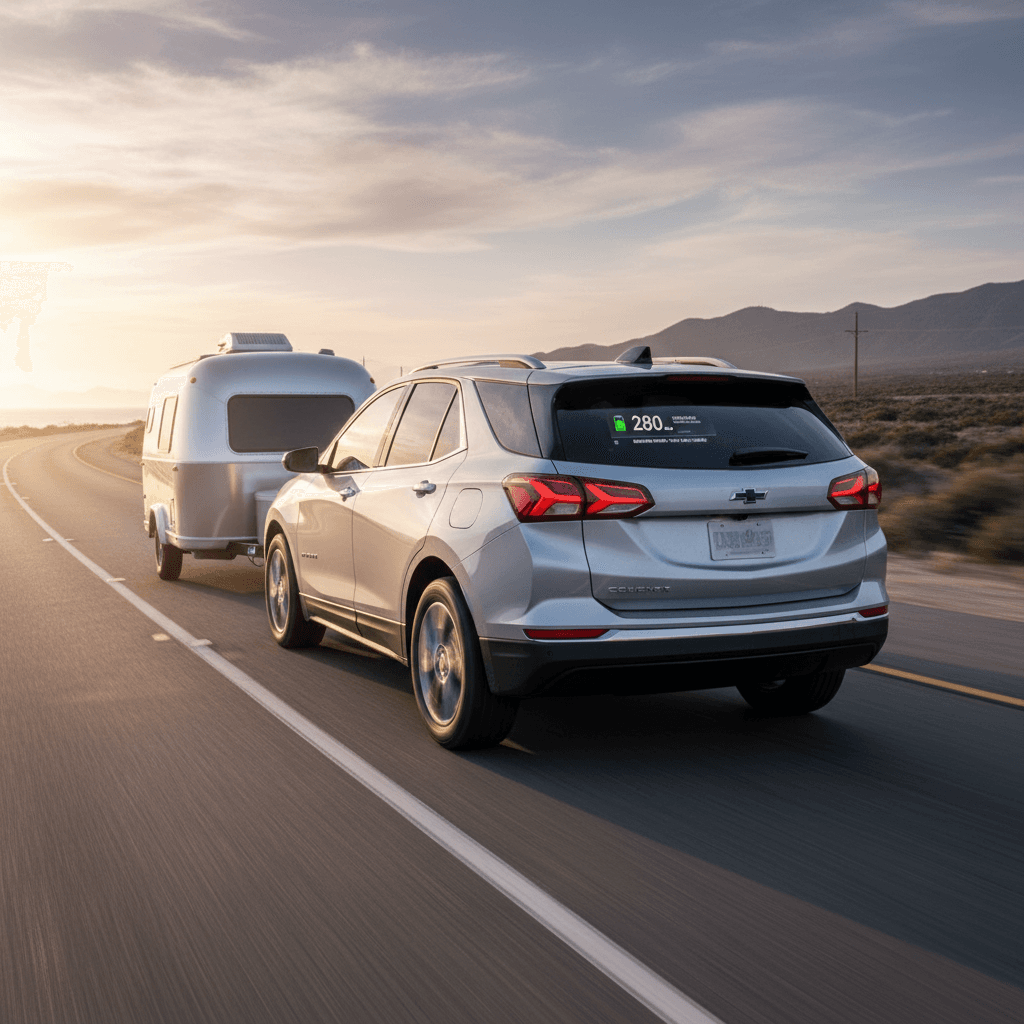
Hook up a 1,400‑lb teardrop camper with a higher frontal area and head out at 70 mph, and you could be looking at 150–190 usable highway miles between charges on that same FWD Equinox EV.
Don’t guess, watch your consumption
Payload, roof racks, and real‑world efficiency
Towing is only part of the story. How you load the Equinox EV itself, and what you hang on the roof, also affects range. The Ultium platform offers generous interior space and a maximum cargo volume around 57 cubic feet, but weight and aerodynamics still matter.
Three range killers beyond the trailer
Even if you’re not towing at the limit, these details add up.
Payload & passengers
Five adults, gear for a long weekend, and a full cooler can easily add 600–800 pounds of payload. Extra weight mostly hurts you in stop‑and‑go driving and on hills.
Roof boxes & racks
Even an empty roof box, ski rack, or kayak can shave 10–20% off highway range. Combine that with a trailer and you’re compounding aerodynamic drag.
Weather & climate control
Cold weather, heavy rain, or strong headwinds all reduce efficiency. Running cabin heat or defrost draws power from the same battery that moves the car.
Easy wins for better range
Charging speeds and road‑trip practicality
If you’re planning to tow with an Equinox EV, charging speed matters just as much as range. Fortunately, Chevy gave this crossover competitive numbers: roughly 11.5 kW AC charging on most trims (up to 19.2 kW on some higher‑end versions) and up to about 150 kW on DC fast chargers, using the NACS connector that’s rapidly becoming the North American standard.
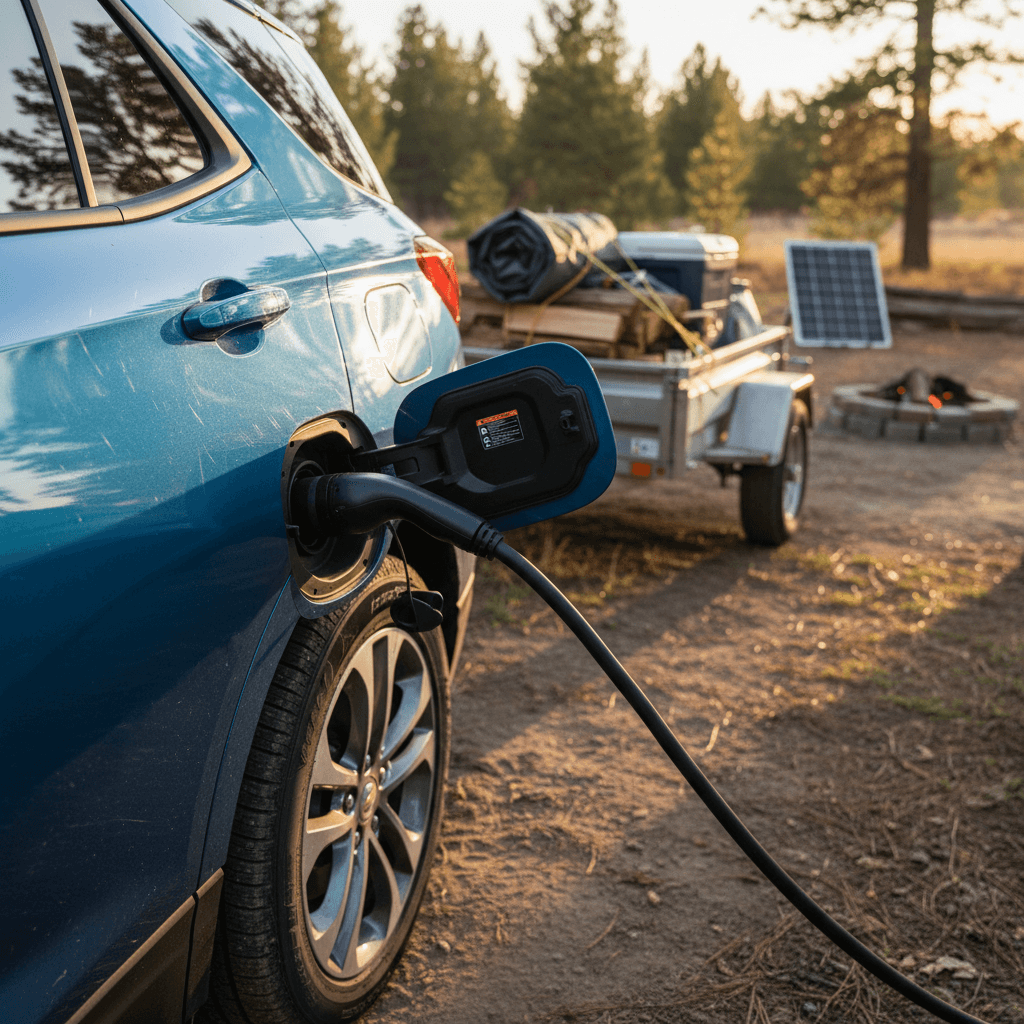
- Plan your first towing leg a bit shorter than the EPA range would suggest, then adjust based on what you actually see on the energy screen.
- When practical, charge without the trailer attached. It’s easier to maneuver, and you can sometimes park closer to the charger for better cable reach.
- Target charging from roughly 10–15% up to 60–80% on road trips. The charging curve tapers at higher states of charge, so shallow, more frequent stops are often faster overall.
- Leverage the Equinox EV’s built‑in route planning and energy prediction, but sanity‑check it when you’re towing by leaving extra margin to the next charger.
Think like a logistics planner
Setting up your Equinox EV for towing safely
EVs deliver instant torque, which makes them feel strong off the line even with a trailer. That doesn’t mean you should hook up anything with a hitch coupler and go. To keep your Equinox EV happy, and to keep your warranty intact, you want the right factory or dealer‑installed equipment and a few smart habits.
Equinox EV towing setup checklist
1. Confirm trailering package or wiring
Check the build sheet or window sticker for trailering provisions and a 4‑pin connector. If the vehicle didn’t ship with them, talk to a Chevy dealer or trusted shop about compatible hitch and wiring options.
2. Match trailer weight to the 1,500‑lb limit
Weigh your trailer and gear, or at least use manufacturer specs and a scale for heavier setups. Stay comfortably under the 1,500‑lb rating, especially if you’ll be driving in mountains or extreme heat.
3. Balance tongue weight and load
Aim for about 10% tongue weight, load heavy items low and over the trailer axle, and avoid overhanging weight at the very back. Poorly distributed loads hurt stability and can stress the hitch and rear suspension.
4. Use the right hitch class and ball height
Make sure your receiver, ball mount, and ball rating meet or exceed the trailer’s weight. Set the ball height so the trailer tows level to slightly nose‑down.
5. Check braking and lighting
Verify lights before every trip. For trailers with their own brakes, make sure they’re functioning correctly and adjusted per the manufacturer’s instructions.
6. Adapt your driving style
Increase following distance, brake earlier, and keep speeds conservative, especially in crosswinds or heavy rain. The Equinox EV has strong regen, but on long descents with a trailer, don’t rely on regen alone; use friction brakes as needed to stay in control.
Warranty and aftermarket hitches
Used Equinox EV: Towing and range checks before you buy
The Equinox EV is already showing up in the used market, often with relatively low mileage but very different usage histories. Some have never towed a thing; others may have spent summers dragging small campers around the country. If you’re shopping used, it pays to ask a few pointed questions and look closely at battery health.
Questions to ask the seller
- “Has this Equinox EV been used for towing? How often and roughly how heavy?”
- “Did you regularly DC fast charge on long trips, or mostly charge at home?”
- “Have you ever received warnings related to the high‑voltage battery or drive unit?”
Honest answers here help you understand how hard the battery and drivetrain have been worked.
Why battery health matters for towing
Heavy towing and frequent fast charging don’t automatically “ruin” an EV battery, but they do add stress. A pack that’s lost noticeable capacity will have less real‑world range, which you’ll feel even more once you hitch a trailer.
How Recharged helps on the used side
Towing & range checklist for a used Equinox EV
1. Review the battery health report
Look for any significant deviation from expected capacity for the vehicle’s age and mileage. A healthy Ultium pack should still support the EPA‑style ranges (adjusted for accessories and weather) within a reasonable margin.
2. Inspect hitch and rear structure
If the vehicle has a hitch, check for signs of overloading: bent receiver, damaged bumper beam, or stress at mounting points. Excessive rust or poor welds are red flags.
3. Test‑drive at highway speed
Watch efficiency at a steady 65–70 mph without a trailer. If consumption seems unusually high versus published figures and conditions are mild, dig deeper into tire choice, alignment, or possible aerodynamic add‑ons.
4. Confirm charging behavior
On a DC fast charger, verify that the Equinox EV ramps up to an expected rate (conditions permitting) and doesn’t quickly throttle due to thermal limits at moderate states of charge.
FAQ: Chevy Equinox EV towing capacity and range
Frequently asked questions
Bottom line: Is the Equinox EV right for towing and range needs?
The Chevy Equinox EV isn’t a half‑ton truck, but that’s not the job it was built for. It’s a compact electric SUV that delivers class‑competitive range, a useful 1,500‑lb tow rating, and the comfort and tech most families want. If your towing is mostly small trailers, yard projects, or the occasional minimalist camper trip, it can absolutely work, especially if you’re willing to plan routes and charging stops with a bit more care.
If you’re exploring a used Equinox EV, or comparing it with other electric SUVs for towing and road‑trip duty, Recharged can help you line up the numbers with your real life. Our Recharged Score battery health diagnostics, fair‑market pricing, and EV‑specialist support are all designed to make it easier to find the right electric SUV, and know exactly what kind of towing capacity and range you’re getting before you sign anything.