If you’re looking at a used Chevy Bolt EV, you’ve probably heard two competing stories: on paper, the Chevy Bolt EV safety rating and crash test results are excellent; in the headlines, battery recalls and fire risks loom large. This guide cuts through the noise so you can understand how the Bolt actually performs in a crash, what the official scores mean, and how to shop confidently for a used example.
TL;DR – Is the Bolt EV safe?
Chevy Bolt EV safety overview
The Bolt EV arrived for the 2017 model year as one of the first affordable long‑range EVs. From a safety standpoint, it was engineered less like an econobox and more like a compact premium car: strong crash structure, lots of airbags, and a very low center of gravity thanks to the battery pack in the floor. That layout helps the Bolt resist rollovers and gives it stable, predictable behavior in emergency maneuvers.
Chevy Bolt EV safety at a glance
Model years to focus on
Official crash test ratings: IIHS & NHTSA
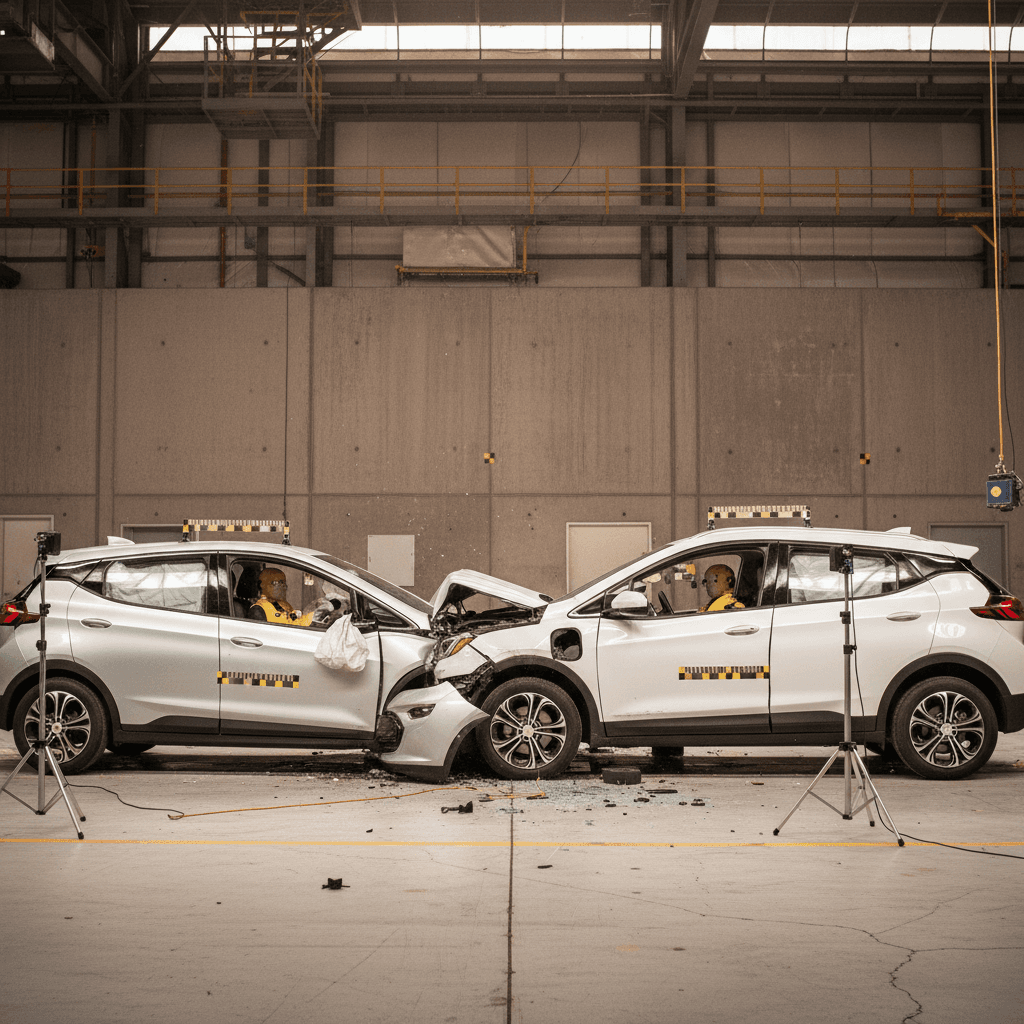
Crash tests are the boring, unglamorous part of car shopping, until you really need them. Two organizations do the heavy lifting in the U.S.: the federal government’s NHTSA 5‑Star Safety Ratings program and the independent IIHS (Insurance Institute for Highway Safety). The Chevy Bolt EV has been through both labs’ wringers.
Chevy Bolt EV crash test scorecard (typical results by test type)
Exact scores vary slightly by model year and testing body, but this table captures the general pattern many Bolt EVs and EUVs follow in official crash testing.
| Test & Category | Typical Result | What It Means For You |
|---|---|---|
| NHTSA overall rating | 5 stars (many years) | Strong protection in a mix of frontal, side, and rollover tests. |
| NHTSA frontal crash | 4–5 stars | Well‑managed occupant forces in a straight‑on collision. |
| NHTSA side crash | 5 stars | Excellent protection in T‑bone and side‑pole scenarios. |
| NHTSA rollover resistance | 4 stars, low rollover risk | EV battery in the floor keeps the car planted. |
| IIHS moderate overlap front | Good | Cabin holds its shape; low risk of serious injury. |
| IIHS side impact (earlier test) | Good | Performs well when struck from the side by a smaller vehicle. |
| IIHS roof strength | Good | Roof resists crushing if the car does roll. |
| IIHS head restraints & seats | Good | Seats and headrests help reduce whiplash in rear‑end crashes. |
Always verify the exact year and body style you’re considering, but this gives you a realistic picture of how the Bolt performs.
Watch the fine print by model year
Bolt EV vs. Bolt EUV: any safety differences?
Bolt EV (hatchback)
- Sold from 2017–2023 as a compact 5‑door hatch.
- Sits a little lower, slightly lighter than the EUV.
- Crash performance is very good; think safe compact car, not flimsy subcompact.
- Most cars share the same battery‑pack‑in‑the‑floor, low‑rollover‑risk layout.
Bolt EUV (taller crossover)
- Introduced for 2022 with a slightly longer body and more rear legroom.
- Similar safety hardware and structure philosophy, just stretched.
- Available with more advanced driver assistance, including GM’s Super Cruise on some trims.
- Crash behavior is broadly similar; in the real world, they protect occupants in very similar ways.
For a shopper, the safety story between Bolt EV and Bolt EUV is essentially a tie. If you want a slightly roomier back seat and the possibility of hands‑free highway assist, the EUV is attractive. If you want the smallest, nimblest package and don’t need the extra inch of ride height, the standard Bolt EV is just as reassuring structurally.
Key Chevy Bolt EV safety features
Core safety tech found on many Bolt EVs
Exact equipment varies by year and trim, but these are the headline items to look for when you shop.
Airbag coverage
Most Bolt EVs include:
- Front airbags for driver and passenger
- Front side‑impact airbags
- Side curtain airbags for both rows
- Driver’s knee airbag on many models
Stability & traction control
Electronic stability control, traction control and anti‑lock brakes are standard. The low center of gravity from the battery pack makes these systems more effective at keeping the car planted.
Advanced driver assistance
Depending on model year and package, look for:
- Automatic emergency braking
- Forward collision alert
- Lane keep assist with lane departure warning
- Rear cross‑traffic alert
- Blind‑spot monitoring
Child seat compatibility
The Bolt includes LATCH anchors on the outboard rear seats and top tethers for all three positions. It’s not a big car, but most common rear‑facing seats fit behind an average‑height driver.
Pedestrian protection
The short front overhang and EV‑specific crumple zone help absorb energy in front impacts, which also benefits pedestrians in urban, low‑speed incidents.
Structural crash engineering
GM designed the Bolt around the battery pack, with reinforced sills, a stiff safety cage and dedicated crash load paths to keep the cabin intact in a variety of impacts.
Look for the active safety bundle
Battery fire recalls and what they really mean for safety
We can’t talk about Chevy Bolt EV safety without acknowledging the elephant in the room: the battery recalls. Several earlier Bolts were recalled for a risk of battery fires tied to rare manufacturing defects. GM ultimately replaced or repaired battery packs and updated software to reduce the chance of an over‑charging event.
- The recall centered on internal battery defects, not crash‑induced fires.
- The fix typically involved new battery modules or an entire new pack, plus updated software limits.
- Post‑repair, most Bolts gained a fresh pack with restored or improved usable range.
- A properly remedied Bolt is actually a better ownership prospect than a pre‑recall car that somehow escaped the fix.
Non‑negotiable: verify recall completion
Real‑world safety: how the Bolt EV behaves in a crash
Crash test dummies are useful, but what most drivers care about is the ugly, real‑world stuff: distracted drivers in crossovers, rush‑hour pileups, someone blowing a red light. In these scenarios, the Bolt EV behaves like a well‑engineered compact car with a structural advantage many gas cars don’t have: the heavy battery is low and between the axles, not hanging off the front.
Frontal & offset crashes
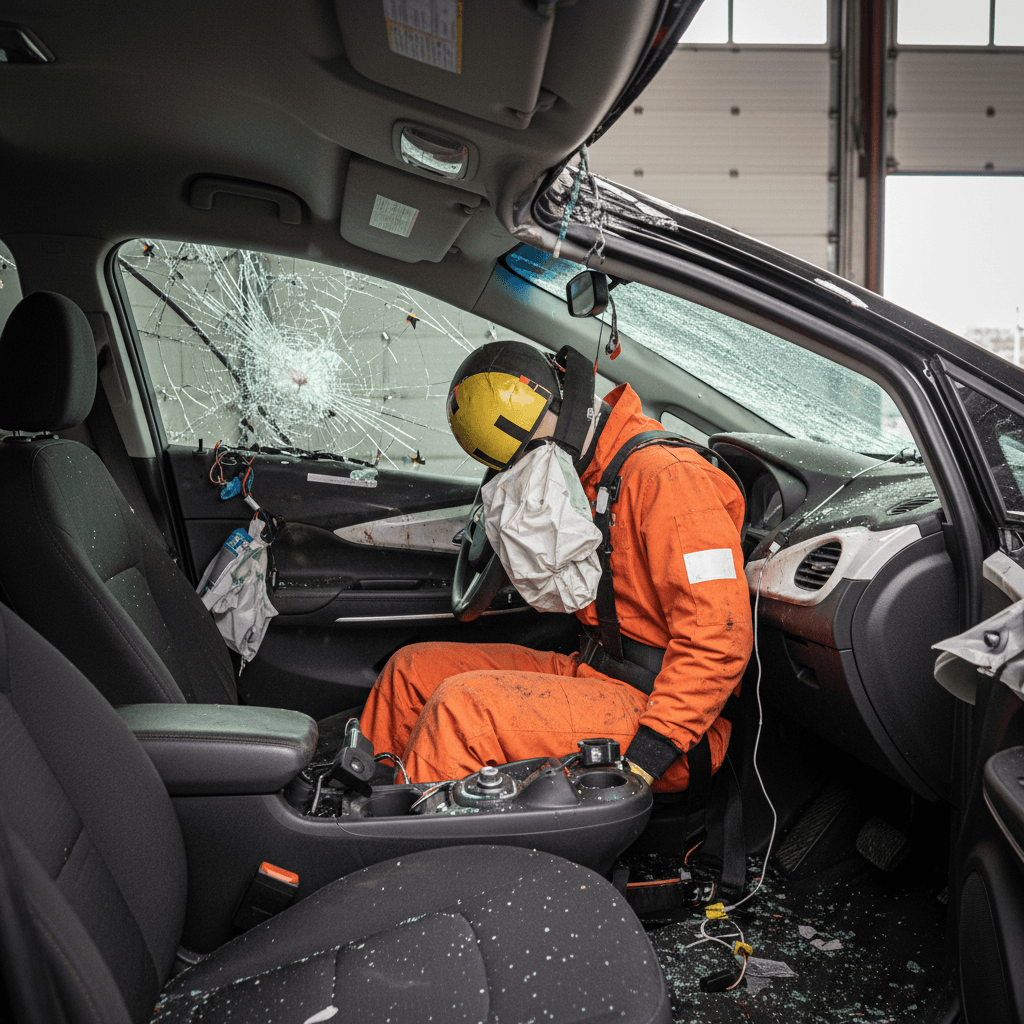
In moderate frontal impacts, the Bolt’s front structure collapses in a controlled way, keeping major deformation away from the passenger cabin. The steering wheel and pedals remain relatively stable, which reduces the risk of leg and foot injuries. Airbags deploy in layers, front, side and curtain, to cocoon occupants.
Side impacts & poles
Side impacts are historically deadly for small cars. Here, the Bolt benefits from strong door structures, robust B‑pillars and side curtain airbags that stay inflated long enough to cover secondary impacts. In many lab scenarios, the cabin doesn’t collapse around the dummy, which means a greater survival space in a real crash.
What about being hit by a truck or SUV?
Used Chevy Bolt EV safety checklist
If you’re shopping used, crash test charts only get you so far. The real question is whether the specific Bolt in front of you is still as safe as it was when it left the lab. Use this checklist to separate the keepers from the question marks.
Inspecting a used Chevy Bolt EV for safety
1. Confirm all recalls are completed
Ask for a printed service record or screenshot from a GM dealer portal showing that battery and other safety‑related recalls are closed. On a marketplace like Recharged, this should be documented as part of the listing and vehicle report.
2. Check for major accident history
Pull a vehicle history report and look for structural damage, airbag deployment or salvage titles. A lightly repaired bumper scrape is one thing; a prior total loss or frame repair is another.
3. Inspect airbags & warning lights
When you start the car, the airbag and ABS lights should come on briefly, then go out. Any persistent warning lights in the cluster deserve a professional inspection before you sign anything.
4. Examine body panels and gaps
Uneven gaps, mismatched paint or doors that don’t close cleanly can signal previous crash damage. On the Bolt, pay particular attention to the front rails, A‑pillars and door sills.
5. Test all safety tech
On a test drive, verify that features like lane keep assist, forward collision alert, and blind‑spot monitoring behave as expected. If the car has cameras, check image quality and parking guide lines.
6. Look at tires and brakes
Bald tires and neglected brakes aren’t just maintenance issues; they’re active safety problems. The best chassis and airbags in the world can’t overcome worn‑out contact patches.
How Recharged evaluates Chevy Bolt EV safety
Because Recharged focuses on used EVs, we treat safety as more than a line item. When a Chevy Bolt EV or EUV comes into our ecosystem, it’s evaluated not just as a used car, but as an aging, high‑voltage machine that has to protect a family in 2026 the way it did on launch day.
What Recharged looks at on every Bolt
Beyond a quick test drive, our process digs into the details that matter for crash safety and long‑term confidence.
Recharged Score & history
Every vehicle gets a Recharged Score Report that includes:
- Accident and title history checks
- Verification of open or completed recalls
- Odometer and usage patterns that may affect wear
Battery health & safety
Our diagnostics look at pack health and charging behavior. That doesn’t just tell you about range; it also helps flag any abnormal patterns that could be safety‑relevant over time.
Structural & safety inspection
EV‑specialist technicians inspect for prior structural repairs, crash damage, underbody corrosion around the battery, and the proper operation of safety systems and warning lights.
Nationwide delivery without the gamble
Because the inspection and reporting happen up front, you’re not rolling the dice on a sight‑unseen purchase. Whether the car is local or shipped to your driveway, you know what you’re getting.
Financing with clarity
Recharged can help you finance a used Bolt EV with the true cost of ownership in mind, so you’re not stretching for a car that might hide an expensive safety or repair issue.
Human help from EV nerds
If you’re not sure how to weigh crash test scores against recalls, our EV specialists can walk you through the tradeoffs and help you compare a Bolt to other safe used EV options.
Ready to find your next EV?
Browse VehiclesChevy Bolt EV safety & crash test FAQ
Common questions about Chevy Bolt EV crash safety
Bottom line: is the Chevy Bolt EV a safe buy?
The Chevy Bolt EV is a case study in contrasts. If you only remember the word “recall,” you might assume it’s a rolling hazard. If you only look at the lab data, you’d call it one of the better‑engineered compact cars of its era. The truth, as usual, sits between those extremes: a well‑maintained, recall‑repaired Bolt EV or EUV is a structurally sound, stable, and thoroughly modern small EV with crash performance that matches or beats many gas‑powered peers.
If you’re shopping for a used Bolt, let the crash test scores give you confidence, but don’t stop there. Demand proof of completed battery recalls, read the vehicle history report closely, and, if you’d rather not do all that homework yourself, consider buying through a platform like Recharged that bakes safety, battery health and transparency into every listing. Do that, and the Bolt stops being a headline and becomes what it should have been all along: a safe, sensible electric car that happens to be fun to drive.