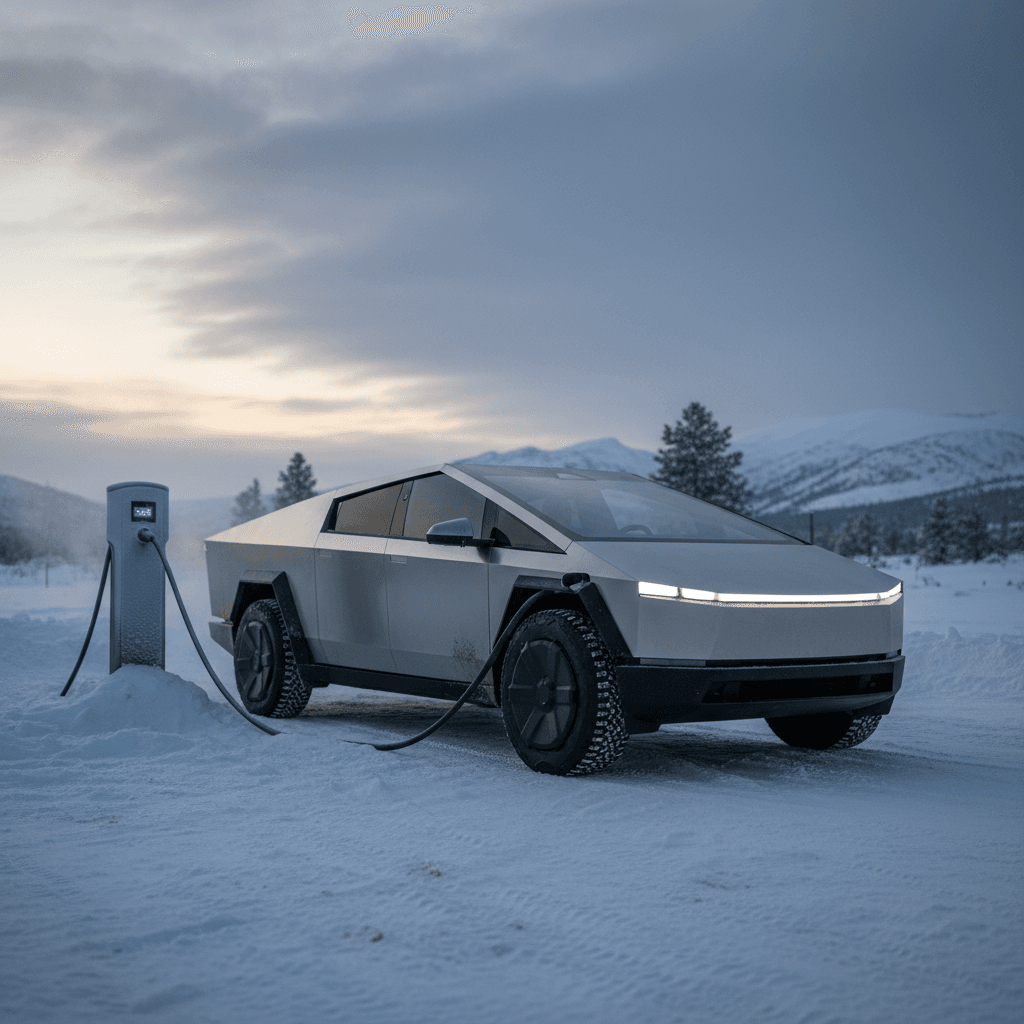
If you’re eyeing a Tesla Cybertruck and you live where winters are real, think snow, ice, and weeks below freezing, you’re right to ask about Tesla Cybertruck range in cold weather. EPA window-sticker numbers look impressive, but once temperatures drop, range, charging speed, and towing expectations all need to be recalibrated.
Quick take
Cybertruck range ratings vs. real-world winter driving
Let’s start with what Tesla claims, then talk about what Cybertruck owners actually see when the mercury drops.
Tesla Cybertruck EPA-rated range (no range extender)
Approximate EPA combined range ratings for key Cybertruck trims without the optional range extender pack. Always check Tesla’s configurator for the latest figures, as details can change between model years.
| Trim | Drivetrain | EPA-rated range (mi) | Notes |
|---|---|---|---|
| All-Wheel Drive (AWD) | Dual motor | ~320–340 | Core volume model; around 79 MPGe equivalent efficiency for a large truck |
| Cyberbeast | Tri motor AWD | ~300–320 | Higher performance, slightly lower efficiency |
| Rear-Wheel Drive* | Single motor | 300+ | Announced, then pulled from configurator in late 2025; availability may vary by year |
These are warm-weather laboratory metrics, not what you’ll see on a 15°F commute or ski trip.
EPA range is not a winter promise
Independent highway tests of the dual-motor Cybertruck at steady freeway speeds have already shown real-world range well under the headline EPA figure even in cool (but not frigid) weather. Add in winter temperatures, snow-packed roads, and a loaded bed or trailer, and you should think in terms of a comfortable usable range window, not the maximum sticker number.
Why cold weather cuts Cybertruck range
The Cybertruck has a big battery, on the order of 120+ kWh usable energy, and an 800-volt architecture. That helps with efficiency and fast charging, but the fundamentals of cold-weather physics still apply. Three things conspire against you when temperatures fall:
- Cold batteries are less efficient. Lithium-ion cells can’t accept or deliver energy as easily when they’re cold, so the truck spends energy just warming the pack, and you get fewer miles per kWh until everything is up to temperature.
- Cabin heating is a major energy draw. Unlike a gas truck that uses waste engine heat, the Cybertruck must power electric heaters or a heat pump to keep you comfortable. At 0–20°F, cabin heat can rival the energy used to push the truck down the road at city speeds.
- Winter driving conditions increase drag. Dense cold air, wet or snowy pavement, and winter tires all make the truck work harder. Even if the temperature is only in the 20s, slushy roads and high winds can chew through range.
Heat pump helps, but doesn’t perform miracles
Truck-specific factors matter, too. The Cybertruck’s bluff shape and all-terrain tires cost you aero and rolling efficiency versus a low, slippery sedan. Those penalties are multiplied at highway speeds and in strong headwinds, exactly what you face on many winter road trips.
How much Cybertruck range you’ll likely lose in the cold
No one has a 10,000-truck winter dataset for the Cybertruck yet, but we can combine what we know from independent EV winter studies with early owner reports to create realistic expectations. Broadly, modern EVs tend to retain about 70–85% of rated range in typical winter use and as little as 60% in deep cold with lots of short trips.
Typical EV winter range loss benchmarks
Translating that into Tesla Cybertruck range in cold weather gives you some useful back-of-the-envelope planning numbers:
Approximate Cybertruck AWD winter range scenarios
Rule-of-thumb estimates for an AWD Cybertruck with ~320–340 miles of EPA-rated range, no trailer, and a healthy battery. These are not guarantees but realistic planning numbers for many drivers.
| Conditions | Outside temp | Driving style | Practical usable range |
|---|---|---|---|
| Cool, not harsh | 40–50°F, dry roads | 65–70 mph, moderate HVAC | ~260–290 miles (80–85% of EPA) |
| Typical winter day | 20–30°F, some wind | 65–70 mph, cabin at 68–70°F | ~220–260 miles (70–80% of EPA) |
| Deep cold, longer drive | 0–20°F, dry | 65–70 mph, cabin warm | ~190–230 miles (60–70% of EPA) |
| Deep cold, short trips | 0–20°F, stop-and-go | Lots of preheating & idling | Sometimes under 60% of EPA, especially for many short hops |
Assumes normal driving, not hypermiling, and a mix of highway and city use.
How to build your own “winter range number”
Also remember that state of charge (SoC) matters for fast charging. A Cybertruck that can go ~220 winter miles on a full battery might only give you 150–170 comfortable miles between fast-charging stops if you follow the usual 10–80% charging window.
Winter range when towing or hauling with a Cybertruck
Cold weather is only half the story for a truck buyer. The other half is what happens when you put the Cybertruck to work, towing a camper, snowmobile trailer, or enclosed work trailer when it’s 15°F and gusty.
Unladen Cybertruck in winter
- Expect 70–80% of EPA on typical winter road trips at legal highway speeds.
- Light headwinds, slushy roads, and roof racks will all nibble away at that number.
- On a ski-weekend run, you’re usually planning stops every 150–200 miles anyway for family breaks, which can align nicely with charging.
Cybertruck + trailer in winter
- Gas trucks often see a 25–35% fuel economy hit when towing. EV pickups can easily see 40–60% range loss with large trailers, and more in bitter cold.
- Boxy cargo or RV trailers punish aero; at 70 mph into a winter headwind, your truck sees a much higher "effective" speed.
- It’s not unusual for real-world winter towing range to land near 100–140 miles between fast charges with a big trailer.
Don’t plan winter towing to “zero”
For many owners, that means reframing the Cybertruck as a fantastic winter commuter and adventure truck and a solid, but more planning-intensive, long-distance tow vehicle in the cold. If your life involves routine 300-mile winter towing days, you’ll be making more frequent stops than your gas-truck neighbors.
10 ways to protect Cybertruck range in cold weather
You can’t change the laws of thermodynamics, but you can stack the deck in your favor. Here are practical steps that make a noticeable difference in real winter driving.
Practical ways to stretch Cybertruck winter range
1. Precondition while plugged in
Use the Tesla app to warm the cabin and battery while the Cybertruck is still connected to your home charger. That shifts some of the heavy heating load off the battery and preserves driving range.
2. Favor seat and wheel heaters
Heated seats and steering wheel use much less energy than blasting warm air. Set the cabin a couple of degrees cooler than you would in an ICE truck and let contact heating keep you comfortable.
3. Start with a warm pack
If you park outdoors, short-hop range will look especially bad because the battery never fully warms. Whenever possible, end your day with a DC fast charge or a longer drive so the pack is already warm for the next leg.
4. Use scheduled departure
In the Tesla app, set a daily departure time. The Cybertruck will automatically precondition the battery and cabin using grid power when possible, helping both range and DC fast-charging speed.
5. Keep speeds realistic
Aerodynamic drag climbs with the square of speed. Dropping from 75 mph to 65 mph in winter can claw back a surprising number of miles, especially in a big, square truck like the Cybertruck.
6. Check tire pressures often
Cold air reduces tire pressure. Underinflated tires increase rolling resistance and hurt range. Use the door-jamb spec as your baseline and adjust when a cold snap hits.
7. Travel light when you can
A loaded bed with heavy gear, a rooftop box, or big off-road accessories all take a bite out of winter range. For long trips, remove what you don’t truly need.
8. Avoid unnecessary idling
Using the Cybertruck as a stationary heater for 30 minutes at a time is comfortable, but costly in energy. In deep cold, that can noticeably cut your remaining range.
9. Use eco or chill modes
Teslas’ efficiency-oriented drive modes smooth out throttle response and can gently encourage more efficient driving habits, helpful when traction is low and range is precious.
10. Learn your personal winter baseline
Keep an eye on Wh/mi (or kWh/100 mi) and note what you see at different temperatures. After a few weeks, you’ll know your own Cybertruck’s “at 20°F, I get X miles per charge” reality.
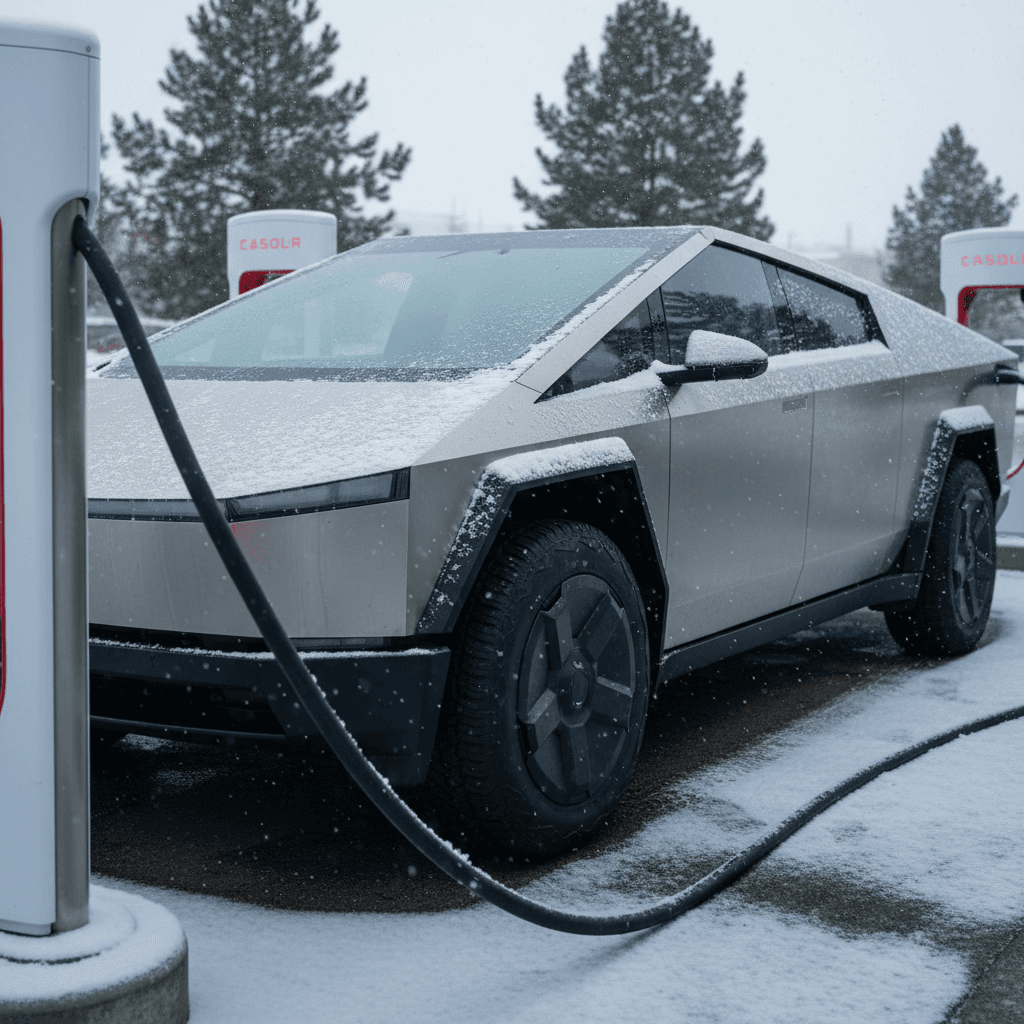
Planning winter trips and charging stops in a Cybertruck
Winter road trips in an electric truck are absolutely doable, you just plan them differently than you would in a V8 pickup. The good news is that Tesla’s Supercharger network and in-car trip planning are among the best tools available for any EV owner.
Smart winter trip planning with a Cybertruck
Use a combination of Tesla’s tools and your own common sense.
Let the truck plan it
Use Tesla’s built-in Trip Planner and navigation. It will estimate arrival state of charge based on temperature, speed, and elevation, then suggest Supercharger stops along the way.
Check charger conditions
In nasty winter weather, verify that your planned Superchargers are online and accessible. Snowdrifts, plows, or closed plazas can complicate access even when the station is technically “up.”
Add a winter buffer
If the in-car nav says you’ll reach a charger with 7% remaining, aim to adjust speed or add a stop so you arrive closer to 15–20%. In winter, a conservative buffer is your friend.
Use breaks to your advantage
If you’re stepping into a Cybertruck from a traditional truck, expect your first couple of winter trips to feel like a learning experience. After that, the rhythm of “drive 150–200 miles, charge while you break, repeat” quickly becomes second nature.
Buying a (used) Cybertruck for cold climates
If you’re considering a Cybertruck as a family hauler or work truck in a northern state, you may be looking hard at the used market to avoid the initial depreciation hit. That’s exactly where a marketplace like Recharged can help you buy with confidence.
What matters most for winter buyers
- Battery health: A healthy high-voltage battery gives you more usable range to start with, which matters a lot once winter subtracts its portion.
- Charging history: Trucks fast-charged hard and run to very low state of charge repeatedly may have more degradation.
- Tire setup: A used Cybertruck with proper winter or all-weather tires is a real plus if you live in the Snow Belt.
How Recharged can help
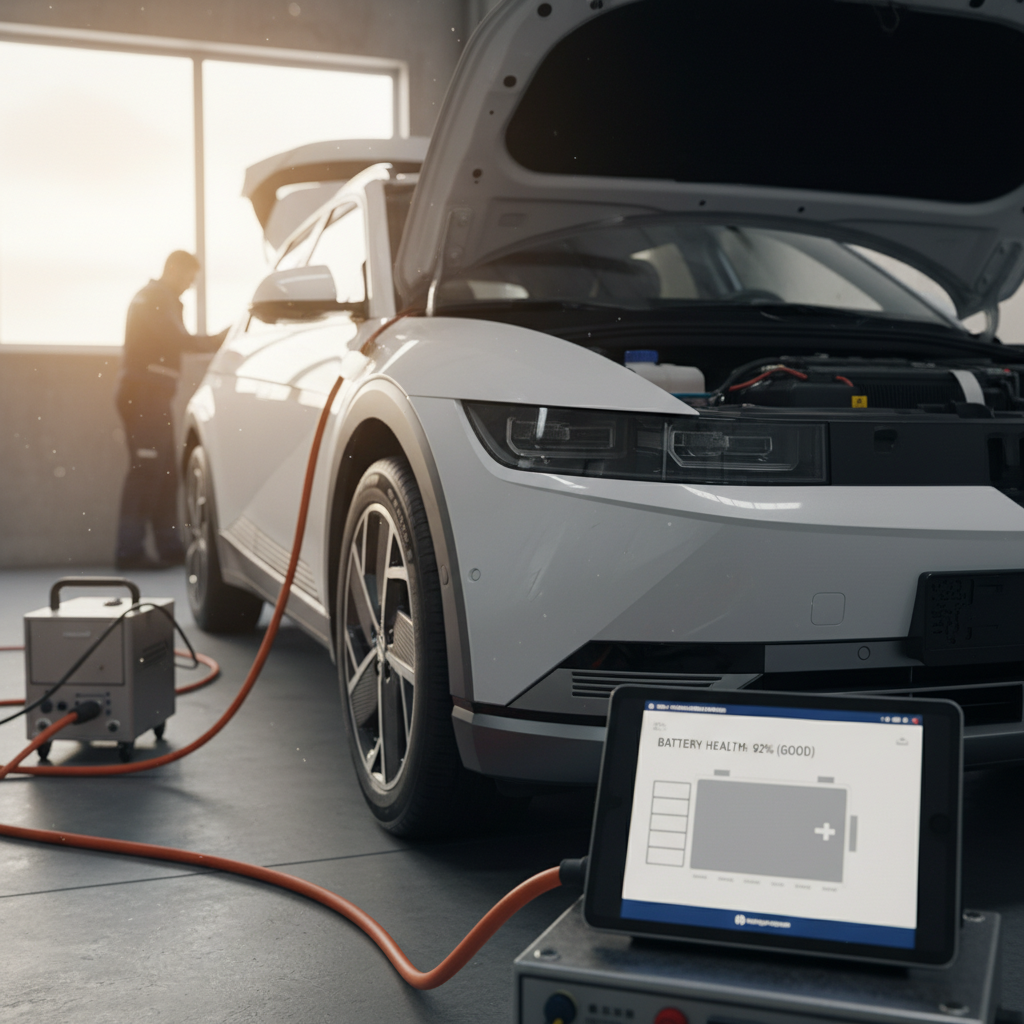
- Every vehicle on Recharged comes with a Recharged Score Report that includes verified battery health diagnostics, so you’re not guessing about your starting range.
- You can compare fair market pricing and financing options side by side for different Cybertruck trims.
- If you’re trading out of a gas truck, Recharged can provide an instant offer or consignment, simplifying the move into your first EV pickup.
Think total winter capability, not just peak range
Tesla Cybertruck cold-weather range FAQ
Common questions about Cybertruck range in cold weather
Bottom line: Is the Cybertruck a good winter truck?
If you’re coming from a gas or diesel pickup, the first thing to internalize is that Tesla Cybertruck range in cold weather will be lower than the EPA label suggests, and towing in winter will demand more planning than you’re used to. But that doesn’t make it a bad winter truck, just a different one.
In return for that planning, you get a vehicle that starts instantly in subzero temps, gives you fine control over traction, and lets you leave home every morning with a “full tank” if you have home charging. For many households, especially those whose winter driving is a mix of commuting, errands, and the occasional mountain trip, the Cybertruck can be a highly capable year-round tool.
If you’re considering a Cybertruck, especially used, for life in a cold climate, focus on battery health, charging access, and realistic winter range expectations. That’s where a transparent marketplace like Recharged, with verified battery diagnostics and expert EV support, can help you choose the right truck for your winter reality, not just your summer dreams.