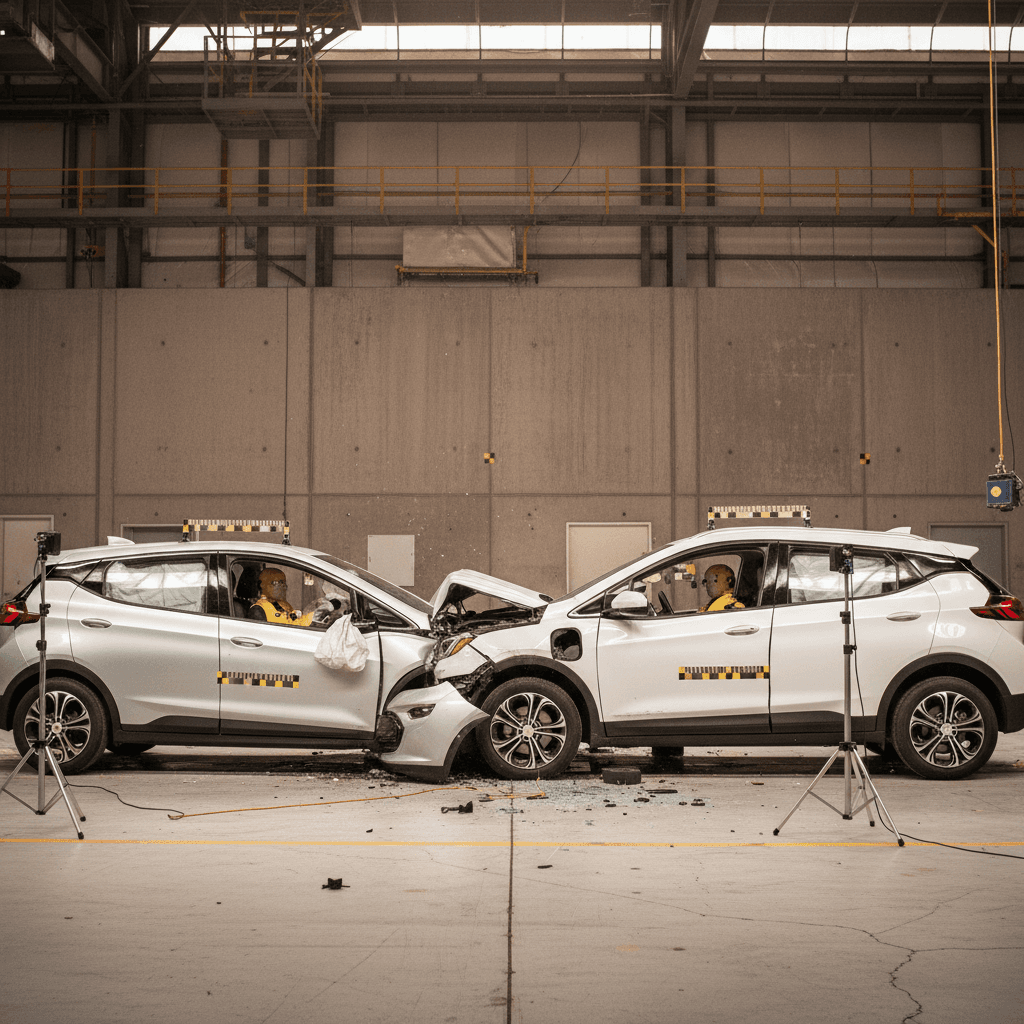
If you’re looking at a Chevy Bolt EUV, you’ve probably heard two very different stories: outstanding crash test scores on one hand, and high-profile battery-fire recalls on the other. This guide pulls together the Chevy Bolt EUV safety rating and crash test data, plus real-world issues, so you can decide, with eyes open, whether this small electric crossover is a safe fit for you or your family.
Quick takeaway
Chevy Bolt EUV safety overview
Chevy Bolt EUV safety snapshot
At a high level, the **Chevy Bolt EUV** blends solid structural crash performance with a deep roster of standard driver-assistance features, especially from the 2022 model year forward. Federal crash-test data shows strong occupant protection, and the safety tech list is competitive with other mainstream EVs in this price bracket. The complicating factor is the Bolt family’s legacy battery recall, which is more about fire risk while parked and charging than about crash protection, but it’s still part of the safety story you should understand.
Model years to focus on
NHTSA crash test ratings for the Chevy Bolt EUV
The National Highway Traffic Safety Administration (NHTSA) is the only agency that has run a full New Car Assessment Program (NCAP) crash test series specifically on the **Chevy Bolt EUV**. Those results are what you see on the factory window sticker and in most dealer advertising.
NHTSA crash test ratings: Chevy Bolt EUV
Summary of core NHTSA NCAP ratings for the Chevy Bolt EUV (U.S. models).
| Category | Subtest | Rating (1–5 stars) | Notes |
|---|---|---|---|
| Overall | Overall vehicle score | 5 | Top rating; combines frontal, side, and rollover results. |
| Frontal crash | Overall frontal impact | 5 | Simulates a head-on collision with another similar vehicle. |
| Side crash | Overall side impact | 5 | Includes moving barrier and side pole impacts on the driver’s side. |
| Rollover | Static rollover risk | 4 | Moderate rollover risk typical of tall hatchbacks and crossovers. |
| Restraints | Airbags & belts | 5 | Comprehensive airbag coverage and pretensioners help manage forces. |
These scores are for the Bolt EUV only, not the shorter Bolt EV hatchback.
How NHTSA tests the Bolt EUV
For a used shopper, the key headline is simple: **recent Bolt EUV models tested by NHTSA carry a 5-star overall safety rating**, with 5 stars across most subtests and a 4-star rollover rating. That puts it in the same conversation as many compact SUVs and EV crossovers that cost more money. Rollover is the one area that doesn’t max out, which is typical for this body style; the relatively low center of gravity from the battery pack helps counter the extra height.
IIHS crash test ratings: what we know and what’s missing
When shoppers search for **Chevy Bolt EUV safety rating crash test**, they often expect a clear Insurance Institute for Highway Safety (IIHS) verdict like “Top Safety Pick+.” Here’s the wrinkle: IIHS has published detailed crash results for the **Bolt EV hatchback**, but not a complete, separate rating set for the longer Bolt EUV in every test category as of early 2026.
What IIHS has tested
- Core crashworthiness tests (small-overlap, moderate-overlap, side, roof strength, and head restraints) on the **Bolt EV** platform show generally strong structural performance.
- The Bolt family performs well enough that some outlets previously highlighted the Bolt as a strong safety performer among small EVs.
- Roof strength and head restraints tests, where data is shared across years, rate the structure as Good, IIHS’s highest score.
What’s still unclear for the EUV
- No published, separate IIHS rating card for the **Bolt EUV** body style in all newer test protocols (like the updated side-impact and moderate-overlap tests).
- No current Top Safety Pick or Top Safety Pick+ award explicitly listing the Bolt EUV as of early 2026.
- Headlight and crash-avoidance scores may differ slightly depending on trim and options like adaptive lighting or specific camera/radar hardware.
How to read the mixed IIHS picture
Crash test results: what the numbers actually mean for you
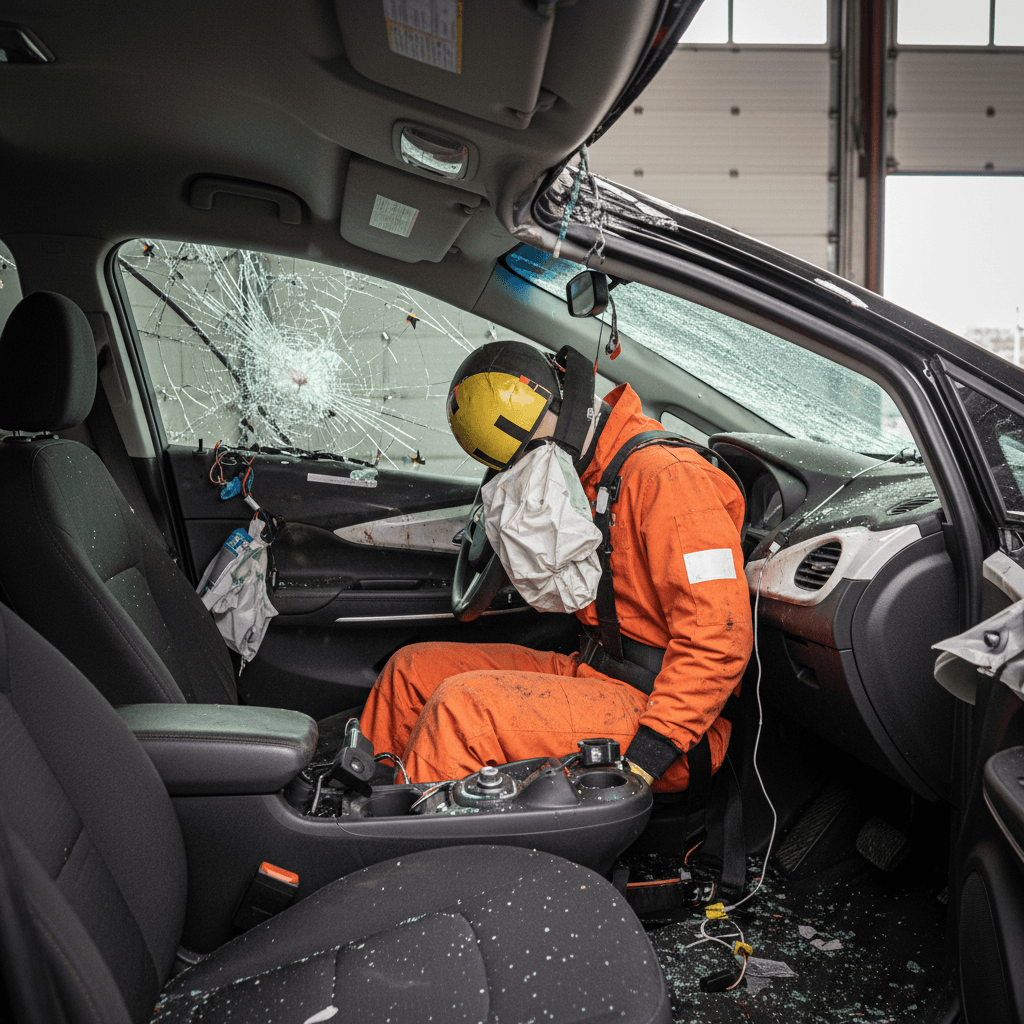
Crash test scores are only helpful if you understand how they connect to real-world crashes. The Bolt EUV’s combination of a rigid passenger cell, well-tuned crumple zones, and a heavy, low-mounted battery pack leads to predictable behavior in NHTSA’s standardized tests, and that typically carries over to the kinds of city and highway collisions many drivers worry about.
- **Frontal crashes:** A 5-star frontal rating means crash forces on the dummies stay below key injury thresholds at NHTSA’s test speeds. In plain English, belts and airbags work together to keep the driver and front passenger within survivable load limits in a typical head-on crash with a similar-sized vehicle.
- **Side impacts:** The EUV’s 5-star side score reflects good protection when a moving barrier hits the side of the vehicle and when the vehicle hits a rigid pole, two of the more dangerous real-world crash types.
- **Rollover risk:** A 4-star rollover score doesn’t mean the car is likely to roll; it just means its probability of rolling over in a severe maneuver is slightly higher than a sedan’s. The EV battery’s weight low in the chassis actually helps stability compared with some gas crossovers.
- **Children and car seats:** While detailed IIHS LATCH scores for the EUV are limited, the Bolt layout offers multiple rear seating positions with anchors. As always, the bigger variable is using the right seat and installing it correctly, not the rating label alone.
Active safety and driver-assistance tech on the Bolt EUV
Raw crash-test scores only tell half the story. A modern EV like the Bolt EUV leans heavily on **advanced driver-assistance systems (ADAS)** designed to help you avoid or lessen crashes in the first place. Many of these features are standard, even on base trims, which is important when you’re cross-shopping used EVs where equipment can vary widely.
Key Chevy Bolt EUV safety and ADAS features
Exact availability can vary by model year and trim, but these are the core technologies you’ll see on most Bolt EUVs.
Automatic emergency braking
Forward collision alert with automatic emergency braking can warn you of a potential frontal crash and apply the brakes if you don’t react in time. Many Bolt EUVs also add pedestrian detection at city speeds.
Lane keep assist & warning
Lane departure warning alerts you if you drift without signaling, while lane keep assist gently nudges the steering to keep you centered. That matters on long highway drives and at night when fatigue creeps in.
Adaptive cruise control
Available adaptive cruise control maintains a set gap to the car ahead, automatically slowing and accelerating with traffic. Owners often mention how well it works in stop‑and‑go traffic when properly equipped.
Blind zone & rear cross-traffic alerts
Blind zone monitoring helps you see what your mirrors miss, while rear cross-traffic alert can warn, and in some trims even brake, if a vehicle or pedestrian crosses behind you as you back up.
IntelliBeam automatic high beams
GM’s IntelliBeam system automatically switches between high and low beams based on traffic, improving visibility without blinding oncoming drivers.
Super Cruise hands-free driving
On certain Premier EUVs, Super Cruise allows limited hands‑free driving on pre‑mapped highways while watching your gaze. It’s not self-driving, but when it works properly it can significantly reduce fatigue on long trips.
Good news for used shoppers
Battery fires, recalls, and real-world safety record
Any honest discussion of **Chevy Bolt EUV safety** has to deal with the battery-fire story. Early Bolt EV and EUV models were swept up in a high-profile recall after a small number of vehicles experienced battery fires while parked or charging. GM ultimately issued a broad recall that involved battery pack inspections, software updates, and in many cases full battery replacements.
What the recall actually addressed
- The issue was linked to rare manufacturing defects in specific battery cells, not to crash-induced failures.
- GM and its battery supplier implemented inspection protocols, software monitoring, and replacement packs for affected vehicles.
- Regulators have allowed vehicles that received the full remedy to return to normal operation without special charging limits.
What it means for safety today
- A Bolt EUV that has had all recall work completed is considered safe to own and charge under normal conditions.
- From a crash perspective, the heavy battery pack still increases structural integrity and lowers the center of gravity.
- The bigger risk with an unremedied vehicle is a thermal event while parked or charging, not a loss of protection in a collision.
Do not ignore open recalls
Used Bolt EUV safety checklist for shoppers
When you’re shopping used, the Bolt EUV’s underlying crash performance is only part of the equation. The way the vehicle has been maintained, how recall work was handled, and whether its safety tech still functions as designed all matter just as much. Use this checklist to quickly size up a candidate.
Safety checks before you buy a used Chevy Bolt EUV
1. Confirm all recalls are closed
Use the VIN to check for open recalls, with particular attention to the battery recall. Make sure you see proof of completed work, ideally a repair order or dealer invoice showing battery inspection or replacement.
2. Verify airbag and crash repairs
Ask whether the car has ever been in a crash. If it has, request body shop invoices and look for OEM parts and proper airbag replacement, not airbag covers painted to look new. Poor repairs can undo the benefits of a 5-star rating.
3. Test every driver-assistance feature
On a test drive, verify that forward collision alerts, lane keep assist, adaptive cruise (if equipped), blind spot monitoring, and rear cross-traffic alerts all behave as expected. Warning lights or disabled systems are a red flag.
4. Inspect tires, brakes, and windshield
Worn tires, cheap mismatched replacements, or cracked glass can compromise otherwise excellent safety engineering. Check tread depth, sidewalls, and for any warning lights related to the ABS or stability control systems.
5. Check for updated software
Ask the seller when the last dealer visit or over-the-air update occurred. Safety systems and battery monitors rely on up-to-date software; you want a vehicle that’s been kept current, not ignored.
6. Evaluate headlights at night
If possible, drive the car after dark. Some trims have better headlight performance than others, and poorly aimed or modified headlights can reduce real-world safety even if the crash scores are strong.
Leverage third-party inspections
How Recharged evaluates Chevy Bolt EUV safety
If you’re buying through Recharged, you’ll see a **Recharged Score Report** attached to every Bolt EUV we list. That score goes beyond a simple Carfax and a quick once-over; it combines battery health diagnostics, pricing analysis, and a structured safety review so you don’t have to start from scratch.
Safety-focused checks baked into every Recharged Bolt EUV
What happens behind the scenes before a Bolt EUV appears on our site.
VIN-level recall & crash history review
We pull manufacturer and federal databases to confirm that **major safety recalls are closed** and look for any severe prior damage or structural repairs that could affect crash performance.
Recharged Score battery diagnostics
Our Recharged Score evaluates pack health, charging behavior, and battery temperature history where data is available. A healthy pack isn’t just about range, it also means the thermal management system is working as designed.
Safety-system function check
From crash sensors and airbags to ABS, stability control, and ADAS cameras, we check for warning lights, stored fault codes, and obvious calibration issues before a vehicle is cleared for sale.
Ready to find your next EV?
Browse VehiclesBecause Recharged operates as a **digital-first used EV retailer and marketplace**, we also give you the tools to line up **financing**, evaluate a **trade‑in or instant offer**, and arrange **nationwide delivery** without sacrificing transparency. If you have questions about a specific Bolt EUV’s safety history, an EV specialist can walk you through the report before you commit.
Chevy Bolt EUV safety FAQ
Frequently asked questions about Chevy Bolt EUV safety
Bottom line: is the Chevy Bolt EUV a safe EV?
Taken as a whole, the **Chevy Bolt EUV** is a fundamentally safe small EV: it delivers top‑tier federal crash test scores, a robust set of standard active safety features, and the inherent stability of a battery‑electric platform. The asterisk is the well‑publicized battery recall, which you should treat as a gating factor, if the work is done and documented, you can focus on more typical used‑car checks like crash repairs, tires, and ADAS function.
If you want a clear, data‑driven picture of a specific Bolt EUV, shopping through Recharged adds another layer of protection. Every vehicle comes with a **Recharged Score Report** that documents battery health, recall status, pricing fairness, and key safety items up front, plus EV‑savvy support, financing options, trade‑in offers, and nationwide delivery. That combination of objective crash performance and transparent vehicle history is ultimately what makes a used Bolt EUV feel safe in the real world, not just on a spec sheet.