If you’re trying to understand Chevrolet Equinox EV common problems in 2026, especially before buying one used, you’re doing exactly what smart EV shoppers should do. The Equinox EV rides on GM’s Ultium platform, which gives it strong fundamentals, but it’s also a relatively new model with very 2020s software quirks, scattered recalls, and a lot of confusing owner anecdotes.
Quick take
Chevrolet Equinox EV problems in 2026: what we’re really seeing
The first U.S. Equinox EVs arrived for the 2024 model year, making 2025–2026 the crucial “shake‑down” period where real‑world problems surface. Early owner reports, GM technical service bulletins, and NHTSA filings all tell a consistent story:
- Most issues are software or charging related, not core powertrain failures.
- There have been a handful of high‑voltage battery fault cases (including one high‑profile “bricked” car), but they are rare relative to the fleet size.
- GM has already issued multiple recalls (for things like pedestrian warning sounds and driver-assistance behavior) and several software updates.
- Owners who have trouble-free cars report the Equinox EV as one of the more reliable Ultium products so far, especially compared with early Hummer EV or Lyriq experiences.
Important context
Early Equinox EV reliability snapshot (2024–2026)
1. Charging problems: from “won’t charge” to “why is DC fast so slow?”
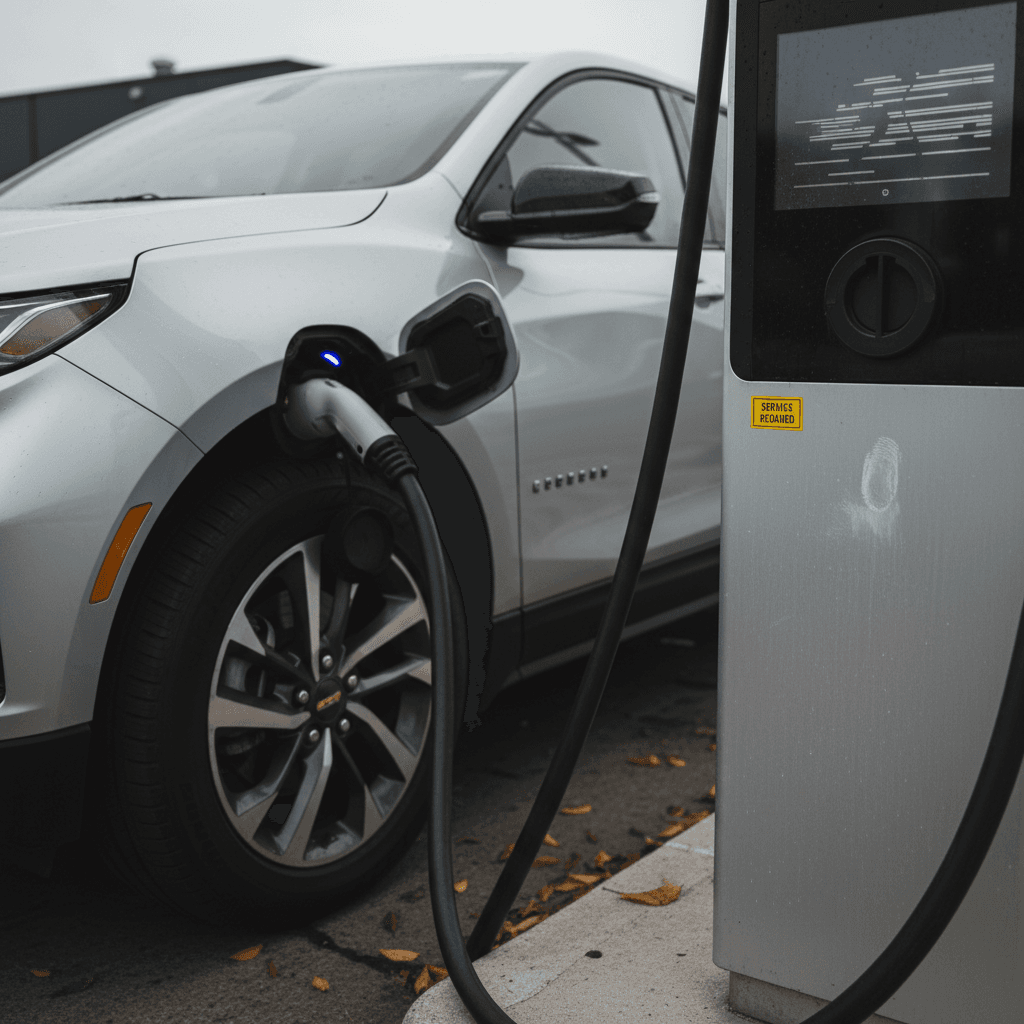
If there’s a single theme in Equinox EV owner complaints so far, it’s charging weirdness. That ranges from annoying (slow DC speeds) to scary (car suddenly refusing to charge at all). The nuance matters, especially if you’re shopping used.
Most common Equinox EV charging complaints
What owners report, and what it usually means
1. Slow DC fast charging
Many owners are surprised to see 30–70 kW instead of the advertised 150 kW, especially on 50 kW or 150 kW labeled chargers.
The big reasons:
- Equinox EV’s battery has lower pack voltage than some rivals, capping power on many public chargers.
- Charge rate drops hard after ~60–70% state of charge.
- Shared or under‑specced public chargers often can’t deliver their advertised peak.
2. Car stops charging early
Multiple owners have reported the car stopping around 70–80% even when the limit is set higher. Often the fix is simply charging to 100% once or twice to recalibrate the battery management system.
In persistent cases, dealers have opened tickets for BMS software updates or diagnostics.
3. “Won’t charge” / error lights
Less common but more serious: cars that suddenly refuse to take a charge on any Level 1/2 charger, or throw a “Service High Voltage” message.
Outcomes vary from a simple software reset to full traction battery replacement under warranty, depending on diagnostics.
How to tell if it’s the car or the charger
Realistic expectations for Equinox EV DC fast charging
GM advertises up to ~150 kW on DC, but in 2026 real‑world data show many Equinox EVs hovering in the 35–90 kW range, especially on 400‑volt public chargers. That’s not strictly a defect; it’s a combination of battery design, station limitations, and how the BMS tapers current to preserve battery life.
- If you plug in near 0–20% on a high‑quality station, you’re more likely to see peak power, at least briefly.
- Above about 60–70%, it’s normal to see power drop sharply; planning fast‑charge stops to 60–70% instead of 100% will feel much quicker.
- On many “50 kW” labeled units, the Equinox EV will top out around 35–40 kW simply due to voltage and current limits.
Is slow charging a “problem” for a used buyer?
2. Battery health, high-voltage faults, and “bricked” cars
Whenever a new EV hits the market, the nightmare scenario everyone watches for is a pattern of high‑voltage battery failures. With the Equinox EV, 2026 data points to a small but non‑zero number of serious cases, most notably a widely reported story of an Equinox EV that went from “fine” to 0% and refused to move after a high‑voltage fault message.
What’s actually happening
- A tiny number of owners have seen “Service High Voltage Battery” or similar errors, sometimes followed by the car entering a no‑drive or no‑charge state.
- In some cases, dealers have traced this to onboard charging system faults or BMS software issues.
- At least one documented case involved complete high‑voltage pack replacement under warranty on a low‑mileage Equinox EV.
How common is this?
- Relative to the total number of Equinox EVs sold, these failures appear to be edge‑case events, not a Bolt‑style systemic defect.
- GM has been issuing updated technical service bulletins (TSBs) for various Ultium vehicles as they learn from early failures.
- There is no broad safety recall in 2026 specifically for Equinox EV high‑voltage pack failure.
Red flags during a test drive
For most owners, the more realistic Equinox EV battery concern in 2026 isn’t sudden death, it’s unknown long‑term degradation. The pack hasn’t been on the road long enough to establish 8–10‑year patterns. That’s why objective battery data starts to matter as these first‑wave Equinox EVs enter the used market.
Where Recharged fits in
Ready to find your next EV?
Browse Vehicles3. Software bugs, app glitches, and connectivity issues
If the Equinox EV has an Achilles’ heel in 2026, it’s software polish. GM has been trying to modernize its infotainment and connectivity stack, and the results are, frankly, uneven.
Common software and connectivity complaints
Annoying more often than dangerous, but worth understanding
Car disappears from the app
Owners regularly report that after a few days parked, the Equinox EV stops responding to the myChevrolet app. In many cases, simply walking up with the key fob and waking the car restores communication.
Dealers and GM reps describe this as an intended power‑saving behavior of the telematics/OnStar module, though not always communicated clearly to owners.
Stale or missing data
Some owners see stuck state‑of‑charge readings or locations from weeks or months ago in the app, even while navigation and in‑car systems seem normal.
Service advisors often point to OnStar or backend connectivity quirks. Software updates have improved this for some, but it’s not fully solved as of early 2026.
Infotainment glitches
Like other recent GM EVs, the Equinox EV occasionally suffers from frozen screens, laggy UI, or random reboots.
These are frustrating but rarely safety‑critical, and generally resolved via over‑the‑air or dealer‑installed software updates.
Before you buy, force the car to “talk”
4. Key Equinox EV recalls through 2026
By April 2026, the Equinox EV has accumulated a modest list of recalls, not unusual for a new EV platform. Understanding them helps you sanity‑check a used car’s history and avoid paying for a vehicle that still needs free safety work.
Major Chevrolet Equinox EV recalls (through early 2026)
Always run the VIN through NHTSA’s lookup tool before you buy, this table is a snapshot, not a substitute for an official search.
| Area | Model years affected* | What’s wrong | Risk / behavior | What to confirm on a used car |
|---|---|---|---|---|
| Pedestrian warning sound | Primarily 2024 | Incorrect software calibration can mean the required low‑speed pedestrian alert sound doesn’t play outside the car. | Pedestrians may not hear the vehicle when it’s moving slowly, increasing collision risk in parking lots and cities. | Ask the seller to show documentation that the recall software update was completed; test the low‑speed sound in a quiet lot. |
| Automatic Emergency Braking (AEB) with cruise | Mainly 2025 | AEB may not function properly when cruise control is active. | Increased crash risk in scenarios where AEB should intervene but doesn’t. | Verify recall completion on the VIN and test AEB behavior on a safe, empty road per the owner’s manual guidance. |
| Broader GM electrical/charging TSBs | 2024–2026 (various GM models, including Equinox EV) | GM has issued multiple technical bulletins around charging behavior, modules, and software on Ultium vehicles. | Not always a formal recall; issues range from nuisance warnings to reduced charging performance. | Ask for the dealer service printout to see which software updates and TSBs have been applied. A “fully updated” car is worth more. |
Recall campaigns evolve. Use this as context, then verify specifics for the VIN you’re considering.
Recalls vs. TSBs: know the difference
5. Cabin reflections, noises, and livability complaints
Beyond charging and software, Equinox EV owners have logged a smattering of everyday annoyance issues that may not show up on a spec sheet but can matter a lot in daily use.
Everyday Equinox EV livability complaints
Not deal‑breakers, but good leverage when negotiating
Windshield reflections
Some owners report a strong dashboard reflection on the windshield in bright conditions, to the point of obscuring vision.
One low‑tech fix is a dark dash mat. But if you find it distracting on a test drive, that’s a real quality‑of‑life concern you shouldn’t ignore.
Rattles and trim noises
Like many compact crossovers, the Equinox EV can develop small rattles in the hatch, doors, or interior panels, especially on rough roads.
Most are addressable by dealers under warranty, but they’re worth checking on your test drive.
HVAC and fan noise
A few owners complain about noisy cabin fans or climate systems that feel under‑tuned compared with rivals.
Spend a few minutes playing with the HVAC on high and low; make sure noises or smells don’t bother you.
Use quiet roads as a diagnostic tool
What this means if you’re buying a used Equinox EV
Put all this together, and the 2026 Equinox EV story looks like this: solid underlying hardware, uneven software, and a normal number of new‑model teething issues. That’s a very different risk profile than, say, an early‑production EV with a known systemic battery defect.
Upside for used buyers
- Because GM has been aggressive with leases and incentives, there’s a growing pool of low‑mile, off‑lease Equinox EVs coming to market.
- Most early cars haven’t had time to accumulate meaningful battery degradation.
- Many of the worst bugs have been patched via software, so a 2026‑updated car can be materially better than how it left the factory.
Risks to manage
- You’re still an early adopter on long‑term battery life data.
- Some cars will have spotty software‑update histories or unresolved recalls.
- A handful of vehicles have had major high‑voltage repairs; you need to know whether that’s a deal‑breaker or just a bargaining chip.
This is exactly where a data‑driven used‑EV process, rather than vibes and dealer reassurances, starts to pay off. At Recharged, that means combining Recharged Score battery diagnostics, full recall/TSB checks, and hands‑on EV specialist inspections so you’re not guessing about how a specific Equinox EV has aged.
Pre‑purchase checklist: vetting a used Equinox EV
10 things to check on a used Equinox EV (2024–2026)
1. Run the VIN for recalls and campaigns
Use NHTSA’s VIN lookup and ask the seller for a dealer service printout. Confirm that key campaigns (pedestrian warning sound, AEB with cruise, major software updates) are complete.
2. Confirm software update history
Ask explicitly what software versions the car is on and when they were last updated. A car that hasn’t seen a dealer or OTA update since 2024 is riskier than one with a documented update trail.
3. Test AC Level 2 charging
If possible, plug the car into a known‑good Level 2 charger and verify it begins charging, stays charging, and reaches your set limit without strange interruptions or warnings.
4. Spot‑check DC fast charging
On a 30–60 minute test drive, stop at a reputable DC fast charger. See whether the car charges normally, watch for error messages, and note realistic power levels. You’re looking for consistent behavior, not a specific kW number.
5. Scan for high‑voltage or charging warnings
Before and after your drive, look for any warning lights or error messages about the high‑voltage system, charging system, or propulsion. If anything appears, demand a full diagnostic before proceeding.
6. Evaluate app connectivity
Pair the car with the myChevrolet app. Confirm that location and state of charge update within a few minutes, and that remote lock/unlock or start commands work as advertised.
7. Check interior reflections and visibility
Drive in bright conditions if you can. Watch for dash reflections on the windshield that make it hard to see; if it bothers you during a 20‑minute drive, it will really bother you years into ownership.
8. Listen for rattles and suspension noises
On both smooth and rough roads, listen for rattles, clunks, or buzzing. A few squeaks aren’t unusual, but persistent noises from the rear or front suspension deserve scrutiny.
9. Review battery and charging history
Ask how the car was used: mostly DC fast charging or home Level 2? High‑mileage highway commuting or short‑trip city use? An EV that lived on fast charging its whole life is a different risk than one that mostly sipped at home.
10. Get independent battery health data
Use a third‑party battery health assessment, like the Recharged Score included with every EV we sell, or a similar diagnostic, to see pack capacity and cell balance rather than guessing based on range alone.
Make the used‑EV math work for you
Chevrolet Equinox EV problems 2026: FAQ
Frequently asked questions about Equinox EV problems (2026)
Bottom line: solid fundamentals, immature software
The Chevrolet Equinox EV in 2026 is neither a flawless future‑mobile nor a ticking time bomb. Its Ultium hardware looks fundamentally sound so far, and most of the widely discussed problems trace back to charging quirks, immature software, or early‑run recalls rather than design‑level battery failures. That’s good news, but only if you use it wisely when you shop.
If you’re evaluating a used Equinox EV, focus less on internet horror stories and more on the specific car in front of you: how it charges, what its battery health looks like, which updates it’s had, and how it feels on real roads. Whether you do that work yourself with our checklists or let Recharged handle it with a Recharged Score Report and EV‑specialist inspection, the goal is the same: enjoy the Equinox EV’s strengths without being surprised by the 2020s‑era growing pains hiding in its software.