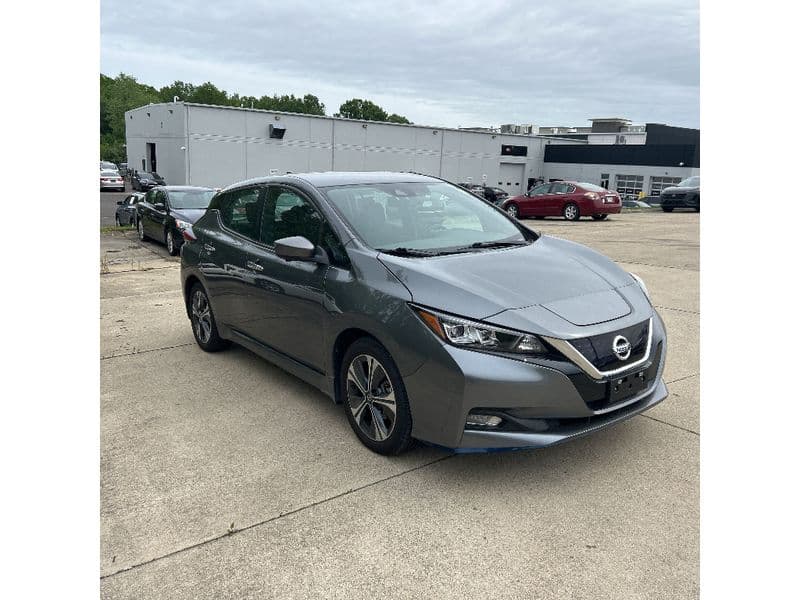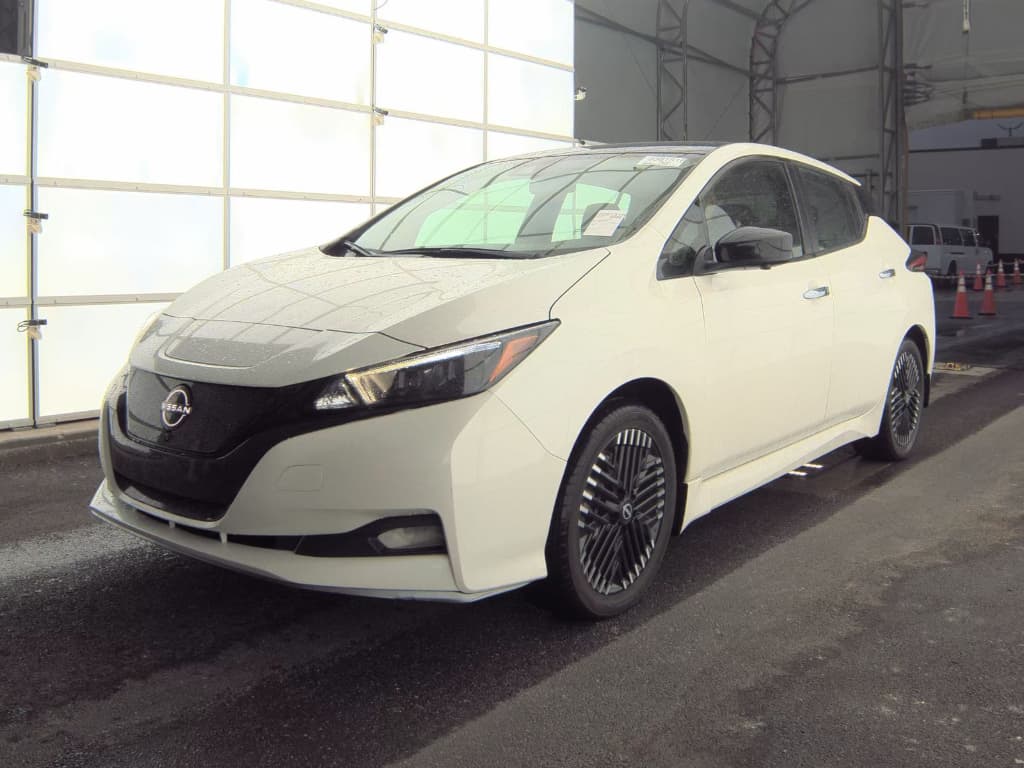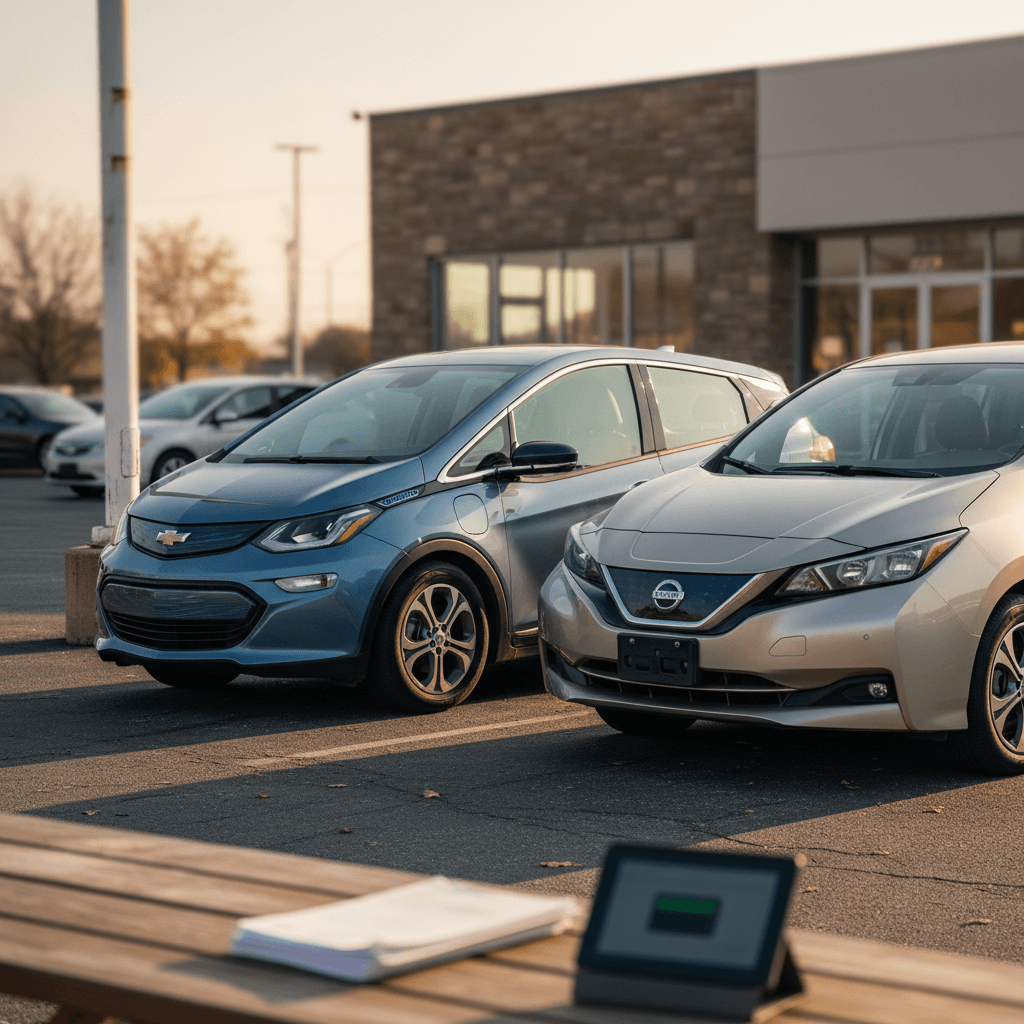
You’re hunting for an affordable electric car, and two names keep popping up: the Chevrolet Bolt EV and the Nissan Leaf. Both are among the cheapest used EVs on the market, both are easy to park, and both can slash your fuel and maintenance bills. But when you dig into range, charging, and especially battery health, the differences between the Chevrolet Bolt EV vs Nissan Leaf get very real, very fast.
Why this matchup matters in 2026
Chevrolet Bolt EV vs Nissan Leaf: who each car is for
Quick answer: which car fits you?
Start with your daily driving and charging situation, then fine‑tune from there.
Chevrolet Bolt EV: the range-first all‑rounder
The Bolt EV is usually the better choice if you:
- Regularly drive 50+ miles per day or take occasional highway trips.
- Need 200+ miles of real‑world range from recent model years.
- Have or plan to add Level 2 home charging.
- Care about modern tech and brisk acceleration.
It feels more like a "normal" modern EV with strong range for the money.
Nissan Leaf: the budget city commuter
The Leaf makes more sense if you:
- Mostly do short city or suburban errands under 60–70 miles per day.
- Want the lowest possible purchase price.
- Can live with shorter range, especially on older models.
- Want a simple, comfortable car that’s easy to drive.
Think of it as an ultra‑efficient replacement for a compact gas hatchback.
Bolt EV vs Leaf: headline numbers (popular years)
Key model years and trims to compare
Both nameplates have been around long enough that you’ll see everything from early, short‑range cars to newer models that finally crack the 200‑mile barrier. When you’re cross‑shopping a Chevrolet Bolt EV vs Nissan Leaf on the used market, you’re usually looking at these core generations:
Common used Bolt EV and Nissan Leaf variants
Focus on these years and trims first, they generally offer the best mix of value, range, and support in 2026.
| Model | Typical Years on Used Market | Battery (approx.) | EPA Range (new) | Notes |
|---|---|---|---|---|
| Chevrolet Bolt EV (Gen 1/2) | 2017–2019 | ~60 kWh | ~238 mi | Early long‑range Bolt; all affected by battery recall work. |
| Chevrolet Bolt EV (Gen 3 refresh) | 2020–2023 | ~65 kWh | 259 mi | Updated interior, slightly more range, DC fast up to ~55 kW. |
| Nissan Leaf 24 kWh | 2011–2016 | 24 kWh | 73–84 mi | Very affordable but often heavily degraded batteries. |
| Nissan Leaf 30 kWh | 2016–2017 | 30 kWh | ~107 mi | Better but still heat‑sensitive; software updates important. |
| Nissan Leaf 40 kWh | 2018–present (base trims) | 40 kWh | 149–150 mi | Good urban commuter; watch highway range and battery health. |
| Nissan Leaf 62 kWh (SV/SL Plus) | 2019–present (Plus) | 62 kWh | 215–226 mi | Only Leafs that truly rival the Bolt’s range when new. |
Earlier Leafs (2011–2016 24 kWh, 2016–2017 30 kWh) can be very cheap but often have significant battery degradation, especially in hot climates.
An easy way to compare cars quickly
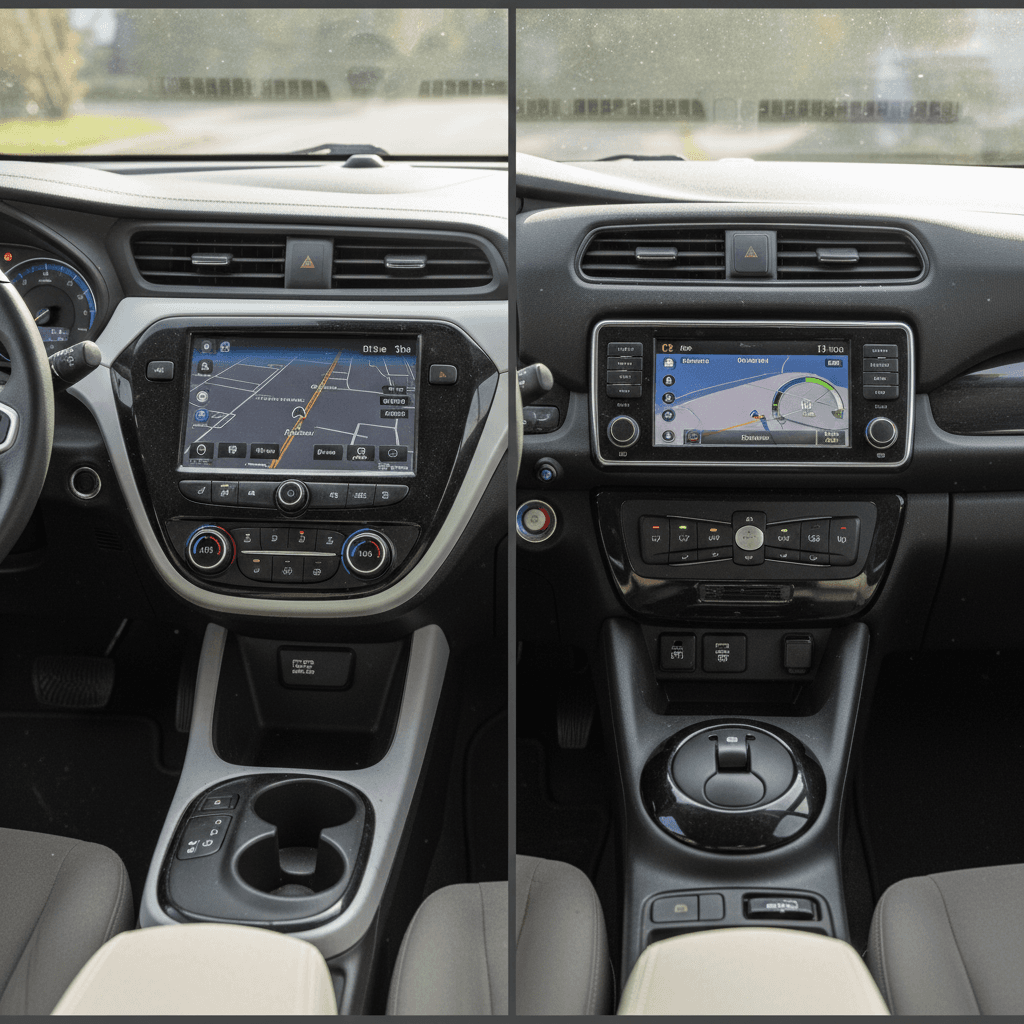
Range and efficiency: Bolt vs Leaf in the real world
Range is usually the first big fork in the road when you compare a Chevrolet Bolt EV vs Nissan Leaf. On paper, newer examples of both can clear 200 miles, but how they get there, and how well they hold that range over time, differs a lot.
Chevrolet Bolt EV range
- 2017–2019 Bolt EV: ~238 miles EPA when new.
- 2020–2023 Bolt EV: 259 miles EPA with the ~65 kWh pack.
- Real‑world highway range is usually a bit lower, but many owners comfortably see 200–220 miles at 70 mph in mild weather.
- Active liquid battery cooling helps the pack stay happier on long road trips and in hot climates.
If you want the most range per dollar in the used EV market, a healthy Bolt EV from 2020–2023 is still hard to beat.
Nissan Leaf range
- 24 & 30 kWh Leafs: 70–110 miles new, often less than that now due to degradation.
- 40 kWh Leaf: ~150 miles EPA; great for short trips, marginal for long highway days.
- 62 kWh Leaf SV/SL Plus: 215–226 miles EPA; the only Leaf that truly plays in Bolt EV territory.
- The Leaf’s air‑cooled pack can lose more capacity in hot climates or with frequent DC fast charging, so actual range on older cars varies a lot.
For many daily commutes, even a 40 kWh Leaf is plenty. The key question is what happens when you need to go farther than usual.
Don’t ignore "usable" range
Charging and connectors: how easy are these to live with?
Range is only half the story. How fast you can add that range, and how easy it is to find compatible fast chargers, may matter even more if you don’t have home charging or you take frequent trips.
Home and public charging: Bolt EV vs Leaf
Both work well on Level 2 at home, but public fast charging is where the split really shows.
Level 1 (120V) at home
- Both cars can use a standard household outlet in a pinch.
- Expect roughly 3–5 miles of range per hour on either car.
- Fine for very light use; painfully slow for regular 50+ mile days.
Level 2 (240V) at home or work
- Bolt EV: on‑board charger up to ~11.5 kW on newer models; a 240V charger can typically refill overnight from low to full.
- Leaf: 6.6 kW on most recent trims; also easily fills overnight from a 240V charger.
- Either car plus a good Level 2 setup is a game‑changer for daily convenience.
DC fast charging on the road
- Bolt EV: CCS connector, peak around 55 kW. Not the fastest, but CCS networks are widespread across the U.S.
- Nissan Leaf: CHAdeMO connector on U.S. models through 2025. Speeds around 50 kW, but the bigger issue is that CHAdeMO stations are shrinking in number.
- For frequent road‑trippers, the Bolt’s CCS port is a big long‑term advantage in North America.
Think about your charging map, not just your driveway
Battery health, recalls, and degradation risks
Here’s the part most used‑EV shoppers don’t see in a glossy spec sheet. The way Chevrolet and Nissan designed, and in some cases, recalled, their batteries has huge implications for how these cars age. If you’re comparing the Chevrolet Bolt EV vs Nissan Leaf for long‑term ownership, this section matters as much as range and price.
Chevy Bolt EV: big recall, better thermal management
- All 2017–2022 Bolt EVs were recalled for a battery fire risk; many had entire packs or modules replaced under warranty.
- The Bolt uses liquid cooling, which helps limit degradation compared with air‑cooled packs.
- Post‑recall packs generally show modest degradation when cared for, and the thermal system helps if you fast‑charge on road trips.
- The flip side: you’ll want documentation that recall work was fully completed and that the car has the latest battery monitoring software.
On a platform like Recharged, this history gets rolled into the Recharged Score so you can see at a glance whether a specific Bolt has a healthy post‑recall battery.
Nissan Leaf: fewer headlines, more quiet degradation
- Most Leafs have not had the same kind of all‑vehicle recall drama as the Bolt.
- But the Leaf relies on air‑cooled batteries. In hot climates or with frequent DC fast charging, they can lose capacity faster.
- Early 24 kWh and 30 kWh packs are especially known for losing bars of capacity over time.
- Later 40 kWh and 62 kWh packs are better, but real‑world data still shows more variation than in many liquid‑cooled EVs.
With a Leaf, you’re often trading a calmer recall history for a higher chance of meaningful range loss on older or hard‑used cars.
Never buy blind on battery health
Space, comfort, and in‑car tech
Numbers tell only part of the story. You still have to sit in this thing every day. Thankfully, both the Bolt EV and the Leaf are genuinely easy to live with, but they feel different from the driver’s seat.
Interior space and practicality
- Bolt EV: Tall, upright hatchback. Surprising headroom up front, rear legroom is adequate but not generous. Cargo space is solid for a subcompact; seats fold flat for bulkier items.
- Nissan Leaf: Feels slightly roomier in the back seat in many model years, with a more conventional compact‑car stance. The hatch opening is wide and cargo floor is user‑friendly.
- Both have easy step‑in heights and good visibility, especially for city driving and parking.
Tech, safety, and driving feel
- Bolt EV: Snappy acceleration, especially around town. Later models have a modern infotainment system, crisp digital cluster, and available driver‑assist features like adaptive cruise and lane keeping.
- Nissan Leaf: Softer, quieter ride in many trims. Tech varies a lot by year; newer Leafs offer ProPILOT Assist on higher trims, which brings semi‑automated steering and adaptive cruise.
- If you prioritize zippy performance and a modern screen setup, the Bolt usually wins. If you care more about a gentler, traditional car feel, the Leaf may suit you better.
Ownership costs, incentives, and resale value
Once you’ve settled on Bolt vs Leaf, the next questions are: what will it really cost me to own, and how well will it hold value if I sell or trade in a few years? Here’s how they typically compare in the U.S. used market today.
Cost and value comparison: Chevrolet Bolt EV vs Nissan Leaf
Actual prices will vary by year, trim, mileage, and local incentives, but this gives you a directional feel for where money changes hands.
| Factor | Chevy Bolt EV (2017–2023) | Nissan Leaf (2013–2024) | What it means for you |
|---|---|---|---|
| Typical used pricing | Generally higher than a similar‑year Leaf, especially 2020–2023 cars with 259‑mile range. | Often the least‑expensive used EVs on the market, especially older 24/30 kWh cars. | Leaf wins on sticker price; Bolt usually commands a premium for its range and CCS fast‑charging. |
| Energy costs | Very efficient; many owners see low cost per mile when charging at home. | Also efficient, especially at city speeds; short‑range Leafs may charge slightly more often. | Both beat gas by a wide margin; your electricity rate and driving pattern matter most. |
| Maintenance | No oil changes; tires, brakes, and coolant for the Bolt’s thermal system. | No oil changes; brakes and tires dominate. Less thermal hardware but watch for cabin and brake maintenance like any compact car. | Routine costs are low on both. A well‑maintained Bolt or Leaf is cheaper to run than a comparable gas car. |
| Resale and demand | Strong interest thanks to range; demand is particularly healthy for post‑recall, low‑mileage cars. | Values drop quickly on older short‑range models; newer Leaf Plus trims hold value better than early 24/30 kWh cars. | Expect a Bolt EV to hold value better, especially if battery health remains strong. Leaf values depend heavily on pack size and degradation. |
Both cars are eligible for various local incentives or utility rebates in some regions; always check your state and utility programs.
Leaning toward selling or trading later?
Ready to find your next EV?
Browse VehiclesWhich one should you buy? Bolt vs Leaf by use case
There’s no single winner here, only the car that best fits your life. Use these scenarios to map your situation onto the right choice.
Choose your path: real‑world buyer scenarios
Daily commuter with occasional road trips
You regularly drive 40–80 miles per day and take a few 200–300 mile trips per year.
You want a car that can handle highway speeds without wrecking your range.
You don’t want to obsess over which public charger networks support your connector.
<strong>Best fit:</strong> A healthy <strong>2020–2023 Chevrolet Bolt EV</strong> with the 259‑mile pack. CCS fast‑charging and liquid cooling make it a much more relaxed road‑trip partner than most Leafs.
City apartment dweller with limited charging
You mostly do short errands and commutes around town, under 50–60 miles per day.
You may rely on workplace charging, shared Level 2, or occasional DC fast charging.
You want to get into an EV at the lowest possible purchase price.
<strong>Best fit:</strong> A <strong>40 kWh Nissan Leaf</strong> in good battery health. It’s cheap to buy, easy to park, and perfectly suited to short‑range urban life. Just be realistic about road‑trip limitations, especially with CHAdeMO.
Budget buyer in a cold or hot climate
You live where summers or winters are brutal and can’t afford to lose much range.
You’re shopping older cars to save money but you need predictability from the battery.
You’re willing to pay a bit more up front to avoid early battery issues.
<strong>Best fit:</strong> Often a <strong>post‑recall Chevrolet Bolt EV</strong> with a documented healthy pack. Its liquid‑cooled battery is more resilient to temperature extremes than early, air‑cooled Leafs. If you go Leaf, favor newer 40/62 kWh cars and insist on strong battery‑health data.
Ultra‑tight budget, short trips only
You rarely drive more than 30–40 miles per day and have another gas car for long journeys.
Purchase price is more important than anything else.
You’re comfortable living with real‑world range that may be under 80–90 miles.
<strong>Best fit:</strong> An older <strong>24 kWh or 30 kWh Leaf</strong> with verified remaining capacity can be a bargain city runabout. Just understand it’s more of a neighborhood EV than a do‑everything car.
Checklist for shopping a used Bolt EV or Leaf
Whether you lean Chevrolet Bolt EV or Nissan Leaf, a smart used‑EV purchase comes down to asking the right questions and getting real data. Use this checklist as you browse listings or walk a dealer lot.
Must‑do steps before you sign
Confirm battery health with real data
Ask for recent battery‑health diagnostics, not just "it seems fine." On Recharged, the <strong>Recharged Score Report</strong> gives you pack health, estimated usable range, and pricing context so you know exactly what you’re buying.
Verify recall and software status (Bolt EV)
For any 2017–2022 Bolt EV, confirm the battery recall was completed and that the latest battery‑monitoring software is installed. Service records or a dealer VIN check can provide proof.
Check remaining capacity (Leaf)
Look beyond the dashboard "battery bars". They can be misleading, especially if the car has had software updates. A professional scan or third‑party diagnostic is worth it on any older Leaf.
Inspect charging hardware and test a charge
Physically inspect the charge ports and cables. If possible, plug into a Level 2 station and confirm the car charges normally without errors. For a Leaf, also confirm the CHAdeMO fast‑charge port is functional if you’ll rely on it.
Match range to your worst‑case day
Write down your longest regular days, not just your average commute. Make sure the car can comfortably cover that distance with <strong>at least 20–30% buffer</strong>, accounting for weather and degradation.
Compare total cost, not just price
Include insurance, home charging installation (if needed), and likely resale value. A slightly more expensive Bolt EV with better range and battery health may be cheaper to own over five years than the cheapest Leaf on the lot.
Chevy Bolt EV vs Nissan Leaf: FAQ
Frequently asked questions
When you line them up, the Chevrolet Bolt EV vs Nissan Leaf story is simple: the Bolt is the range and road‑trip hero with a big recall chapter you must understand; the Leaf is the budget‑friendly city specialist whose long‑term value depends heavily on battery size, climate, and care. If you match the right car to your driving pattern, and insist on objective battery‑health data, either can be a smart way to go electric without overspending. If you’d like a shortcut, start your search on Recharged, where every used EV comes with a Recharged Score Report, expert EV‑specialist support, and the option to finance, trade in, or get your next car delivered right to your driveway.