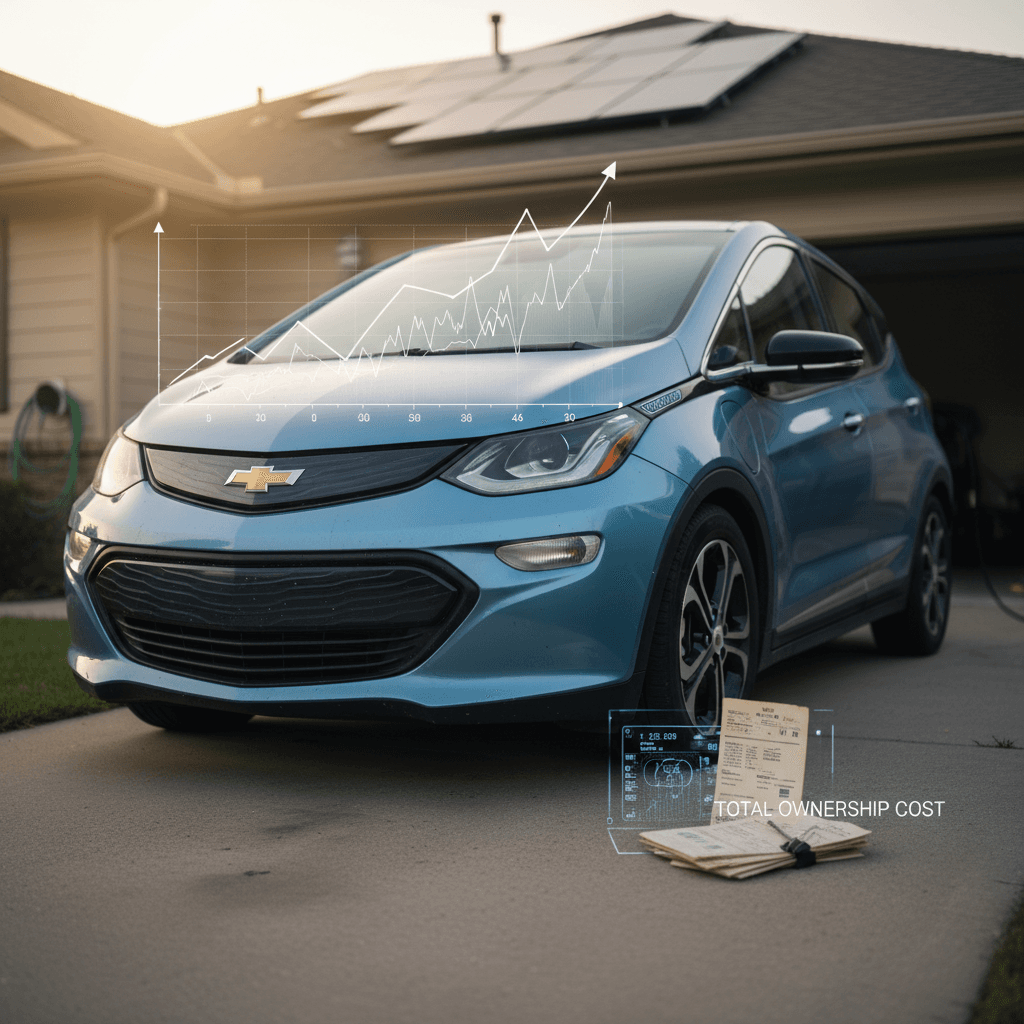
If you’re eyeing a Chevrolet Bolt EV, you’re probably not just thinking about the sticker price, you want to know the true cost of ownership over 5 years. That means payments, charging, depreciation, maintenance, insurance, and the very real question: will this EV still be a good deal when you’re ready to sell or trade it in?
What this guide covers
Why the Chevrolet Bolt EV’s 5‑Year TCO Matters
The Bolt EV earned a reputation as one of the most affordable long‑range EVs on the market. With over 200 miles of range, a compact footprint, and aggressive pricing, especially on the used market, it’s often the entry point for first‑time EV owners. But incentives, depreciation from the 2021–2022 battery recall, and rapidly changing EV prices mean your 5‑year math today looks very different than it did a few years ago.
Understanding the 5‑year true cost of ownership (TCO) helps you compare a Bolt to a conventional gas compact, decide between new and used, and see how much you actually save on fuel and maintenance once everything is added up.
Bolt EV basics: models, battery, and price points
Chevrolet Bolt EV snapshot
Key details that drive your 5‑year costs
Model years & trims
The main Chevrolet Bolt EV ran from the 2017–2023 model years as a compact hatchback. The Bolt EUV (slightly larger) joined for 2022–2023. Trims are simple, typically LT and Premier/2LT, with most cost differences tied to features, not powertrain.
Battery and range
Early Bolts used a ~60 kWh pack, upgraded to ~65 kWh from 2020 on, with EPA ranges around 238–259 miles depending on year. Real‑world range varies with climate, driving style, and tires, which all matter for energy costs.
Charging hardware
All Bolt EVs are DC fast‑charge capable and charge overnight on Level 2 at home. They use the CCS connector for DC fast charging and J1772 for AC Level 2. Home charging access is a big lever on your 5‑year cost.
Price ranges today
By 2026, many used Bolt EVs sit in the $12,000–$22,000 range depending on year, mileage, and recall/battery history, while new‑car pricing has been discontinued but still influences used-market values.
Purchase price, incentives, and financing assumptions
To compare apples to apples, we’ll use two realistic 2026 scenarios: buying a used Bolt EV and buying an equivalent used gas hatchback. These are simplified models, but they’re close enough to show where the big dollars move.
Baseline purchase & financing assumptions (2026)
Typical U.S. buyer scenarios for a used Chevrolet Bolt EV vs a comparable gas car.
| Item | Used Chevrolet Bolt EV | Comparable used gas compact |
|---|---|---|
| Purchase price | $18,000 | $16,000 |
| Down payment | $2,000 | $2,000 |
| Amount financed | $16,000 | $14,000 |
| Loan term & APR | 60 months @ 6% | 60 months @ 6% |
| Estimated monthly payment | ≈$309 | ≈$270 |
| Federal/State EV incentives | Usually none on used; some states offer $1,000–$2,000 rebates | None |
| Net effective price after any used‑EV incentives | $16,000–$18,000 depending on rebates | $16,000 |
Actual prices, rates, and incentives vary by state, lender, and mileage. Use these as directional averages, not hard quotes.
Where new-vehicle tax credits still help you
Five‑year Chevrolet Bolt EV cost breakdown: quick view
Illustrative 5‑year cost of ownership (60,000–75,000 miles)
In most realistic scenarios, a used Chevrolet Bolt EV undercuts a similar gas hatchback on 5‑year cost once you factor in cheaper energy and lower maintenance. The key variables that can swing your TCO up or down are electricity rates, annual mileage, insurance premiums, and how much depreciation hits you between your purchase and sale.
Depreciation and resale value for the Bolt EV
EV depreciation is where a lot of shoppers get nervous, and with the Bolt EV, that’s understandable. The model has already seen a big value reset thanks to aggressive new‑car pricing toward the end of its run and the high‑profile battery recall. The good news is that much of that early‑life depreciation is behind you when you buy used in 2026.
What typical 5‑year depreciation looks like
- From new: Original owners of 2019–2022 Bolts often saw 45–55% value loss in the first 5 years due to incentives, discounts, and EV price pressure.
- From used in 2026: If you buy a $18,000 used Bolt EV that’s already 3–5 years old, a reasonable 5‑year resale value might be in the $8,000–$10,000 range depending on mileage and battery health.
How that compares to a gas compact
- A similar $16,000 gas compact might be worth $7,000–$9,000 after 5 years and 75,000+ miles.
- That means depreciation is broadly similar, with the Bolt EV sometimes doing slightly better if battery health remains strong and local demand for used EVs grows.
Local market conditions, mileage, and cosmetic condition can easily move these numbers by a couple thousand dollars either way.
Watch for mileage and battery history
Charging costs vs gasoline over 5 years
Fuel savings are where the Bolt EV quietly wins the long game. The exact math depends heavily on your electricity rates and whether you can charge at home on a time‑of‑use (off‑peak) plan, but even at average U.S. rates the Bolt usually costs far less per mile than a comparable gas car.

Illustrative 5‑year energy cost comparison
Assumes 12,000 miles per year (60,000 miles over 5 years).
| Assumption | Chevrolet Bolt EV | Comparable gas compact |
|---|---|---|
| Efficiency | 3.5 mi/kWh | 32 mpg |
| Energy price | $0.15 per kWh (home, blended) | $3.50 per gallon |
| Energy cost per mile | ≈$0.043 | ≈$0.109 |
| Annual fuel/energy spend | ≈$520 | ≈$1,308 |
| 5‑year fuel/energy spend | ≈$2,600 | ≈$6,540 |
Electricity rates and gas prices vary widely. Run your own numbers with your utility’s off‑peak rate and current local fuel prices.
Estimated 5‑year fuel savings: about $4,000
- If you can charge almost entirely at home off‑peak, your Bolt EV’s per‑mile cost can rival or beat even the thriftiest hybrids.
- Heavy DC fast‑charging on expensive public stations will narrow your savings, but you’ll usually still come out ahead of a comparable gas car.
- Higher annual mileage amplifies the Bolt’s advantage because more of your total cost is fuel, where EVs shine.
Maintenance, repairs, and common Bolt EV issues
EVs eliminate oil changes, timing belts, and many other wear items. The Bolt EV is no different: over 5 years you’ll mainly see tires, cabin filters, brake fluid, and the occasional software update or minor fix. That said, there are some model‑specific issues to know about.
5‑year maintenance picture for the Bolt EV
Where you’ll spend, and where you won’t
Routine maintenance
- No oil changes, spark plugs, or exhaust.
- Cabin air filter and brake fluid changes.
- Tire rotations and alignments.
Typical 5‑year spend: often in the $1,000–$1,500 range if you keep up with basics.
Repairs & recalls
- Most major battery recall work was handled by GM at no cost to owners.
- Occasional warranty repairs on electronics or charging hardware.
- Out‑of‑warranty fixes can add variability but are generally infrequent.
Compared to a gas car
- Gas compacts add oil changes, more complex transmissions, and exhaust systems.
- Over 5 years, gas‑car maintenance and repairs often run $1,500–$2,500, sometimes more with aging components.
Don’t ignore tires on an EV
Insurance, registration, and taxes
Insurance costs for the Chevrolet Bolt EV tend to be similar to or slightly higher than a comparable gas compact, depending on your state, carrier, and driving record. Parts availability and repair procedures for EVs can push premiums up a bit, but the Bolt’s compact size and modest performance help keep things reasonable.
Approximate 5‑year ownership‑related overhead
Illustrative national averages, your personal numbers may differ significantly.
| Category | Chevrolet Bolt EV | Comparable gas compact |
|---|---|---|
| Insurance (full coverage) | $1,200–$1,500 per year | $1,100–$1,400 per year |
| 5‑year insurance total | $6,000–$7,500 | $5,500–$7,000 |
| Registration & fees | Similar or slightly lower in EV‑friendly states | Similar |
| EV‑specific road/registration fees | Some states add modest annual EV fees | Usually none |
Check quotes from multiple insurers and look for EV‑friendly carriers that understand electric‑specific repairs.
How to keep Bolt EV insurance costs in check
Battery health, warranties, and long‑term risk
Battery health is the wild card in any EV’s true cost of ownership. The Bolt EV’s pack is covered by an 8‑year/100,000‑mile battery warranty (from the original in‑service date), which will overlap part of your 5‑year horizon if you buy a relatively young used example. But warranty coverage isn’t the whole story, you also care about day‑to‑day range and long‑term degradation.
- Most Bolt EV drivers report modest annual range loss when packs are treated reasonably, avoiding constant 100% fast‑charges and extreme heat when possible.
- A recall‑replaced pack usually restarts the clock on practical battery life, even if the official warranty period doesn’t reset fully.
- Extreme climates, high‑speed driving, and frequent DC fast‑charging can accelerate degradation and slightly raise your 5‑year TCO by reducing resale value.
Battery transparency is quickly becoming the single most important factor in used‑EV value. When buyers can see real, verified pack health, the market prices the car more accurately, and more confidently.
How Recharged handles battery risk
Used Chevrolet Bolt EV ownership with Recharged
Because a big chunk of Bolt EV depreciation has already happened, the used market is where this car really shines on a 5‑year TCO basis. The key is buying the right example at the right price, with clear visibility into battery health and prior recall work.
Why a used Bolt EV can be a bargain
- Lower upfront price than a new or nearly new EV.
- Many examples have already had recall battery work completed.
- Depreciation curve is flatter from year 4 onward, so your 5‑year hit is more predictable.
How Recharged fits into your cost story
- Every vehicle gets a Recharged Score battery‑health diagnostic, so you see real range and pack condition.
- Transparent, fair‑market pricing helps you understand where depreciation has already happened, and what’s likely left.
- Financing, trade‑in, and nationwide delivery simplify the math from your current car to your next one.
You can shop entirely online or visit the Recharged Experience Center in Richmond, VA for in‑person support.
Checklist: how to lower your 5‑year Bolt EV cost
Practical steps to cut your Chevrolet Bolt EV 5‑year TCO
1. Buy after early depreciation hits
Look for Bolt EVs that are 3–6 years old. Much of the steep, early depreciation has already happened, so your 5‑year ownership window sits on a flatter part of the curve.
2. Prioritize verified battery health
Choose a Bolt with a documented recall repair or recent battery replacement when possible, and lean on tools like the <strong>Recharged Score</strong> to confirm real‑world capacity and range.
3. Maximize home charging
Install or use a Level 2 home charger if you can, and sign up for off‑peak electric rates. Shifting most of your charging home can cut your 5‑year energy costs by thousands compared with public DC fast‑charging.
4. Right‑size your insurance
Shop multiple insurers, ask about EV‑specific discounts, and choose deductibles that balance risk and monthly cost. Review your coverage annually as the Bolt depreciates so you’re not over‑insuring.
5. Plan proactive maintenance
Budget ahead for tires, brake fluid, and basic wear items instead of waiting for surprises. EVs are simpler than gas cars, but neglecting basics can still cost you in tire wear, braking performance, and alignment issues.
6. Think about your exit strategy
Before you buy, consider whether you’re likely to sell, trade, or consign the car in 3–5 years. Platforms that understand EVs, like Recharged, can help you unlock stronger resale value when it’s time to move on.
FAQ: Chevrolet Bolt EV 5‑year true cost of ownership
Frequently asked questions about Bolt EV 5‑year costs
Bottom line: Is a Chevrolet Bolt EV worth it over 5 years?
When you zoom out over a full 5‑year ownership window, the Chevrolet Bolt EV usually comes out ahead of a similar gas hatchback on cost, often by a comfortable margin. You’re trading traditional fuel and maintenance bills for a simpler electric powertrain, lower energy costs, and a depreciation curve that’s finally stabilizing in the used market.
The keys to making the math work in your favor are straightforward: buy after the early depreciation hit, lock in verified battery health, keep most of your charging at home, and be intentional about insurance and maintenance. If you do that, the Bolt EV isn’t just a practical commuter, it’s a compelling value play over 5 years.
If you’re ready to run your own numbers, consider browsing used Bolt EVs on Recharged. Every car comes with a Recharged Score Report, fair‑market pricing, and EV‑specialist support to help you understand exactly what your next 5 years of ownership are likely to cost.