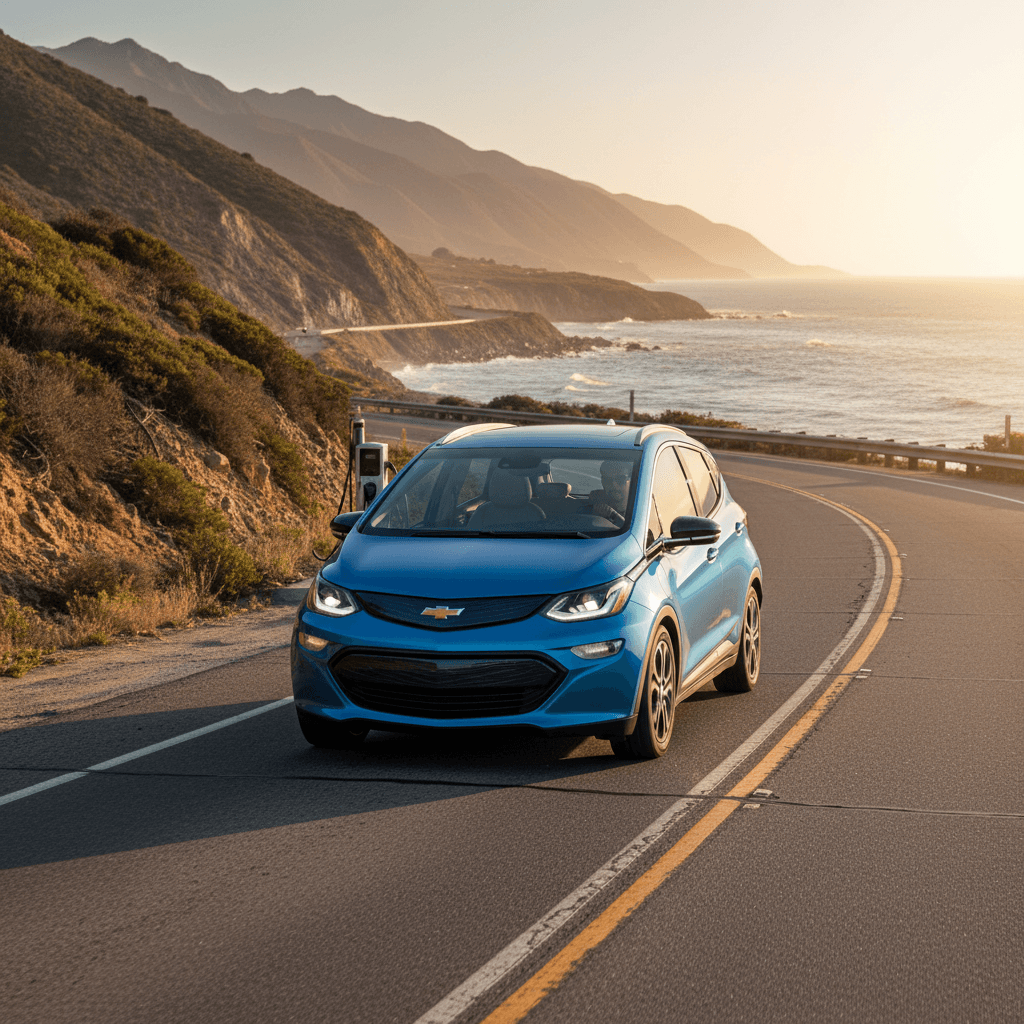
The Chevrolet Bolt EV is the introvert of road-trip cars. It’s small, upright, unassuming, and quietly hiding a battery pack big enough to cross a couple states on a good day. A Chevrolet Bolt EV road trip review, though, has to answer a harder question: can this affordable hatchback actually handle long highway days without driving you insane at every DC fast charger?
The short version
Chevy Bolt EV on a road trip: at a glance
Chevy Bolt EV highway road-trip numbers
Those numbers explain almost everything about the Bolt as a road-trip tool. It has a big battery for its size, modest aero, and just‑okay DC fast charging. Treat it like a compact crossover that happens to be extremely efficient, not a high-speed charging monster, and you’ll get along just fine.
Which Bolt is this road trip review about?
For clarity, let’s define our subject. When we say Chevrolet Bolt EV here, we’re talking primarily about the 2017–2023 hatchback with the 60–66 kWh pack, plus its slightly taller sibling, the Bolt EUV (2022–2023). Both use essentially the same battery and powertrain, with about 259 miles EPA range in later model years.
- 2017–2019 Bolt EV: ~60 kWh originally, many now have 66 kWh recall packs
- 2020–2021 Bolt EV: 66 kWh from the factory, 259‑mile EPA rating
- 2022–2023 Bolt EV and EUV: updated interior, 65–66 kWh usable, similar real‑world range
- All DC fast‑charge at up to ~55 kW peak and taper fairly aggressively above ~50% state of charge
About the 2027 Bolt
Real-world highway range in a Bolt EV
On paper, the later Bolt EV’s 259‑mile EPA range sounds like a license to cross Montana in one gulp. On an actual interstate at American speeds, you’ll never see that. What you get instead is a very repeatable, very honest 200–240 miles per leg, depending on how disciplined you are with your right foot.
How speed and conditions hit your Bolt EV range
Rough real‑world numbers from full to low state of charge, assuming a healthy pack
Best‑case cruising
60–65 mph, mild weather
- ~4.0–4.3 mi/kWh
- Usable range: 240–260 miles
- Requires patience and truck‑lane zen
Typical interstate pace
65–70 mph, light wind
- ~3.3–3.7 mi/kWh
- Usable range: 210–230 miles
- Sweet spot for time vs. efficiency
Fast & headwinds
75+ mph, bad weather
- ~2.7–3.2 mi/kWh
- Usable range: 170–200 miles
- Turns the Bolt into a short‑range sprinter
Set a realistic cruise speed
DC fast charging in the Bolt EV: how slow is slow?
Here’s the Bolt’s great moral failing as a road‑trip car: DC fast charging tops out around 55 kW, and the party doesn’t last long. From about 20–50% state of charge, you’ll see that peak. Above that, the car protects its pack by tapering, think 30–35 kW through the middle and a gentle crawl once you’re past roughly 75%.
The efficient window: 10–60%
If you plug in around 10–20% and unplug by 60–70%, you’re living in the Bolt’s happy place. Expect something like:
- Peak ~55 kW when nearly empty
- 30–40 kW through the middle
- 30–45 minutes for a useful 15–70% session
On a road trip, this typically adds 120–170 miles of real‑world range per stop.
The misery zone: 80–100%
Charging a Bolt from 80% to full on DC is a spiritual test. Power can fall into the teens (kW), which means you’re paying for electrons and minutes while getting very little distance back.
- Only worth it if the next charger is truly far away
- Better strategy: add an extra stop instead
- Use this time only when overnighting at DC or facing a charging desert
Don’t trust marketing slogans blindly
Comfort, noise, and fatigue over long days
The Bolt EV doesn’t pretend to be a luxury tourer. It’s a tall, narrow hatchback with a long wheelbase and short overhangs, more big backpack than grand tourer. On a road trip, the experience is oddly split: the powertrain is serene, the ride is acceptable, and the front seats are either fine or your personal nemesis, depending on your anatomy.
How the Bolt EV feels after 6–8 hours on the road
Where this little hatch surprises you, and where it doesn’t
Seats & driving position
2017–2021 cars had notoriously narrow seats that some drivers hate on long trips. The 2022+ refresh brought wider, better‑padded chairs. Always do an extended test drive if you’re sensitive.
Noise & refinement
Wind and road noise are moderate. It’s quieter than most subcompact crossovers, louder than a true luxury EV. Over coarse highway pavement, you’ll reach for the podcast volume.
Fatigue & mood
The upright seating and big windows are a blessing on long days. Visibility is good, ergonomics simple, and one‑pedal driving takes a lot of effort out of traffic and downhill grades.
Adaptive cruise & safety tech
Space and practicality: packing the Bolt for a trip
One of the Bolt’s great party tricks is that it’s packaged like a tiny minivan. The spec sheet calls it a subcompact, but the hatch and high roof make it feel much bigger inside than its footprint suggests. For a couple, it’s an easy week‑long road‑trip companion. For a family of four, it’s workable with discipline and soft bags.
Bolt EV & EUV cargo and practicality highlights
Approximate capacities and what they mean on the road
| Model | Seats up cargo | Seats folded | Real‑world takeaway |
|---|---|---|---|
| Bolt EV | ~16.6 cu ft | ~57 cu ft | Enough for two large suitcases + soft bags; with seats down it swallows bikes and camping gear. |
| Bolt EUV | Similar | Slightly less | A bit more rear legroom, slightly less vertical cargo; still very practical for road trips. |
| Rear seat comfort | Adult‑OK | Best for 2 | Bolstered for two adults; a third seat is short‑haul only. Kids fit fine. |
Numbers vary slightly by model year; think of these as real‑world packing guidance, not brochure trivia.
Roof racks and cargo boxes
Planning a road trip in a Bolt EV
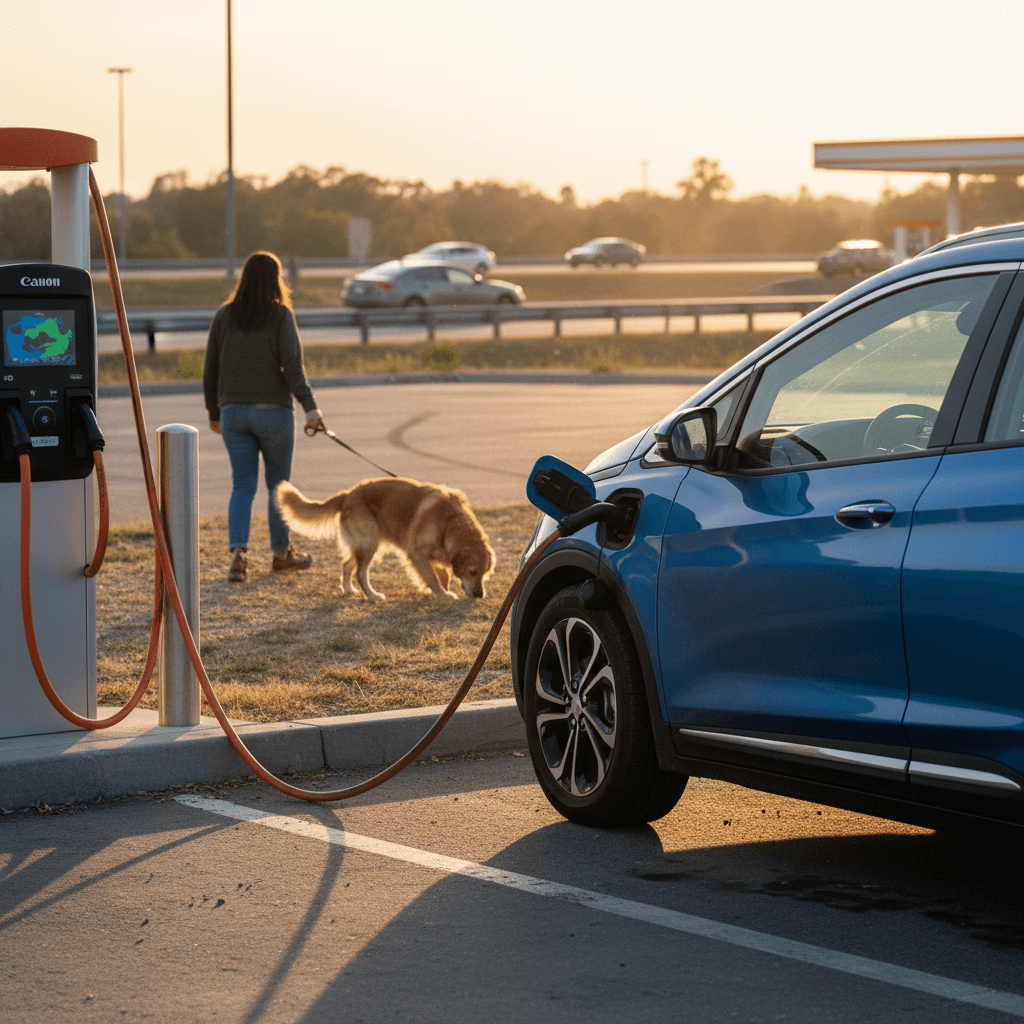
In a Lucid or Taycan, you plan road trips around where you want to stop for pastries. In a Bolt, you plan around where the next reliably working DC fast charger lives. The good news is that once you accept this, it becomes a very repeatable game: drive 2–3 hours, charge 30–45 minutes, walk the dog, repeat.
Step‑by‑step: planning a successful Bolt EV road trip
1. Map DC fast chargers first, not destinations
Use PlugShare, A Better Routeplanner, or your preferred app to plot CCS and NACS (with adapter) fast chargers along your route. In a Bolt, you’re ideally never more than 150–180 miles from your next stop.
2. Aim to arrive low, leave around 60–70%
To keep average charging speeds decent, arrive at chargers around 10–20% and unplug by 60–70% when possible. Two shorter, efficient stops usually beat one long, painful 10–95% slog.
3. Keep cruise at 65–70 mph when you can
Every 5 mph over 70 bites into your range. Slowing down a hair often saves an entire charging stop over a full day’s drive.
4. Have a Plan B charger for each leg
Because non‑Tesla networks can still be hit‑or‑miss, always know where you’d limp to if your first‑choice station is down or full.
5. Use the climate controls strategically
Precondition the cabin while plugged in, use heated seats and wheel before cranking the HVAC, and expect winter to trim your range noticeably.
6. Build your day around the Bolt’s rhythm
Think in 2–3 hour chunks. Snack, stretch, walk, and answer email during charging. If you try to rush the car, it will not rush for you.
Be realistic about rural charging
Bolt EV vs Bolt EUV: which is better for road trips?
The EUV is the Bolt’s slightly taller, slightly longer cousin, think of it as the Bolt that went to a crossover‑themed Halloween party. For road trips, the differences are real but subtle.
Bolt EV: the efficient original
- Pros: Slightly lighter and more efficient, a bit more cargo depth with seats down, usually a touch cheaper on the used market.
- Cons: Tighter rear legroom, earlier cars have narrower seats, and some trims lack the latest driver‑assist tech.
- Best for: Couples or solo drivers who prioritize efficiency and value over back‑seat comfort.
Bolt EUV: the road‑trip tweener
- Pros: More rear legroom, available Super Cruise on some trims, slightly more relaxed ride and seating position.
- Cons: A hair less efficient, marginally less cargo depth, limited model years.
- Best for: Small families and anyone who values rear‑seat comfort and semi‑hands‑free driving on compatible highways.
So which should you pick?
Used Bolt road-tripper: what to check before you buy
Because Chevrolet stopped building the original Bolt after 2023, every Bolt EV you’ll road‑trip from here on out is a used car. That’s not a bug; it’s the selling point. The question is which used Bolt, and in what condition, makes a trustworthy long‑distance partner.
Road‑trip‑focused checks for a used Bolt EV
What matters more than paint color when you’ll be living at chargers
Battery health & recall status
Confirm the LG battery recall work is complete and ask for documentation. A healthy pack should still deliver close to its original 60–66 kWh usable. At Recharged, every Bolt gets a Recharged Score battery health report so you know what you’re starting with.
Highway behavior & charging test
On a test drive, do a sustained 65–70 mph run and watch efficiency. If possible, sample a DC fast charge to verify the car reaches expected peak power and doesn’t throw charging errors.
Seats, driver aids, and comfort
Spend at least 30–45 minutes in the driver’s seat. Check for adaptive cruise, lane‑keeping, and, on EUVs, Super Cruise. These are the things you’ll care about after five hours on I‑80.
How Recharged helps here
FAQ: Chevrolet Bolt EV road trip questions
Chevy Bolt EV road trip FAQ
Is the Chevy Bolt EV a good road trip car? Final verdict
The Chevrolet Bolt EV is not a heroic road‑trip machine in the modern EV sense. It doesn’t gulp electrons at 250 kW or shrink continents on a whim. What it does is quietly, efficiently, and affordably turn electricity into miles in a way that makes long drives entirely possible for patient, organized drivers.
If you’re the kind of traveler who already prefers two‑ to three‑hour stints between breaks, who doesn’t mind 65–70 mph in the right lane, and who can treat charger stops as built‑in coffee or dog‑walking time, the Chevy Bolt EV can absolutely be your road‑trip car. If you are constitutionally allergic to planning or routinely drive 500‑mile days at extra‑legal speeds, you’re shopping in the wrong segment.
On the used market, that gap between expectation and reality is your opportunity. Bolts are some of the most affordable long‑range EVs you can buy, and with a healthy pack and a realistic plan, they turn into wildly capable little distance tools. At Recharged, you can shop used Bolt EVs and EUVs with verified battery health, transparent pricing, expert help on charging strategy, and nationwide delivery, so the only drama on your next road trip is which podcast to queue up, not whether you’ll make it to the next plug.