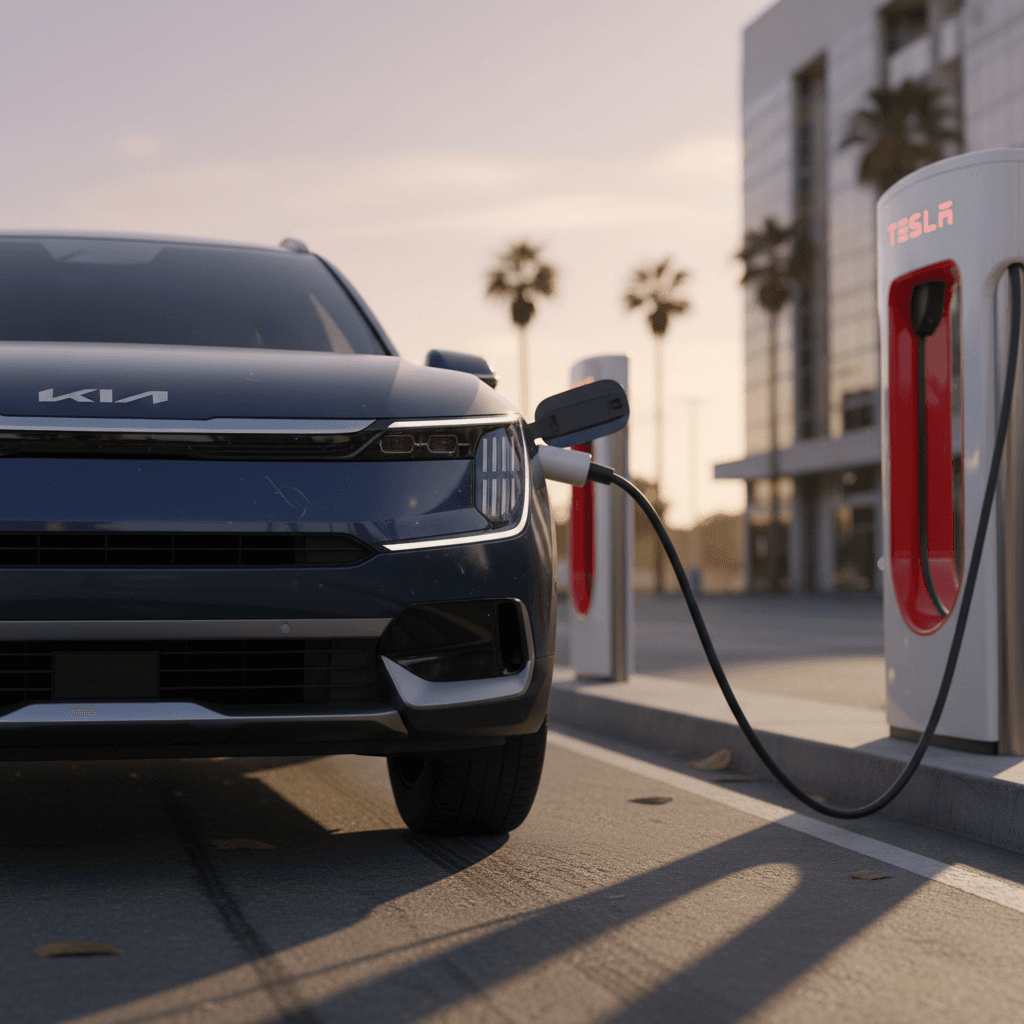
If you drive a Nissan Leaf or another CHAdeMO-equipped EV, you’ve probably stared at a busy CCS fast charger while the CHAdeMO handle sits unused. A CHAdeMO to CCS adapter sounds like the perfect fix: plug your CHAdeMO car into a CCS station and unlock a much bigger DC fast charging network. In 2025, that dream is finally starting to become real, but it comes with serious caveats you need to understand before you spend hundreds of dollars on hardware that could be unsafe, unusable at many stations, or obsolete within a few years.
Who this guide is for
Why CHAdeMO to CCS adapters are a hot topic in 2025
CHAdeMO’s shrinking footprint in North America
CHAdeMO was the first widely deployed DC fast charging standard in North America, anchored by the Nissan Leaf and some early Mitsubishi models. But in 2025, virtually all new public DC fast charging hardware uses CCS or Tesla’s NACS/J3400. As networks retire older hardware, CHAdeMO drivers see fewer and fewer fast options, especially on highway corridors.
The existential problem for CHAdeMO drivers
CHAdeMO vs CCS: a quick explainer
CHAdeMO
- Originated in Japan; used by Nissan Leaf, some Mitsubishi and older EVs.
- Separate DC port alongside the J1772 AC port.
- Typical power: 50 kW in North America, with a few higher-power sites.
- Communication uses CAN bus, the same protocol that ties together many in-car computers.
- Being phased out in most markets outside Japan.
CCS (Combined Charging System)
- Standard for most non-Tesla EVs in North America up to 2024–2025.
- Combines AC and DC pins into a single inlet (CCS1 in the U.S.).
- Typical power: 50–350 kW, depending on site hardware and vehicle.
- Communication uses PLC (Power Line Communication), a different technology than CHAdeMO.
- Being joined (and eventually replaced) by Tesla’s NACS/J3400 standard.
Why adapters are hard
Do CHAdeMO to CCS adapters actually exist now?
For years the answer was an easy “no”, at least for DC fast charging. Level 1/Level 2 AC adapters between various plugs have been around for a long time, but DC fast charging between CHAdeMO and CCS was considered too complex and niche to justify a commercial product.
That has changed. In 2024 and 2025, a handful of companies, especially in Asia, began selling CCS1-to-CHAdeMO adapters that claim to let CHAdeMO vehicles charge on CCS fast chargers. These are typically substantial, box-like devices with built-in control electronics and firmware that can be updated over USB-C.
Official bodies still don’t endorse them
How a CHAdeMO to CCS adapter works (and why it’s tricky)
Think of a CHAdeMO to CCS adapter as a mini charging station in a box. On one side it “pretends” to be a CHAdeMO car talking to a CCS charger; on the other side it “pretends” to be a CCS charger talking to your CHAdeMO vehicle. In real time, it has to translate all the messages about voltage, current, fault conditions, and shutdown between two very different languages.
- It takes high-voltage DC power from the CCS connector (often up to 500–600 V).
- Internal electronics manage contactor control, isolation monitoring, and thermal protection.
- Firmware constantly translates commands between CCS (PLC) and CHAdeMO (CAN bus).
- If anything looks unsafe, overheating, communication failure, insulation fault, the adapter has to stop the session instantly.
- All of this happens in a rugged, weather-exposed device that regular drivers use without training.
Why mistakes are serious at DC fast charge power
Safety and warranty risks you need to know
Key risks of CHAdeMO–CCS adapters
Before you buy, understand what you’re signing up for.
1. Limited certification
2. Vehicle warranty exposure
3. Thermal and reliability issues
Read the fine print, especially from charge networks
Real-world CHAdeMO–CCS adapters and what they promise
Because this is an evolving market, specific brand recommendations age quickly. Instead, it’s more useful to understand the typical specs and tradeoffs you’ll see when you search for a CHAdeMO to CCS adapter in 2025.
Typical CCS1-to-CHAdeMO adapter specs in 2025
Representative numbers from current products; always verify the latest specs with the manufacturer before buying.
| Attribute | Common Value | What it means for you |
|---|---|---|
| Rated power | Up to ~50 kW | Good enough to match many Leaf and CHAdeMO vehicle limits, but won’t unlock 150–350 kW speeds. |
| Rated current | 125–200 A | Higher current rating generally supports higher power at mid-pack voltages. |
| Voltage range | Up to ~600 V | Fine for most CHAdeMO cars, which typically use pack voltages well below 500–600 V. |
| Weight | ~5–12 lb (2–5 kg) | You’re carrying a small brick, not a pocket adapter, consider storage and ergonomics. |
| Firmware updates | USB-C or app-based | Crucial for fixing handshake bugs with different chargers and vehicles. |
| Price | Around $700–$1,000+ | A sizable investment for an older car, especially if you’re already considering upgrading your EV. |
Example specifications only, do not assume every product meets these values.
How to evaluate a specific adapter
Network rules: can you use these adapters anywhere?
Even if you buy a robust CHAdeMO–CCS adapter, that doesn’t mean every charging provider is okay with you using it. In 2025, networks are under pressure to keep uptime high and minimize fire risk, so they’re tightening what’s allowed at their sites.
Before you depend on an adapter, check these policy questions
1. Does the network allow third-party DC adapters?
Some providers explicitly prohibit unapproved DC adapters and extension cables in their terms of service. If you ignore those terms and cause damage, you could be on the hook.
2. Is the adapter from an automaker or a third party?
Networks are far more comfortable with OEM-provided adapters (for example, NACS to CCS) that meet specific standards. CCS–CHAdeMO adapters are currently produced mostly by smaller third parties.
3. Is the site monitored or staffed?
At staffed sites, employees may intervene if they see an unfamiliar device hanging between the charger and your car. At unattended sites, you’re less likely to be confronted, but you’re still assuming the risk.
4. What’s your backup plan?
If the adapter doesn’t work at a given station, because of policy, firmware, or a simple handshake bug, make sure you have another charger within range or a slower Level 2 option nearby.
Is a CHAdeMO to CCS adapter right for you?
Who might (and might not) want a CHAdeMO–CCS adapter
Be honest about your range needs, risk tolerance, and upgrade timeline.
You might consider an adapter if…
- You own a newer Leaf or CHAdeMO EV in good condition and plan to keep it several more years.
- You routinely drive routes where CHAdeMO coverage has recently disappeared but CCS stations are plentiful.
- You’re comfortable being an early adopter and keeping up with firmware updates and user communities.
- You understand that some sites or sessions will fail and that you always need a backup plan.
You probably shouldn’t if…
- Your CHAdeMO EV is older, out of warranty, and not worth much more than the cost of the adapter itself.
- You only fast charge a few times a year and can work around current CHAdeMO locations.
- You’re not comfortable troubleshooting failed sessions or reading technical documentation.
- You’re already thinking seriously about upgrading to a CCS or NACS-equipped EV in the next 12–24 months.
Run the math before you buy
Smart alternatives: upgrading your EV or charging strategy
For a lot of CHAdeMO drivers, the best answer isn’t a complex DC adapter, it’s a smarter overall charging strategy or a planned transition into a newer EV. Here are options worth comparing against the adapter path.
Alternatives to buying a CHAdeMO–CCS adapter
Ways to future-proof without strapping more hardware between your car and the grid.
1. Rely more on Level 2
2. Re-plan trip routes
3. Upgrade to CCS or NACS
Think of the adapter as a down payment
How Recharged helps if you’re ready to move on from CHAdeMO
If this guide leaves you feeling like an adapter is more hassle than help, you’re not alone. Many CHAdeMO drivers reach the point where they’d rather upgrade the car than keep fighting a shrinking charging standard.
- Recharged is a dedicated marketplace for used electric vehicles, with transparent pricing and expert guidance tailored to EVs, not gas cars.
- Every vehicle comes with a Recharged Score Report, including verified battery health, so you can see how much real-world range you’re getting, not just what the window sticker once claimed.
- You can trade in your CHAdeMO car, get an instant offer or list it on consignment, and apply that value toward a CCS- or NACS-equipped EV.
- Our team can walk you through charging options, adapter compatibility, and trip planning so your next EV is aligned with how, and where, you actually drive.
- You can complete the whole purchase process digitally, or visit our Experience Center in Richmond, VA if you prefer in-person support.
From CHAdeMO stress to future-proof charging
Ready to find your next EV?
Browse VehiclesFAQ: CHAdeMO to CCS adapter questions
Frequently Asked Questions
Bottom line on CHAdeMO to CCS adapters
CHAdeMO to CCS adapters are no longer vaporware. In 2025, real products exist that can, in many situations, let your Leaf or other CHAdeMO EV tap into CCS DC fast chargers. But they’re still complex, relatively expensive, and not yet blessed by the major standards bodies, automakers, or networks. If you’re technically inclined, comfortable accepting some risk, and locked into a CHAdeMO car for the long haul, an adapter can extend your fast charging options for a few more years.
For many drivers, though, the smarter move is to zoom out. Instead of stacking hardware on top of a shrinking standard, consider whether your money is better spent improving your home charging, planning trips around the infrastructure that still exists, or upgrading into a CCS or NACS EV with a healthier long-term outlook. If you’re in that camp, Recharged is built to make that transition simpler, combining verified battery health, fair pricing, financing, trade‑in options, and EV‑savvy support into a single, transparent experience.