Searching for “car electrical repair near me” usually means your car is already trying to tell you something: dim headlights, a dead battery, a dashboard lit up like a Christmas tree, maybe an EV that refuses to wake up. Electrical problems are the great equalizer of modern vehicles, gas, hybrid, or fully electric, so choosing the right shop isn’t just convenient, it’s a reliability and safety decision.
Modern cars are rolling computers
Why “car electrical repair near me” matters more than you think
The electrical system is the nervous system of your car. The battery and alternator supply power, wiring and fuses distribute it, and dozens of modules decide what happens when you press a pedal or push a button. When something goes wrong, you’re not just dealing with inconvenience, you’re dealing with a potential safety issue, especially at night, in bad weather, or on the highway.
Why electrical issues deserve fast attention
Don’t ignore electrical warning signs
Common car electrical problems and warning signs
“Car electrical problem” sounds vague, but most issues fall into a few familiar buckets. Knowing the patterns helps you talk more clearly with the shop you choose, and spot the difference between a minor fix and an emerging crisis.
7 electrical problems shops see every day
From dead batteries to mysterious warning lights, these are the usual suspects when you Google "car electrical repair near me".
1. Weak or dead battery
Your battery supplies the power to start the engine and boot all those control modules.
- Symptoms: slow cranking, clicking but no start, dim interior lights, frequent jump-starts.
- Typical fix: battery test and replacement, cleaning corroded terminals.
2. Failing alternator
The alternator charges the battery while you drive. When it quits, you’re running on borrowed time.
- Symptoms: battery warning light, dimming headlights, accessories shutting off, burning rubber smell, squealing belt.
- Typical fix: alternator and belt inspection, likely alternator replacement.
3. Starter motor issues
The starter is a heavy-duty electric motor. When it gets tired, you feel it.
- Symptoms: loud click but no crank, intermittent starting, no response from the key or start button.
- Typical fix: starter replacement and wiring/ground checks.
4. Blown fuses & relays
Fuses and relays are the electrical system’s safety valves.
- Symptoms: single feature dies suddenly, windows, radio, power seats, horn, wipers.
- Typical fix: replace the fuse/relay, then trace anything that caused the overload.
5. Wiring faults & shorts
Modern cars use delicate wiring looms. Age, heat, and rodents are not friends.
- Symptoms: random warning lights, intermittent failures, blown fuses that keep blowing, burnt-plastic smell.
- Typical fix: visual inspection, wiring repair or harness replacement.
6. Control module (computer) faults
From engines to door locks, a lot is run by software now.
- Symptoms: persistent warning lights, limp mode, features that work one day and not the next.
- Typical fix: scan-tool diagnostics, software updates, occasionally module replacement and programming.
7. Lighting & accessory problems
Headlights, taillights, infotainment, clusters, all depend on solid electrical supply.
- Symptoms: dim or flickering lights, stereo cutting out, screens going black, power seats or windows stalling.
- Typical fix: bulb or LED unit replacement, switch or wiring repair, ground cleaning.
Watch for patterns, not one-offs
What car electrical repair usually costs
Nobody Googles “car electrical repair near me” for fun; there’s a number you’re dreading. While costs vary by region and vehicle, there are fairly consistent ranges for common jobs.
Typical car electrical repair cost ranges (U.S.)
These are ballpark ranges for passenger vehicles as of late 2025, not quotes. EV and luxury models can skew higher.
| Repair | What It Covers | Typical Cost Range |
|---|---|---|
| Battery replacement | New battery, installation, recycling | $200 – $350 |
| Alternator replacement | Alternator, belt check, labor | $400 – $900 |
| Starter replacement | Starter motor and labor | $450 – $900+ |
| Fuse or relay replacement | Single circuit issue | $20 – $150 |
| Computer diagnostics | Scan-tool time, basic testing | $120 – $250 |
| Wiring repair | Tracing and fixing damaged wiring | $200 – $600+ |
| Module replacement & programming | ECU/BCM or other control unit | $400 – $1,200+ |
Always ask for a written estimate and diagnostic line item before approving work.
Why diagnostics isn’t “just plugging in a scanner”
How to find good car electrical repair near you
Electrical problems separate the parts changers from the true diagnosticians. You’re not just looking for a shop that’s nearby, you’re looking for one that’s methodical, transparent, and equipped for modern cars and EVs.
Checklist: Choosing the right auto electrical repair shop
1. Ask about diagnostic process, not just price
When you call, ask: “How do you usually diagnose electrical issues?” Listen for words like <strong>testing</strong>, <strong>wiring diagrams</strong>, and <strong>step-by-step diagnosis</strong>, not just “We’ll try a new battery.”
2. Look for electrical and EV certifications
For gas cars, look for ASE-certified technicians or manufacturer training. For EVs and hybrids, ask specifically about <strong>high‑voltage training</strong> and safety certifications.
3. Confirm they have modern diagnostic tools
Shops should have up-to-date scan tools, access to factory service information, and the ability to test batteries, alternators, and parasitic draws, not just a cheap code reader.
4. Check reviews for electrical work, not just oil changes
In reviews, search for “electrical,” “no start,” “alternator,” or “wiring.” You want to see stories about tricky issues solved, not just fast tire rotations.
5. Ask for written estimates and clear communication
A good shop will separate <strong>diagnostic time</strong> from <strong>repairs</strong>, send photos or videos, and explain what they found in plain language before you approve anything.
6. Evaluate how they talk about safety
If you mention an EV, hybrid, or burning smell and the answer is “just bring it in, it’s fine,” that’s a red flag. You want a shop that takes electrical safety seriously.
Using online search the smart way
- Search a mix of terms: “car electrical repair near me”, “auto electrician near me,” “alternator repair near me.”
- Open 3–5 shop sites and look for a page specifically about electrical diagnostics or EV service.
- Favor shops that explain their process instead of just listing coupons.
What to say when you call
Give the advisor a quick, structured story:
- Year, make, model, mileage.
- Exact symptoms and when they happen (cold start, after rain, at highway speeds).
- Any warning lights or recent work (new battery, audio install, etc.).
Good input gets you better output: detailed information encourages a shop to treat your case seriously from the start.
Extra checks if you drive an EV or hybrid
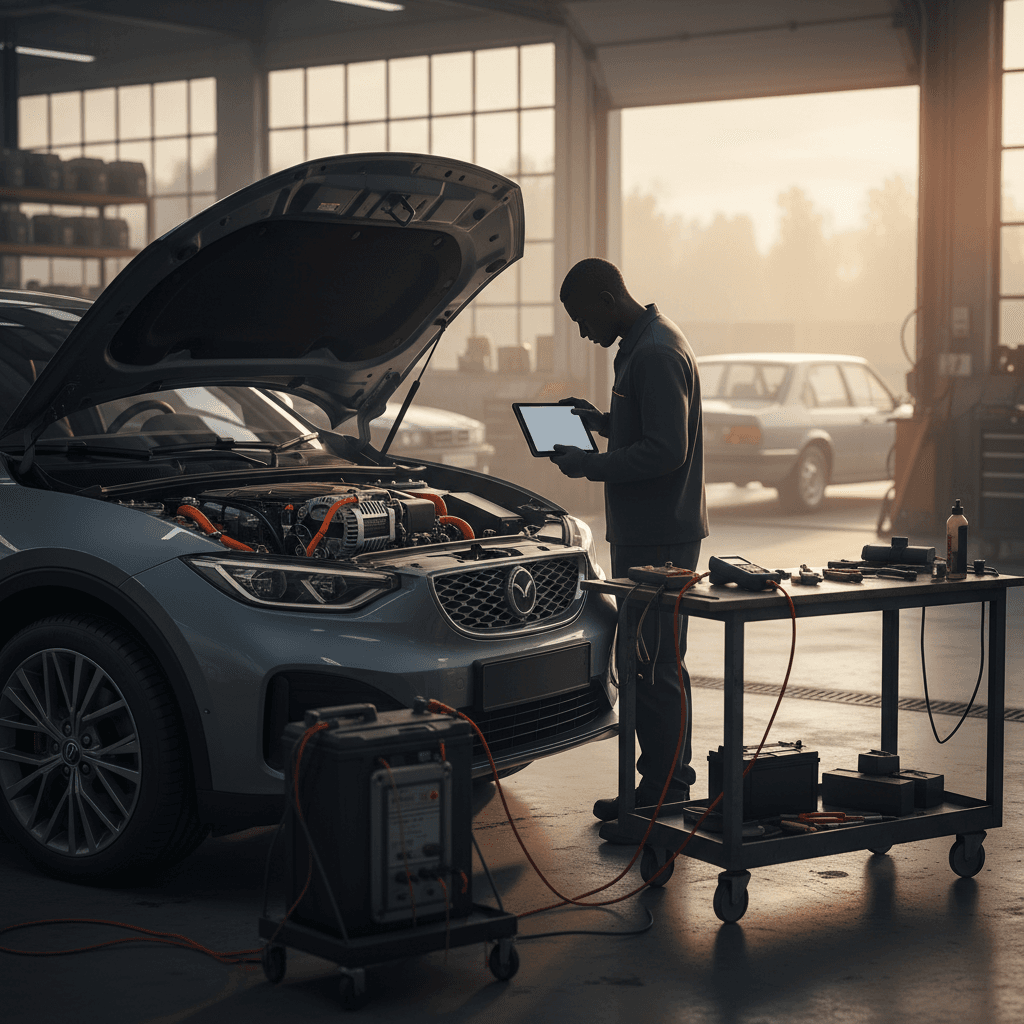
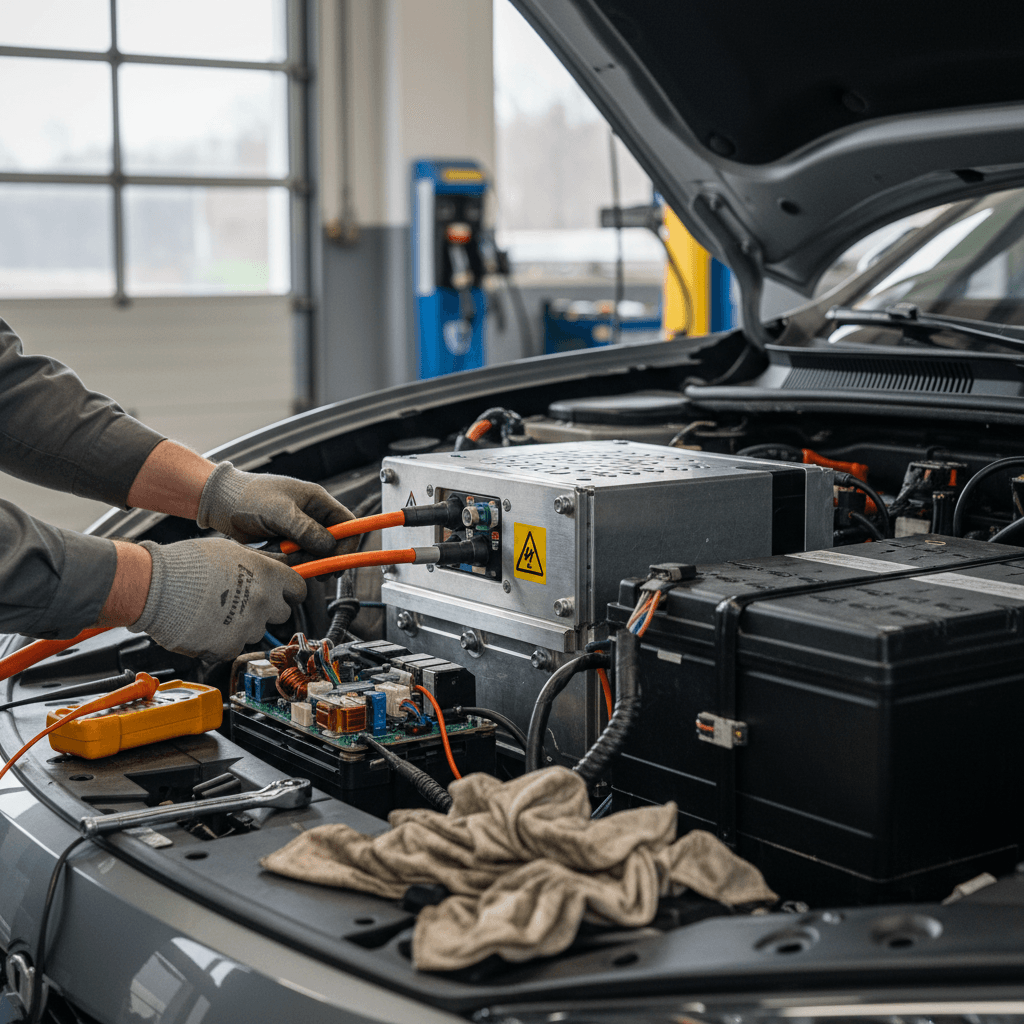
With an EV or hybrid, “electrical repair” can mean anything from a 12‑volt battery swap to work near a 400–800‑volt high‑voltage battery pack. Those are not the same universe of risk. You need a shop that respects that difference.
What to ask if you’re booking EV or hybrid electrical repair
High voltage changes the rules. Your safety depends on the shop knowing that.
Do you have EV-specific training and PPE?
A qualified EV shop should be able to tell you:
- Which high‑voltage safety training their techs completed.
- That they use insulated tools and gloves around orange HV cables.
- How they power down and verify a de‑energized system before working.
Can you distinguish 12‑volt vs high‑voltage issues?
Many “dead EV” complaints are simply a failed 12‑volt battery, but others involve traction batteries or inverters.
- Ask how they diagnose no‑start or no‑charge situations.
- Look for a methodical process, not guesswork.
Will you document battery health?
For used EVs, battery health is a big part of resale value.
Ask if the shop can provide:
- State-of-health reports
- Charge history or fault-code summaries
- Printouts you can keep with service records
Are you comfortable saying “we don’t do that”?
A trustworthy shop will have boundaries.
If they’re not equipped for deep HV work, they should be willing to:
- Handle basic 12‑volt issues only, or
- Refer you to a specialist or dealer.
Hearing “we’re not the right shop for that” can be a very good sign.
Never DIY high‑voltage EV repairs
DIY vs professional car electrical repair
There’s a place for DIY in electrical work, testing a battery, replacing a fuse, swapping a bulb. And there’s a hard line where you should stop, for your safety and your wallet.
Reasonable DIY electrical jobs
- Checking and cleaning battery terminals (with the car off).
- Replacing easily accessible fuses with the correct amperage.
- Swapping conventional bulbs for OEM‑equivalent replacements.
- Using a basic multimeter to check battery voltage.
If you’re unsure, photograph the fuse box and owner’s manual pages before you pull anything.
Jobs to leave to the pros
- Repeatedly blown fuses or melted fuse panels.
- Wiring repairs under the dash or in the engine bay.
- Alternator, starter, or control module replacement.
- Any work involving hybrid or EV high‑voltage components.
Modern vehicles are sensitive; it’s frighteningly easy to turn a $150 fix into a four‑figure control module replacement.
A good rule of thumb
Simple ways to prevent future electrical issues
Once your car is back to behaving itself, a little routine care can keep you from repeating the same Google search in six months.
- Test your battery at least once a year, and before winter or a long road trip.
- Keep battery terminals tight and free of corrosion; a baking-soda solution and a brush go a long way.
- Avoid stacking aftermarket electronics, huge stereos, light bars, inverters, without professional wiring and proper fusing.
- Fix water leaks quickly; moisture in the cabin or trunk can quietly ruin wiring and modules.
- Pay attention to early warning signs: dim lights, slow cranking, warning icons, and strange smells are your early-warning system.
- For EVs, keep software up to date and follow the manufacturer’s recommendations for charging habits and inspections.
Use service records as a shield
Where Recharged fits into the picture
If you’re shopping for a used EV, one of the scariest unknowns is the electrical system, especially the battery and charging gear. That’s exactly the anxiety Recharged is built to remove.
Buying a used EV? Electrical health is half the story.
Here’s how Recharged makes EV electrical and battery health less mysterious.
Recharged Score battery diagnostics
Every EV listed through Recharged comes with a Recharged Score Report, including verified battery health. You get data on degradation and usable range, not just a mileage number and a smile.
Expert EV guidance, start to finish
Our EV specialists help you understand what electrical and battery history matters, what doesn’t, and how that should influence your buying decision and maintenance plan.
Trade-in, financing & delivery
From instant offers and consignments to financing and nationwide delivery, Recharged is designed to make moving into your next EV as smooth and transparent as possible.
So while a local shop is still your go‑to for day‑to‑day electrical repairs, a platform like Recharged helps you start with a car whose electrical and battery health are already documented, making every future repair decision simpler and more predictable.
FAQ: Car electrical repair near me
Frequently asked questions about car electrical repair
When you type “car electrical repair near me”, you’re not just hunting for the closest shop, you’re choosing who gets to interpret the nervous system of your car. Look for methodical diagnostics, clear communication, and, if you drive an EV, proven high‑voltage expertise. That combination will save you time, money, and a lot of late-night parking-lot drama. And when it’s time to choose your next EV, starting with a verified electrical and battery health report, like the Recharged Score, means the odds are on your side from day one.