Shopping for a car charger for your electric car feels strangely harder than buying the car. Amps, kilowatts, tax credits, NEMA outlets, suddenly you need to moonlight as an electrician just to get to work tomorrow. Let’s de‑mystify home charging, so you know exactly what to buy, what it will really cost, and how to future‑proof your setup.
The short version
Why the right car charger for your electric car matters
If you’re using the included 120V brick that came with your EV, you’ve already discovered its limitations. A Level 1 charger adds maybe 3–5 miles of range per hour, fine if you drive very little, maddening if you don’t. A properly sized home Level 2 charger can add 20–45 miles of range per hour, turning your driveway into the only “gas station” you regularly need.
Charging a typical EV at home in 2025
Don’t overpay for public charging
EV charging levels explained: Level 1 vs Level 2 vs DC fast
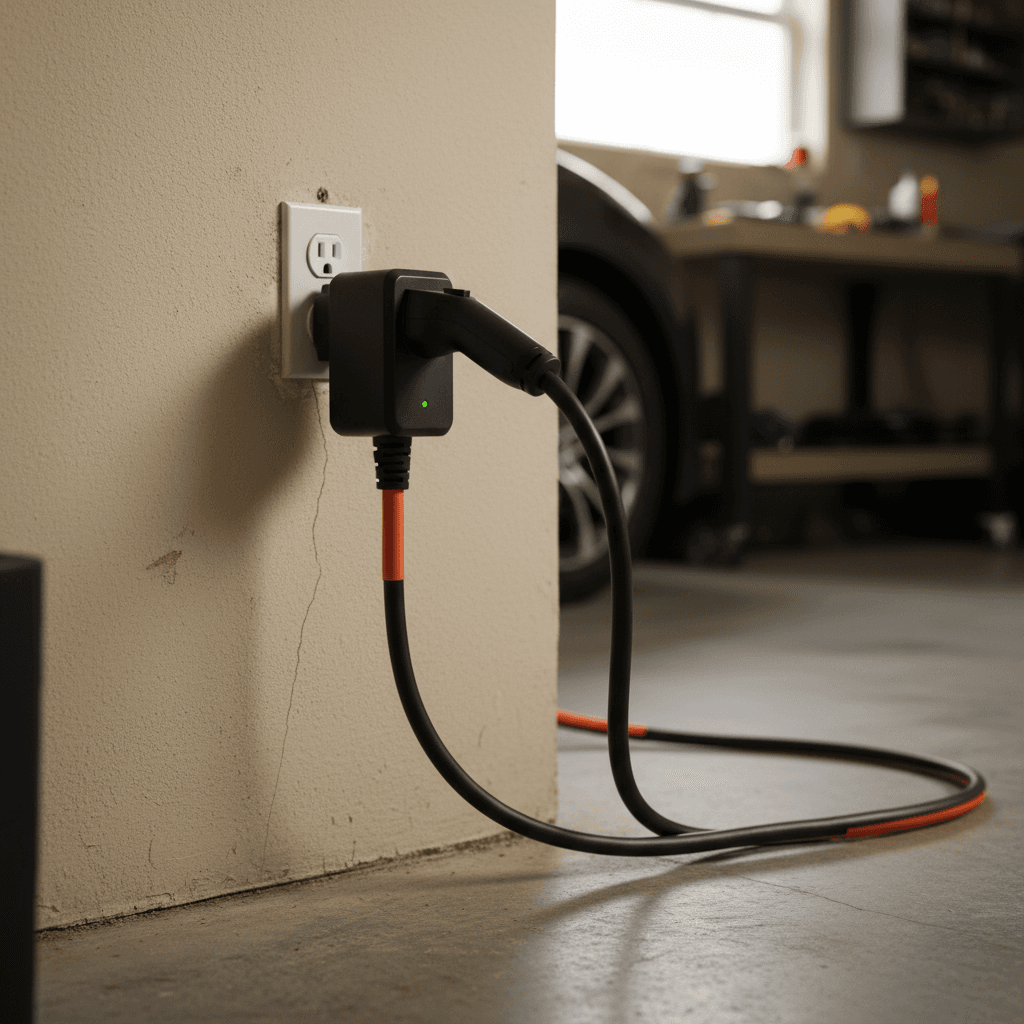
Level 1: The “included” backup
- Voltage: 120V household outlet
- Power: ~1.4–1.9 kW
- Speed: roughly 3–5 miles of range per hour
- Best for: very short commutes, plug‑in hybrids, or emergency top‑ups
Think of Level 1 as the doughnut spare tire of charging: good to have, not something you rely on every day.
Level 2: The home charging workhorse
- Voltage: 240V dedicated circuit
- Power: commonly 7–11 kW for home units
- Speed: about 20–45 miles of range per hour, depending on car
- Best for: primary at‑home charging for almost every EV driver
Level 2 is what makes EV life feel effortless: you plug in at night and wake up to a “full tank.”
DC fast charging (often branded as 50–350 kW) lives in a different universe: highway stations, thick cables, expensive equipment, and commercial power rates. It’s brilliant for road trips and utterly overkill for home. You can’t practically or safely install DC fast charging in a typical US residence in 2025, and you don’t need to.
Follow the 90% rule
How fast will my electric car charge at home?
Your charging speed depends on three things: charger power (kW), your car’s onboard AC charger limit, and your battery size. The slowest link in that chain sets the pace, not the biggest number on the box.
Real‑world home charging examples
Approximate overnight charging speeds for common setups. Actual numbers vary by model and weather.
| Charger type | Circuit & amps | Max power | Approx mi/hour | Who it suits |
|---|---|---|---|---|
| Level 1 portable | 120V / 12A | 1.4 kW | 3–4 | Under 25 miles of driving per day |
| Level 2 “light” | 240V / 24A | 5.7 kW | 15–20 | Apartments or older homes with limited capacity |
| Level 2 standard | 240V / 32–40A | 7.7–9.6 kW | 25–35 | Most suburban homeowners |
| Level 2 high‑power | 240V / 48–60A | 11.5–14.4 kW | 35–45 | Large‑battery SUVs and heavy commuters |
Assumes ~3 mi/kWh efficiency and typical modern EVs.
Bigger isn’t always faster
Types of car chargers for an electric car at home
Three main home charger formats
They all deliver electrons; the experience is what changes.
Portable Level 2
Looks like the travel charger your car came with, but runs on 240V.
- Plugs into outlets like NEMA 14‑50
- Easy to take when you move
- Great for renters or multi‑home charging
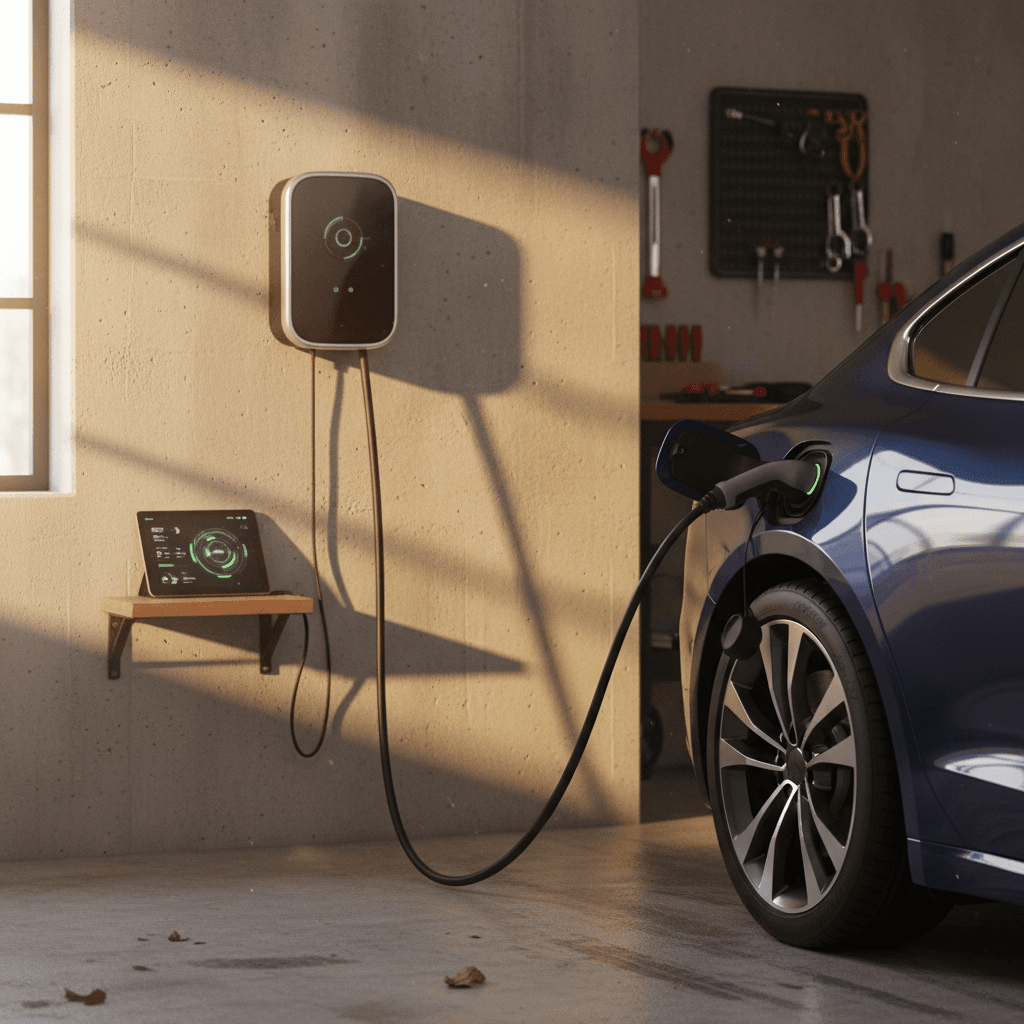
Wall‑mounted station
The classic hard‑wired box in your garage or driveway.
- Clean install, no visible outlets
- Often supports higher amps
- Best choice if this is your long‑term home
Smart connected charger
A wall box or portable unit with Wi‑Fi/app control.
- Schedules for off‑peak rates
- Energy tracking and user access control
- Some support bidirectional or solar integration
About “included” chargers
Key features to compare when choosing a charger
What to look for in a home car charger
1. Amperage and power
For most drivers, a <strong>32–40A</strong> charger (7.7–9.6 kW) hits the sweet spot of speed, panel friendliness, and cost. Only go 48A+ if your car and panel can actually use it.
2. Plug type vs hard‑wired
A NEMA 14‑50 plug‑in offers flexibility, you can replace the charger without an electrician. Hard‑wired is cleaner and sometimes required outdoors, but less portable.
3. Cable length and ergonomics
Aim for a <strong>20–25 foot</strong> cable so you’re not playing twister in your driveway. Check for a sturdy holster and a connector that’s easy to handle with gloves on.
4. Smart features that matter
Scheduling for off‑peak hours, basic energy tracking, and reliable app connectivity are more useful than gimmicks. Compatibility with your utility’s EV rate plans is a plus.
5. Weather rating and location
Look for NEMA 3R/4 ratings if the unit will live outdoors. Wall boxes handle weather better than dangling portable units in a carport.
6. Connector standards and future‑proofing
In North America, new EVs are converging on <strong>NACS</strong> (Tesla plug), but many existing cars still use <strong>CCS/J1772</strong>. Adapters and dual‑standard chargers make transitions easier.
A simple spec to remember
What a home car charger really costs in 2025
The sticker price on the box is only part of the story. To understand the true cost of a car charger for your electric car, you need to factor in hardware, installation, and operating cost, and then subtract available incentives.
Typical cost breakdown for home charging
Approximate US costs in 2025; your local electrician and utility will give the final word.
| Item | Low | High | Notes |
|---|---|---|---|
| Level 2 charger hardware | $300 | $1,200 | More for high‑power, Wi‑Fi, or bidirectional units |
| Basic installation | $250 | $800 | Short wire run, panel has capacity |
| Heavy‑up / new circuit | $1,000 | $2,000+ | Panel upgrades or long conduit runs |
| Operating cost (year) | $400 | $900 | Depends on kWh rate and miles driven |
Installation can be trivial in a new build and substantial in an older home.
Don’t forget incentives
Once installed, home charging is typically the cheapest way to “fuel” an EV. At around $0.15–$0.18 per kWh in many states, a 75 kWh battery top‑up might cost roughly $11–$14 at home, versus 2–3 times that at a public DC fast charger in 2025.
Installation, safety, and where to put your charger
Electricians will tell you there are two kinds of jobs: straightforward and “who wired this place?” Where your home lands on that spectrum determines how painless your charger install will be.
- Hire a licensed electrician who’s installed EV chargers before, this is not a DIY water‑heater swap.
- Ask for a load calculation on your panel to see what amperage you can safely support.
- Decide on a location where the cable can reach your car in its usual parking spots without extension cords.
- If you’re in a condo or apartment, talk to the HOA or landlord early; many already have policies and preferred installers.
- Consider future needs: if you might add a second EV, it’s cheaper to plan conduit and panel capacity now.
Safety first, always
Smart charging strategies and battery health
Lithium‑ion batteries are like people: they prefer moderation. Extreme fast charging, constant 0–100% swings, and high heat all make them age faster. The right car charger for your electric car should make it easier, not harder, to treat the pack kindly.
Three habits that keep your battery happy
Use your charger’s settings to automate all of this.
Schedule off‑peak charging
Set your charger or car to start charging late at night.
- Lower electricity rates on time‑of‑use plans
- Cooler battery temps in hot climates
- Less strain on the grid
Aim for 20–80%
For daily driving, there’s rarely a need to top to 100%.
- Improves long‑term battery health
- Reduces time spent in slow “top‑off” phase
- Reserve 100% for road‑trip days
Use the app, not your memory
Most EVs and smart chargers have solid apps.
- Set and forget charge limits
- Get alerts if charging stops unexpectedly
- Track energy use for tax or reimbursement
Home charging is kinder to the battery
How Recharged helps you get charging right from day one
If you’re still shopping for an EV, home charging shouldn’t be an afterthought, especially with a used car, where battery history matters. Every vehicle sold through Recharged includes a Recharged Score Report with verified battery health and charging data, so you understand how the previous owner actually treated the pack.
See how your future car will charge
- Recharged Score shows estimated real‑world range and charging performance.
- Our EV specialists can explain how your specific model behaves on Level 1 vs Level 2.
- We’ll help you right‑size a car charger for your electric car based on your commute and panel capacity.
From driveway to plug, handled
- Digital buying experience with financing and trade‑in options.
- Guidance on charger selection and what to ask your electrician.
- Nationwide delivery plus an Experience Center in Richmond, VA if you’d rather talk it through in person.
Pair the right car with the right charger
Ready to find your next EV?
Browse VehiclesFAQ: Car charger for electric car
Frequently asked questions
A good car charger for your electric car doesn’t have to be exotic or expensive, it just has to be the right match for your driving, your home, and your future plans. Focus on a solid 32–40A Level 2 unit, a safe 240V installation, and smart settings that keep both your battery and power bill happy. Get those basics right and charging fades into the background of ownership, leaving you to enjoy what EVs are really good at: quiet, quick, low‑maintenance miles. And if you’re still choosing the car itself, Recharged can help you line up the right EV and the right charger from day one.