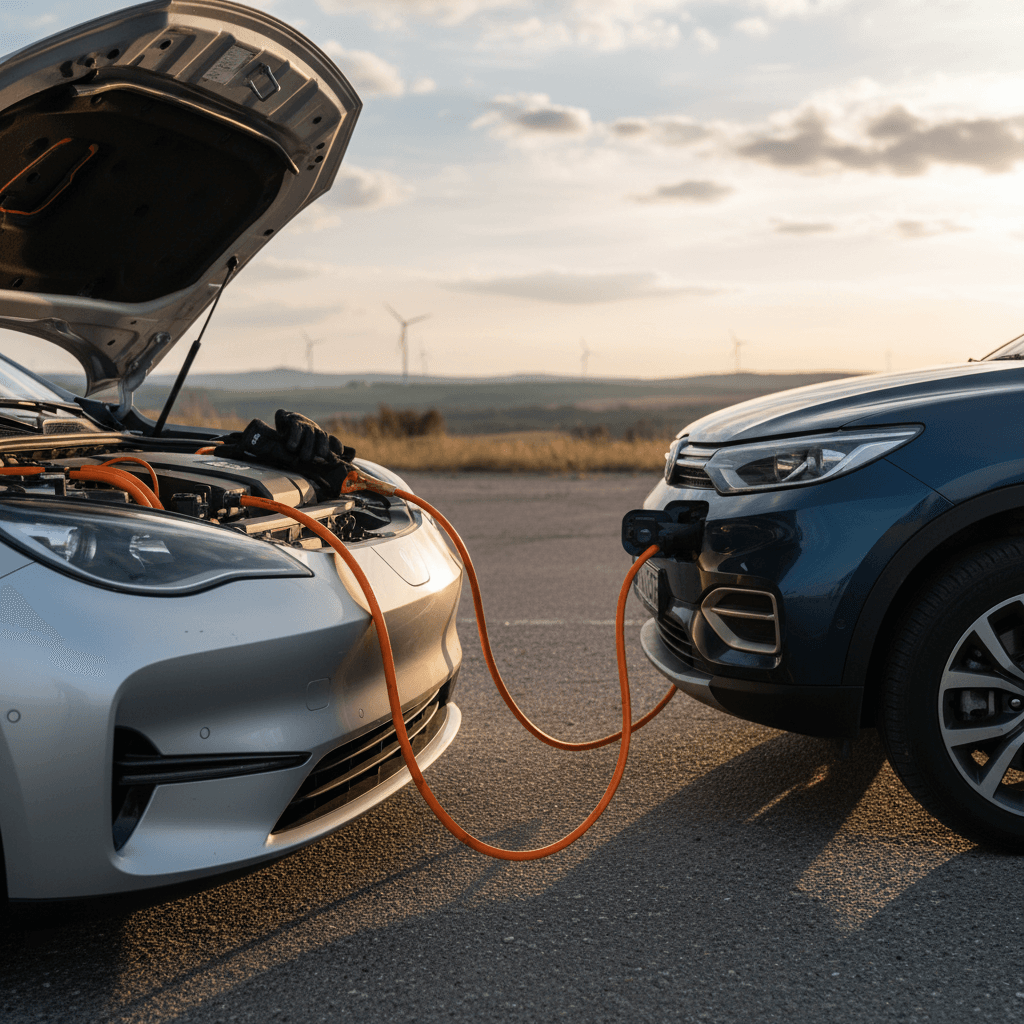
If you’ve popped the hood on your electric car and found a dead battery, you’re probably asking yourself, “Can you jump start an electric car?” The short answer: yes, in many cases you can jump the small 12‑volt battery in an EV much like a gas car, but you must do it correctly, and there are a few things you should absolutely never try.
Quick answer
Can you jump-start an electric car?
Every modern EV, from Nissan Leaf and Chevy Bolt to Tesla, Hyundai Ioniq 5, and Ford Mustang Mach‑E, still relies on a traditional 12‑volt battery to power computers, contactors, locks, and lights. If that little auxiliary battery goes flat, the car can appear completely dead, even if the big high‑voltage pack still has plenty of charge.
In that situation, most manufacturers say it’s acceptable to jump-start the 12‑volt system using another vehicle with a healthy 12‑volt battery or a portable jump starter. Once the 12‑volt system wakes up, the EV’s high‑voltage pack and DC‑DC converter can usually take over and keep things alive.
What you can’t do is magically add driving range with jumper cables. Jump-starting an EV does not recharge the main traction battery; it only powers up the electronics so the car can boot and then manage its own charging system.
Always check your owner’s manual
How EV batteries actually work: high-voltage vs. 12‑volt
High-voltage traction battery
- Large lithium-ion pack, typically 300–800 volts.
- Powers the drive motor(s) and handles fast or Level 2 charging.
- Cannot be jump-started with cables or a portable pack.
- Isolated and heavily protected for safety.
12‑volt auxiliary battery
- Small lead‑acid or lithium 12V battery, just like a gas car.
- Runs computers, relays, power steering, HVAC controls, door locks, and safety systems.
- Must be awake before the car can "start" and connect the high‑voltage battery.
- Can usually be jump-started if it’s discharged.
In a gas car, the 12‑volt battery cranks the engine and then the alternator takes over. In an EV, there’s no alternator. Instead, a DC‑DC converter steps down power from the high‑voltage pack to keep the 12‑volt battery charged once the car is on. If the 12‑volt goes flat, the converter can’t wake up, and you’re stuck until you boost that system back to life.
Pro tip for new EV owners
When you can safely jump-start an EV
Typical situations where a jump-start is OK
You’re dealing with the 12‑volt system, not the main drive battery
The car sat for weeks
Cold snap overnight
Doors unlock but it won’t "ready"
In these scenarios, it’s usually safe to jump the 12‑volt battery as long as you follow the proper order for connecting and disconnecting the cables and avoid the high‑voltage orange cables.
Good news for EV drivers
Step-by-step: how to jump-start an electric car
The exact details vary by model, but the basic process for jump-starting an EV’s 12‑volt battery is similar to a gas car. Here’s a generalized checklist you can adapt once you’ve read your owner’s manual.
Checklist: safe jump-starting for electric cars
1. Confirm it’s the 12‑volt battery
If the car is unresponsive or throws 12‑volt battery warnings, you’re likely dealing with a discharged auxiliary battery, not a dead main pack. If possible, check the 12‑volt voltage with a meter; under about 11.5V is considered low.
2. Park and secure both vehicles
If you’re using another vehicle as the donor, park close enough for the cables to reach. Both vehicles should be in Park with parking brakes set and all accessories turned off. Never leave either vehicle in gear.
3. Locate the 12‑volt battery or jump posts
On some EVs the 12‑volt battery is under the hood; on others it’s in the trunk or under a seat, with dedicated jump terminals under the hood. Follow the manual to find the correct connection points, not just any bare metal you can see.
4. Connect the positive (+) cable first
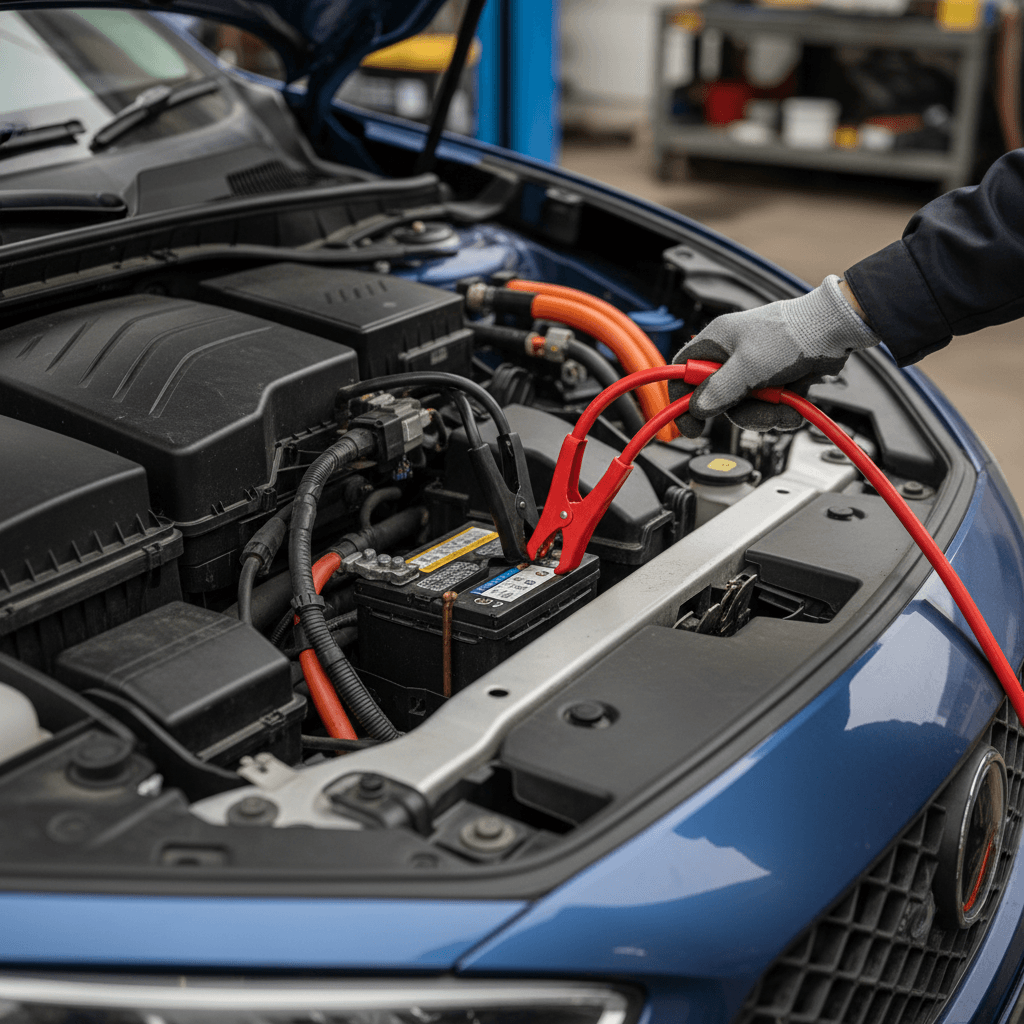
Attach one red clamp to the positive (+) terminal of the dead 12‑volt battery or designated positive post. Attach the other red clamp to the positive (+) terminal of the donor battery or jump pack. Make sure clamps don’t touch anything else.
5. Connect the negative (–) cable correctly
Attach one black clamp to the negative (–) terminal of the donor battery or the negative lead on the jump pack. On the EV, connect the other black clamp either to the negative (–) terminal or to a solid, unpainted metal ground point recommended by the manual.
6. Start the donor vehicle or power the jump pack
If using a gas car or hybrid as the donor, start it and let it idle for a few minutes so its charging system can support both batteries. If using a portable jump starter, switch it on per the device instructions.
7. Power up the EV
With cables still connected, try turning the EV on ("Start," "Power," or "Ready" mode depending on the car). If it boots, leave it on for at least 20–30 minutes so the DC‑DC converter can recharge the 12‑volt battery.
8. Disconnect in reverse order
Turn off the donor vehicle if required, then remove the cables in the reverse sequence: black from EV, black from donor, red from donor, red from EV. Make sure clamps never touch each other or nearby metal while energized.
Portable jump packs are EV‑friendly
What you should NEVER do when jump-starting an EV
- Never attach cables to any orange high‑voltage cables or components.
- Never try to "jump" the main drive battery pack, there is no safe way to do this with consumer gear.
- Don’t attempt a jump while the car is plugged into a charger.
- Don’t reverse the jumper cables; crossing polarity can instantly damage electronics.
- Don’t keep cranking or repeatedly cycling the car on and off, if it won’t start after a couple of tries, stop and call for help.
- Don’t use an EV as a donor vehicle unless the manual explicitly says it’s allowed.
High-voltage is off-limits
Can an EV jump-start another car?
This is where the answer flips. While most electric cars can receive a 12‑volt jump, manufacturers generally warn against using an EV to give a jump to another car. That includes helping out a stranded gas car in the grocery store lot.
Why? The 12‑volt system in an EV isn’t built to deliver the huge current surge, often 300 to 600 amps, that a starter motor on a gasoline engine demands. Pushing that much current through your EV’s small auxiliary battery and DC‑DC converter can overheat components, confuse battery‑management software, and in some cases void your warranty if the automaker explicitly forbids it.
Why using your EV as a jump donor is a bad idea
Even if it "works," you may pay for it later
Strain on the 12‑volt system
Warranty and software issues
Resist the good‑Samaritan impulse
What to do if your EV still won’t start
Sometimes, a dead 12‑volt battery is just a symptom. If you’ve followed correct procedures, tried a healthy donor vehicle or quality jump pack, and your EV still refuses to wake up, it’s time to stop experimenting.
If jump-starting doesn’t work: next steps
What to try, and what to avoid, after a failed jump attempt
| Symptom | What it may mean | What to do |
|---|---|---|
| No response at all after a proper jump | Severely failed 12‑volt battery or DC‑DC converter fault | Call roadside assistance and have the vehicle towed to an EV‑qualified shop or dealer. |
| Car wakes up, then dies again quickly | 12‑volt battery can’t hold a charge anymore | Plan to replace the 12‑volt battery soon; repeated jump-starts are a band‑aid, not a cure. |
| Multiple warning lights after a jump | Low‑voltage event confused some control modules | Let the car sit powered on if safe, then power cycle once. If warnings persist, schedule service. |
| Clicking, chattering relays, or dimming screens | Voltage dropping under load | Stop trying to start the car. Further attempts can damage electronics, get professional help instead. |
When a simple jump doesn’t bring your EV back, focus on diagnosis, not repeated cranking.
Use your coverage
How to prevent a dead 12‑volt battery in your EV
Like most car problems, a dead 12‑volt is easiest to deal with before it happens at the worst possible time. A little routine attention goes a long way, especially as EVs age.
Simple habits that protect your EV’s 12‑volt battery
Drive (or at least "start") it regularly
Most EVs top up the 12‑volt battery while the car is awake. If it sits for weeks at a time, make a point of powering it on and letting it run long enough to do housekeeping.
Keep software up to date
Automakers regularly refine how their cars manage 12‑volt charging. Installing over‑the‑air updates or dealer updates can fix early quirks that drain the auxiliary battery.
Avoid heavy accessory loads when parked
Running HVAC, audio, or accessories for long periods while the car is off can draw down the 12‑volt battery. If you’re camping or tailgating, keep the car in the proper "on" mode so the DC‑DC converter can help.
Have the 12‑volt tested every few years
Just like in a gas car, 12‑volt batteries age. A quick load test at a shop, or during a multi‑point inspection, is cheap insurance against surprise failures.
Carry a jump pack and cables
A quality lithium jump starter and a set of well‑insulated cables sized for modern vehicles can turn a potential towing bill into a minor hiccup.
Think of it like a smoke detector battery
Used EVs and 12‑volt battery health
If you’re shopping for a used electric car, especially a first‑generation model, the 12‑volt battery is one of the quiet troublemakers to ask about. A car can look great and show decent high‑voltage range, yet still hide an auxiliary battery that’s on its last legs.
Questions to ask the seller
- When was the 12‑volt battery last replaced?
- Has the car ever needed a jump or shown 12‑volt warnings?
- Has any dealer software or recall work been done related to low‑voltage systems?
How Recharged helps
Every vehicle on Recharged comes with a Recharged Score Report that goes beyond range estimates. Our EV specialists review battery health, error codes, and recent maintenance so you know whether that 12‑volt system has been a problem, and what to expect down the road.
Buying with fewer surprises
Ready to find your next EV?
Browse VehiclesFAQ: jump-starting electric cars
Frequently asked questions about jump-starting EVs
Bottom line: jump-starting EVs the smart way
So, can you jump start an electric car? Yes, as long as you’re talking about the 12‑volt battery, and you respect the fact that there’s a lot more going on under the hood of an EV than there ever was in a gas car. Follow your owner’s manual, connect the cables in the correct order, and keep your hands well away from anything orange or unfamiliar.
What you shouldn’t do is draft your EV into service as a rolling jump pack for every stalled sedan you meet. Protect your 12‑volt system and DC‑DC converter, carry a quality portable jump starter, and consider preventive 12‑volt replacement as part of EV ownership, especially on older and used cars.
If you’re shopping for a used electric vehicle, or you already own one and want fewer surprises, leaning on specialists helps. At Recharged, every car gets a Recharged Score Report with transparent battery health, fair pricing, and EV‑savvy support, so you’re not left guessing about what might happen the next time you press the Start button.