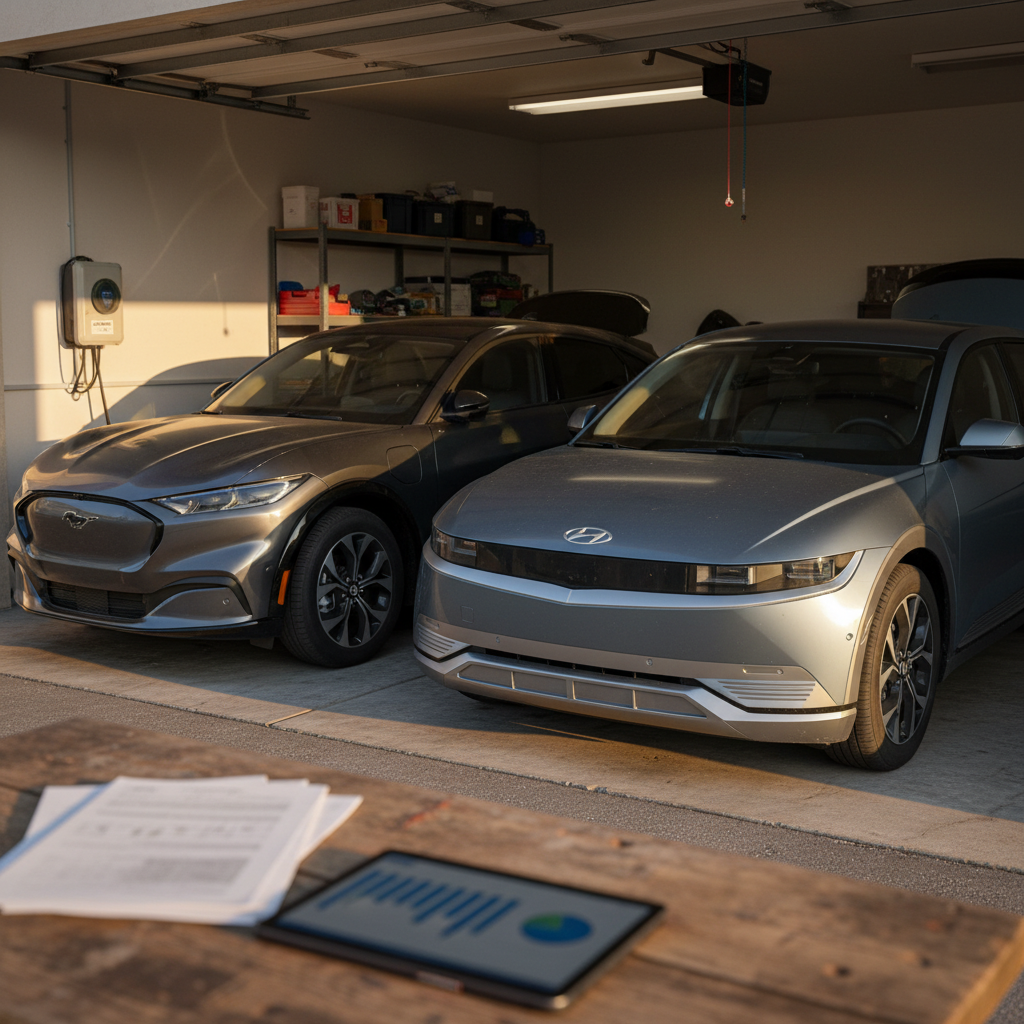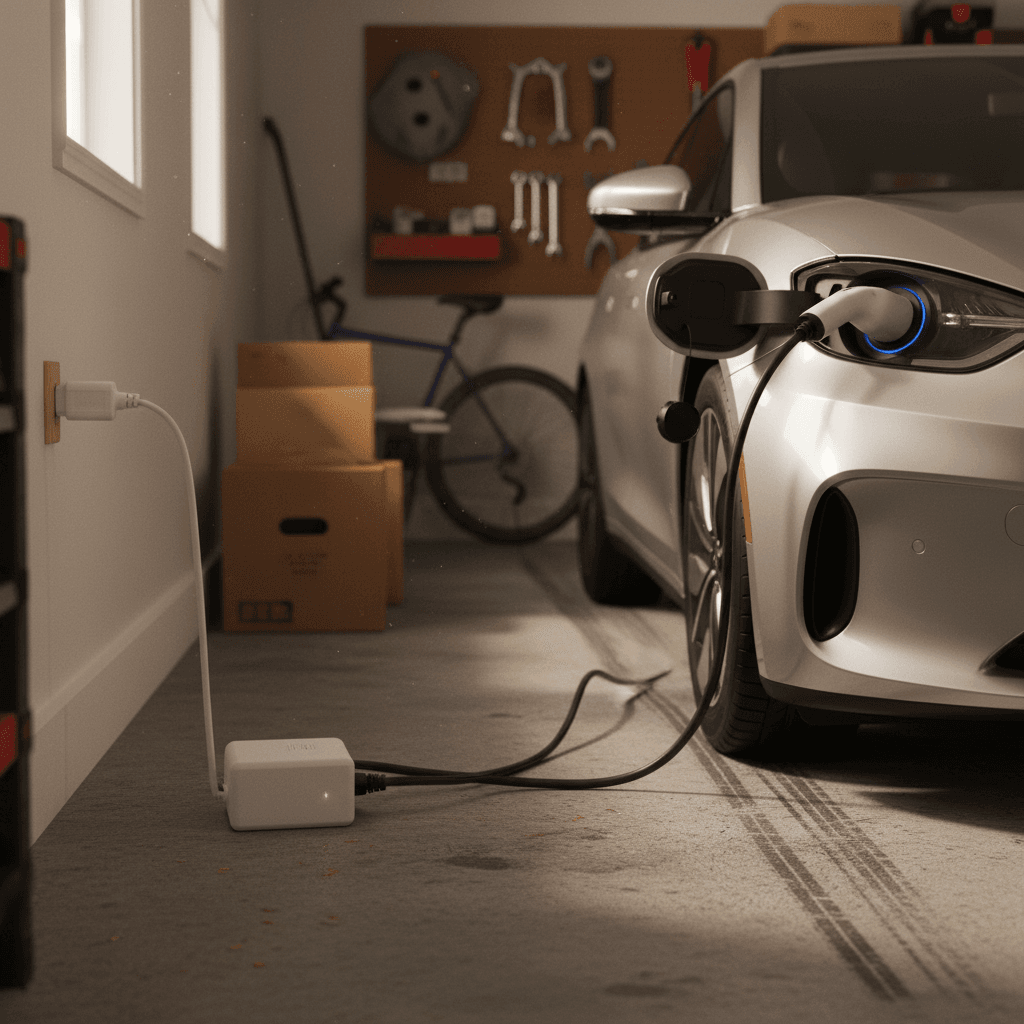
Yes, in most U.S. homes you *can* charge an EV with a regular 120‑volt outlet. Automakers call this **Level 1 charging**, and almost every EV sold today includes a portable cordset that plugs into a standard wall receptacle. The real question isn’t “can you?” so much as **“is it fast enough and safe enough for your life?”** This guide walks through how Level 1 charging works, what kind of range you can expect overnight, safety pitfalls to avoid, and when it’s worth upgrading to faster home charging.
Key takeaway
Can you charge an EV with a regular outlet?
In the U.S., a “regular outlet” usually means a **120‑volt, 15‑amp household receptacle** (the same style you plug a lamp or phone charger into). Plugging your EV’s included **Level 1 charging cable** into that outlet is a fully supported way to charge, as long as the circuit is in good condition and not overloaded.
- Most EVs ship with a Level 1 cord that plugs into a standard 120V outlet and has a J1772 or NACS connector for the car.
- Level 1 charging typically pulls **12 amps** continuously, which is within code limits for a 15‑amp circuit that’s dedicated to EV charging.
- No wallbox or special hardware is required beyond the included cord, but the outlet and wiring need to be up to the task.
Don’t assume every outlet is EV‑ready
How Level 1 (120V) EV charging actually works
EV folks like to talk in kW, amps, and volts, but you don’t need to be an engineer to understand Level 1 charging. At a basic level, you’re sipping energy slowly through a small straw.
Level 1 charging by the numbers
Your EV’s onboard charger converts **AC power from the wall** into DC power for the battery. With Level 1, you’re limited by the small current the circuit can safely supply, so the car simply takes small, steady sips over many hours. That’s why automakers and agencies sometimes call this **“trickle charging.”**
Good fit for plug‑in hybrids
How long does it take to charge an EV on a regular outlet?
The honest answer: it depends on **how far you drive each day** and your car’s efficiency. But we can put practical brackets around it.
Realistic Level 1 charging time estimates
Approximate home charging times from a regular 120V outlet, assuming typical 3–5 miles of range added per hour and common U.S. driving patterns.
| Use case | Daily miles driven | Battery size example | Overnight Level 1 result | Bottom line |
|---|---|---|---|---|
| Light commuter | 0–25 miles/day | 60 kWh | Plug in ~10 hours, regain daily use plus small buffer | Regular outlet is usually plenty. |
| Average driver | 25–40 miles/day | 60–75 kWh | 10 hours often replaces most or all of your daily driving | Works if you’re consistent about overnight charging. |
| Heavy commuter | 40–70+ miles/day | 70–90 kWh | 10 hours may not fully replace daily use, especially in winter | Will feel limiting unless you can top up at work or public chargers. |
| Road‑trip recovery | Arrive home near empty | 70–90 kWh | Could take 2–3 nights to go from low state‑of‑charge to 80%+ | You’ll want occasional Level 2 or DC fast charging. |
Use these as planning ranges, not promises, weather, driving style, and your specific EV all matter.
Think of Level 1 as **daily maintenance charging**, not full refills from zero. If you get home with 40–60% battery and plug in every night, a regular outlet can easily keep you topped up even in a long‑range EV. If you routinely arrive home nearly empty, Level 1 alone will feel painfully slow.
Is charging an EV on a regular outlet safe?
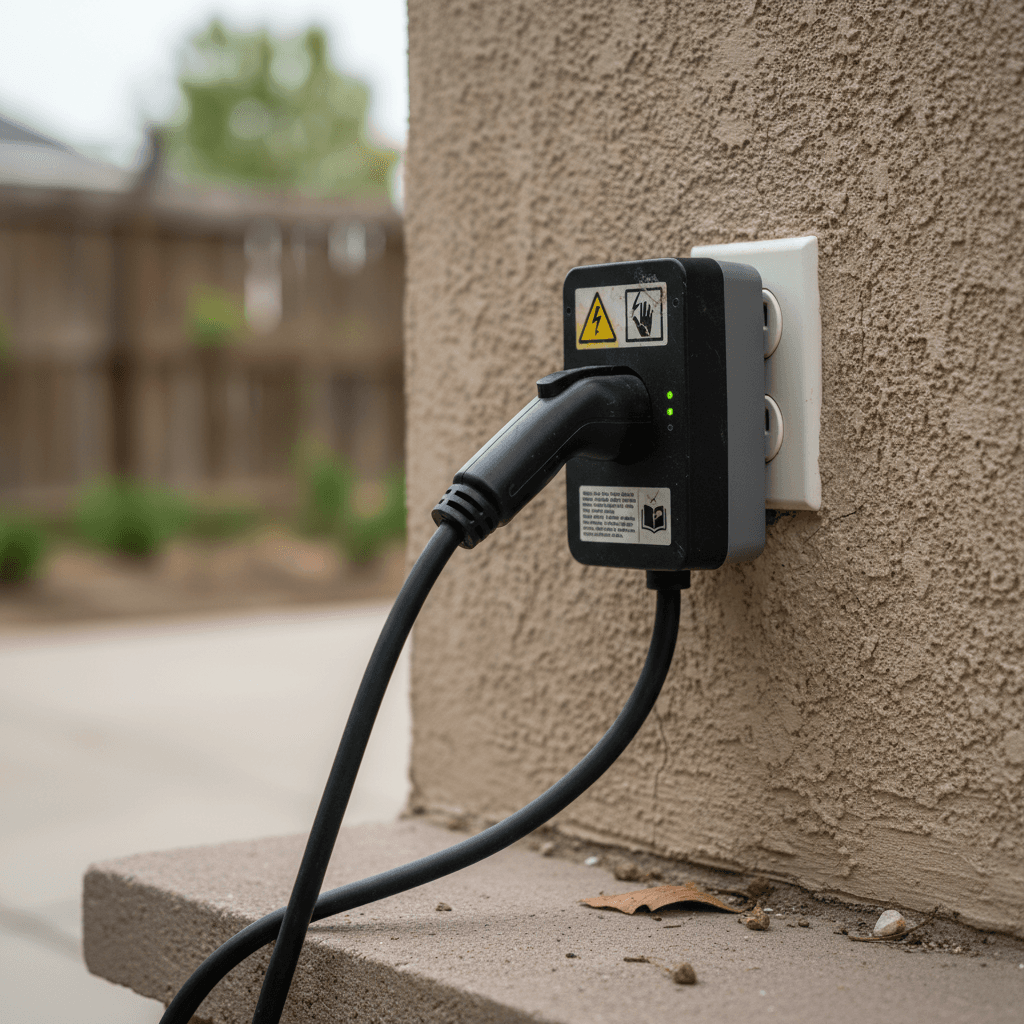
Done properly, Level 1 charging is **designed to be safe**, but it pushes that outlet much harder than a phone charger or TV. The two big risks are **overheating weak electrical components** and **improper use of extension cords or adapters**.
Main safety considerations for Level 1 charging
What to check before relying on a regular outlet
Circuit and outlet condition
- Outlet should be properly grounded, not loose, discolored, or cracked.
- Ideally a **dedicated circuit** (no fridge, tools, or other big loads sharing it).
- Breaker and wiring sized correctly for continuous 12A draw.
Extension cords & adapters
- Most automakers and safety bodies say **do not use** extension cords for EV charging.
- If you must, use the shortest, heaviest‑gauge outdoor cord you can, and monitor for heat.
- Avoid multi‑tap adapters, power strips, and daisy‑chained cords entirely.
Non‑negotiables for safety
Pre‑flight checklist before using a regular outlet for EV charging
1. Inspect the outlet and faceplate
Look for cracks, yellowing/browning, looseness, or signs the plug doesn’t fit tightly. Any of these are reasons to replace the outlet before charging.
2. Confirm the circuit details
Identify which breaker controls the outlet. For Level 1, a **15 or 20 amp breaker** on modern wiring is typical. If the circuit already feeds many outlets, consider it shared and higher risk for overload.
3. Minimize other loads on that circuit
Avoid running space heaters, power tools, or big appliances on the same circuit while charging. Ideally the EV is the only significant load on that line.
4. Use the automaker’s supplied cord
Start with the **OEM Level 1 cordset** that came with your vehicle. Cheap third‑party cords may lack temperature sensors, ground‑fault protection, or proper certifications.
5. Start with a supervised test charge
For the first few sessions, plug in while you’re awake. Check the outlet, plug, and cord every 30–60 minutes. If anything gets hot or trips breakers, stop and call an electrician.
When a regular outlet is enough vs. when it isn’t
When a regular outlet is usually enough
- Short commute: You drive 20–30 miles most weekdays and can plug in 8–12 hours overnight.
- Two‑car household: The EV isn’t always handling every errand or road trip.
- Plug‑in hybrid (PHEV): Smaller battery means you can refill most of it overnight on Level 1.
- Access to charging elsewhere: You can top up at work or public Level 2 once or twice a week.
When a regular outlet will feel inadequate
- Long commute: 50–70+ miles per day, especially in cold climates where winter range shrinks.
- Single EV household: The car handles everything, commuting, errands, weekend trips.
- No workplace or public charging: Home is your only realistic charging option.
- Multiple EVs: Trying to share one 120V outlet among two battery‑electric vehicles.
Rule of thumb
Cost: how much does Level 1 charging at home cost?
Because Level 1 and Level 2 both use the same residential electricity, their **per‑kWh cost is identical**, the only difference is speed. What you pay depends on your local electric rates. As of 2024–2025, U.S. households are typically paying **around 17–19¢ per kWh on average**, though some states are much cheaper and others much higher.
Example: home charging cost on a regular outlet
Using national‑average electricity prices and typical EV efficiency to show ballpark costs.
| Scenario | Assumptions | Energy used | Electricity rate | Approx. cost |
|---|---|---|---|---|
| Daily top‑up | 30 miles/day, 3.5 mi/kWh | ≈8.6 kWh | $0.18/kWh | ≈$1.55/day |
| Monthly driving | 1,000 miles/month, 3.5 mi/kWh | ≈285 kWh | $0.18/kWh | ≈$51/month |
| Full charge on long‑range EV | 75 kWh battery from 10% to 90% | ≈60 kWh | $0.18/kWh | ≈$10.80 per session |
These are directional examples, check your own rate plan for precise numbers.
Compared with gas, even relatively expensive home electricity almost always wins on energy cost per mile. The bigger question is **time and convenience**, not the price of the electrons themselves.
Use scheduled charging to save
Smart ways to use a regular outlet for EV charging
If Level 1 fits your lifestyle, a few smart habits can make it feel nearly invisible, your car simply “refills” while you sleep.
Make the most of a regular outlet
Practical tactics to stretch Level 1 charging
Plug in early, unplug late
Avoid deep discharges
Stack errands efficiently
Use apps to monitor charging
Upgrading from a regular outlet to faster home charging
If Level 1 starts to feel limiting, or you’re planning for a second EV, moving up to **Level 2 (240V) home charging** is the natural next step. That typically means adding a 240‑volt circuit and either a NEMA 14‑50 style receptacle or a hard‑wired wallbox.
Level 1 vs. Level 2 at home
How a regular outlet compares to a dedicated 240V solution.
| Feature | Level 1 (120V outlet) | Level 2 (240V circuit) |
|---|---|---|
| Typical power | 1.3–1.8 kW | 7–11 kW |
| Miles of range per hour | ≈3–5 mi/hr | ≈20–45 mi/hr |
| Hardware cost | Usually included with car | $400–$800 for EVSE, plus installation |
| Electrical work | Often none, if outlet is suitable | New 240V circuit and breaker, sometimes panel upgrade |
| Best for | Low‑mileage drivers, PHEVs, temporary setups | Most daily drivers, multi‑EV homes, long commutes |
Level 1 is about “good enough for now.” Level 2 is about “future‑proof and convenient.”
Always use a licensed electrician
If you’re not ready to commit to a wallbox, a common middle‑ground is having an electrician install a **NEMA 14‑50 or 6‑50 240V outlet** in your garage or parking area. You can then use a portable Level 2 EVSE, which travels with the car and plugs into that receptacle.
How this affects shopping for a used EV
Understanding what you can realistically do with a regular outlet is crucial when you’re evaluating a **used EV**. The right car for someone with only Level 1 charging access might be very different from the right car for a home with a 48‑amp wallbox in the garage.
- If you’ll rely on a 120V outlet, favor **efficient EVs** (more miles per kWh) and/or smaller battery packs that don’t take days to refill from low.
- If your commute is long, prioritize cars that can **DC fast charge reliably** so you can do occasional big top‑ups instead of asking Level 1 to do everything.
- Ask the seller how they charged the vehicle: mostly DC fast charging, or gentle Level 1/Level 2 home charging? That history matters for long‑term **battery health**.
- Think about your **electrical panel and parking situation** as much as the car itself, especially if you rent or live in a condo where upgrades require approval.
Where Recharged fits in
Ready to find your next EV?
Browse VehiclesFAQ: charging an EV with a regular outlet
Frequently asked questions
You really can charge an EV with a regular outlet, and for a lot of households, **that’s enough to make an EV work today**, especially as a second car or for modest commutes. The trade‑off is time and planning, not safety or battery health, as long as your electrical system is up to the job. If you’re EV‑curious but not ready to rewire your house, starting with Level 1 is a perfectly reasonable way in. And when you are ready to upgrade or choose your next (or first) electric car, Recharged can help you match the right used EV to the charging reality at your home, not the one in a brochure.