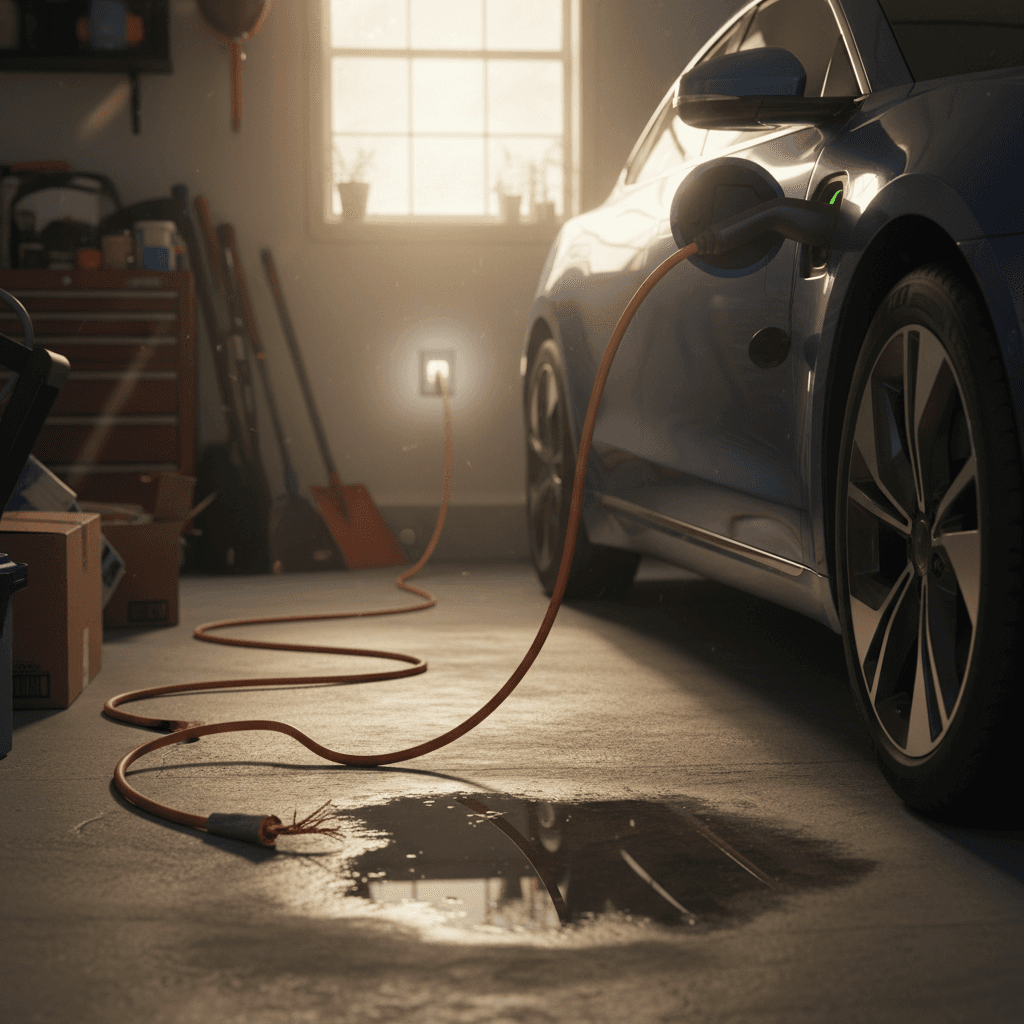
If your driveway is just a little too short or your street-parked EV is a few feet from the nearest outlet, it’s natural to wonder: can I charge my EV with an extension cord? Technically, you might be able to make the electrons flow. But from a safety, warranty, and code perspective, it’s one of the riskiest shortcuts you can take with an electric car.
Key takeaway
Can you charge an EV with an extension cord?
On a purely technical level, yes: if you plug your Level 1 “trickle” charger into a 120‑volt outlet using an extension cord, the car will usually start charging. That’s why so many YouTube videos and forum posts show people doing it.
The problem is that “can it work?” is a very different question from “is it safe, code‑compliant, and supported by your manufacturer?” On that score, the answer is overwhelmingly no. EVs draw continuous, relatively high current for hours at a time, which is exactly what most extension cords were never designed to handle.
Short answer
Why extension cords and EV charging don’t mix
Four big reasons extension cords are risky for EVs
All of them get worse the longer and thinner the cord is
1. Overheating and fire risk
2. Shock hazard outdoors
3. Voltage drop & poor charging
4. Warranty & insurance headaches
Continuous load matters
What codes, manuals, and experts actually say
This isn’t just Internet paranoia. Automakers, safety organizations, and electrical codes are unusually aligned on this topic:
- Owner’s manuals from brands like Tesla, Chevrolet, Kia, and others explicitly say not to use extension cords, power strips, splitters, or surge protectors with their charging equipment.
- The Electrical Safety Foundation International (ESFI) warns that using an extension cord for EV charging is a FIRE AND SHOCK HAZARD and recommends having a dedicated, properly rated circuit installed instead.
- Electricians and safety guides consistently list EVs, and even smaller electric vehicles like scooters, as devices that should never be powered through general‑purpose extension cords.
- Many local interpretations of the National Electrical Code (NEC) treat routine EV charging via extension cords as non‑compliant, especially if it’s effectively permanent wiring (used nightly).
Why NEC and ESFI care so much
“But what if it’s just temporary?”
This is the honest, messy middle of the conversation. People move into older houses, rent apartments, or wait on an electrician, and still need to get to work tomorrow. So what about using an extension cord just once, or for a few weeks?
From a strict safety and warranty standpoint
If you ask an automaker, electrician, or fire marshal, the answer will still be **no**. Their job is to eliminate preventable risk, and there are too many weak links you can’t see, aging wiring behind walls, loose outlets, mystery‑brand cords.
From a real‑world risk perspective
People do sometimes use heavy‑duty cords in a pinch and get away with it. But that doesn’t make it a good idea, especially overnight or unattended. Think of it like driving on a nearly bald spare tire: you might make it home, but you’re stacking the odds against yourself.
If you still decide to do it…
Safer ways to reach your EV without an extension cord
The good news is that you have several options that are dramatically safer, and usually more convenient, than dragging out a cord every night.
Common situations and better fixes
Solve the root problem instead of patching around it
1. Install a dedicated outlet or Level 2
2. Buy a charger with a longer cable
3. Use a properly rated receptacle
4. Adjust how you park
5. Public or workplace charging
6. Plan an electrical upgrade
Options if you park on the street or in an apartment
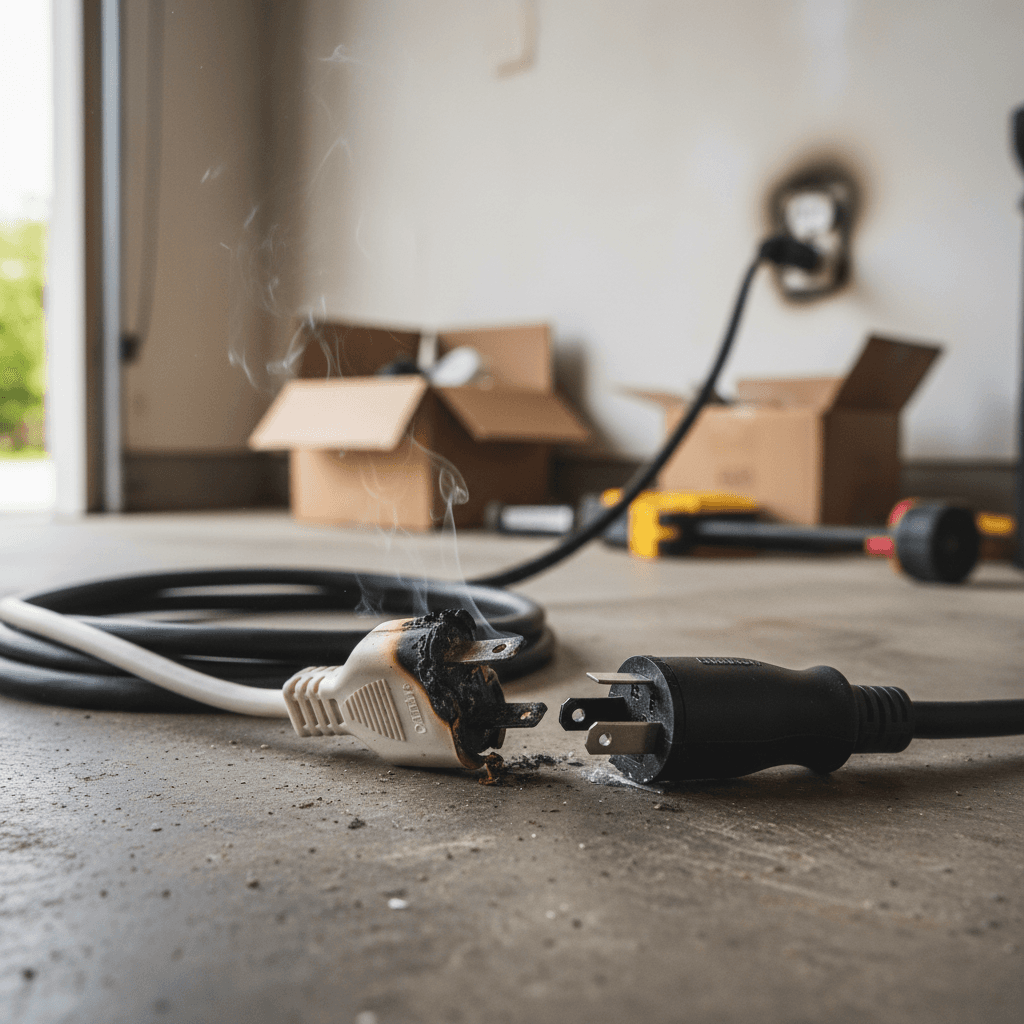
For many city drivers in the U.S., the real challenge isn’t a too‑short cable, it’s **no private driveway or garage at all**. Running an orange cord over the sidewalk to a street‑parked EV is common in photos, but it’s usually a bad idea both legally and practically.
Trip hazards and local rules
Safer strategies for street and multifamily parking
Use public Level 2 and DC fast chargers
Get familiar with networks near you (ChargePoint, EVgo, Electrify America, Tesla Superchargers that support non‑Tesla EVs, etc.). Many drivers in dense cities rely mostly on public charging plus occasional workplace charging.
Talk to your landlord or HOA
Some property owners will add shared Level 2 chargers to improve the property’s appeal. Rebates and tax credits can offset part of the cost, and a properly installed charger is a lot less hassle than extension cords everywhere.
Look for dedicated EV parking
Some garages and surface lots offer reserved EV spots with charging. Monthly rates can be competitive with home electricity once you factor in the cost of electrical work you’d otherwise need.
Use Level 1 at work if available
A basic 120V outlet in a parking garage at work, when properly wired and approved, can add 20–40 miles of range during an 8‑hour shift, without you needing to charge at home every night.
Choose an EV that fits your charging reality
If you know you’ll rely on public charging, you may want an EV with faster DC charging and good charging‑network coverage where you live. This is exactly the kind of question to ask when shopping for a used EV.
Plan around your weekly pattern
Instead of topping off every night with a cord, many urban EV owners fast‑charge once or twice a week on the way home from work or errands, treating it like a quick gas stop.
How to use a standard outlet as safely as possible
Even without an extension cord, there are right and wrong ways to use the Level 1 charger that came with your car. Done properly, charging from a standard 120V outlet can be a safe, long‑term solution for low‑mileage drivers.
Safer Level 1 (120V) charging checklist
What to do, and what to avoid, when using a standard outlet without an extension cord
| Do this | Why it matters | What to avoid |
|---|---|---|
| Use a dedicated, modern outlet on its own circuit | Prevents overload from other devices on the same breaker | Old, loose, or shared outlets powering tools, heaters, or fridges |
| Have an electrician inspect the circuit | Confirms wire gauge, breaker size, and grounding are correct for continuous load | Assuming any random garage outlet is fine because it “works” |
| Plug the EVSE directly into the receptacle | Minimizes resistance and loose connections that cause heat | Power strips, surge protectors, adapters, or extension cords |
| Keep the cord off sharp edges and out of puddles | Prevents insulation damage and shock hazards | Running cords under doors, rugs, or across wet driveways |
| Monitor for heat during first few sessions | Outlet and plug should be warm at most, never hot to the touch | Ignoring discoloration, plastic smell, or frequent breaker trips |
These tips don’t make extension cords safe; they help you use the built‑in cord that came with your EV more safely.
Pro move: schedule charging
How this all ties into buying a used EV
If you’re in the market for a used EV, how and where you’ll charge it should be part of your purchase decision, not an afterthought. Too many first‑time EV buyers assume they can just “use an extension cord for now” and figure the rest out later.
Questions to ask yourself before you buy
- Do I have a dedicated parking spot within 20–25 feet of an outlet or panel?
- Can an electrician reasonably run a new circuit to that location?
- Will I rely mostly on home charging, or can I lean on workplace/public options?
- Is my daily mileage low enough that Level 1 is realistic?
Where Recharged fits in
Every vehicle sold through Recharged comes with a Recharged Score Report, including verified battery health and transparent pricing. Our EV specialists can also walk you through a realistic home‑charging plan, whether that’s Level 1, a new Level 2 install, or a strategy built around public charging, so you’re not tempted into unsafe workarounds like extension cords.
A safer ownership experience
Ready to find your next EV?
Browse VehiclesFAQ: EVs and extension cords
Common questions about EVs and extension cords
Bottom line on EVs and extension cords
You can physically make an EV charge through an extension cord, but that doesn’t mean you should. EV charging pushes more current, for longer, than most homes were designed for, and extension cords are the weakest link in that chain. Overheating, shock, tripping hazards, code issues, and warranty headaches all become more likely the longer you lean on a temporary fix.
If your cable won’t quite reach, treat that as a signal to upgrade your charging setup, not to improvise around it. A properly installed outlet or Level 2 charger, a unit with a longer cable, or a charging strategy built around public or workplace options will serve you far better over the life of the car.
And if you’re shopping for a used EV, fold charging reality into the decision from day one. At Recharged, we combine transparent battery health reports with expert guidance on charging options so you can enjoy EV ownership without leaning on risky extension‑cord hacks.