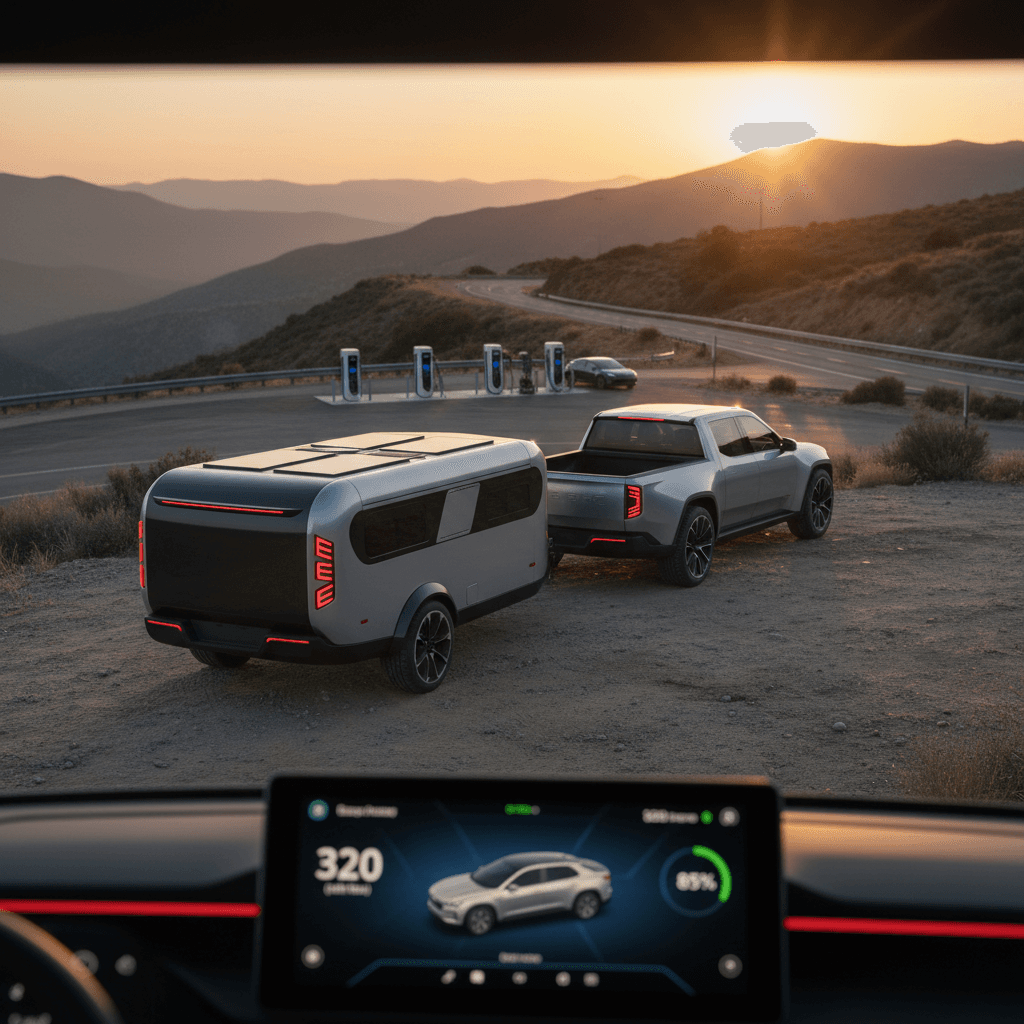
Yes, many modern electric vehicles *can* tow a camper trailer, and some can tow a very big one. The real question isn’t **“can an EV tow a camper trailer?”** so much as **“will it tow the way you actually camp?”** Your answer depends on weight, aerodynamics, charging access, and how far you like to roam between s’mores.
Short answer
Can EVs Tow Camper Trailers Safely?
From a hardware standpoint, **electric trucks and SUVs are excellent tow vehicles**. Instant torque, low centers of gravity, and sophisticated stability control systems make them confident haulers. The limitation today is **range and infrastructure**, not whether the truck can pull the trailer.
EV Towing: What EVs Do Well vs. Where They Struggle
Understanding strengths and tradeoffs is the key to happy electric camping
Where EVs Shine When Towing
- Instant torque: Effortless launches even on steep grades.
- Low center of gravity: Battery in the floor improves stability with a trailer attached.
- Strong regen braking: Helps control downhill speed and reduces brake wear.
- Smart towing aids: Many EV trucks estimate range with a trailer factored in.
Where EVs Are Challenged
- Range loss: Expect roughly 35–60% less range with a typical camper attached.
- Charging logistics: Not every fast charger is easy to reach with a trailer on the hitch.
- Time cost: More frequent charging stops turn 300‑mile days into 2–3‑stop slogs.
Safety comes first
Which EVs Can Tow a Camper Trailer?
There are now several electric trucks and SUVs on the U.S. market with **serious tow ratings**, more than enough for most travel trailers and pop‑ups. Here’s how some headline numbers look as of 2026 (always check your specific trim and options):
Sample EV Towing Capacities (U.S. Market, 2026)
Approximate manufacturer‑rated maximum trailer weights. Always verify specs for your exact model and configuration.
| EV model | Type | Approx. max tow rating | Typical camper match |
|---|---|---|---|
| Ford F-150 Lightning (extended range, tow pkg) | Truck | Up to 10,000 lbs | Mid-size travel trailer, toy hauler |
| Rivian R1T | Truck | Up to 11,000 lbs | Mid-size or heavier travel trailer |
| Rivian R1S | SUV | Around 7,700 lbs | Small–mid travel trailer, off-road camper |
| Tesla Cybertruck AWD | Truck | Up to ~11,000 lbs | Mid-size travel trailer |
| Chevy Silverado EV WT/RST | Truck | 10,000–12,500 lbs | Larger travel trailer or heavy toy hauler |
| Hyundai Ioniq 5 / Kia EV6 (US-rated) | Crossover | Typically 2,000–2,300 lbs | Small teardrop, pop‑up, or lightweight camper |
| Volvo EX90 / Kia EV9 class | 3-row SUV | 5,000–6,000 lbs (target range) | Family bunkhouse, mid travel trailer |
These ratings assume a properly equipped vehicle; options and tow packages matter.
Tow ratings vary by market
How Towing a Camper Affects EV Range
Now for the part that separates marketing photos from Monday morning reality: **range collapse**. Whether you’re burning gas or electrons, bolting a big rolling wall to the back of your vehicle murders efficiency. With EVs you feel that instantly, because your range readout is honest to the mile.
What Really Happens to EV Range When You Tow
Consider a Ford F‑150 Lightning with an unloaded EPA range around 300 miles. Independent tests have seen that **drop to roughly 100–120 miles** when towing mid‑weight campers in the 3,000–5,000 lb range. Heavier trailers and higher speeds can drag that into double digits. A similar pattern appears with Rivian’s R1T and Tesla’s Cybertruck: great torque, but **you’re burning 2–3 times the energy per mile** when you tow a full‑size travel trailer.
Why range falls off a cliff
- Aerodynamic drag: A tall, square camper is like driving with a parachute open. Drag rises dramatically above 60–65 mph.
- Extra weight: Every additional pound increases rolling resistance and motor load, especially on hills.
- Higher sustained power: EVs are incredibly efficient at light loads. Add a trailer, and they spend more time at higher kW output.
What helps you fight it
- Slower speeds: Cruising at 60–65 mph instead of 75 can claw back a surprising amount of range.
- Streamlined campers: Teardrops, aero‑front trailers, and “EV‑friendly” RVs cut drag significantly.
- Route planning: Sticking to corridors rich in DC fast chargers means you can live with shorter legs.
Planning rule you’ll actually use
Matching Your EV to the Right Camper
Electric towing success usually isn’t about owning the biggest truck; it’s about a **smart pairing** of tow vehicle and trailer. The lighter and more aerodynamic the camper, the more the experience feels like the Instagram ad instead of a science experiment.
Good, Better, Best Camper Choices for EVs
Same truck, very different range outcomes
Tall box trailer
Example: 28–32 ft traditional travel trailer.
- Weight: Often 6,000–8,000 lbs loaded.
- Profile: Big, flat front; lots of drag.
- EV outcome: Max range hit, frequent stops, more charger gymnastics.
Mid-size aero trailer
Example: 18–24 ft trailer with sloped front.
- Weight: 3,500–5,000 lbs loaded.
- Profile: Rounded nose, moderate height.
- EV outcome: Usable 80–140 mile legs for many trucks.
Teardrop & off‑grid micro‑campers
Example: Teardrop, small overland box, EV‑optimized RVs.
- Weight: 1,200–3,500 lbs.
- Profile: Very low and sleek.
- EV outcome: Minimal range hit; ideal for crossovers and smaller SUVs.
When small is smarter
Quick Pairing Guide: EV Types and Camper Styles
Very rough guidance to get you in the right ballpark. Always check your vehicle’s manual and the trailer’s actual loaded weight.
| Your EV | Best-suited camper types | What to avoid |
|---|---|---|
| Compact crossover EV (e.g., Kona, Niro, smaller Ioniq/EV6 trims) | Teardrops, small pop‑ups, ultralight single‑axle trailers | Large boxy trailers; anything near or over tow rating |
| Mid-size SUV EV (e.g., Model Y, ID.4 where rated, EQB) | Teardrops, ultralights, very small bunkhouse trailers | Tall 25–30 ft campers; heavy toy haulers |
| 3-row SUV EV (e.g., EV9, EX90‑class) | Small–mid travel trailers, off‑road campers | Very tall or 8,000+ lb rigs, especially with full passengers & cargo |
| Electric trucks (Lightning, R1T, Cybertruck, Silverado EV) | Most mid‑size travel trailers, many toy haulers | Maxing out tow rating and payload at the same time |
Think of this as a starting point, not legal advice.
Planning a Trip When Your EV Tows a Camper
Driving an EV with a camper requires a slightly different trip rhythm. Instead of blasting 300 miles on a tank, you’re playing chess with range, chargers, and campgrounds. Done right, it feels like a **deliberate, relaxed road trip** rather than a forced march.
How to Plan an EV + Camper Road Trip
1. Start with conservative range assumptions
Use your EV’s trip planner with a trailer profile if available. If not, assume 40–50% range loss and build in a 10–15% buffer on top of that.
2. Map fast chargers along your *actual* route
Use apps like PlugShare, A Better Routeplanner, or your manufacturer’s planner, and then zoom in. Make sure chargers are accessible without unhitching, or that there’s space to pull through.
3. Plan shorter legs than you’re used to
Aim for 80–140 mile intervals between DC fast chargers, especially on your first long trip. You can stretch that once you know your combo’s real‑world consumption.
4. Look for charging near your overnight stop
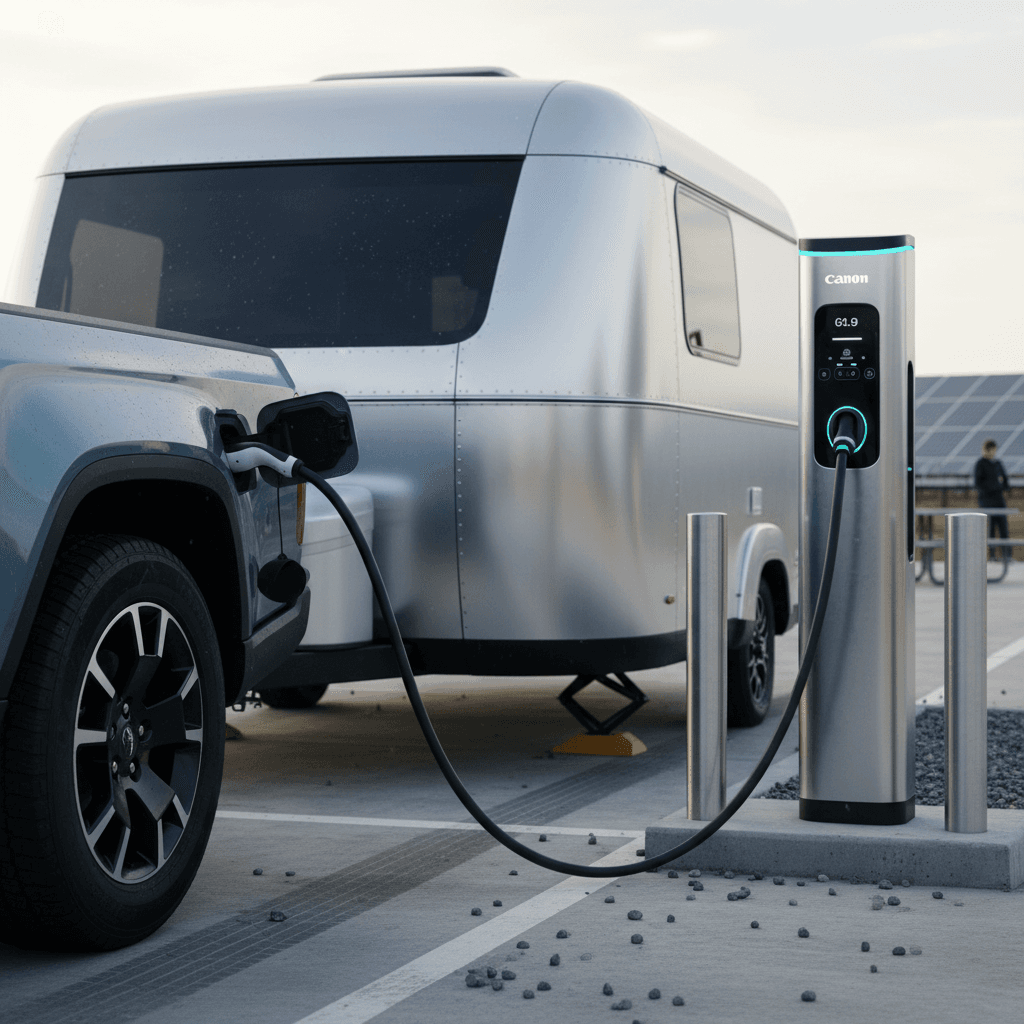
Some campgrounds offer EV‑friendly hookups or nearby fast chargers. In a pinch, a 50‑amp RV pedestal (with the right adapter) can add meaningful overnight charge for some EVs.
5. Consider terrain and weather
Headwinds, long grades, and cold temperatures all eat into range. If your route crosses mountain passes or you’re camping in winter, trim another 10–20 miles off your expected leg length.
6. Have a backup plan
Identify at least one alternate charger between every planned pair of stops. If a site is busy or out of order, you’ll want a plan B that doesn’t involve sweating over the last 5% battery.
Think in hours, not miles
Pre-Trip Checklist for Towing a Camper with an EV
Before you hitch up and chase the horizon, run through this **EV‑specific towing checklist**. A half‑hour of prep in your driveway beats a long afternoon on the shoulder waiting for a flatbed.
EV Towing Safety & Setup Checklist
Confirm legal tow rating and tongue weight
Check your owner’s manual and door‑jamb labels. Verify that the loaded trailer weight and tongue weight are below your EV’s limits, <strong>and</strong> that payload (passengers + cargo + tongue) stays within spec.
Dial in tire pressures for load
Set tire pressures on both EV and trailer to the loaded recommendations. Low tire pressure increases rolling resistance and can slash range even further.
Test lights and trailer brakes
Verify that turn signals, brake lights, and running lights all work. If your trailer has electric brakes, confirm operation and adjust brake controller gain for smooth stops.
Set up towing modes and driver aids
Engage your EV’s tow/haul mode if available. Many electric trucks adjust accelerator response, regen, and even range predictions when they detect a trailer.
Secure cargo and weight distribution
Load heavy items low and centered over or slightly ahead of the trailer axle. Avoid overloading the rear of the camper or your EV’s cargo area, which can make sway more likely.
Run a short shakedown loop
Take a 10–20 mile local drive with the camper before a big trip. Watch energy use, feel for sway, and make adjustments before you’re 150 miles from home.
Common Mistakes When Towing a Camper with an EV
Most EV towing horror stories follow a pattern: wrong trailer, wrong route, wishful thinking. Avoid these missteps and you’ll already be ahead of half the camping‑forum commentariat.
- Buying the biggest trailer your tow rating allows and then loading it to the roof.
- Assuming your unloaded EPA range applies with a camper attached, then planning 200+ mile legs.
- Ignoring how tall and boxy the trailer is compared with sleeker options.
- Arriving at a tight urban DC fast charger with a 30‑foot camper and no way to pull through or back out.
- Driving 75–80 mph “to make up time,” which simply burns more energy and forces extra charging stops.
- Skipping a proper brake controller and hitch setup, then being surprised when the trailer pushes the EV around under braking or in crosswinds.
Do not do this
The Future of EVs and Camper Trailers
You’re already seeing the first wave of **EV‑aware trailers** hit the market: sleeker shapes, lighter materials, even self‑propelled RVs with their own batteries and drive systems that help offset the load on the tow vehicle. These designs can dramatically cut the range penalty, at a price that currently makes Airstream look thrifty.
What’s coming from the EV side
- Bigger batteries & 800V architectures: New trucks and SUVs are adding capacity and faster charging, which translate directly into better towing range.
- Smarter towing software: More EVs can now recognize trailers, estimate drag, and adjust range predictions on the fly.
- Better charging layouts: Expect more pull‑through DC fast chargers designed with trucks and trailers in mind.
What’s coming from the RV side
- EV‑optimized campers: Lower, narrower, and slipperier, often with rounded fronts and enclosed undersides.
- Powered trailers: High‑end RVs with their own motors and batteries that assist under acceleration and regen on descents.
- Integrated energy systems: Roof solar, large house batteries, and bidirectional charging between trailer and EV.
Where Recharged fits in
FAQ: EVs Towing Camper Trailers
Frequently Asked Questions About EVs Towing Camper Trailers
Is an EV Right for Your Camper Adventures?
If your idea of camping is blasting 400 miles in a day and pulling into a remote boondocking site with no charging for 200 miles in any direction, today’s EVs will feel like the wrong tool. But if you’re happy with **measured days, 2–3 hour driving stints, and smarter trailer choices**, an electric truck or SUV can tow a camper trailer with surprising grace.
The key is to stop asking only, “Can an EV tow a camper trailer?” and start asking, “Does an EV match the way I actually camp?” Get honest about your routes and trailers, then choose an EV, and a camper, that fit the life you really live. And if you’re shopping used, Recharged can help you find an EV whose battery, tow rating, and price all pull their weight.