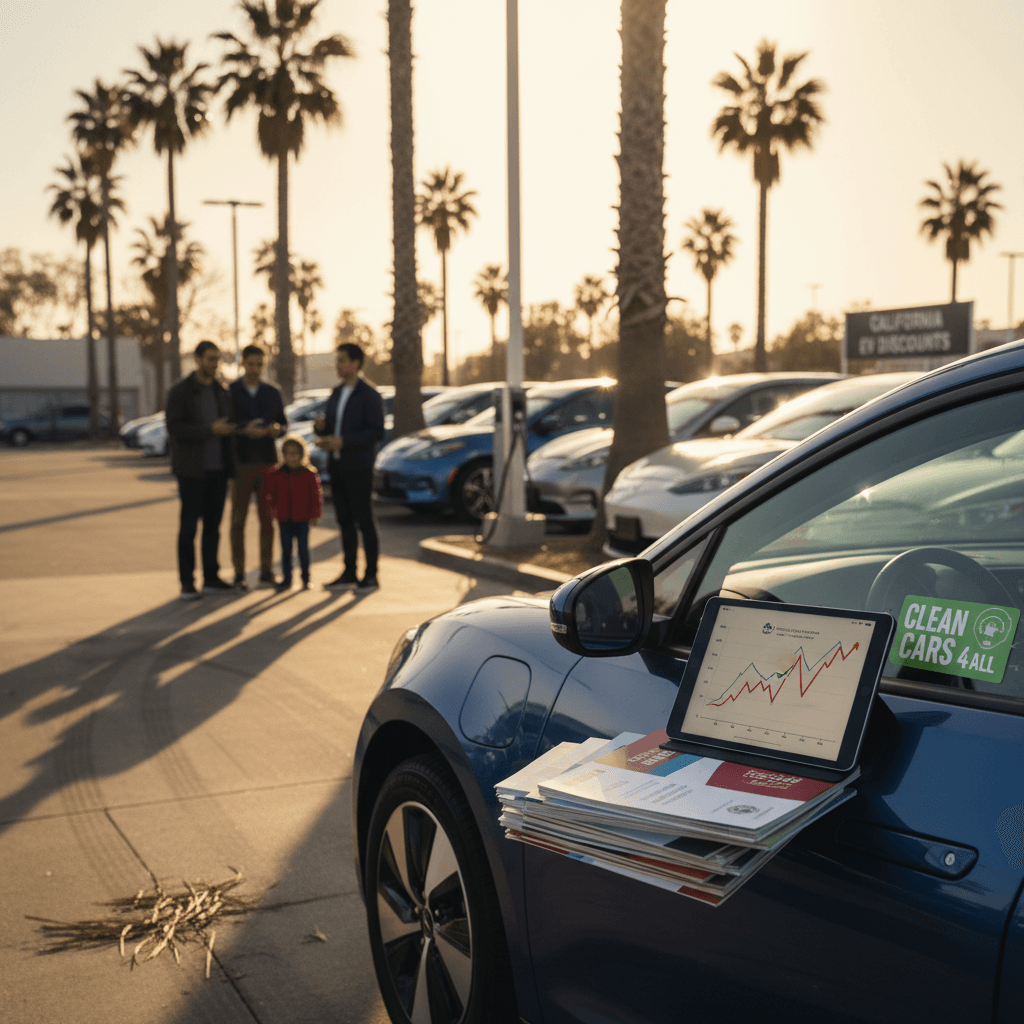
If you’re trying to figure out **California used EV incentives in 2026**, you’ve probably run into outdated blog posts and closed application links. The big federal used EV tax credit disappeared after September 30, 2025, and California’s old statewide rebate (CVRP) is long gone. But that doesn’t mean the deals are dead. Instead, the landscape has shifted toward income‑based state grants, local air‑district programs, and generous utility rebates that can still knock thousands off a used electric car.
Key takeaway for 2026
Overview: California used EV incentives in 2026
Used EV incentives in California, 2026 at a glance
Think of 2026 as the “patchwork” era for California used EV incentives. There’s no single button to push for a statewide rebate anymore. Instead, you’ll mix and match:
- **Equity‑focused state programs** that help lower‑ and moderate‑income drivers replace older gas cars with cleaner vehicles, including used EVs.
- **Local or regional grants** from air districts that pay extra if you scrap an older, higher‑polluting vehicle.
- **Utility rebates**, from providers like LADWP, PG&E, and Southern California Edison, that offer cash back when you buy a qualifying used EV as a customer in their territory.
- Smaller **city or community power agency programs** that stack on top of state and utility money in some zip codes.
Check program status first
What changed in 2025 – and why 2026 looks different
If you last researched EV incentives back in 2023 or 2024, the landscape has changed dramatically. Here are the big shifts that matter as you shop for a used EV in 2026:
Major incentive changes affecting used EVs
Why your old bookmarks are misleading in 2026
Federal used EV tax credit ended
The federal Used Clean Vehicle Credit, worth up to $4,000, ended for vehicles acquired after September 30, 2025. That leaves California buyers leaning more heavily on state and local help.
CVRP phased out
California’s long‑running Clean Vehicle Rebate Project (CVRP) stopped taking new applications once its final funding ran out in late 2023. There is no 2026 statewide post‑purchase rebate for used EVs.
Equity programs expanded
The state has shifted funding into income‑based programs like Clean Cars 4 All and the Driving Clean Assistance Program (DCAP), which support new and used clean vehicles for qualifying households.
Local incentives stepped up
Air districts, community choice aggregators, and utilities now do more of the heavy lifting with regional rebates and grants that you won’t see on federal incentive lists.
Why used EVs are still a deal
Statewide equity programs: DCAP and Clean Cars 4 All
In 2026, the heaviest hitters for **California used EV incentives** are state‑funded, equity‑focused programs. They aren’t technically “statewide rebates,” but they are funded at the state level and administered regionally.
Driving Clean Assistance Program (DCAP) – statewide backbone
The **Driving Clean Assistance Program (DCAP)** is designed to help income‑eligible Californians replace older, high‑polluting vehicles with cleaner options, including **used EVs**. DCAP is newer and still evolving, but a few themes are clear in 2026:
- Available to income‑eligible households, typically under a multiple of **area median income** or the **federal poverty level**.
- Supports **new or used battery‑electric, plug‑in hybrid, or fuel‑cell vehicles**, as well as some non‑car options like e‑bikes in certain designs.
- Often requires that you **retire an older gasoline car** (or at least certify that you’re replacing one), not just add a second vehicle.
- Funds can reach **several thousand dollars** toward the transaction, sometimes combined with down‑payment assistance or low‑interest financing.
How DCAP interacts with local programs
Clean Cars 4 All (CC4A) – big money if you scrap an old car
**Clean Cars 4 All** is one of California’s most generous programs for used EV buyers, especially in 2026 as new funding cycles roll through major air districts. CC4A focuses on drivers who own older, higher‑emitting vehicles and live in communities hit hardest by pollution.
Clean Cars 4 All basics for used EV buyers
Details vary by air district, but these are common 2026 program features.
| Feature | Typical Requirement/Range (2026) | Why it matters |
|---|---|---|
| Where it operates | Major air districts (Bay Area, South Coast, San Joaquin Valley, Sacramento, San Diego) | You must live in a participating air district to apply. |
| Household income | Generally below 300–400% of federal poverty level | Program is aimed at lower‑ and moderate‑income households. |
| Old vehicle | Often 2007 or older, registered and operational in CA for 2+ years | You usually must scrap this car through an approved dismantler. |
| Incentive amount | Commonly up to $9,500 including add‑ons | Enough to cover a large share, or all, of a well‑priced used EV. |
| Eligible vehicles | New or used BEV, PHEV, or FCEV under price caps | Used EV must be on the CARB‑approved list and below a maximum sale price. |
| Extras | Possible transit cards, e‑bike vouchers, or charging support | Some districts let you choose non‑car options instead of a replacement vehicle. |
Always verify rules with your local air district before you shop; price caps and income limits can change mid‑year.
Watch for program pauses
Local utility used EV rebates worth knowing about
Alongside state equity programs, California utilities quietly offer some of the **most reliable used EV incentives** in 2026. These rebates are usually smaller than CC4A grants but much easier to access, and they rarely require scrapping your old car.
LADWP: Charge Up LA (Used EV)
The Los Angeles Department of Water and Power has been a leader on used EV rebates. The exact numbers adjust over time, but the structure in 2025–2026 looks roughly like this:
- Base rebate on a qualifying used battery‑electric or plug‑in hybrid, usually around the low four figures.
- Higher tiers (up to roughly $4,000) for income‑qualified customers.
- Vehicle must be registered to an LADWP service address and meet model year and price limits.
In practice, this rebate can wipe out sales tax and DMV fees, or more, on a sensibly priced used Nissan LEAF, Chevy Bolt, or similar city EV.
PG&E, SCE and other utilities
Investor‑owned utilities and community power agencies run similar programs:
- PG&E has offered rebates up to $4,000 for income‑eligible customers who buy a used EV and register it in PG&E territory.
- Southern California Edison (SCE) has run used EV rebates in the $1,000–$4,000 range, with higher amounts for lower‑income households.
- Community choice aggregators like Peninsula Clean Energy and San Jose Clean Energy sometimes layer on their own used EV incentives or financing help.
Most of these programs require you to apply within a set time (often 180 days) after purchase and keep the car registered in the service area for a minimum period.
Utility rebates are stackable, usually
City and air‑district programs for used EV buyers
Dig a little deeper and you’ll find city‑level and air‑district incentives that sit between state equity programs and utility rebates. These are often time‑limited but powerful when available.
Examples of local programs that can help with a used EV
Exact names and amounts change, but these patterns hold in 2026.
Bay Area Air District
The Bay Area’s Clean Cars for All program relaunched with fresh funding in 2025, again offering thousands of dollars to retire an older car and switch to a cleaner vehicle. By 2026, the focus remains on lower‑income residents in high‑pollution neighborhoods.
South Coast & San Joaquin
South Coast AQMD (greater L.A.) and San Joaquin Valley APCD continue to run CC4A‑style programs with their own quirks, different income cutoffs, vehicle price caps, and add‑ons like transit passes or home charging support.
City & CCA pilots
Cities and community choice aggregators periodically test small programs: extra rebates for residents of certain zip codes, EV‑curious workshops bundled with financing help, or e‑bike vouchers as alternatives to car ownership.
Use California’s incentive search tool
Stacking incentives: How much can you still save?
Let’s put some realistic numbers to all this. The exact stack depends on where you live and your income, but here are a few 2026‑style examples to show what’s possible with a **used EV in California**.
Sample 2026 used EV incentive stacks
Illustrative scenarios for different buyers in California. Amounts are approximate and depend on funding cycles and eligibility.
| Scenario | Vehicle | Programs stacked | Approx. total incentives |
|---|---|---|---|
| Lower‑income Bay Area driver | 2019 Chevy Bolt EV around $16,000 | Clean Cars 4 All grant (with scrappage) + PG&E used EV rebate | $9,500–$13,000 |
| Moderate‑income LA renter | 2020 Nissan LEAF around $13,000 | LADWP used EV rebate (income‑qualified) | $2,000–$4,000 |
| Fresno‑area commuter | 2018–2019 plug‑in hybrid around $15,000 | San Joaquin Valley CC4A‑style grant + possible utility rebate | $7,500–$10,000 |
| Middle‑income Bay Area driver with newer gas car | 2021 Hyundai Kona Electric around $20,000 | No scrappage grant, but eligible PG&E or CCA used EV rebate | $1,000–$4,000 |
These examples are for educational purposes; always confirm current amounts and rules before you buy.
Don’t build your budget on maximum numbers
Eligibility checklist: Do you qualify?
Quick eligibility check for 2026 California used EV incentives
1. Confirm your household income
Most big‑ticket grants (DCAP, Clean Cars 4 All) require your income to fall below a threshold, often a percentage of the federal poverty level or area median income. Gather recent tax returns or pay stubs before you apply.
2. Check your current vehicle
For scrappage‑based programs, you usually must own a gasoline vehicle of a specific model year (often 2007 or older), registered and operational in California for at least two years. If you don’t have an older car, focus on utility rebates instead.
3. Verify your address
Eligibility is tied to where you live, not just where you shop. Make sure your **home address** is in a participating air district, city, or utility territory before you count on any specific program.
4. Look at credit and financing
Some programs offer grants that can be used as a down payment; others require you to secure financing first. Knowing your credit situation makes it easier to pair incentives with a realistic loan or lease.
5. Confirm vehicle requirements
Used EV programs usually require that the car come from a <strong>licensed dealer</strong>, fall under a price cap, and appear on an approved clean‑vehicle list. Private‑party sales frequently don’t qualify.
6. Note timing rules
Many incentives require you to apply **before** you buy, or within a window like 60–180 days after purchase. Put these deadlines on your calendar the day you get serious about shopping.
How to shop for a used EV around incentives
The smartest California shoppers in 2026 don’t just ask, “What’s the biggest rebate?” They ask, “How do I line up the right car with the incentives I can actually use?” Here’s a simple playbook.
- Start with programs, not cars. Spend one evening mapping out every incentive you’re eligible for by income, address, and current vehicle. That will tell you whether a scrappage‑based program is your main lever or if you’ll be relying on utility rebates.
- Define your budget after incentives. Instead of asking, “What can I afford before rebates?” work backward: target an **all‑in monthly payment** and see how far grants and rebates can push you toward a safer, newer EV.
- Focus on models that fit the rules. Some programs cap the vehicle price or require a certain range. Popular used choices in 2026 include **Chevy Bolt EV**, **Nissan LEAF Plus**, **Hyundai Kona Electric**, **Kia Niro EV**, and older **Tesla Model 3** trims.
- Check battery health, not just mileage. Incentives can help you buy the car, but they don’t guarantee it’s a good one. Look for verified battery diagnostics, like a Recharged Score Report, so you know how much real‑world range you’re buying.
- Shop where incentives are understood. Many franchise dealers and used‑car lots are still catching up on post‑2025 rules. Look for sellers who can talk concretely about current California programs, not just whatever was true three years ago.
- Leave room in your timeline. Because some programs require pre‑approval, try not to shop in crisis mode. Give yourself a few weeks so you can align vehicle availability with incentive windows.
How Recharged helps California used EV buyers
Buying a used EV in 2026 shouldn’t feel like a graduate seminar in incentive policy. At Recharged, the entire experience is built around making that process simpler and more transparent, especially if you’re trying to unlock California’s remaining used EV incentives.
What Recharged brings to the table
Beyond the sticker price, we help you understand the whole deal.
Battery health you can trust
Every vehicle on Recharged comes with a Recharged Score Report, including verified battery health diagnostics. That matters when you’re pairing a grant or rebate with a car you plan to keep for years.
Expert EV‑specialist support
Our EV‑specialist team can help you understand which California incentives might apply to your situation, what documentation programs typically need, and how to time your purchase.
Nationwide delivery to California
See a used EV you love but it’s not in your zip code? Recharged offers nationwide delivery, so California buyers can focus on the best car and the right incentives rather than what happens to be sitting on the nearest lot.
Financing that works with grants
Recharged offers EV‑friendly financing and can help you structure a deal that anticipates state or utility money, so your payment still works if paperwork takes longer than expected.
Trade‑in and instant offers
If you’re replacing an older gasoline car, Recharged can provide a trade‑in or instant offer. In some cases you may still choose to scrap that vehicle separately for CC4A, but either way you’ll have a clear baseline value.
Fully digital, transparent process
From browsing inventory to signing paperwork, Recharged is a fully digital retail experience. That gives you more time and headspace to focus on incentive applications instead of dealership back‑and‑forth.
Ready to find your next EV?
Browse VehiclesReady to run the numbers?
FAQ: California used EV incentives in 2026
Frequently asked questions about California used EV incentives in 2026
Bottom line: Are California used EV deals still good in 2026?
The era of simple, one‑click rebates is over. In 2026, **California used EV incentives** are messier, but they’re also more targeted toward the drivers who need help most. If you’re willing to navigate a few application forms and line up your purchase with active programs, you can still carve thousands of dollars off the cost of going electric, especially if you qualify for Clean Cars 4 All or a strong utility rebate.
Your best move now is to map the incentives you’re eligible for, then shop for a used EV whose price, battery health, and timing line up with those programs. That’s exactly the kind of puzzle Recharged was built to solve: transparent battery diagnostics, fair pricing, EV‑savvy support, and financing that plays nicely with grants and rebates. Put those pieces together, and a used EV in California can still be one of the smartest buys on the road in 2026.