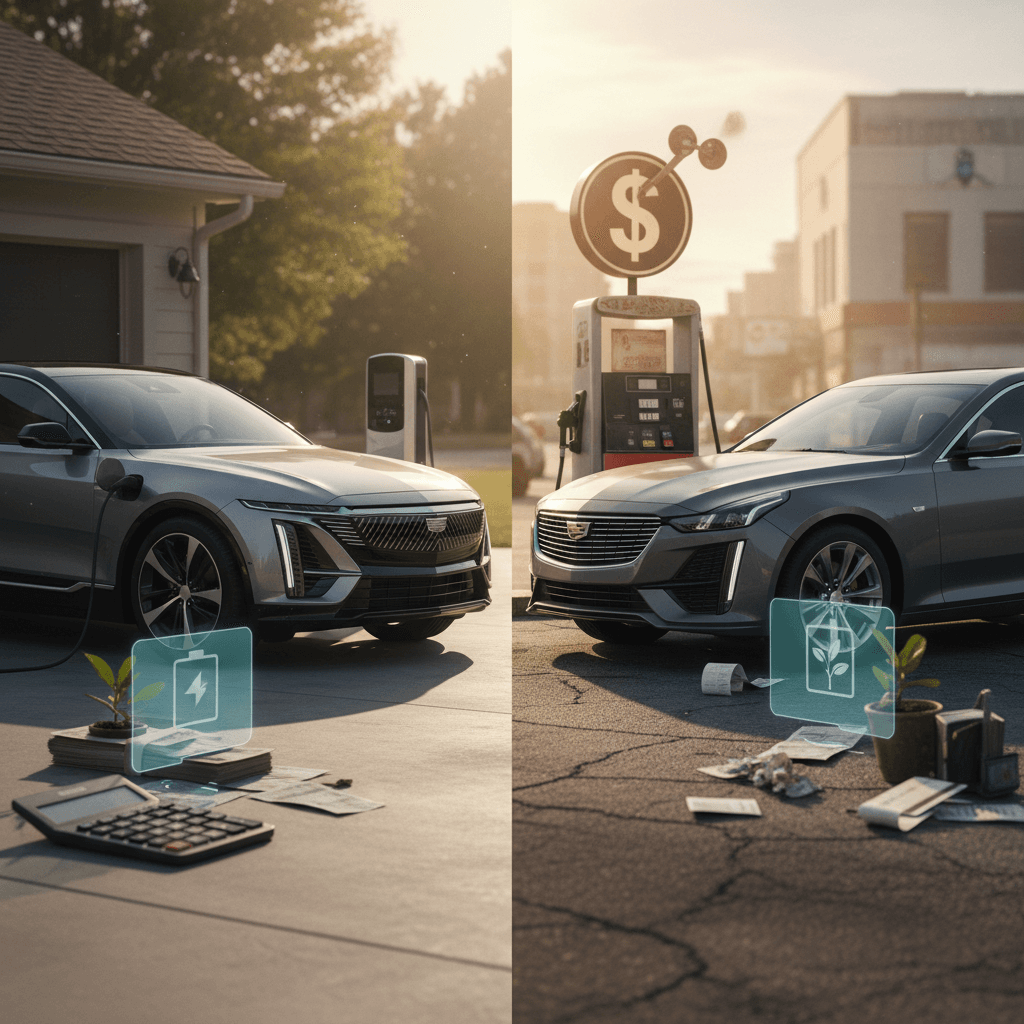
If you’re cross-shopping a Cadillac Lyriq against a similar gas-powered Cadillac SUV, you’re asking the right question: what does the total cost of ownership really look like over several years? Sticker prices only tell part of the story. Fuel, maintenance, tax credits, and resale value can easily swing the math by tens of thousands of dollars.
What this guide covers
Why compare Cadillac Lyriq total cost vs a gas SUV?
If you’re looking at a Cadillac Lyriq, you’re probably not cross-shopping a budget compact crossover. You’re comparing it to a similarly luxurious, similarly sized gas SUV. That’s where total cost of ownership (TCO) really matters. A Lyriq can have a higher MSRP than a gas equivalent, yet still cost less to own once you factor in fuel, maintenance, tax credits, and resale value.
- Lyriq vs similar Cadillac gas SUV pricing can look close on paper, but ownership costs diverge quickly.
- EV fuel (electricity) costs are typically far lower per mile than gasoline.
- EVs usually need less maintenance, but tires and insurance can be higher.
- Federal and state incentives can erase much of the initial price gap, especially on a used EV if it qualifies for the used EV tax credit.
Think in monthly cost, not just sticker price
What’s the gas car equivalent to a Cadillac Lyriq?
The Lyriq is a two-row, midsize luxury SUV with a premium interior and strong performance. Within Cadillac’s own lineup, the closest gas equivalent is the Cadillac XT5 or a well-equipped Caddy two-row crossover in the same price and size band. For this comparison, we’ll use a generously equipped XT5‑type vehicle as the benchmark.
Cadillac Lyriq vs gas SUV: apples-to-apples starting point
We’ll use a high-trim gas SUV as the realistic alternative you’d consider in the showroom.
Cadillac Lyriq (EV)
- All-electric luxury SUV
- Approx. 300+ miles of range depending on version
- High-tech interior, strong torque
- Access to home charging and public DC fast charging
Gas Cadillac SUV (XT5-class)
- Gasoline V6 or turbo engine
- Similar size and interior space
- Traditional fueling and maintenance
- Comparable luxury features and options
Key assumptions for this Lyriq vs gas cost comparison
To keep the math realistic and comparable, we’ll make a few standard assumptions. You can adjust up or down for your own situation, but this will give you a solid baseline for the Cadillac Lyriq total cost vs gas car equivalent.
Baseline assumptions (5‑year ownership)
You can plug in your own numbers later, but these figures give us a fair, realistic starting point for most U.S. drivers.
| Factor | Assumption |
|---|---|
| Ownership period | 5 years |
| Annual mileage | 12,000 miles (60,000 miles total) |
| Gas price | $3.75 per gallon (national average can vary) |
| Lyriq efficiency | ~3.1 miles per kWh combined |
| Gas SUV efficiency | 22 mpg combined |
| Home electricity rate | $0.15 per kWh (before any EV time-of-use discount) |
| Public DC fast charging | Used sparingly (10–15% of miles) |
| Financing | 60‑month loan, average new‑car APR |
| Location | Typical U.S. state with standard registration fees |
All numbers are ballpark estimates for illustration, not quotes or guarantees.
Your local prices matter
Purchase price, incentives, and financing
On paper, a Cadillac Lyriq can carry a higher MSRP than a comparably equipped gas SUV. But incentives and financing can narrow, or even reverse, that gap.
1. Purchase price and incentives
- Lyriq: As a new luxury EV, it often starts higher than a similarly equipped gas XT5-class SUV. However, depending on production location and your income, a new Lyriq may qualify for a federal clean vehicle tax credit, plus possible state or utility rebates.
- Gas SUV: Typically has fewer direct incentives beyond dealer discounts and manufacturer rebates. You won’t see a big federal tax credit for a new gas Cadillac.
On a dollar basis, that can erase a significant chunk of the upfront premium for the Lyriq.
2. Financing and monthly payment
- Loan terms: Many buyers choose a 60‑month loan for both EVs and gas SUVs.
- Rates: APRs are usually similar, but some lenders and captives occasionally offer special EV financing to drive adoption.
- Net effect: The Lyriq’s payment may come in slightly higher each month, even after any federal tax credit is factored into your effective cost.
The key question is whether lower fuel and maintenance costs more than offset a slightly higher payment.
Use tax credits to offset your down payment
Cadillac Lyriq charging costs vs gasoline
Fuel is where the Cadillac Lyriq often pulls away from a gas SUV. Even with today’s electricity rates, most Lyriq drivers will spend significantly less per mile than they would in a comparable gas Cadillac.
5‑year fuel vs electricity cost snapshot (baseline case)
Here’s the rough math behind those totals.
Fuel vs electricity: simple 5‑year math
Illustrative example using the assumptions above.
| Item | Gas Cadillac SUV | Cadillac Lyriq EV |
|---|---|---|
| Efficiency | 22 mpg | ~3.1 mi/kWh |
| Energy price | $3.75/gal | $0.15/kWh (home) |
| Total energy used over 60k miles | ≈2,727 gallons | ≈19,350 kWh |
| Estimated 5‑year energy cost | ≈$10,250 | ≈$3,900 (home‑heavy mix) |
Actual numbers will vary with your driving, energy prices, and how often you use DC fast charging.
Public charging vs home charging
Maintenance and repairs: EV vs gas reality
Over 5 years, a gas Cadillac SUV will likely visit the service bay more often than a Lyriq, and not just for oil changes. EVs eliminate several systems that commonly need service, though they introduce a few EV-specific considerations.
Typical 5‑year maintenance: Lyriq vs gas Cadillac
Exact costs vary by dealer and region, but the pattern is consistent.
Gas Cadillac SUV
- Multiple oil and filter changes
- Transmission service possible by ~60k miles
- Engine air filters, spark plugs (depending on mileage)
- More frequent brake service in stop‑and‑go driving
- Higher chance of emissions‑system repairs
Cadillac Lyriq (EV)
- No engine oil, spark plugs, or exhaust system
- Fewer moving parts in the drivetrain
- Brake pads can last longer thanks to regenerative braking
- Routine items: cabin air filter, tire rotations, brake fluid checks
- Battery and electric drive components typically covered by long warranties
Don’t forget tires
When you add it up, many owners see maintenance savings in the low thousands of dollars over 5 years with the Lyriq compared with a gas peer, especially if they keep up with regular service on the gas SUV.
Insurance, taxes, and fees
Insurance and registration can push in both directions. Luxury EVs sometimes cost more to insure than their gas counterparts because of expensive bodywork, sensors, and battery-related repairs after a crash. On the other hand, some states and insurers offer EV-friendly incentives or discounts.
- Insurance: Expect the Lyriq to be similar to, or moderately higher than, a comparable gas Cadillac SUV, especially in the first few model years while insurers gather real-world claims data.
- Registration and fees: Some states add a modest annual EV registration surcharge to make up for lost gas-tax revenue. Others reduce registration fees or offer perks like HOV lane access.
- Property or excise taxes: If your locality bases taxes on vehicle value, the higher upfront price of a new Lyriq can mean slightly higher annual taxes than a cheaper gas SUV, at least early in ownership.
Shop insurance quotes before you decide
Depreciation and resale value
Depreciation, how much value your vehicle loses over time, is the single biggest cost of ownership for most new cars, EV or gas. Early EVs had steep depreciation, but luxury EVs like the Lyriq now live in a different world than the first-generation compliance cars.
Gas Cadillac SUV depreciation
Luxury gas SUVs often lose a big chunk of value in the first 3–5 years as new models and incentives roll in. After that, their values can stabilize somewhat as they enter the used‑luxury market sweet spot.
Over 5 years, it’s reasonable to expect a well-equipped gas Cadillac SUV to retain perhaps 40–50% of its original MSRP, depending on mileage, condition, and the broader market.
Cadillac Lyriq depreciation
The Lyriq is newer to the market, so long‑term data is still evolving. However, EV depreciation is no longer automatically worse than gas. Strong demand for clean, tech-forward luxury SUVs can help support used values.
Your Lyriq’s resale value will depend heavily on battery health, mileage, and software/feature updates. This is where Recharged’s Recharged Score battery health report can give both you and future buyers more confidence in a used Lyriq.
EV depreciation is normalizing
5‑year total cost of ownership: Cadillac Lyriq vs gas SUV
Let’s roll everything up into a simplified 5‑year total cost picture. These are illustrative ballpark numbers using our baseline assumptions for a new Lyriq vs a new gas Cadillac SUV in the same price band.
Illustrative 5‑year total cost comparison
High-level comparison using baseline assumptions; does not reflect taxes, dealer fees, or your specific financing terms.
| Category | Cadillac Lyriq (EV) | Gas Cadillac SUV |
|---|---|---|
| Purchase price (after typical discounts) | Higher MSRP; potential federal EV tax credit reduces effective cost | Lower MSRP; no major federal credit |
| 5‑year fuel/energy cost | ≈$3,900 | ≈$10,250 |
| 5‑year maintenance (routine only) | Lower (no oil changes, fewer engine services) | Higher (engine, transmission, emissions systems) |
| Insurance/fees | Similar to slightly higher, plus any state EV surcharge | Similar, no EV surcharge |
| Depreciation (5‑year estimate) | Significant but improving as EV market matures | Significant, similar order of magnitude |
| Net 5‑year TCO (very rough) | Often comparable or lower once incentives + fuel + maintenance are included | Often similar or slightly higher despite lower upfront price |
Dollar figures are approximate and rounded. Your results will vary based on purchase price, incentives, and local energy costs.
Where the Lyriq often comes out ahead
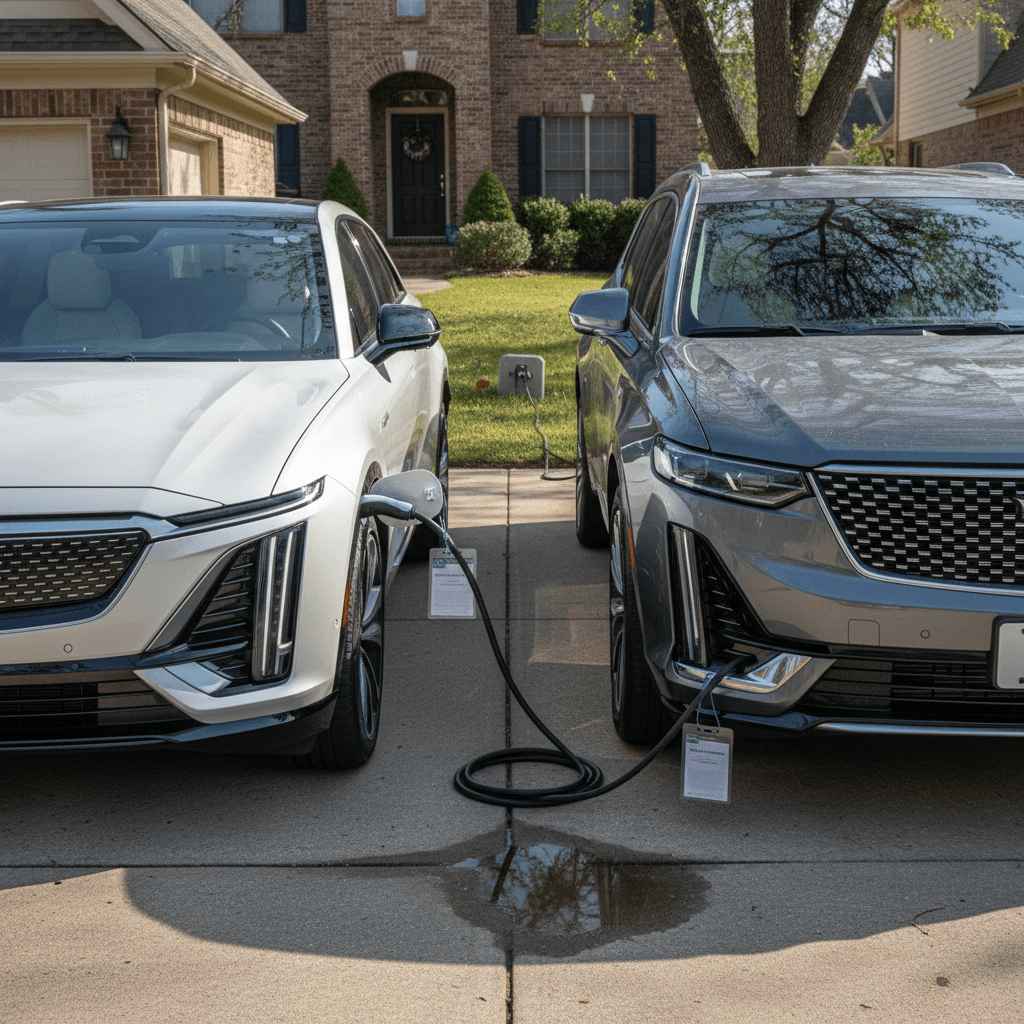
When the Lyriq saves you money, and when it doesn’t
Lyriq vs gas Cadillac: when each one wins
Total cost is only part of the story, you’re also buying a driving experience.
Scenarios where Lyriq is a clear win
- You drive more than 12,000 miles per year, amplifying fuel savings.
- You can charge at home overnight at a reasonable electricity rate.
- You qualify for meaningful federal and/or state EV incentives.
- You value quiet, smooth power and enjoy the latest tech.
- You plan to keep the vehicle for at least 4–5 years.
Scenarios where gas might still make sense
- You have no reliable home or workplace charging and rely almost entirely on more expensive public fast charging.
- Your local electricity prices are very high relative to gasoline.
- You drive very few miles per year, so fuel savings are minimal.
- You prefer the familiarity of gas fueling or tow heavy loads often.
The one big red flag
How a used Cadillac Lyriq changes the cost equation
Buying a used Cadillac Lyriq can dramatically improve the total-cost picture, because you let the first owner absorb much of the initial depreciation while still benefiting from low running costs.
Why a used Lyriq can be the sweet spot
1. Lower upfront price
A 1–3‑year‑old Lyriq often sells for substantially less than new while still offering cutting-edge tech, long range, and a modern interior.
2. Possible used EV tax credit
Depending on your income, the vehicle’s price, and where you buy, a used Lyriq may qualify for a <strong>federal used EV tax credit</strong>, further cutting your effective cost.
3. Battery health transparency
At Recharged, every used EV comes with a <strong>Recharged Score</strong> that includes verified battery health diagnostics. That insight helps protect you from buying a car with hidden degradation that could hurt long-term value.
4. Similar fuel and maintenance savings
You still enjoy the Lyriq’s low electricity and maintenance costs relative to a comparable gas SUV, so your <strong>ongoing monthly expenses drop</strong> versus owning a used gas luxury SUV.
Have the numbers run with your exact car
FAQ: Cadillac Lyriq total cost vs gas car equivalent
Frequently asked questions
Bottom line: Is the Cadillac Lyriq worth it vs a gas Cadillac?
If you’re simply glancing at sticker prices, a Cadillac Lyriq can look more expensive than a similar gas Cadillac SUV. But once you dig into total cost of ownership, fuel, maintenance, potential incentives, and resale, the Lyriq often closes the gap or pulls ahead, especially for drivers who rack up miles and can charge at home.
For many shoppers, the decision comes down to lifestyle. If you have convenient charging, drive a typical or above‑average number of miles, and appreciate quiet, instant EV power, the Lyriq delivers a compelling mix of luxury, technology, and operating-cost savings. If public charging is your only realistic option or you drive very little, a gas Cadillac SUV may still fit your life better.
If you’re curious how the math looks for a specific Lyriq, a used gas Cadillac, or any other EV you’re considering, Recharged can help. Every EV we sell comes with a Recharged Score battery health report, transparent pricing, and expert guidance on costs, financing, and trade‑ins. That way, you’re not just buying the right luxury SUV, you’re buying it with a clear picture of what it will really cost to own.