If you’re considering a Cadillac Lyriq, or you just bought one, charging speed is probably near the top of your list. On paper, the Lyriq supports up to 190 kW DC fast charging and can add roughly 80–86 miles in about 10 minutes, but real-world charging speed tests tell a more nuanced story.
Quick spec snapshot
Cadillac Lyriq charging speed at a glance
Cadillac Lyriq charging speed highlights
In independent charging speed tests, the Lyriq generally lines up with Cadillac’s claims. DC fast charging from about 10% to 80% typically takes around 37–40 minutes when the battery is preconditioned and you’re using a robust 150–350 kW charger. That’s competitive with other large luxury SUVs, even if it’s not the absolute quickest EV on the market.
Think in 10–80%, not 0–100%
Battery and charging basics: what the specs really mean
All current Cadillac Lyriq models ride on GM’s Ultium platform with a battery pack rated around 102 kWh of energy and roughly 100 kWh usable. Single‑motor RWD trims are EPA‑rated in the low‑ to mid‑320‑mile range, while dual‑motor AWD versions sit closer to 300 miles, depending on trim and wheel size.
- Battery capacity: ~100 kWh usable. This is the "gas tank" for your EV.
- Max DC charging power: 190 kW. This is the peak rate the car can pull from a compatible DC fast charger.
- Onboard AC charger: 11.5 kW standard, 19.2 kW available. This is your maximum home or Level 2 public charging speed.
- Port type: CCS1 (Combined Charging System). Newer Lyriqs can also use Tesla Superchargers via a GM‑approved NACS adapter.
The key is understanding how those numbers translate into time. A 190 kW peak doesn’t mean you’ll sit at 190 kW for an entire session. The Lyriq, like every EV, follows a charging curve, starting high, then tapering down as the battery fills. That curve is what you feel in the real world.
Cadillac Lyriq DC fast charging speed test (10–80%)
Let’s translate specs into a realistic speed test. Imagine you pull a Lyriq onto a 350 kW station on a road trip with the battery at about 10–20% and properly preconditioned (using built‑in route planning or Google Maps integration to warm the pack). Here’s the kind of behavior owners and testers are consistently seeing in the wild.
Cadillac Lyriq DC fast charging: typical 10–80% session
Approximate values based on manufacturer claims and independent testing in mild weather on a high‑power DC fast charger.
| Metric | Typical Result | What It Means |
|---|---|---|
| Starting charge | 10–20% | Arrive low to maximize fast‑charge speed. |
| Peak power | 170–190 kW | Brief peak early in the session if conditions are ideal. |
| Average power (10–80%) | ~110–130 kW | More meaningful than the peak when planning stops. |
| Time 10–50% | ~15–18 minutes | This is your quickest, highest‑power window. |
| Time 10–80% | ~37–41 minutes | Plan on ~40 minutes including plug‑in and unplug time. |
| Miles added (10–80%, RWD) | ~210–230 miles | Plenty to comfortably reach the next stop on most interstates. |
Numbers will vary by temperature, charger quality, and how well the battery is preconditioned, but this table reflects what many Lyriq drivers report on good DC hardware.
Why your Lyriq might charge slower than this
Real-world Lyriq charging curve: what you’ll actually see
Owners posting detailed charging graphs from EVgo and other 350 kW stations show a pretty consistent pattern: when the battery is preconditioned, the Lyriq jumps quickly into the 170–190 kW range around 15–30% state of charge, then tapers steadily as it approaches 60–70%, and more sharply beyond 80%.
0–40%: Fast ramp-up
- On a warm, prepped pack, you can see 170–190 kW briefly.
- This is where you add miles fastest, roughly 7–8 miles per minute.
- If you’re short on time, even a 10–15 minute splash here makes a big dent.
40–80%: Controlled taper
- Charging steps down into the 120–150 kW range, then lower as you get closer to 80%.
- Energy still comes in quickly, but each percent takes a bit longer.
- Beyond ~80%, the curve falls off hard, use that top band only when you truly need it.
Watch for thermal limits on hot days
If you’re coming from something like a Hyundai Ioniq 5, Kia EV6, or Porsche Taycan, the Lyriq’s 10–80% window is a bit slower. But versus many large luxury SUVs, and certainly compared with plug‑in hybrids, the Lyriq’s charging speed test results land it firmly in the competitive set.
Home charging speeds: Level 1 vs Level 2 for the Lyriq
Fast charging might get the headlines, but most Lyriq miles will be powered by home charging. That’s where the onboard 11.5 kW (standard) or 19.2 kW (available) AC charger matters.
Cadillac Lyriq home charging options
How long it really takes to recharge overnight
Level 1 (120V outlet)
This is the slowest option and best treated as a backup.
- ~3–4 miles of range per hour.
- 0–100% can take 2–3 days.
- Fine for occasional top‑ups, not daily heavy use.
Level 2 (11.5 kW)
The standard onboard charger when paired with a 48A Level 2 station.
- Roughly 25–31 miles of range per hour.
- 0–100% in about 10–12 hours.
- 10–80% in around 6.5–8 hours.
Level 2 (19.2 kW)
Available on certain trims with upgraded onboard hardware.
- Up to ~50 miles of range per hour.
- 0–100% in just under 10 hours despite the same pack size.
- Great if you regularly arrive home nearly empty.
Right-size your home setup
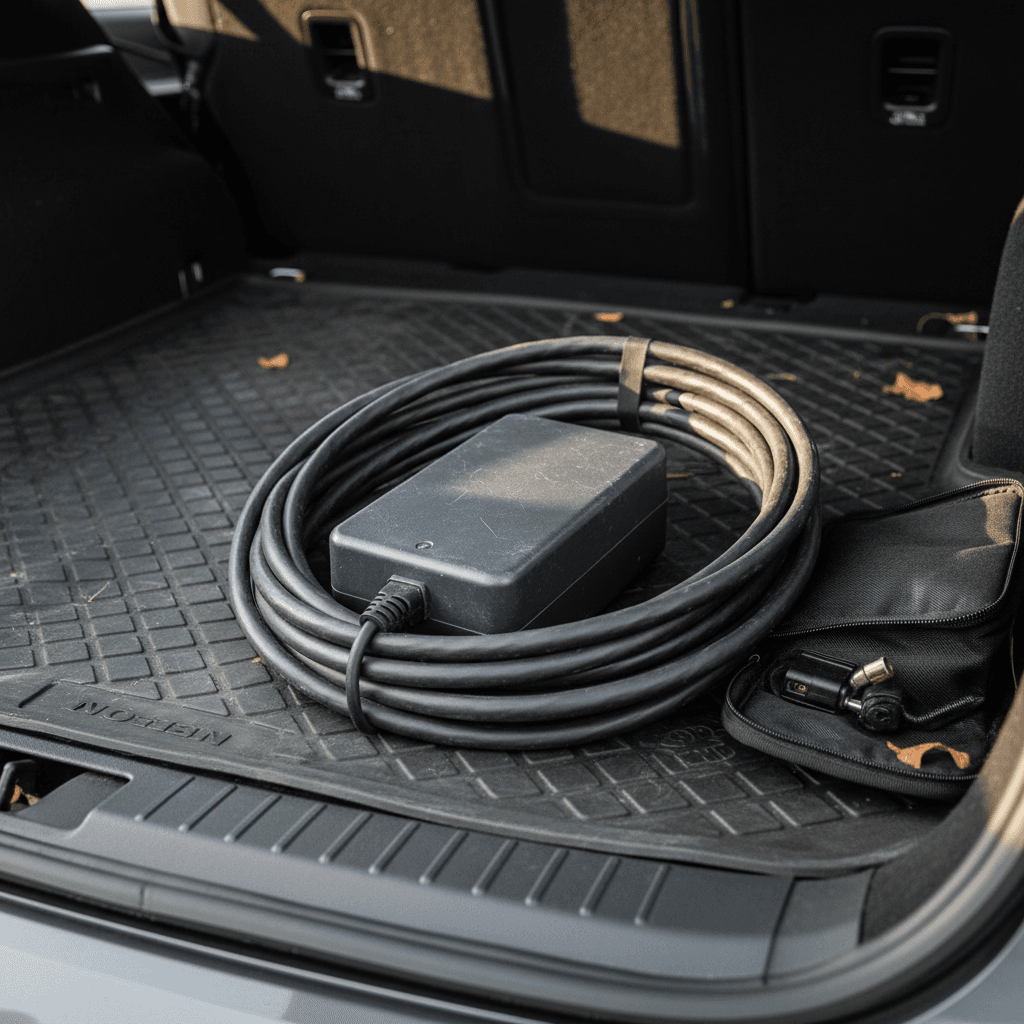
Every Lyriq ships with a dual‑level charging cord that can plug into a standard household outlet or a 240V, four‑prong outlet. That’s a practical bridge while you line up a permanent Level 2 solution.
Thinking about a used Lyriq?
Charging cost, time, and road-trip planning
On a road trip, the real question isn’t just, “What’s the peak kW?” It’s, “How often do I have to stop, and for how long?” With roughly 300+ miles of range, many Lyriq owners find a 150–180‑mile hop pattern comfortable, arriving with 10–25% in the pack and leaving around 70–80%.
Example Lyriq road-trip stop strategy
Assumes RWD Lyriq in mild weather, averaging 2.7–3.0 mi/kWh on the highway and using reliable high‑power DC fast chargers.
| Scenario | Arrival / Departure | Time on charger | Miles added (approx.) |
|---|---|---|---|
| Aggressive hopping | Arrive 10%, leave 60–65% | ~20–25 min | ~150–180 mi |
| Balanced comfort | Arrive 15–20%, leave 70–75% | ~30–35 min | ~180–210 mi |
| Max stretch | Arrive 5–10%, leave 80–85% | ~40–45 min | ~220–240 mi |
Don’t chase 100%, aiming for the 10–80% band keeps your average charging power high and your stops predictable.
Public DC fast‑charging costs vary widely by network and location. You’ll typically pay more per kWh on a 350 kW station than at home, but the Lyriq’s decent efficiency and big battery mean you’ll usually need one fewer stop per day than a shorter‑range EV.
Use your apps to stack the deck
Does fast charging hurt Lyriq battery health?
EV shoppers often hear that DC fast charging is “bad for the battery.” The reality is more nuanced. The Lyriq’s battery management system carefully limits power as the pack warms up or fills, and modern Ultium chemistry is designed to tolerate regular fast charging, within reason.
- Occasional DC fast charging on road trips is well within what the Lyriq is engineered for.
- Repeated back‑to‑back fast‑charge sessions from very low to very high state of charge in extreme heat can accelerate wear compared with gentle Level 2 use.
- Regularly charging to 100% and leaving the car parked for long periods at a full state of charge is harder on any EV battery than stopping around 70–80% when you can.
Signs to watch on a used Lyriq
In other words, use DC fast charging when it makes sense, especially on long trips, but let Level 2 do the heavy lifting at home or work. That approach keeps your total cost of ownership down and supports long‑term battery health.
Charging checklist for used Cadillac Lyriq shoppers
If you’re evaluating a used Lyriq, a quick charging “audit” can tell you as much about the car’s real‑world usability as a test drive. Here’s a practical checklist to run through before you sign anything.
Used Cadillac Lyriq charging checklist
1. Confirm onboard charger size
Ask whether the vehicle has the standard 11.5 kW onboard charger or the available 19.2 kW unit. The bigger charger isn’t required, but it can matter if you plan high daily mileage and need faster overnight recovery.
2. Test Level 2 charging at least once
If possible, plug into a known‑good 40–48A Level 2 charger and verify the Lyriq ramps to expected power and stays stable. Sudden drops or error messages might point to charger issues or vehicle hardware problems.
3. Try a short DC fast-charging session
A 10–60% test on a robust 150–350 kW charger will show whether the car can approach triple‑digit kW and hold solid power through the mid‑pack. This doesn’t need to be a full 10–80% test, just enough to see normal behavior.
4. Check charge‑port condition
Inspect the CCS port and charge door for damage, corrosion, or evidence of repeated forced closures. A worn or damaged port can lead to intermittent charging issues later.
5. Review charging history (if available)
See if the owner can share app data or receipts showing a mix of home and DC fast charging. A car that lived on DC all its life isn’t automatically a problem, but you’ll want a battery‑health report to go with it.
6. Ask for a battery-health report
On a used Lyriq, don’t guess. A quantified health score, like the <strong>Recharged Score Report</strong> used on Recharged vehicles, shows remaining capacity and flags abnormal degradation early.
Cadillac Lyriq charging speed: FAQ
Frequently asked questions about Cadillac Lyriq charging speed
Bottom line: Is the Cadillac Lyriq fast enough to live with?
In repeated charging speed tests, the Cadillac Lyriq proves to be a solid, if not class‑leading, fast‑charging SUV. You get a genuine 190 kW peak under the right conditions, a realistic 10–80% DC window in about 40 minutes, and home‑charging hardware that makes overnight top‑ups easy if you invest in a proper Level 2 setup.
If you’re cross‑shopping used luxury EVs, the Lyriq’s combination of range, charging speed, and Ultium‑based battery tech makes it an appealing choice, especially when you have clear data on pack health and real‑world charging behavior. That’s exactly what the Recharged Score Report is designed to show: how a specific vehicle’s battery and charging performance stack up before you commit.
Whether you end up buying a Lyriq or another used EV, approach charging speed tests the same way you’d evaluate a test drive. Understand the specs, validate them in the real world, and let data, not guesswork, guide your decision. And if you want expert help decoding those numbers, Recharged is built to make that part simple.