If you’re shopping for a used electric vehicle, chances are the perfect car isn’t sitting at the closest corner lot. Inventory is scattered, prices vary by region, and some models are nearly impossible to find locally. That’s why many shoppers start **buying a used EV from another state**, and if you understand the rules, it can be a smart move rather than a stressful one.
Out-of-state doesn’t have to mean out-of-control
Why buy a used EV from another state?
Four good reasons to widen your EV search
When staying local limits your options, going interstate can pay off.
More inventory
Better pricing
Specific features
Lower mileage, less wear
Big picture: how out-of-state EV purchases work
Where you pay sales or use tax
For most buyers, the key principle is simple: you ultimately pay **tax where you register the car**, not where you bought it. In many cases a dealer in the seller’s state will collect your home-state tax and send it along with the paperwork. If they don’t, your DMV will typically charge **use tax** when you register.
Some states give you **credit for tax paid to another state**, so you don’t get taxed twice, as long as you bring proof on the bill of sale or dealer tax form.
How registration and title work
The title follows the car, but **registration follows you**. The seller signs over their state’s title, and you (or the dealer on your behalf) submit that title to your home DMV with the right forms and fees. Some states issue temporary transit tags so you can drive the vehicle home; others require shipping or a one-trip permit.
Once your home DMV processes the paperwork, you’ll receive a new title in your name and **permanent plates** from your state.
Watch out for temporary tag games
Step-by-step: buying a used EV from another state
Your out-of-state used EV buying checklist
1. Verify the car fits your real-world needs
Confirm **range, charging port, on-board charger speed**, and options match how you’ll use the car at home. For example, a short-range city EV that’s fine in Los Angeles might feel tight in a cold-climate suburb with long highway commutes.
2. Get serious about battery health
Unlike a gas car, the **battery pack is the car’s most expensive component**. Ask for a battery health report, recent service records, and charging history. With Recharged, every car includes a Recharged Score Report that quantifies battery health and projected range, so you’re not guessing from a dashboard bar graph.
3. Line up financing and trade-in
If you’re financing, confirm your lender is comfortable with **out-of-state purchases** and any distance requirements for inspections. If you plan to trade in, consider getting an **online instant offer** or separate appraisal so you’re not locked into one dealer’s number.
4. Negotiate price plus fees, in writing
Ask the seller for an itemized buyer’s order that clearly shows **purchase price, doc fees, any state-specific fees, and taxes**. Make sure it states whether they’re collecting **your home-state tax** or just their own fees.
5. Decide: ship it or fly-and-drive
Compare the cost and risk of shipping versus traveling to pick up the EV. Factor in **hotel, airfare, temporary tags, insurance, and charging costs** if you’ll road-trip it home, plus the time you’ll spend en route.
6. Confirm title, payoff, and paperwork
Make sure the seller truly has **clear title** or, if there’s a loan, a clean process to get the title released. Double-check that the VIN on the title, purchase contract, and vehicle all match.
7. Arrange delivery and insurance
Before the car leaves the seller, have **insurance active**, a written bill of lading (for shipping), and a clear handoff plan for keys, charging cable, and any adapters.
Typical shipping costs for used EVs in 2025–2026
Taxes when you buy a used EV from another state
Tax is where many out-of-state buyers get nervous, but the rules are more straightforward than they seem once you break them down.
Common tax scenarios when buying out of state
Always confirm with your state DMV or tax agency, this table is a starting point, not legal or tax advice.
| Scenario | What usually happens | What to watch for |
|---|---|---|
| Dealer in seller’s state collects your home-state tax | Dealer uses your home address to calculate and collect **your state’s** sales or use tax and sends it with the paperwork. | Make sure the **rate and state** on the buyer’s order match your home state and that you get a detailed tax line item. |
| Dealer collects their state tax only | Some dealers must charge their state motor vehicle tax regardless of where you register. | Ask your DMV whether you’ll get **credit for tax paid to another state** and what documentation they require. |
| No tax collected at sale (common with private-party) | You pay **use tax** and fees when you register the EV in your home state. | Be prepared to write a sizable check at registration. Keep the bill of sale handy in case the DMV questions the purchase price. |
| States with extra EV fees | Many states layer on **EV or hybrid registration fees** to replace lost gas tax revenue. | Factor these annual fees into your total cost of ownership when comparing vehicles and states. |
How tax is typically handled when you bring a used EV home from another state.
Federal EV tax credits changed in late 2025
Title, registration, and insurance for an out-of-state EV
- Confirm whether you’ll receive a **signed paper title**, an electronic title release, or both. If there’s a lien, understand who’s paying it off and when the title will be free to transfer.
- Ask your DMV what they require to register a **used out-of-state EV**: typically the title, bill of sale, odometer disclosure, driver’s license, proof of insurance, and any state-specific forms.
- Check if your state requires an **out-of-state VIN inspection**, safety inspection, or emissions test. Pure EVs often skip emissions, but some states still require a quick verification.
- Activate insurance **before** you or a shipper take possession of the car. Your insurer will usually need the VIN, purchase price, and start date.
- Plan for registration timing. Many states require you to **register within a set window** (often 30–60 days) after purchase to avoid penalties.
Pro tip: ask your DMV about use-tax credits
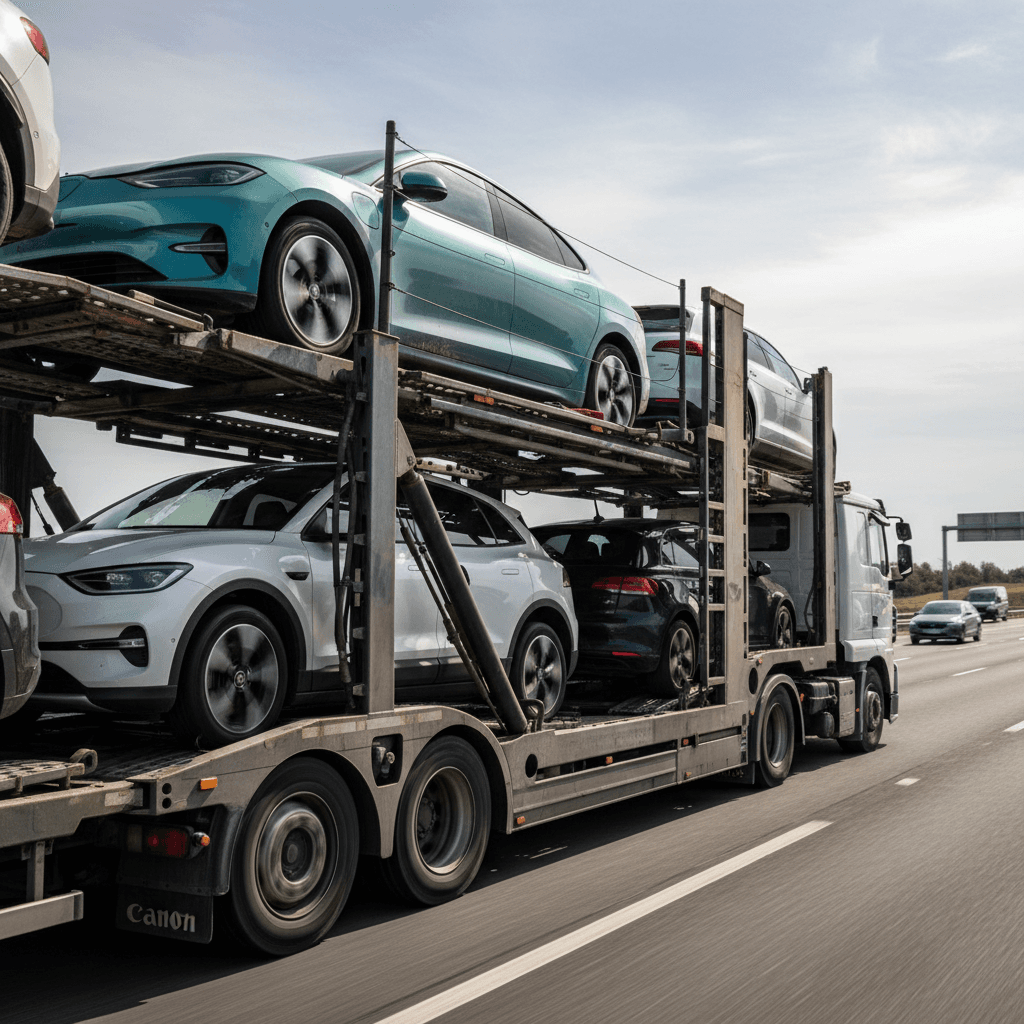
Shipping or flying and driving your used EV home
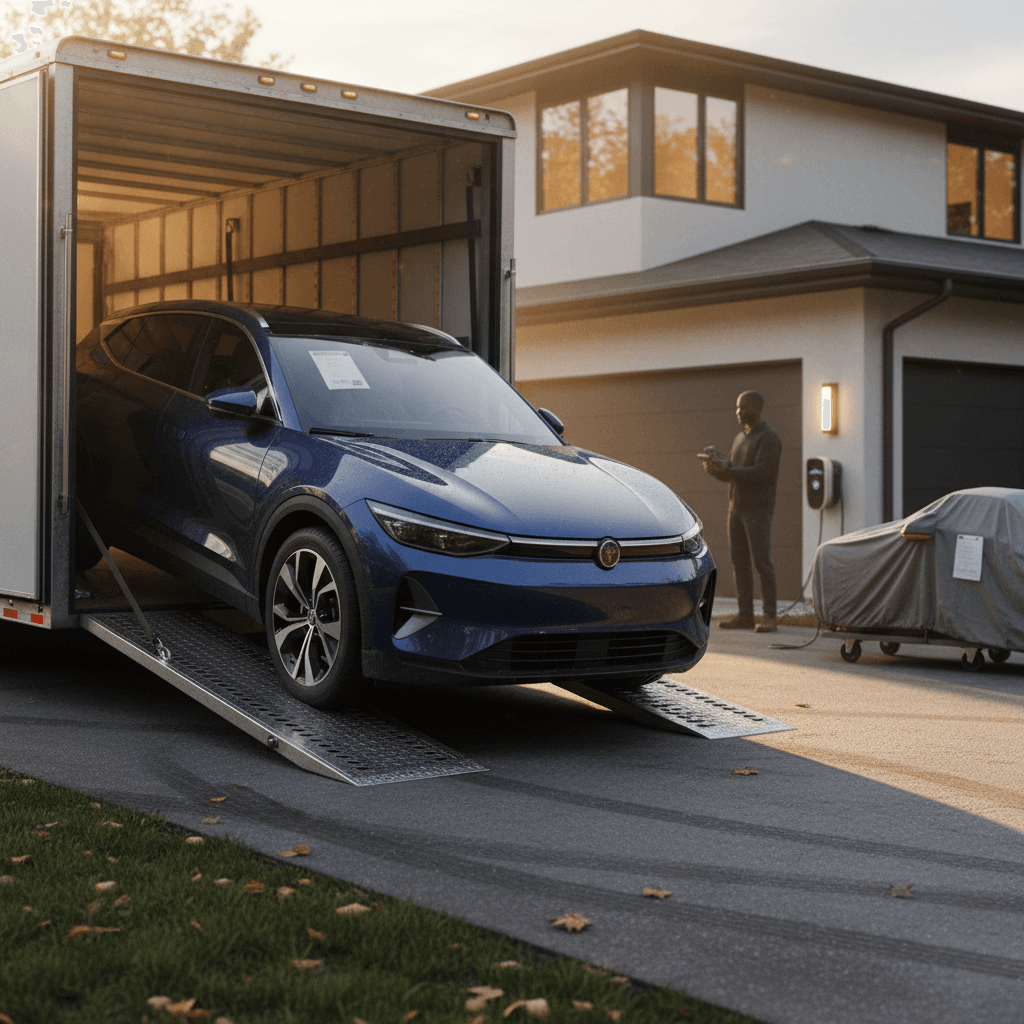
Once the deal is in place, you have two main choices: **ship the car** or **go get it yourself**. Both can work well; the right call depends on distance, your schedule, and how comfortable you are road-tripping an unfamiliar EV.
Option 1: Ship the EV
- Convenience: The car is picked up at or near the seller and dropped near your home.
- Cost: Expect roughly $700–$900 for short hops and $1,300–$2,500 for cross-country open transport, with EVs often costing $100–$300 more than gas cars.
- Protection: Enclosed transport offers more protection but can push cross-country costs into the $2,000–$3,500+ range.
Vet shippers carefully. Look for FMCSA registration, strong reviews, explicit **EV experience**, and clear policies on battery state-of-charge and damage claims.
Option 2: Fly-and-drive
- Experience: It can be a fun way to get to know your EV on a mini road trip.
- Hidden costs: Factor in airfare, hotel, food, temporary tags, and **public charging** on the way home.
- Logistics: Plan your route around reliable fast-charging, especially in winter or sparsely populated regions.
For longer distances, shipping is often cheaper than taking multiple days off work, especially if the weather or charging network between the two states is marginal.
Set the right charge level for shipping
Special considerations unique to used EVs
What matters more for EVs than gas cars
Out-of-state or local, these are the non‑negotiables for a used electric vehicle.
Battery health and degradation
Charging standard and adapters
Climate history
On-board charger limits
Software, warranty, and recalls
High-voltage safety
How Recharged handles EV-specific risk
Common pitfalls and how to avoid them
Avoid these costly out-of-state mistakes
Paying twice in taxes or fees
Solve this before you sign. Ask the dealer **exactly which state’s tax** they’re collecting and confirm with your DMV if you’ll get credit at home. Keep the buyer’s order and any tax receipts.
Buying sight-unseen with no third-party check
If you can’t see the EV yourself, hire a **reputable inspection service** that understands EVs or buy from a platform that provides verified condition and battery data, not just photos.
Ignoring registration deadlines
Many states impose **late fees or penalties** if you don’t register a new purchase quickly. Mark your calendar from the purchase date or delivery date so you don’t get caught out.
Assuming your home charger will “just work”
Before the car ships, confirm your **home charging setup** matches the car’s connector and amperage needs. If you rent or live in a condo, check building policies on EV charging ahead of time.
Using the cheapest possible shipper
Rock-bottom quotes can signal **bait-and-switch pricing** or poor insurance. Choose carriers with documented EV experience, clear contracts, and transparent coverage limits.
Never skip verifying the VIN and title
How Recharged simplifies buying a used EV from any state
Buying a used EV across state lines used to mean juggling dealers, shippers, inspectors, lenders, and your DMV on your own. Recharged was built to remove as much of that friction as possible, while keeping the parts that matter in your control.
What Recharged brings to an out-of-state EV purchase
Less guesswork, more transparency, regardless of where the car starts.
Verified battery health & pricing
Financing and trade-in options
Nationwide delivery
EV-specialist support
Fully digital buying experience
Experience Center in Richmond, VA
FAQ: buying a used EV from another state
Frequently asked questions
Bottom line: should you buy a used EV from another state?
Buying a **used EV from another state** isn’t automatically risky or complicated, it just requires a bit more planning than a traditional local purchase. If you understand how taxes, title, registration, and shipping work, and you insist on real data about battery health, you can turn the entire country into your shopping ground instead of being limited to what happens to be nearby this week.
If you’d rather not manage all of that yourself, platforms like Recharged are designed to make cross-state EV buying feel local: transparent pricing, financing and trade‑in options, expert EV guidance, a **Recharged Score Report** on every car, and **nationwide delivery** from the seller’s driveway to yours. However you choose to buy, take your time, ask the right questions, and let the numbers, not the distance, decide whether that out-of-state EV really is the right one for you.