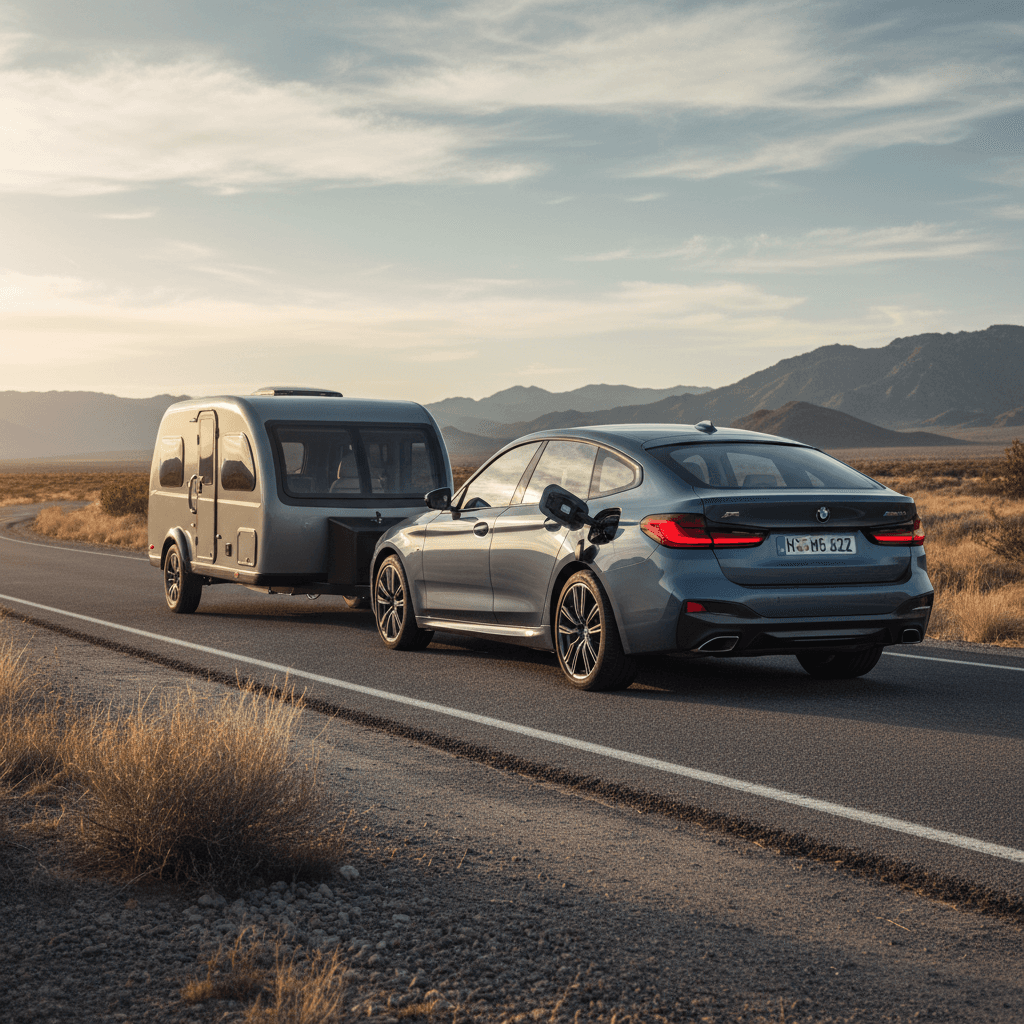
If you’re drawn to the BMW i5’s quiet, locomotive shove but still want to tow a small camper, boat, or utility trailer, you’re asking two smart questions: **what’s the BMW i5 towing capacity, and what happens to range when I tow?** This guide breaks down official tow ratings, EPA range by trim and wheel size, and what you can realistically expect once you hook up a trailer.
Quick snapshot
BMW i5 towing and range overview
BMW i5 at a glance: power, range, tow
Luxury electric sedan first, light tow vehicle second
Power & layout
The BMW i5 is an all-electric 5 Series offered mainly as:
- i5 eDrive40 – single-motor, rear-wheel drive
- i5 M60 xDrive – dual-motor, all-wheel drive performance model
Battery & range
Both trims use an ~81 kWh usable battery. EPA-rated range (sedan):
- eDrive40: 270–295 miles depending on wheels
- M60 xDrive: 240–256 miles depending on wheels
Towing capability
With a factory or approved tow package, the i5 can tow:
- eDrive40: up to 1,500 kg (~3,300 lb)
- M60 xDrive: up to 2,000 kg (~4,400 lb)
Always confirm U.S.-market ratings in your manual, as limits can vary by region and hitch.
Read your specific owner’s manual
BMW i5 towing capacity by trim and configuration
BMW doesn’t market the i5 as a baby X5, but properly equipped it’s no shrinking violet. In markets that publish tow data, you’ll see two main ratings: one for the rear-drive eDrive40 and a higher one for the dual-motor M60 xDrive.
Indicative BMW i5 towing capacity by trim
Based on manufacturer and regional data for 2024–2025 BMW i5 sedans. Always confirm your car’s exact figures.
| Trim | Drive | Typical braked tow rating | Unbraked limit | Best use cases |
|---|---|---|---|---|
| i5 eDrive40 | RWD | Up to 1,500 kg (~3,300 lb) | Up to 750 kg (~1,650 lb) | Small campers, single-axle utility trailers, light boats |
| i5 eDrive40 M Sport | RWD | Up to 1,500 kg (~3,300 lb) | Up to 750 kg (~1,650 lb) | Same as eDrive40, firmer suspension |
| i5 M60 xDrive | AWD | Up to 2,000 kg (~4,400 lb) | Up to 750 kg (~1,650 lb) | Heavier campers, enclosed trailers, small car haulers |
BMW i5 tow ratings assume a factory-approved hitch and trailer brakes where required.
No hitch, no tow
Checklist: is your BMW i5 truly tow-ready?
1. Confirm factory tow prep
Check your build sheet, VIN decoder, or original window sticker for a towing or trailer prep package. If you’re shopping used, ask the seller for documentation.
2. Inspect the hitch and hardware
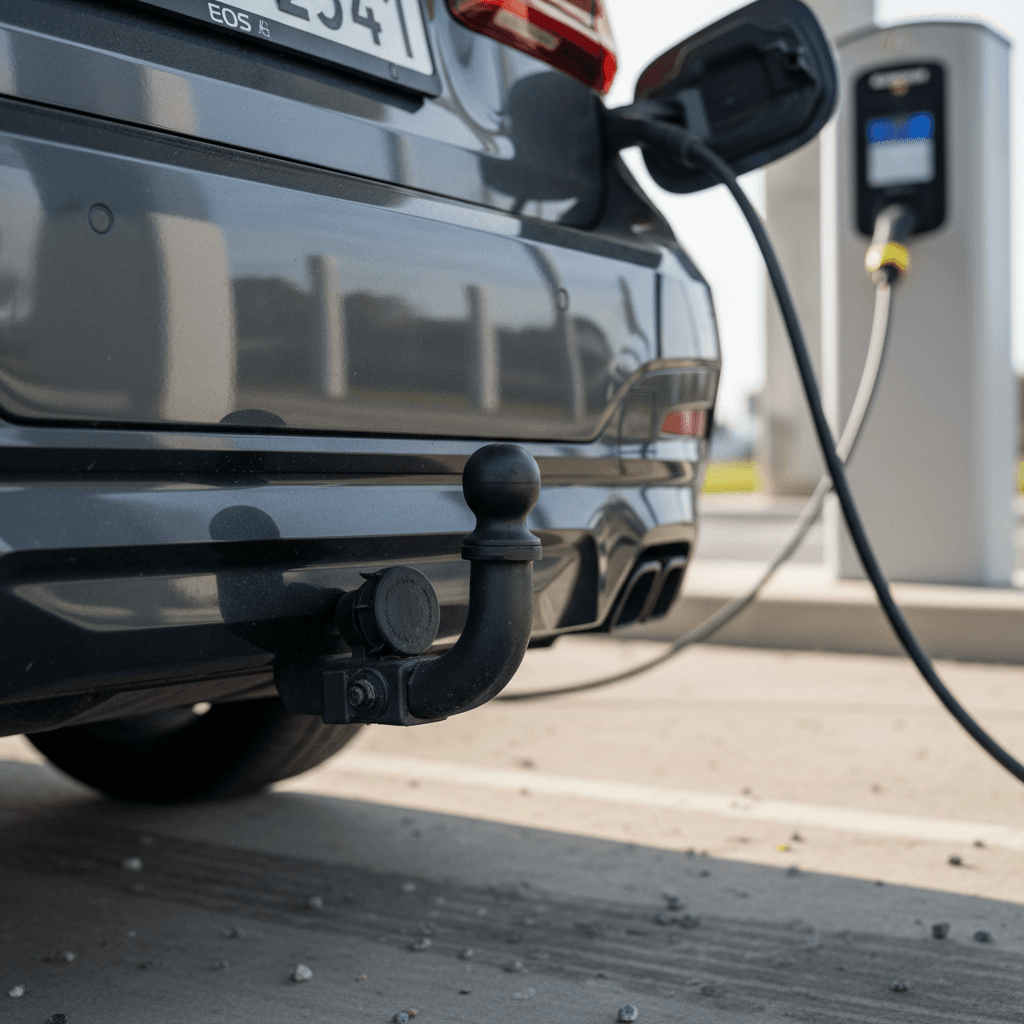
A proper tow setup includes a rated receiver, integrated wiring, and often cooling or software changes. Look for a rating plate on the hitch itself.
3. Verify electrical connection
You’ll need a 7-pin or 13-pin connector for lights and, ideally, electric brakes. Avoid splicing into the lighting harness on a modern EV.
4. Check tongue weight limits
Even if the overall tow rating is 3,300–4,400 lb, tongue weight is usually limited to <strong>~10%</strong> of that. An overloaded tongue can overwhelm the rear axle and suspension.
5. Weigh your trailer loaded
Visit a public scale once your trailer is packed. Actual weight often creeps 10–20% above the brochure number, critical on an EV where range matters.
BMW i5 EPA range by trim, wheels, and model year
Before you can understand how towing affects range, you need a clean baseline. For 2024–2025, the BMW i5 sedan comes in two main electric trims with a shared battery but different motors and wheels.
BMW i5 EPA-rated range (sedan, 2024–2025)
BMW i5 EPA range by trim and wheel size
EPA ratings for early BMW i5 model years. Later software tweaks may add a handful of miles, but the pattern stays the same: smaller wheels, more range.
| Model | Drive | Wheel size | EPA range (mi) | Notes |
|---|---|---|---|---|
| i5 eDrive40 | RWD | 19" | 295 | Most efficient configuration |
| i5 eDrive40 | RWD | 20" | 278 | Sportier look, modest range hit |
| i5 eDrive40 | RWD | 21" | 270 | Biggest wheels, shortest range |
| i5 M60 xDrive | AWD | 19" | 256 | High power, decent range |
| i5 M60 xDrive | AWD | 20" | 248 | Mid-spec performance setup |
| i5 M60 xDrive | AWD | 21" | 240 | Max performance, min range |
All figures rounded; U.S. EPA combined range for 2024 i5 sedan.
If you plan to tow, choose smaller wheels
How towing changes your BMW i5’s real-world range
Towing is where physics collects its dues. The moment you add frontal area, rolling resistance, and weight, your i5’s elegant EPA label becomes more of a wistful memory. Like most EVs, you should expect a 30–50% range hit at highway speeds with a typical small trailer, and even more with tall, blunt campers.
Drag and frontal area
Even a relatively light camper or utility trailer punches a much bigger hole in the air than a solo sedan. At 65–70 mph, aerodynamic drag dominates EV energy use. Double the drag and you can nearly double consumption.
Add a square-fronted box trailer to an i5 and you’ll see the impact much sooner than you would in a diesel X5 with a 20-gallon tank.
Weight and rolling resistance
Extra weight hurts acceleration and climbing efficiency, and it increases rolling resistance at any speed. An extra 2,000–3,000 lb behind the i5 means the motors and battery work harder for the same trip, which you see directly as fewer miles per kWh.
The regenerative brakes can harvest some energy on descents, but not enough to cancel the additional load.
Rule-of-thumb range loss when towing with a BMW i5
Assuming good conditions, moderate speeds, and an efficient trailer
Light, low trailer
Example: small aluminum utility trailer or lightweight teardrop under ~1,500 lb loaded.
Highway range hit: ~30–35%.
That 295-mile EPA eDrive40 becomes ~190–205 miles of usable highway range.
Mid-weight camper or boat
Example: 2,000–3,000 lb small travel trailer, pop-up camper, or fiberglass boat.
Highway range hit: ~40–50%.
Plan for 130–170 miles between charges depending on speed, wind, and terrain.
Near max tow rating
Example: 3,300–4,400 lb trailer near the i5’s rated limit.
Highway range hit: 50%+.
You might see 100–140 miles per charge at 65–70 mph, and you’ll feel every hill.
Heat, cold, and speed matter more when towing
What can you safely tow with a BMW i5?
The BMW i5 is happiest when you treat it as a light-duty tow rig: think efficient trailers that respect its drag profile and tow rating. The good news is that covers a lot of real-world use, yard work, dirt bikes, a small fishing boat, or a compact camper.
Example trailer matches for each i5 trim
Keep an eye on both weight and aerodynamics
i5 eDrive40 (up to ~3,300 lb)
- Best matches: small teardrop campers, folding pop-up trailers, single-axle utility trailers, pair of motorcycles or ATVs, light aluminum boat and trailer.
- Avoid: tall, heavy travel trailers with big flat fronts; they’ll eat range and feel nervous in crosswinds.
- Sweet spot: keep loaded trailer weight under ~2,500 lb if you care about comfortable range.
i5 M60 xDrive (up to ~4,400 lb)
- Best matches: slightly larger campers, enclosed track-day trailer, heavier boats, compact car on a lightweight dolly.
- Remember: the M60 already starts with less range than the eDrive40; extra power doesn’t add miles.
- Sweet spot: 2,500–3,000 lb for long weekends without living at fast chargers.
Know your weights, not just ratings
Charging strategies when towing with an i5
The BMW i5’s DC fast charging, up to roughly 205 kW at a peak, with 10–80% in around 30 minutes in ideal conditions, makes towing road trips manageable if you plan ahead. With a trailer on the back, you’ll just be stopping more often.
Smart charging tactics for towing trips
1. Plan chargers with trailer access
Some stations are shoehorned into tight parking lots. Look for <strong>pull-through DC fast chargers</strong> at highway sites or plan stops where you can easily drop the trailer in a safe spot before charging.
2. Aim for 10–60% or 10–70% SOC
Fast-charging slows dramatically above ~70–80%. When towing, it’s often quicker overall to make more frequent, shorter stops between <strong>10% and 60–70%</strong> than to try to stuff the battery to 100%.
3. Reduce speed between chargers
Each 5 mph above 65 is brutal on consumption with a trailer. Backing down to the right lane at 60–65 mph can add tens of miles of range and reduce the number of stops you need.
4. Use preconditioning for DC fast charging
Use BMW’s navigation to a fast charger so the car can <strong>precondition the battery</strong>. A warm battery takes a charge faster, especially in winter.
5. Charge overnight when possible
Booking campgrounds or hotels with Level 2 charging lets your i5 refill slowly while you sleep. Even 7–11 kW overnight can replace a big towing day’s energy.
Two years of fast charging on many new i5s
Battery health, towing, and shopping for a used BMW i5
Towing itself doesn’t magically destroy an EV battery, but it does mean more high-load and fast-charge events, which can accelerate wear if the previous owner was careless. If you’re eyeing a used BMW i5 that’s seen a lot of trailer duty, you want hard data, not just reassuring noises from a salesperson.
How towing affects long-term battery health
- More frequent DC fast charging on long towing trips can add thermal stress if the car isn’t managed carefully.
- High sustained loads (mountain passes with a trailer) push the pack harder and may warm it up more often.
- Short, occasional towing trips with mostly Level 2 home charging are unlikely to make a dramatic difference versus non-towing use.
Why a third-party battery check matters
This is where a marketplace like Recharged changes the game. Every EV we sell comes with a Recharged Score Report that includes verified battery health diagnostics, so you’re not guessing about how a past life of towing, fast charging, or hard driving affected the pack.
Shopping locally and don’t see that kind of report? Consider an independent battery health test before you sign.
Questions to ask when buying a used i5 that might have towed
1. Was the car factory-equipped for towing?
If you see a hitch, ask whether it’s a BMW-approved solution or pure aftermarket. Factory or OEM-approved systems are more likely to respect cooling and control limits.
2. How often was it used for towing?
Light seasonal use, say, a small trailer a few weekends per year, is very different from regular heavy towing to the track or jobsite.
3. What’s the current battery health?
Ask for data. A <strong>Recharged Score</strong> or equivalent battery report gives you a clear, numeric view of remaining capacity and any anomalies.
4. Any history of overheating or power-limiting?
On long grades with a trailer, the car may log events for high temperatures or reduced power. Review service records for cooling system or high-voltage repairs.
5. Are charging habits documented?
A well-kept log, or at least a believable story, about mostly Level 2 home charging and modest DC use is a positive sign for long-term battery health.
BMW i5 towing and range vs other electric sedans
If you’re cross-shopping the i5 with other luxury EV sedans, it sits in a sensible middle ground: more traditional-feeling than a Tesla, more engaging than many crossovers, and with enough tow capacity for real toys, if not an Airstream the size of a starter home.
How the BMW i5’s range stacks up in its class
A high-level comparison of EPA range figures for popular luxury EV sedans as of 2025.
| Model | Segment | Approx. max EPA range | Towing capability (indicative) | Notes for tow-curious buyers |
|---|---|---|---|---|
| BMW i5 eDrive40 | Midsize luxury sedan | 295–~300 mi (updates may add a few miles) | Up to ~3,300 lb (region-dependent) | Balanced range and dynamics; best with efficient trailers. |
| BMW i5 M60 xDrive | Performance luxury sedan | 240–256 mi | Up to ~4,400 lb (region-dependent) | Serious shove, solid tow rating, but less range buffer. |
| Mercedes EQE 350+ | Midsize luxury sedan | Around 305 mi | Limited/non‑emphasized in most markets | Comfort-first, but less towing focus and infrastructure support. |
| Lucid Air Pure | Large luxury sedan | ~410 mi | Tow ratings evolving; check latest data | Class-leading range, but hitch setups and towing use are still niche. |
| Tesla Model S Dual Motor | Large luxury sedan | ~405 mi | Not widely rated/marketed for towing in U.S. | Superb range and charging network, but sedan towing remains unusual. |
Towing ratings vary widely and are still evolving; always check each manufacturer’s latest specs.
Consider an SUV if towing is a core use case
FAQ: BMW i5 towing capacity and range
Frequently asked questions about BMW i5 towing and range
Bottom line: Is the BMW i5 good for towing?
The BMW i5 wasn’t built to replace a half-ton pickup, and it doesn’t pretend to. What it does offer is a rare combination: quiet, long-legged electric luxury with enough towing capacity to bring genuinely useful trailers along for the ride, if you respect its limits.
If you choose the right trim (and wheels), keep trailer weights reasonable, and adjust your expectations around range and charging stops, the i5 can handle weekend toys, road-trip teardrops, and the usual Home Depot runs with surprisingly little drama. Treat it as a superb electric sedan that can tow, not a tow vehicle that happens to be electric, and you’ll stay on the right side of the compromise.
And if you’re shopping for a used BMW i5, especially one that might have seen a hitch, buying through Recharged means you get a Recharged Score Report with verified battery health, fair market pricing, and EV‑specialist support from first click to delivery. That’s exactly the kind of transparency you want before you hitch your life, and your trailer, to an electric 5 Series.