If you’re eyeing a BMW i5, you’re probably wondering how it does in crash tests and real-world safety. The good news: the fully electric 5 Series has already earned top marks from major safety organizations, and its suite of high-end driver-assistance tech puts it near the front of the luxury EV pack. This guide breaks down the BMW i5 safety rating and crash test results in plain English, and explains what they actually mean for you as a buyer, especially if you’re shopping the used market with a platform like Recharged.
Key takeaways at a glance
BMW i5 safety overview
The BMW i5 is the fully electric version of BMW’s 5 Series sedan (internal code G60). In normal conversation, people mix “i5” and “5 Series” together, but for crash tests the important detail is this: safety agencies typically test one or two versions of the model line, and those results carry over to the rest of the range when the body structure is shared.
- Body style: midsize luxury sedan (same basic shell for gas and electric versions)
- Battery-electric variants: i5 eDrive40 (RWD) and i5 M60 (AWD performance model)
- Launched globally for the 2024 model year, with continuing updates for 2025+
- Standard active-safety tech across the range, with additional optional packages for advanced driver assistance
Because the i5 uses the same core crash structure as the rest of the 5 Series, ratings you see referenced as “5 Series Sedan” typically apply to the electric versions too, unless noted otherwise. When you’re comparing an i5 to other EVs, it makes sense to think of it as a 5 Series that happens to be electric, not a completely separate car.
BMW i5 / 5 Series headline safety numbers
Crash test results and safety ratings
Euro NCAP: 5-star rating for the electric i5
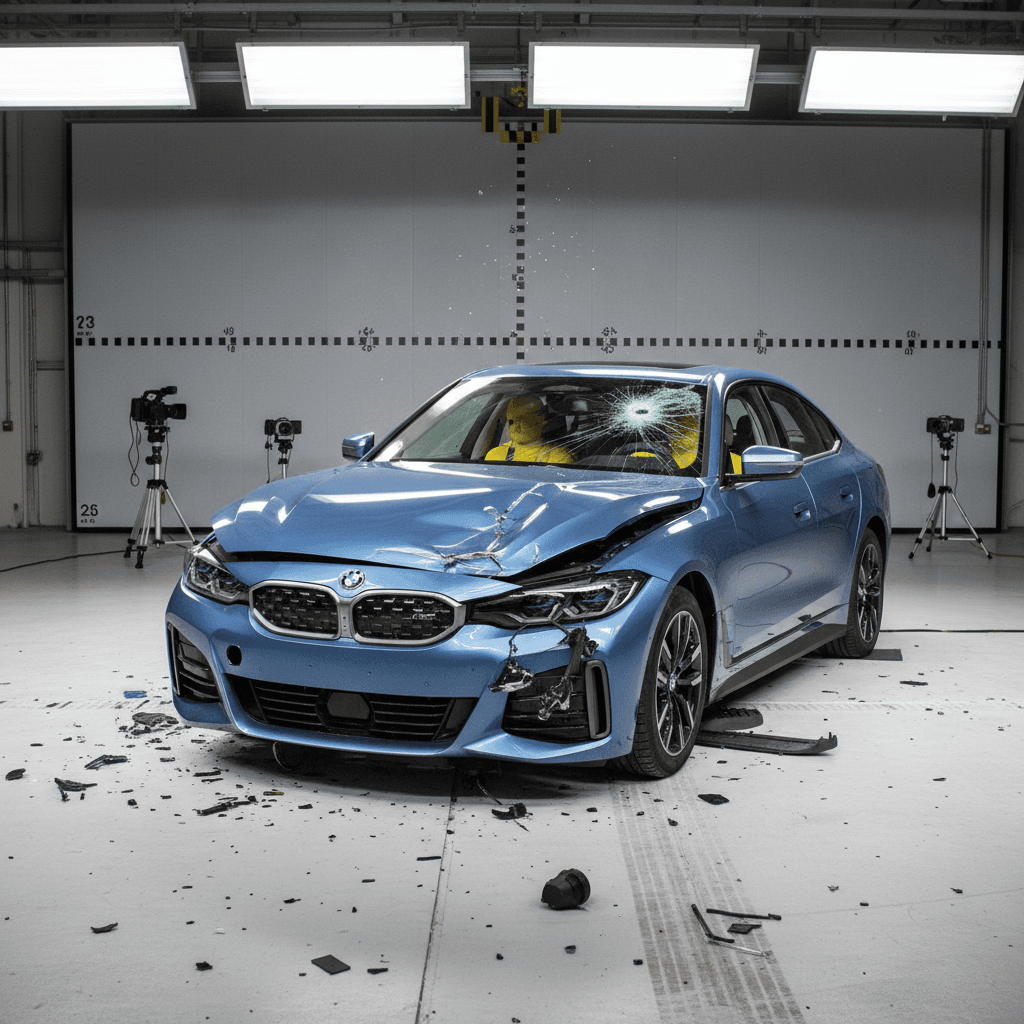
Europe’s Euro NCAP program tested the 2024 BMW 5 Series Sedan in the fully electric i5 eDrive40 configuration and awarded it a full 5‑star overall rating. That’s the highest score available and indicates strong performance not just in crash protection, but also in advanced driver-assistance systems.
Euro NCAP BMW i5 / 5 Series detailed scores
Core Euro NCAP category scores for the eighth‑generation BMW 5 Series Sedan, tested as the i5 eDrive40.
| Category | Score | What it means |
|---|---|---|
| Adult Occupant | 89% | Strong protection for driver and front passenger in frontal and side crashes. |
| Child Occupant | 85% | Good protection for kids in approved seats plus clear ISOFIX mounting and instructions. |
| Vulnerable Road Users | 86% | Effective pedestrian and cyclist impact mitigation and automatic emergency braking. |
| Safety Assist | 78% | Robust active-safety systems such as AEB, lane support, and speed assistance. |
Scores are for the tested configuration but apply across the 5 Series range where the structure and safety systems are comparable.
Those numbers put the i5 in line with other high‑performing executive EVs. For everyday use, 89% adult occupant and 85% child occupant scores translate into a cabin that manages crash forces well, with effective airbags, seatbelts, and structural crumple zones.
How to read a 5-star Euro NCAP rating
IIHS: TOP SAFETY PICK+ in the U.S.
In the U.S., the Insurance Institute for Highway Safety (IIHS) evaluated the new 5 Series Sedan and awarded it a TOP SAFETY PICK+ designation, the group’s most demanding award. BMW notes that the fully electric i5 shares the same high-strength body and restraint systems that IIHS tested.
- Good ratings in small overlap and moderate overlap frontal tests
- Good side-impact results with strong occupant compartment integrity
- Effective head restraints and seat design for rear‑end crashes
- Advanced or superior ratings for automatic emergency braking in both vehicle‑to‑vehicle and vehicle‑to‑pedestrian scenarios (depending on trim and equipment)
To earn TOP SAFETY PICK+, a vehicle must perform well across a broad matrix of crash tests, headlight performance, and active-safety tests. The i5 clears that bar, which is particularly meaningful if you drive regularly at night or in mixed traffic where AEB and lane keeping can make a real difference.
NHTSA: What we know so far
As of early 2026, the BMW i5 itself has not been a headline model in the U.S. government’s New Car Assessment Program (NHTSA 5‑Star Safety Ratings), and recent test schedules focus more on SUVs and trucks. That’s not unusual for lower-volume luxury sedans. If or when NHTSA crashes a 5 Series or i5, you’ll see a separate star rating on the Monroney window sticker and NHTSA’s website.
Don’t confuse IIHS and NHTSA
BMW i5 vs. gas 5 Series: Any safety differences?
From a crash‑protection standpoint, the i5 and the gas‑powered 5 Series share the same basic body shell and safety engineering. BMW designed this generation from the ground up to accommodate both combustion and electric powertrains, so the structure has been engineered with battery protection and additional weight in mind.
Where they’re essentially the same
- Core crash structure, crumple zones, and passenger cell design.
- Airbag coverage (front, side, head curtain) and seatbelt systems.
- Standard safety tech like automatic emergency braking and lane-keeping assist on most trims.
- IIHS and Euro NCAP ratings published under the broader “5 Series Sedan” umbrella.
Where the i5 is different
- Battery pack integrated into the floor adds weight but lowers the center of gravity, which can improve stability.
- Additional reinforcements and underbody shielding around the high-voltage battery.
- EV‑specific software tuning for traction and stability control, especially on dual‑motor M60 models.
- Acoustic alerts for pedestrians at low speeds, as required for EVs.
In practice, you can treat the safety credentials of a well‑equipped 530i and an i5 eDrive40 as broadly equivalent, with the i5’s extra mass shifting some crash dynamics but not undermining the overall protection picture.
Active safety and driver-assistance tech
BMW leans heavily on advanced driver-assistance systems (ADAS) in the i5, and that’s a big part of why it scores well in Euro NCAP and IIHS evaluations. Even base cars get a robust set of tech, and option packages layer on more sophisticated features for long‑distance driving.
Standard BMW i5 safety & assistance features
Most trims in the U.S. and Europe share a generous baseline of active safety tech.
Automatic emergency braking
Lane departure & lane-keep
Blind spot & rear alerts
Adaptive cruise control
Parking Assistant
Traffic sign & speed assist
Driving Assistance Professional & Highway Assistant
The optional Driving Assistance Professional package is where the i5 really separates itself. It bundles enhanced adaptive cruise control, more capable lane centering, and BMW’s latest hands‑free Highway Assistant on certain markets and roads.
- Hands‑free driving on compatible highways at speeds up to around 85 mph, while an interior camera monitors your attention.
- Active lane‑centering and automated lane changes, including an eye‑activated lane change where the system responds to your glance toward the side mirror.
- Evasive steering assist to help you steer around an imminent obstacle when you’re already braking hard.
- Enhanced traffic-jam assist that can handle low‑speed stop‑and‑go with minimal driver input, still requiring supervision.
Remember: this is still Level 2, not self‑driving
Passive safety, structure, and battery protection
Crash‑test scores are only part of the story. The engineering that earns those scores matters just as much, especially when you’re talking about a heavy electric sedan carrying a large battery pack under the floor.
What’s protecting you inside an i5?
BMW’s safety engineering blends traditional crash structure with EV‑specific reinforcement.
Rigid passenger cell
Crumple zones
Battery shielding
Airbag coverage
High‑voltage safety in a crash
If you’re looking at a used i5, it’s worth checking whether the car has ever been in a significant collision. A severe side impact or underbody strike that reaches the battery area should be evaluated by a BMW‑certified repair facility. Platforms like Recharged can help here, since each vehicle comes with a Recharged Score Report that documents battery health and flags signs of past major damage.
How the BMW i5 compares to other luxury EVs
In raw numbers, the i5’s Euro NCAP and IIHS results put it near the top of the executive‑EV class. It’s not the absolute best in every sub‑score, but it’s firmly in the first tier when you stack it against rivals like the Mercedes‑Benz EQE sedan, Tesla Model S, and Hyundai Ioniq 6 in higher trims.
BMW i5 vs. key luxury EV safety benchmarks
High‑level comparison of how the i5’s safety credentials stack up against major rivals. Exact scores vary by year and configuration.
| Model | Crash-test highlights | Notable safety strengths |
|---|---|---|
| BMW i5 / 5 Series | Euro NCAP 5‑star, IIHS TOP SAFETY PICK+ | Balanced crash performance, sophisticated Level 2 highway assist, strong pedestrian protection. |
| Mercedes EQE Sedan | Strong Euro NCAP performance; some trims with advanced ADAS packages | High‑end driver assistance and Mercedes’ strong passive safety heritage. |
| Tesla Model S | Solid crash structure; active safety scores depend heavily on software version | Over‑the‑air updates for ADAS; mixed IIHS results over different years for headlights and AEB. |
| Hyundai Ioniq 6 | Euro NCAP 5‑star and strong IIHS scores in many trims | Excellent value with robust active safety as standard. |
Use this as a directional comparison, and always confirm ratings for the exact model year and spec you’re shopping.
Where the i5 really shines
Used BMW i5 safety checklist
Safety ratings don’t change on paper when a car moves from “new” to “used,” but the actual safety of a specific i5 does depend on how it’s been driven, maintained, and repaired. Before you commit to a pre‑owned i5, whether through a private party, dealer, or a digital marketplace like Recharged, walk through this safety‑focused checklist.
Safety steps before you buy a used BMW i5
1. Pull crash and repair history
Run a vehicle‑history report and ask for service records. Look for any structural repairs, airbag deployments, or “salvage/rebuilt” branding. If Recharged lists the vehicle, their Recharged Score Report will summarize major events and give you a clear battery‑health snapshot.
2. Inspect ADAS hardware
Verify that front and rear cameras, radar sensors, and parking sensors are intact and aligned. Misaligned sensors after a fender‑bender can degrade AEB or lane‑keeping performance without throwing obvious warnings.
3. Check for warning lights and software updates
On a test drive, look for any persistent alerts related to airbags, driver‑assistance systems, or the high‑voltage battery. Confirm that the car’s software has been updated, BMW regularly refines safety and driver‑assist behavior via updates.
4. Test driver-assistance behavior
Safely try adaptive cruise, lane keeping, blind‑spot alerts, and parking assist on a quiet stretch of road and in a parking lot. The systems should operate smoothly without abrupt or inconsistent interventions.
5. Examine tires and brakes
High‑performance EVs are heavy and hard on consumables. Worn tires or cheap replacements with poor wet grip are a real safety liability. Check for adequate tread depth, even wear, and quality brands.
6. Verify charging and high‑voltage integrity
While not a crash‑test metric, a healthy battery and charging system are safety issues. Look for signs of underbody damage or DIY work around high‑voltage components, and prefer cars that have been serviced at BMW dealers or reputable EV specialists.
How Recharged can help on the safety front
FAQs: BMW i5 safety rating & crash tests
Common questions about BMW i5 crash tests and safety
Bottom line: Is the BMW i5 a safe EV?
Put simply, yes: the BMW i5 is one of the safer luxury EV sedans you can buy today. Between its 5‑star Euro NCAP rating, IIHS TOP SAFETY PICK+ award, and a dense stack of modern driver‑assistance tech, it checks the right boxes for both passive crash protection and crash avoidance.
The bigger question for you as a shopper is which specific i5 you’re considering. Trim level, option packages, and crash/repair history all influence how safe a particular car will be in the real world, especially a few years down the road. That’s where a transparent, EV‑focused marketplace like Recharged can make your life easier, with verified battery health diagnostics, a clear Recharged Score, and expert guidance on whether the car’s safety equipment and condition truly match your expectations.
If you’re cross‑shopping the i5 against other electric sedans, use this crash‑test information as a baseline. Then look at practicality, range, charging, and ownership costs to round out the picture. Safety is one of the i5’s strengths, you can confidently treat it as a core part of your decision, not a compromise.