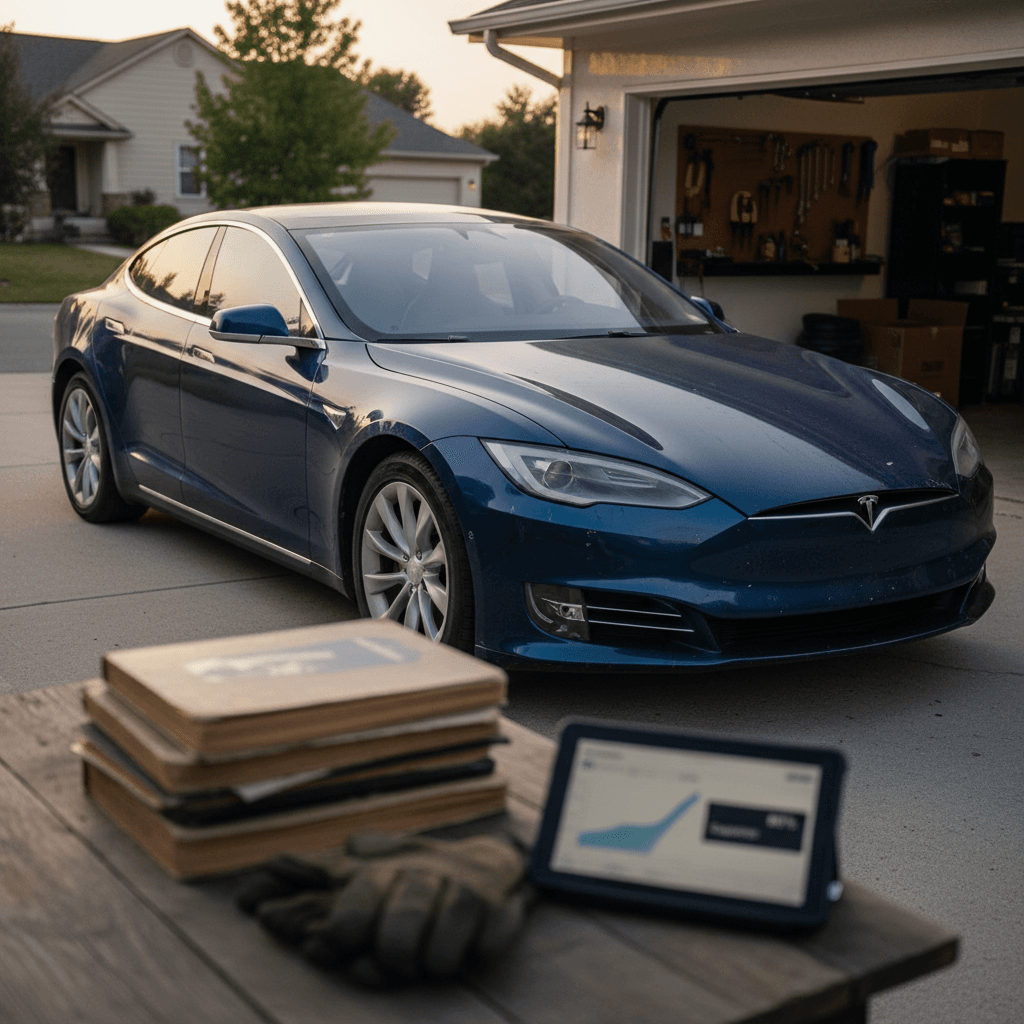
Search for the best used Tesla under $10K right now and you’ll see click‑worthy headlines and a handful of shockingly cheap listings. But when you dig in, most of those cars have 150,000–250,000 miles, branded titles, or big question marks around battery health. This guide gives you a reality check on what’s actually available in 2026, and how to chase a budget Tesla (or smarter alternative) without getting burned.
Quick reality check
Can You Really Get a Tesla Under $10K in 2026?
The short answer: yes, but only in very specific circumstances. Nationwide used‑car listings still show the bulk of Teslas, especially Model 3 and Model Y, well above $20,000. However, if you filter for price only, you’ll occasionally see early‑production 2012–2014 Model S sedans pop up under $10,000, usually with more than 175,000–200,000 miles and a long ownership history.
- Early Model S (2012–2014) with very high mileage (often 175k–250k+ miles)
- Cars sold at auction, small independent lots, or private classifieds, not certified programs
- Listings that mention issues like "needs battery," "limited range," or "no Supercharging"
- Branded titles (salvage, rebuilt) that kill the factory battery/drive unit warranty
Watch the fine print
What a Sub‑$10K Tesla Actually Looks Like
Typical Profile of a Tesla Under $10K
Same badge, very different ownership experience than a $30K CPO car
Older, First‑Gen Model S
Almost all Teslas under $10K are 2012–2014 Model S sedans. You won’t see Model 3 or Model Y at this price yet.
High Mileage, Heavy Use
Expect 175k–250k+ miles. Many were highway commuters or rideshare cars with lots of DC fast charging in their history.
Thin or No Warranty
Battery and drive unit coverage may be expired or void, especially if the title is branded or the pack has already been replaced once.
That doesn’t automatically make a $9,500 Model S a bad idea. EV drivetrains can handle high mileage better than many gas cars, and plenty of early Teslas are still driving well past 200,000 miles. But at this price, you’re no longer buying a luxury EV, you’re buying a complex, aging electric platform that demands careful inspection.
Best Candidates for a Used Tesla Under $10K
If you’re determined to stay under $10,000, there are a few Tesla configurations that make more sense than others. None are perfect, but some strike a better balance between risk and value.
Best (Relative) Bets for a Tesla Around $10K
These are the configurations most likely to show up near $10K, and what you’re trading off to get there.
| Candidate | Why It’s on the List | Key Trade‑Offs |
|---|---|---|
| 2012–2013 Model S 60 (RWD) | Simpler powertrain, smaller pack means lower replacement cost, often used as commuters | Shorter range when new, many have heavy degradation today, early infotainment hardware |
| 2013–2014 Model S 85 (RWD) with 200k+ miles | Larger pack can still offer usable range even with 20–30% degradation | Very high mileage, likely suspension and interior wear, possible limited Supercharging speeds |
| Branded‑title Model S (any early year) | Cheapest way to get into a Tesla badge; sometimes damage was cosmetic only | Battery/drive unit warranty usually void, resale value low, insurance can be tricky |
| Rough‑cosmetic but mechanically sound Model S | Curb rash, faded paint, torn seats cut price without always affecting drivability | Harder to resell later, may indicate hard use or weak maintenance history |
Always confirm battery health, title status, and option packages before committing.
Focus on mechanicals, not cosmetics
Biggest Risks With Ultra‑Cheap Teslas
Under $10,000, you’re trading price for certainty. That’s true for any used car, but the stakes are higher with an EV because the single most expensive component, the high‑voltage battery, has an opaque history and can cost as much as the car to replace.
Major Risks to Watch Before You Fall for a $9,999 Tesla
1. Battery degradation and range loss
Even though many Teslas still retain 80–90% capacity at high mileage, some early packs fall outside that curve. A car that originally did 240 miles may only give you 120–150 miles now, and even less in winter.
2. Limited fast‑charging speed
High‑mileage cars often see <strong>throttled Supercharging</strong> to protect the pack. That can turn a 20‑minute road‑trip stop into 45+ minutes for the same miles added.
3. Out‑of‑warranty repairs
Once the 8‑year/150k–160k‑mile battery and drive unit warranty expires, or is voided by a salvage title, you’re fully exposed to four‑ and five‑figure repair bills.
4. Hidden software and feature losses
Used Teslas don’t always keep their original software packages. Previous owners may have had Premium Connectivity, Full Self‑Driving, or free Supercharging that no longer transfers to you.
5. Parts, labor, and downtime
Tesla service centers prioritize newer cars and warranty work. With an old Model S, expect longer waits, higher parts pricing, and fewer independent EV shops that can step in.
The one deal breaker
How to Evaluate a Cheap Used Tesla
You don’t need to be a battery engineer to shop smart at this price point, but you do need a process. Treat that $8,500 Model S more like a project car than a normal used sedan, and insist on hard numbers instead of vibes.
Step 1: Verify the basics
- Match the VIN, year, trim, and options to what’s advertised.
- Run a vehicle history report to check for salvage or flood events.
- Confirm title status (clean vs. rebuilt) and number of prior owners.
- Check for any open recalls or service campaigns.
Step 2: Demand battery evidence
- Ask the seller for screenshots of the rated range at 80–100% charge.
- Request recent trip data showing real‑world efficiency and range.
- If possible, use a third‑party app or report to estimate pack health.
- Test both AC charging and DC fast charging to see real speeds.
Test‑Drive Checklist for a Sub‑$10K Tesla
Warm up the pack
Start the test drive with at least 60% charge and a short highway stint. This gives you a better feel for how quickly the percentage drops under load.
Watch the energy screen
Monitor the energy graph and projected range. Erratic behavior or dramatic drops can hint at <strong>cell imbalance</strong> or a pack on the edge.
Try a DC fast charge
If there’s a Supercharger or CCS station nearby (with adapter), plug in and note the <strong>peak kW</strong>. Very low peak speeds on a warm battery can signal throttling or pack stress.
Listen for drive‑unit noise
Whines, clunks, or vibration from the rear of an early Model S can indicate a drive‑unit issue, expensive on an out‑of‑warranty car.
Check HVAC and thermal management
Turn the climate control up and down, then drive at highway speed. Weak heating or cooling can hint at <strong>coolant or heat‑pump issues</strong> that also affect battery conditioning.
How Recharged helps here
Ready to find your next EV?
Browse VehiclesFinancing and Total Cost on a $10K Budget
Shoppers often fixate on the sticker price, "I just want the cheapest Tesla I can find", but what matters is total cost of ownership over the next 3–5 years. A $9,500 Tesla with a weak battery can easily become more expensive than a $17,000 one with a healthy pack and lower running costs.
How a "Cheap" Tesla Can Get Expensive Fast
If cash is tight, financing a slightly more expensive but healthier car can be smarter than paying cash for the very cheapest Tesla on the map. With Recharged, you can apply for financing online and see what a $12k–$18k budget looks like in real monthly payments, not just list prices.
Smarter Alternatives to a $10K Tesla
You might discover that what you really want isn’t a Tesla logo, it’s an affordable, reliable EV that cuts your fuel bill without handing you a surprise $10,000 repair. In that case, widening your search beyond Tesla can unlock much better options at or under $10K.
Budget‑Friendly EV Alternatives Worth Considering
All of these often land near or under $10K depending on year, mileage, and market.
Chevy Spark EV / Fiat 500e
Short‑range city cars that are cheap to buy and fun to drive. Great for second‑car duty, tight commutes, and urban parking.
Early Nissan LEAF (with care)
Older LEAFs lack active battery cooling, but the right climate and verified battery health can make them extremely budget‑friendly commuters.
Slightly pricier, much safer bet
A $14k–$18k Tesla Model 3 or Bolt EV with documented battery health is often far cheaper to own long‑term than a mystery $9,000 Model S.
Use price filters, not brand filters
Where Recharged Fits Into a Budget Tesla Hunt
Recharged exists specifically to take the guesswork out of used EVs, especially around the single biggest wildcard in a cheap Tesla purchase: the battery. Whether you’re browsing a $9,800 Model S or a $16,000 Model 3, you get the same level of transparency.
- Recharged Score Report on every vehicle, with verified battery health, real‑world range estimates, and charge performance.
- Fair‑market pricing based on current used‑EV data, not just what a seller hopes to get.
- EV‑specialist support to talk through whether a high‑mileage Tesla fits your use case, or if another EV is a better fit.
- Financing and trade‑in options tailored to EV buyers, plus nationwide delivery and an Experience Center in Richmond, VA.
Thinking about selling instead?
FAQ: Best Used Tesla Under $10K
Frequently Asked Questions
Bottom Line: Is a $10K Tesla Worth It?
If you’re chasing the best used Tesla under $10K, the honest answer is that you’re shopping in a niche corner of the market where the badge says "Tesla" but the experience is closer to owning an aging European luxury car. It can absolutely work, especially if the battery is healthy and your daily driving is modest, but it’s not a shortcut to cost‑free EV ownership.
For most shoppers, the safer move is to treat $10K as a starting point, not a hard ceiling. A slightly higher budget, combined with verified battery health, transparent history, and realistic range expectations, usually delivers a far better deal over the next five years. And if you’d like help sorting the unicorns from the money pits, Recharged can pair you with EV‑specialist support, a Recharged Score Report, and financing tools so you can decide, with eyes wide open, whether a budget Tesla, or another used EV, truly fits your life.