If you’re hunting for the best EV deals in Baltimore, the timing is unusually good. Used electric vehicle prices have cooled off from their 2022 peak, Maryland still offers solid state-level support, and local programs from BGE can shave even more off your total cost of ownership. The key is knowing how to stack used-car pricing, incentives, and smart charging so you don’t leave money on the table.
Quick snapshot for Baltimore shoppers
Why Baltimore is a strong market for used EV deals
Baltimore sits in one of the most EV-friendly corridors in the country. The wider Maryland–D.C. region has been aggressive on climate goals and EV adoption, which means a lot of early adopters are now trading out of their first or second EVs. That creates a steady stream of used Teslas, Chevy Bolts, Nissan Leafs, Hyundai/Kia EVs, and others hitting the used market.
Used EV market dynamics that favor Baltimore shoppers
Because Maryland originally pushed aggressive EV targets and incentives, it pulled a lot of demand forward. Now, with some federal incentives phasing out and state programs evolving, the pressure has shifted from buyers to sellers. Dealers and marketplaces have to work harder to move used EV inventory, which is exactly when savvy shoppers in Baltimore can score their best deals.
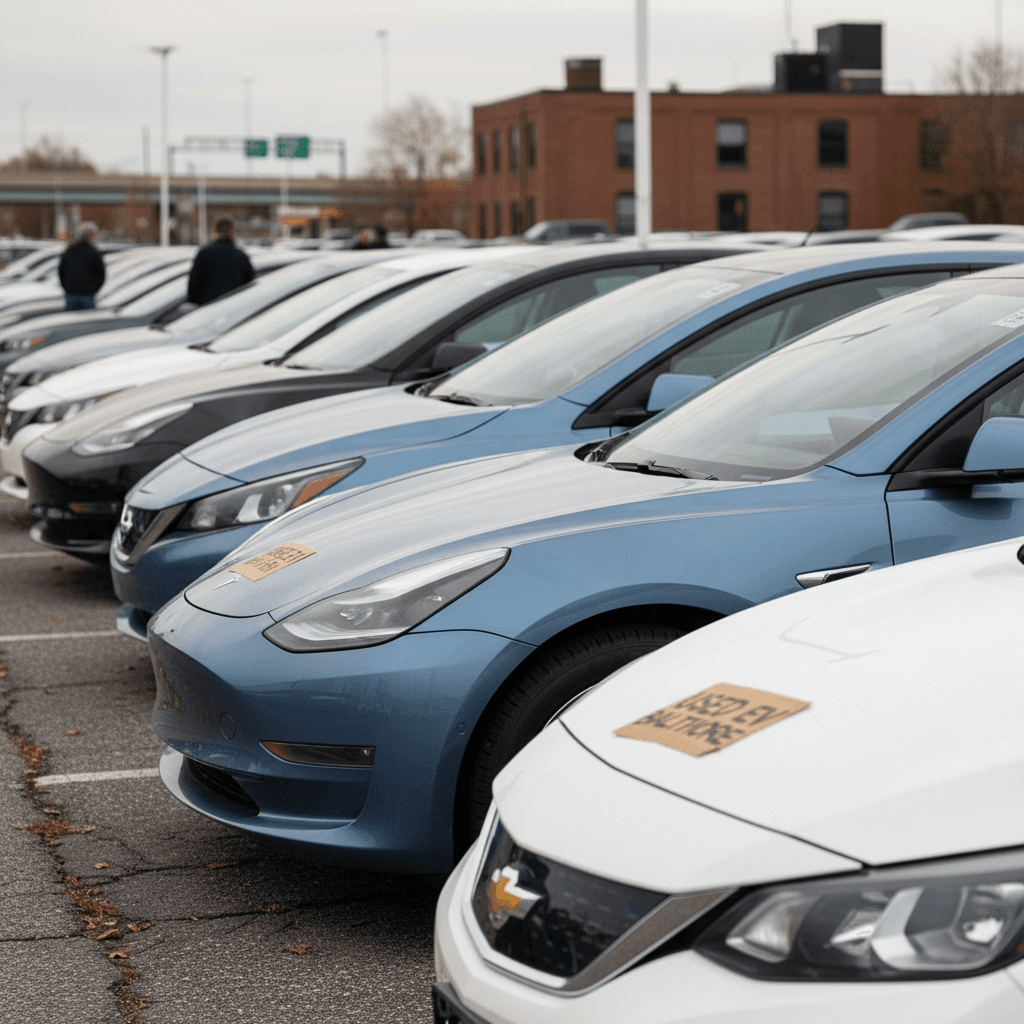
How much used EVs cost around Baltimore right now
Exact prices change week to week, but if you’re shopping for the best EV deals in Baltimore today, there are some clear patterns in the 3–7 year-old used market. Here’s a rough snapshot of what you can expect at retail for well‑maintained examples with average mileage, before tax, fees, and incentives:
Typical used EV asking-price ranges near Baltimore
Approximate retail asking prices for common used EVs in the Baltimore region as of early 2026.
| Model | Model years you’ll see most | Typical price range | Notes for deal-hunters |
|---|---|---|---|
| Chevy Bolt EV | 2017–2022 | $11,000–$22,000 | Excellent value; watch for recall battery replacements and confirm remaining warranty. |
| Nissan Leaf | 2018–2022 | $9,000–$18,000 | Often the cheapest EVs on the market; range is modest, and battery health matters a lot. |
| Tesla Model 3 RWD | 2018–2021 | $18,000–$30,000 | Huge spread based on mileage and options; strong candidates if battery/drive unit warranty remains. |
| Hyundai Kona EV / Kia Niro EV | 2019–2022 | $17,000–$28,000 | Good real‑world efficiency and range; prioritize vehicles with complete service history. |
| Volkswagen ID.4 | 2021–2023 | $22,000–$32,000 | Plenty of ex‑lease inventory; software updates can improve the driving and charging experience. |
| Ford Mustang Mach‑E | 2021–2023 | $24,000–$36,000 | Performance and style; shop carefully as prices are still normalizing post‑incentive changes. |
Use these ranges as a starting point. Actual prices vary by trim, mileage, battery health, and equipment.
Don’t over-index on sticker price
Stacking Maryland EV incentives for the best deal
When people talk about the “best EV deals,” they usually mean more than just a low price. In Maryland, the best deals come when you stack a fair used‑EV price with state incentives and other programs that still exist after the federal credit shake‑up.
Key Maryland incentives Baltimore shoppers should know
Some programs change year to year, so always double‑check current funding before you buy.
Maryland excise tax credit
Maryland has offered a state excise tax credit for qualifying EVs, with funding windows set by the legislature.
- Applies to vehicles titled in‑state within defined fiscal years.
- Price caps and battery size minimums apply.
- Funding is first‑come, first‑served and can run out mid‑year.
Before you sign, confirm whether funding is available and whether your used EV qualifies.
Maryland EVSE rebate (home charging)
The Maryland Energy Administration’s EVSE Rebate Program helps cover the cost of installing home chargers.
- Rebates on qualified Level 2 EV charging equipment and installation.
- Residents, businesses, and organizations can apply.
- FY2026 funding is live and applications are open.
This doesn’t lower your car price, but it reduces total ownership cost.
Alternative Fuel Infrastructure tax credit
The federal Alternative Fuel Vehicle Refueling Property Credit can offset part of your charger installation cost, particularly in eligible census tracts.
- Up to 30% of installed cost, with dollar caps.
- Currently scheduled to run through mid‑2026.
Pairing this with state rebates can significantly reduce your home‑charging bill.
How to check what’s actually available
BGE programs that make EV ownership cheaper
For Baltimore‑area drivers, Baltimore Gas & Electric’s EVsmart program is where a lot of the real “deal” shows up, after you own the car. BGE isn’t discounting your purchase price, but its programs can reduce your fuel cost and even send you rewards for smart charging behavior.
BGE EVsmart programs worth knowing about
These don’t all show up in the window sticker, but they matter over 3–5 years of ownership.
Smart Charge Management & TOU rates
BGE offers managed smart charging and time‑of‑use (TOU) rates that reward you for charging at off‑peak times.
- Enroll a qualifying smart charger or telematics‑connected EV.
- Shift most charging to off‑peak hours overnight.
- Earn bill credits and save on per‑kWh energy costs.
Some drivers can save up to a few hundred dollars per year compared with unmanaged charging.
Rebates and referral rewards
BGE periodically offers installation rebates for home chargers and even referral rewards (like RFID cards for public charging) through its EVsmart programs.
- Public charging credits reduce road‑trip costs.
- Installation rebates help defray upfront charger costs.
Check BGE’s EVsmart pages before or right after you buy to grab any active offers.
Why this matters for “best deal” math
Best types of used EV deals you’ll see in Baltimore
Not all bargains look the same. Around Baltimore, the best EV deals tend to fall into a few clear patterns, each with its own pros and trade‑offs.
Four common “best deal” EV archetypes in Baltimore
Match the deal type to your driving pattern and risk tolerance.
1. High-depreciation, high-range EVs
Examples: Early Tesla Model 3s, Mustang Mach‑E, ID.4.
These vehicles launched with relatively high MSRPs, so after 3–5 years they may be priced tens of thousands below new, but still offer strong range and DC fast‑charging.
Best for: Commuters who also take occasional road trips and want modern range without paying new‑car prices.
2. Short‑range city specialists
Examples: Older Nissan Leafs, BMW i3, early compliance‑car EVs.
These are often the cheapest EVs on the lot. For Baltimore‑centric driving, short commutes, local errands, they can be fantastic value if the battery is healthy.
Best for: Households with another long‑range vehicle, or drivers who rarely leave the metro area.
3. Ex‑fleet and ex‑lease crossovers
Examples: Kona EV, Niro EV, ID.4, some Mach‑E trims.
Fleet and lease returns often have documented service histories and predictable wear. They may not be the cheapest, but they’re often the most predictable.
Best for: Buyers who prioritize predictability and warranty coverage over rock‑bottom pricing.
4. Incentive‑friendly “Goldilocks” cars
Some price points and model years thread the needle for remaining state incentives, home‑charger rebates, and attractive insurance rates.
If you can find a car that fits your budget and still unlocks one or two programs, the effective price can beat out nominally cheaper options.
Best for: Detail‑oriented shoppers willing to do a bit of homework to stack programs.
Watch out for false bargains
How to compare Baltimore used EV deals like a pro
Comparing used EVs is different from comparing gas cars. Mileage and Carfax reports matter, but with EVs, battery health, charging performance, and software support often matter more. This is where tools like the Recharged Score come in.
1. Prioritize battery health over odometer alone
Two EVs with the same mileage can have very different battery outcomes, depending on how they were charged and driven. You want verified data, not guesses.
- Look for a battery health report (like the Recharged Score) that measures remaining capacity.
- Be cautious if the seller can’t provide any objective state‑of‑health data.
- On older models, ask about completed recall work or warranty replacements.
2. Evaluate real-world charging fit
Don’t just ask “how fast” an EV can charge. Ask whether it fits your life:
- Can it charge overnight to cover your daily miles on a BGE TOU plan?
- Does it support DC fast‑charging comfortably for trips down I‑95?
- Are adapters or network memberships required for your typical routes?
A car that charges a bit slower but easily meets your needs might still be the better deal.
What the Recharged Score does for you
Financing, trade-ins, and selling your gas car
Even a great sticker price isn’t a great deal if your financing, trade‑in, or add‑ons quietly erase the savings. In Baltimore, you’ll typically be choosing between dealer financing, a credit union, or an online marketplace that can pre‑qualify you.
Three levers that can turn a good EV price into a great deal
Don’t just negotiate the car, optimize how you pay for it and what you do with your old one.
1. Financing structure
Compare APRs and terms across at least 2–3 lenders.
- Pre‑qualification (like you can do with Recharged) lets you see your real payment without impacting your credit.
- Shorter terms cost more monthly but reduce total interest.
- Beware of steep markups on add‑on products rolled into the loan.
2. Trade‑in vs. sell outright
Your existing gas car is part of the deal math.
- A dealer or marketplace trade‑in is fastest and can reduce Maryland’s taxable amount in some cases.
- Selling privately can net more money but takes time and effort.
- Recharged can give you an instant offer or consignment option to help maximize value.
3. Fees and protection plans
Ask for an itemized out‑the‑door quote so you see doc fees, tags, taxes, and any extras.
- Consider EV‑specific coverage like battery or electronics protection only if the price is reasonable.
- Skip generic “add‑ons” that don’t address EV‑specific risk.
Red flags in EV financing and add-ons
Step-by-step checklist to score the best EV deal
Baltimore EV deal hunter’s checklist
1. Define your real range and charging needs
Write down your typical weekly miles, longest regular trip, and whether you can install a Level 2 charger at home or in your building. This will filter out EVs that don’t realistically fit your life, no matter how cheap they look.
2. Shortlist EV models that fit Baltimore driving
Target 3–5 models whose range, charging speed, and body style actually work for your mix of city, beltway, and I‑95 driving. In this region, compact crossovers and mid‑range sedans are often the sweet spot.
3. Check Maryland and BGE incentives this month
Visit Maryland EV, MEA, and BGE EVsmart pages to see which state credits, EVSE rebates, and utility rewards are live. Prioritize cars and chargers that unlock multiple programs where possible.
4. Use battery health data to compare individual cars
For each candidate vehicle, look for a <strong>battery health report</strong> (such as the Recharged Score). Avoid buying blind; a few percentage points of capacity can matter more than 5,000 extra miles on the odometer.
5. Get at least two financing quotes
Pre‑qualify online (Recharged can help), then compare that offer to your bank or credit union. Focus on APR, term length, and total interest paid, not just monthly payment.
6. Decide your plan for your current car
Get instant offers from at least one marketplace, a dealer trade‑in quote, and a rough private‑sale estimate. Use the spread to decide whether speed or maximum cash matters more for you.
7. Ask for an out‑the‑door number and sleep on it
Once you’ve found the right car, ask for a full out‑the‑door quote in writing. Review taxes, fees, and add‑ons, then sleep on it instead of signing on emotion. The best EV deal still looks good in the morning.
FAQ: Best EV deals in Baltimore
Frequently asked questions about EV deals in Baltimore
Bottom line: getting the best EV deal in Baltimore
Baltimore is in a rare sweet spot: a mature EV market with growing used‑car inventory, strong (if evolving) state and utility support, and enough competition that you don’t have to accept the first offer you see. The best EV deals in Baltimore go to shoppers who treat battery health and incentives as seriously as they treat sticker price, and who are willing to walk away from cars that don’t add up on total cost of ownership.
If you want help shortcutting that process, Recharged was built for exactly this moment. Every EV comes with a Recharged Score battery‑health report, expert guidance on Maryland and BGE programs, transparent financing options, and the ability to trade in or sell your current car without a separate side quest. However you choose to shop, go in with a clear sense of your needs, insist on real data, and let the competition for your business work in your favor.