If you’re looking at a **2022 Hyundai Kona Electric**, you’ve probably heard it’s efficient, affordable, and easy to live with. But how reliable is it once the new-car shine wears off, and what should you watch for if you’re buying one used? Let’s walk through real owner data, common issues, and how to protect yourself when you shop.
Big picture
Overview: How reliable is the 2022 Kona Electric?
From a reliability standpoint, the 2022 Kona Electric sits in a **“solid but not bulletproof”** zone. It benefits from Hyundai’s long battery warranty and a proven powertrain carried over from earlier model years, while inheriting some recurring quirks, especially around the 12‑volt electrical system and software.
2022 Kona Electric at a glance
In plain terms, if you get a **well‑maintained 2022 Kona Electric with good software updates and a healthy 12V system**, you can expect years of mostly trouble‑free driving. But you do need to go in with your eyes open to the specific problem patterns this model has shown.
Owner reviews and reliability scores
Numerically, owner sentiment for the 2022 Kona Electric lands in the **upper-middle of the pack** for compact EVs. On major review platforms, reliability scores hover right around **3.9 out of 5**, with about **61% of owners giving it a perfect 5‑star rating** and roughly **73% saying they would recommend the vehicle** to others. That’s a healthy endorsement, especially considering its price point.
What owners like
- Low running costs and strong efficiency.
- Peppy around‑town performance from the 201‑hp motor.
- Easy to park and maneuver; feels like a regular small SUV.
- Hyundai’s long battery and powertrain warranty provides peace of mind.
What owners complain about
- Cabin can feel tight compared with larger EV crossovers.
- Ride can be firm over rough pavement.
- Scattered reports of infotainment or driver‑assist glitches.
- Most notably: 12V battery draining and related electrical issues on some cars.
Read the patterns, not just individual horror stories
Common 2022 Hyundai Kona Electric problems
Hyundai ironed out the major high‑voltage battery recall that affected early 2019–2020 Kona Electric models, so the 2022 doesn’t carry that particular baggage. Instead, its reliability story centers on **electrical quirks and wear‑and‑tear items** you’d expect on any small crossover.
Most commonly reported issues on the 2022 Kona Electric
What you’re most likely to run into as mileage climbs
1. 12V battery draining
2. Software & warning chimes
3. Driver‑assist system quirks
4. Tire wear & noise
5. Suspension wear with age
6. Infotainment glitches
Watch for repeat electrical complaints
High-voltage battery health, range and degradation
The heart of any EV reliability discussion is the **high‑voltage battery pack**. For the 2022 Kona Electric, that’s a 64‑kWh lithium‑ion pack paired with a 201‑horsepower motor and front‑wheel drive. In real‑world driving, most owners see **EPA‑rated range in the 250‑ to 260‑mile ballpark when new**, depending on climate and driving style.
- So far, there are **very few reports of outright pack failures** on 2022 cars.
- Most long‑term owners report **modest degradation**, typically a small range dip rather than a dramatic loss.
- Hyundai backs the pack with a **10‑year / 100,000‑mile warranty** against defects and excessive capacity loss for original U.S. buyers.
Battery life expectations
When you’re evaluating a used 2022 Kona Electric, focus less on the **odometer alone** and more on **how the car was used and charged**. A 40,000‑mile car that mostly did gentle commuting and Level 2 charging is often a safer bet than a 15,000‑mile car quick‑charged to 100% every day and parked in extreme heat.
12V battery drain and electrical glitches
If you hang around Kona Electric owner forums or read complaint databases, one pattern jumps out: **dead 12‑volt batteries on relatively young cars**. The 12V battery powers control modules, locking, and computers, without it, your Kona EV can be completely unresponsive even if the main pack is full.
On some 2022 cars, owners describe scenarios like this: park the car with a healthy state of charge, come back after a day or two, and find **no interior lights, no dash, and no ability to shift into gear**. A jump start brings it back to life, but the issue recurs until the 12V battery and/or software are addressed.
- Battery management software not waking up to charge the 12V often enough from the main pack.
- A marginal or defective factory 12V battery that loses capacity early.
- Parasitic drains, modules or accessories that don’t fully go to sleep when the car is locked.
- Simple user‑error items like a hatch not fully closed or an interior light left on.
Why 12V problems matter on an EV
Smart 12V checks when shopping used
1. Ask directly about 12V issues
When inspecting a used 2022 Kona Electric, ask the seller: Has the 12V battery ever gone dead? Has it been replaced? What did the dealer say?
2. Review service records
Look for TSBs or software updates related to the 12V system, and note any repeat visits for electrical or “no start” concerns.
3. Check age of the 12V battery
A three‑ to four‑year‑old battery that’s original is due for replacement anyway. Factor that $150–$300 expense into your budget.
4. Test for odd warnings
On a test drive, watch for phantom alerts, charging‑door‑open messages, repeated beeps, or settings that won’t save. These can point to underlying electrical glitches.
5. Consider a proactive replacement
If everything else checks out, replacing an older 12V battery proactively is cheap insurance compared to a roadside no‑start incident.
Warranty coverage, recalls and software updates
Hyundai’s warranty coverage is one of the 2022 Kona Electric’s strongest selling points, especially for used buyers in the U.S. market. Even in 2026, many 2022 cars will still carry years of remaining coverage if they’re within the original time and mileage limits.
Key U.S. warranty coverage for the 2022 Kona Electric (original owner)
Exact terms can vary by market and whether the car was sold in a CARB state, but this captures the broad structure.
| Component | Typical Coverage | What it means for you |
|---|---|---|
| High‑voltage battery pack | 10 years / 100,000 miles | Protects against manufacturing defects and excessive degradation for the original owner. |
| EV system / powertrain | 10 years / 100,000 miles | Motor, reduction gear, and other major EV drive components. |
| Basic bumper‑to‑bumper | 5 years / 60,000 miles | Covers many electrical and interior issues early in life. |
| Corrosion (perforation) | 7 years / unlimited miles | Rust‑through protection for body panels. |
| 12V battery | Shorter term (often 3 years) | Treat it as a wear item; coverage may be limited depending on age and mileage. |
Always verify remaining coverage by VIN with a Hyundai dealer before you buy used.
Don’t guess, verify by VIN
As for recalls, the early high‑voltage battery recall that affected some 2019–2020 Kona Electrics is largely behind us, and 2022 models were built after Hyundai’s corrective actions. However, Hyundai does periodically release **software updates and technical service bulletins (TSBs)** for things like 12V charging logic and infotainment behavior, so you want a car that has been kept current.
Out-of-warranty repair and maintenance costs
Once you’re out of the basic 5‑year/60,000‑mile coverage, you’ll shoulder more of the repair risk. The good news is that a 2022 Kona Electric has **far fewer moving parts** than a gas Kona, no engine oil, spark plugs, timing belts, or exhaust system. Routine maintenance mainly comes down to tires, brakes, cabin filters, coolant service for the battery and motor, and miscellaneous wear items.
Typical ownership costs on an aging Kona Electric
Ballpark ranges to help you budget (actual prices vary by region and shop).
Routine service
Tires
12V battery
Suspension & steering
Electronics diagnosis
High‑voltage components
How the 2022 Kona Electric compares to other used EVs
If you’re cross‑shopping a 2022 Kona Electric with other compact used EVs, like a Chevrolet Bolt EV, Nissan Leaf Plus, or older Tesla Model 3, its reliability picture is **competitive and often better than its price suggests**.
Strengths vs. other used EVs
- Long battery warranty is a major selling point compared with many rivals.
- Battery‑fire recall era is mostly behind the Kona Electric by 2022.
- Simpler front‑wheel‑drive layout can mean fewer drivetrain surprises than dual‑motor EVs.
- Compact size and efficient powertrain keep running costs low.
Weak spots to keep in mind
- 12V battery and minor electrical issues are more common talking points than on some rivals.
- Cabin space is tighter than in larger crossovers like Hyundai IONIQ 5 or VW ID.4.
- Ride quality and noise levels feel more economy‑car than luxury‑EV.
Where the Kona Electric shines for used buyers
Buying a used 2022 Hyundai Kona Electric: checklist
Reliability is partly about the model and partly about the individual car. Here’s how to stack the deck in your favor when you’re evaluating a specific 2022 Kona Electric, whether you’re shopping locally or browsing an online marketplace like Recharged.
Pre‑purchase checklist for a 2022 Kona Electric
1. Pull a full history report
Look for accident damage, flood branding, or repeated tow‑in events that might hint at electrical gremlins. A clean history isn’t a guarantee, but a branded title is a reason to walk away.
2. Confirm software and recall status
Ask for records showing the latest Hyundai software updates, especially any that mention battery management or 12V charging behavior.
3. Inspect and test the 12V system
Check the age of the 12V battery, verify that the car wakes up instantly from sleep, and watch for odd warning messages on startup and during a longer test drive.
4. Evaluate high‑voltage battery health
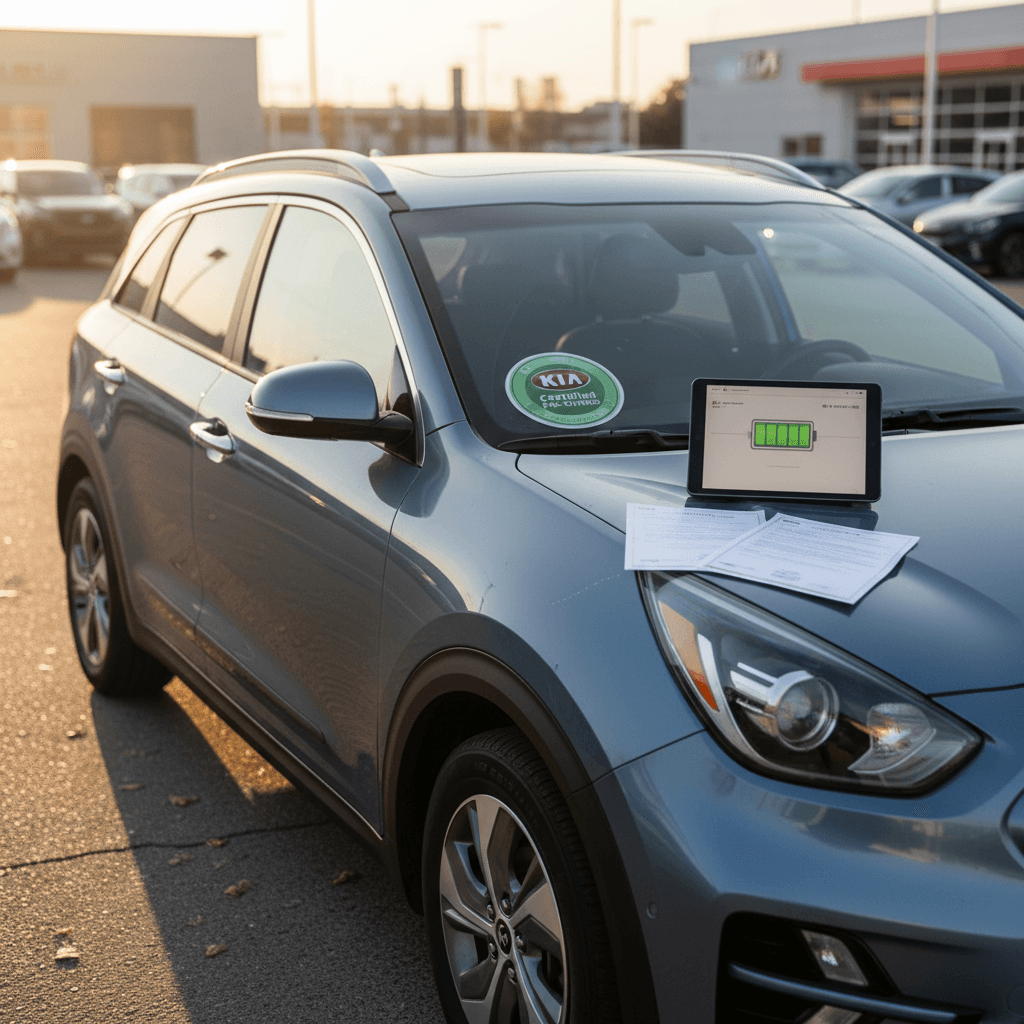
Range estimates alone don’t tell the whole story. At Recharged, every vehicle comes with a <strong>Recharged Score Report</strong> that includes battery‑health diagnostics so you can see how the pack has aged.
5. Look for consistent charging behavior
Test both Level 2 charging and, if possible, a DC fast‑charge session. The car should start and stop charging cleanly, without faults or repeated error messages.
6. Listen for suspension and steering noise
On a rough road, pay attention to clunks, rattles, or wandering steering that might suggest worn bushings or alignment issues.
7. Verify remaining warranty by VIN
Have a Hyundai dealer or EV‑savvy retailer confirm remaining warranty coverage so you know what big‑ticket items are still protected.
8. Consider professional EV inspection
If you’re new to EVs, a shop or marketplace that specializes in electric vehicles, like Recharged’s EV‑specialist team, can help you interpret battery data and spot red flags you might miss.
How Recharged can help
FAQ: 2022 Hyundai Kona Electric reliability
Frequently asked questions about 2022 Kona Electric reliability
Bottom line: Is the 2022 Kona Electric a good used buy?
Taken as a whole, **2022 Hyundai Kona Electric reliability is better than many shoppers expect**, especially considering its price bracket. The high‑voltage battery and drive system have matured nicely, Hyundai’s warranty is generous, and most owners are satisfied enough that they’d recommend the car to a friend.
The trade‑offs come down to **space, ride quality, and the possibility of 12V electrical annoyances**. If you prioritize a compact footprint, low running costs, and are willing to vet each individual car carefully, a 2022 Kona Electric can be a smart, value‑packed used EV.
If you’d like help taking the uncertainty out of the process, Recharged can handle the heavy lifting: from **battery‑health diagnostics and fair pricing, to financing, trade‑in or consignment, and nationwide delivery**. That way, you can focus on finding a Kona Electric, or another used EV, that fits your life, not just your budget.