If most of your miles are on the interstate, the **best electric cars for highway driving** aren’t always the ones at the top of the generic “longest range” lists. Real‑world highway range, charging speed, cabin comfort, and driver‑assist tech all matter just as much as the number printed on the window sticker, especially if you’re planning long trips or a daily freeway commute.
Highway vs city driving in an EV
Why highway driving is different in an EV
Range behaves differently
EPA window stickers use a **combined city/highway** cycle. On the highway, your EV is fighting aerodynamic drag constantly. Above about 60 mph, every extra 5–10 mph can take a noticeable bite out of range. A car rated for 320 miles combined might deliver closer to 240–260 miles if you sit at 75–80 mph into a headwind with passengers and luggage.
Charging stops feel different, too
On a gas road trip, a five‑minute fuel stop is normal. In an EV, you’re thinking in **10–30 minute DC fast‑charge sessions**. The good news: modern models can add 150–250 miles of range in well under half an hour when you use the right chargers and arrive with a low state of charge.
Highway EV realities at a glance
How to choose an electric car for highway driving
Key factors that make an EV great on the highway
Think beyond headline range numbers
Highway‑friendly range
Look for an **EPA rating in the high‑200s or better** and real‑world tests that show good efficiency at 70 mph. If you routinely cross empty stretches of highway or live in a cold climate, nudging into the 320–360‑mile range band buys peace of mind.
Fast, repeatable DC charging
Peak numbers ("up to 350 kW") grab headlines, but what matters is the **charging curve**, how long your EV actually holds high power. Good highway EVs can add 150–200 miles in ~20 minutes and don’t fall on their face when you fast‑charge multiple times in a day.
Comfort, noise & seats
Four hours on I‑80 will expose every squeak and pressure point. Prioritize cars with **quiet cabins, supportive seats, and stable ride/handling** over razor‑sharp cornering. Your back and your passengers will thank you.
Highway driver‑assist
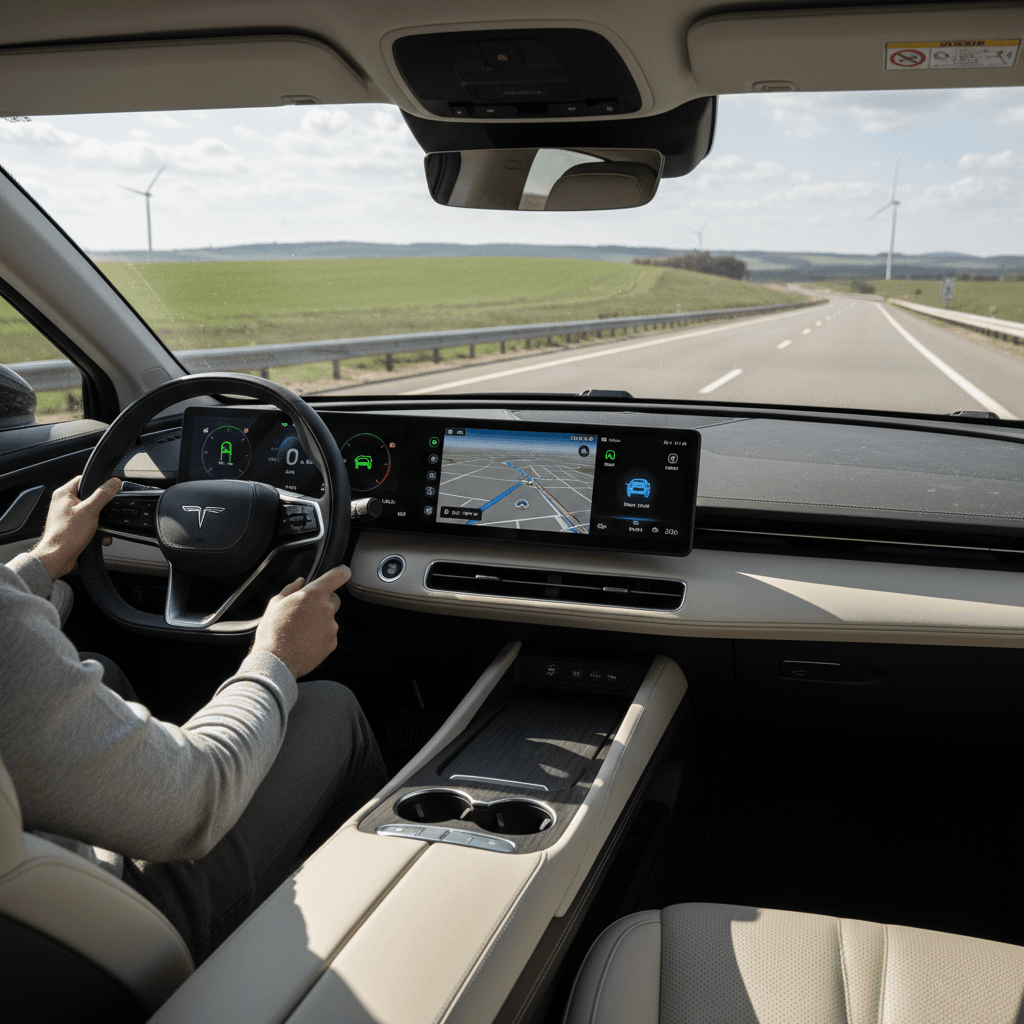
Systems like **adaptive cruise, lane centering, and hands‑free highway driving** (on some models) dramatically cut fatigue. They’re not self‑driving, but they make long days behind the wheel feel shorter.
Charging network access
In North America, **NACS (Tesla) access** is a big deal. Many 2025+ EVs can use Superchargers with an adapter or a native NACS port, on top of networks like Electrify America and EVgo. More networks = more flexibility when weather or traffic disrupt your plan.
Battery health (for used EVs)
On a used EV, real‑world highway range is only as good as the **remaining battery capacity**. Tools like the Recharged Score battery health report help you see whether that “300‑mile” car still behaves like a 300‑mile car.
Best luxury electric cars for highway driving
If you want to eat states for breakfast and arrive relaxed, these luxury EVs are built for serious long‑distance duty, with massive range, fast charging, and quiet, composed manners.
Luxury highway EV standouts (2025 model year)
Approximate specs for trims optimized for long range rather than maximum performance. Always verify exact figures for the configuration you’re considering.
| Model | Why it shines on the highway | Est. EPA range (mi) | Charging strength | Highway comfort highlights |
|---|---|---|---|---|
| Lucid Air (long‑range trims) | One of the longest‑range EVs on sale, with outstanding efficiency and a big, calm cabin, built from the ground up as a long‑distance electric luxury sedan. | 400–500+ | Very strong: high peak charging power and excellent sustained rates on compatible 300 kW DC fast chargers. | Superb ride, quiet interior, excellent seats; feels like a modern electric grand‑tourer. |
| Tesla Model S Long Range | Still a highway hero: big battery, slippery aerodynamics, and access to the vast Supercharger network make it a cross‑country staple. | ≈375–400 | Strong: broad Supercharger access, solid peak rates, and a dense network in North America. | Low, comfortable seating; quiet, efficient cruising; advanced driver‑assist including Navigate on Autopilot on supported roads. |
| BMW i5 (eDrive40 / long‑range trims) | Mid‑size luxury sedan that consistently **outperforms its EPA estimate in independent highway tests**, with classic BMW road manners. | ≈295–310 | Competent DC fast charging; not the wildest peak number, but maintains good speeds through most of the charge window. | Excellent seats, controlled ride, hushed cabin; feels planted and confident at speed. |
| Mercedes‑Benz EQE Sedan | Cushy, quiet, and aero‑slick. Not the spec‑sheet range champ, but a very easy place to spend 6 hours at a stretch. | ≈260–300 | Respectable fast‑charging with competitive 10–80% times on high‑power chargers. | Soft ride, rich sound insulation, advanced driver‑assist and navigation that understands charging. |
Luxury EVs that combine long range, rapid charging, and comfort for extended highway use.
Don’t overbuy performance
Best mainstream and family EVs for highway trips
Luxury sedans are great, but many drivers want a roomy, affordable crossover that can handle Costco runs and cross‑state drives with equal ease. These mainstream models balance range, value, and comfort for family road duty.
Highway‑friendly EVs for real‑world families
Strong range, fast charging, and room for people and gear
Hyundai Ioniq 5
The Ioniq 5 has become a road‑trip favorite thanks to its **800‑volt architecture, very fast DC charging, and spacious cabin**. Upper trims deliver range in roughly the high‑200s to low‑300s, and its relaxed, quiet demeanor at speed makes it easy to live with.
- Ultra‑fast charging on compatible stations
- Excellent rear‑seat and cargo space
- Comfort‑focused ride and available highway assist
Kia EV6
Sharing much of its hardware with the Ioniq 5, the EV6 skews sportier but still ticks the highway boxes: solid real‑world range, very quick DC charging, and comfortable seats. It’s a great pick if you like a more dynamic feel without sacrificing road‑trip utility.
- High‑200s to low‑300s of range, depending on trim
- One of the quickest fast‑charging mass‑market EVs
- Sportier stance with hatchback practicality
Chevrolet Equinox EV
Chevy’s compact electric SUV aims squarely at budget‑conscious highway travelers. Well‑equipped trims offer **range in the low‑300‑mile neighborhood** with straightforward ergonomics and a quiet ride, making it a compelling value for long‑distance family duty.
- Strong range for the money
- Comfortable, conventional cabin layout
- Access to both CCS networks and, via adapter or native port, Tesla Superchargers
Kia EV9
For bigger families, the three‑row EV9 brings **minivan‑like space** with modern EV manners. Range in the mid‑200s to around 300 miles is plenty for 2–3 hour highway stints between stops, and its fast‑charging tech keeps breaks shorter than a kids’ meal.
- Three rows and real adult‑size space
- Quick DC charging on 800‑V hardware
- Comfort‑oriented highway ride
Watch wheel and tire choices
Best used electric cars for highway driving
A well‑chosen used EV can be a fantastic highway car, and a smart way to sidestep new‑car pricing. The trick is separating genuinely road‑trip‑ready examples from cars whose batteries or older charging tech make them better city commuters.
Used EV highway heroes & what to look for
1. Tesla Model 3 Long Range (2019–2023)
Still one of the most efficient highway EVs, with strong real‑world range and full Supercharger access. Look for cars with healthy battery metrics and limited DC fast‑charging abuse.
2. Tesla Model Y Long Range
If you want SUV practicality plus road‑trip chops, a used Model Y Long Range is hard to beat. Pay attention to tire condition and alignment, these cars are sensitive to setup at highway speeds.
3. Hyundai Kona Electric
Earlier Konas don’t charge as quickly as today’s 800‑V stars, but they’re highly efficient. For modest budgets and 2–3 hour highway hops, a well‑cared‑for Kona Electric can be a quietly excellent choice.
4. Chevrolet Bolt EUV
The Bolt EUV’s compact size hides solid highway poise and decent range. DC fast‑charging is slower than the latest hardware, but if you’re okay with slightly longer stops, it’s great value for money.
5. Nissan Ariya (early years)
The Ariya offers comfortable seats, a quiet cabin, and competitive real‑world range. Some trims charge more slowly than rivals, so match your expectations and typical route distances carefully.
How Recharged de‑risks used highway EVs
EVs that outperform their EPA highway range
Not all EVs behave the same way at 70 mph. Some see a steep drop versus their EPA numbers; others quietly overachieve. Independent range tests have highlighted several models, like BMW’s i4 and i5, that **exceeded their EPA estimates on standardized highway loops**, sometimes by dozens of miles. That kind of efficiency bonus effectively buys you an extra buffer between chargers.
- Look for independent 70‑mph range tests, not just city‑heavy cycles.
- Pay attention to efficiency (mi/kWh), not just battery size.
- Consider your climate; cold weather narrows the gap between EPA and reality.
- Don’t forget that load, passengers, roof boxes, and bikes all cost range at speed.
Highway test your shortlist
Comfort and driver assistance matter, too
Range and charging get all the attention, but what makes a car truly great on the highway is how *fresh you feel* after four hours behind the wheel. EVs are naturally quiet, but there’s still huge variation in seat comfort, ride quality, and the polish of driver‑assistance tech.
Comfort features that turn an EV into a highway lounge
Details that matter more after hour three than mile three
Seats you can live in
Look for **multi‑way adjustment, lumbar support, and decent thigh support**. If you or your passengers run hot or cold, ventilated and heated seats go from nice‑to‑have to essential over long stretches.
Noise isolation
Ask yourself on a test drive: at 70 mph, do I need to raise my voice to talk? Wind and tire noise are the main culprits. Softer‑riding trims with touring tires are often quieter and less tiring.
Driver‑assist that feels natural
Systems like **GM’s Super Cruise, Ford BlueCruise, Tesla Autopilot, Hyundai/Kia Highway Driving Assist, and others** can reduce fatigue when they’re well tuned. What matters is consistency and clear communication, not flashy names.
A great highway EV doesn’t just go far; it makes 300 miles feel like 150.
Highway charging strategy and network access
Even the best highway EV can be hobbled by poor charging access, or by a driver who asks too much of a sparse network. The good news is that in the U.S., fast‑charging coverage along major interstates has improved dramatically over the past few years, and more brands now plug into Tesla’s Supercharger network as well.
Plan around 10–80%, not 0–100%
EVs charge **fastest when the battery is low** and slow down as they approach full. For highway trips, it’s usually quicker overall to arrive near 10–20%, charge to 60–80%, and get back on the road than to wait for those last slow 20 percent points.
- Shorter, more frequent stops often beat one long slog.
- Most road‑trippers quickly settle into 2–3 hour stints between breaks.
Understand your plug and networks
By 2025–2026, many new EVs in North America either **ship with a NACS (Tesla‑style) port or include an adapter**, opening up tens of thousands of Supercharger stalls on top of CCS stations from Electrify America, EVgo, and others. When you’re shopping, check:
- Which fast‑charging networks your car can use on day one.
- Whether a NACS adapter is included or available.
- How the car’s native nav/app integrates charger locations and payment.
Beware of weak charging hardware on your route
Pre‑purchase checklist for highway‑heavy driving
Checklist: is this EV truly highway‑ready for you?
Confirm real‑world highway range
Don’t just read the brochure. Look up independent 70‑mph tests and owner reports. Make sure the car can comfortably cover your longest regular leg with a healthy buffer, in bad weather, with passengers and luggage.
Match charging speed to your patience
If you hate sitting still, focus on EVs that can add ~150–200 miles in 15–25 minutes on DC fast‑chargers. Slower‑charging models can still road‑trip, but you’ll need to accept longer coffee breaks.
Sit in the seats for at least 20 minutes
On a test drive, park somewhere quiet and just sit. Adjust the seat and wheel, check lumbar support, and simulate your highway posture. Pressure points that show up in 10 minutes will be brutal after three hours.
Test driver‑assist on the actual highway
Ask for an extended drive that includes your usual freeway. Try adaptive cruise and lane‑keeping. The best systems feel natural and trustworthy; the worst nag, ping‑pong, or cut out when you need them most.
If buying used, demand battery transparency
A healthy pack is everything. With Recharged, your **Recharged Score** includes battery‑health diagnostics and transparent range estimates, so you know exactly what you’re getting before you sign anything.
Map your key routes in advance
Before you buy, plug your most common highway trips into a planner (or the car’s own route planning if available). Make sure the charging layout and stop cadence match your family’s rhythm.
FAQs: best electric cars for highway driving
Frequently asked questions about highway EVs
Bottom line: finding the right EV for the open road
The best electric cars for highway driving share a common recipe: **honest real‑world range, fast and repeatable DC charging, quiet comfort at speed, and driver‑assist tech you actually trust**. Whether that looks like a Lucid Air cross‑country flagship, a Hyundai Ioniq 5 family shuttle, or a carefully chosen used Tesla Model 3 depends on your roads, passengers, and budget.
If you’re leaning toward a used EV, let Recharged do some of the heavy lifting. Every vehicle we sell includes a **Recharged Score Report** with verified battery health and transparent pricing, plus EV‑savvy specialists who can talk through how a given car will behave on your specific routes. That way, when you merge onto the interstate in your next EV, you’ll know exactly what you, and your range gauge, can count on.