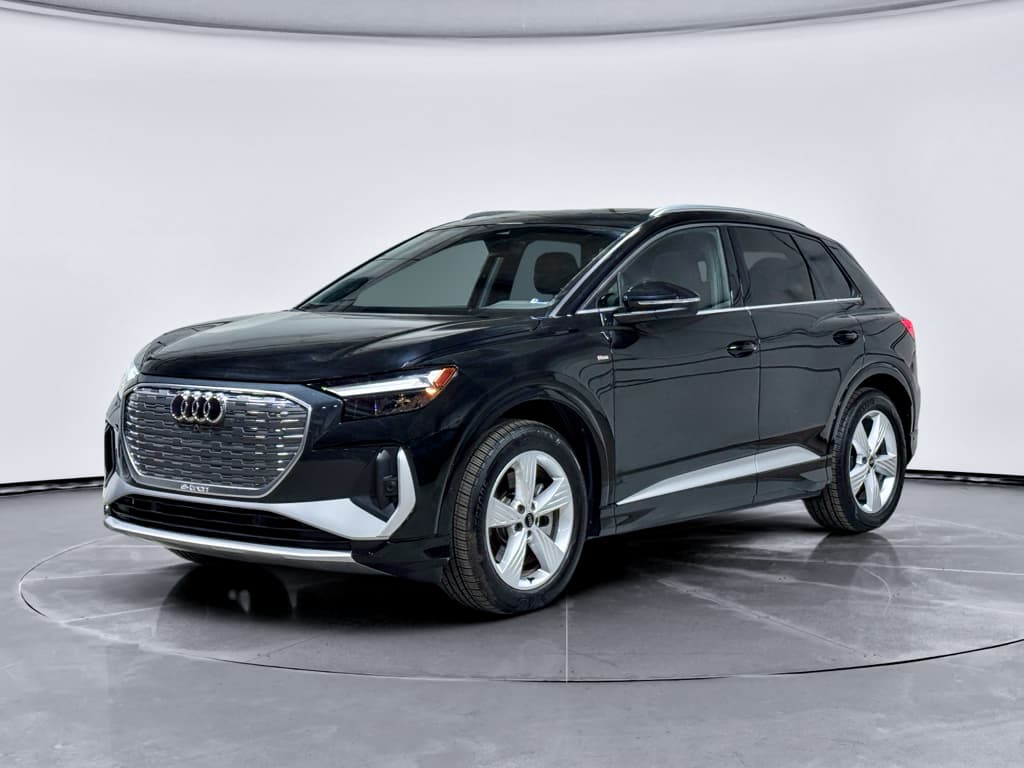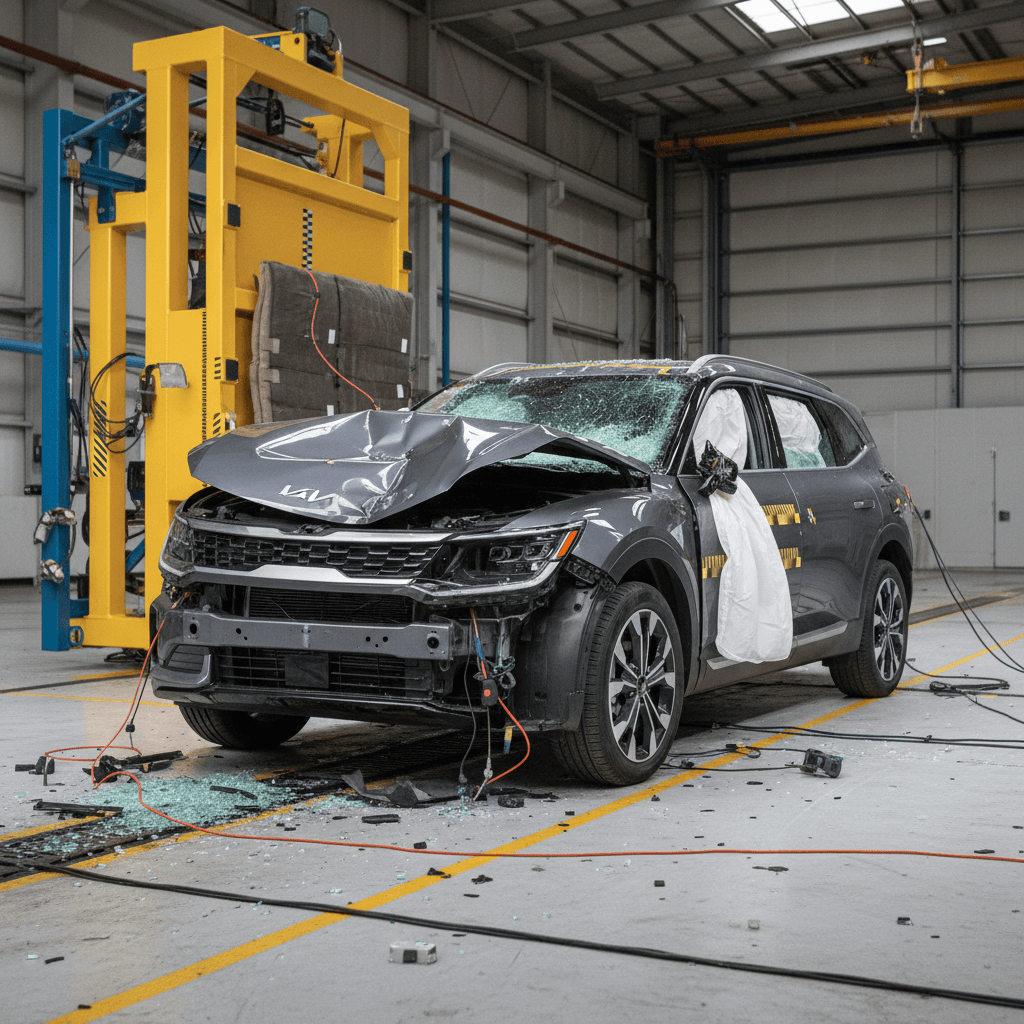
If you’re considering an Audi Q8 e-tron, new or used, its safety rating and crash-test performance are probably near the top of your checklist. The good news: the Q8 e-tron has been thoroughly tested by both IIHS and NHTSA and comes packed with modern driver-assistance tech. This guide breaks down the Audi Q8 e-tron safety rating and crash test results in plain English, and explains what those scores actually mean for you as a driver or used-EV shopper.
Quick takeaway
Audi Q8 e-tron safety overview
The Audi Q8 e-tron is the renamed and lightly updated version of the original Audi e-tron SUV. The underlying structure and crash performance are essentially the same, which is why IIHS explicitly notes that crash-test results from earlier e-tron models carry forward to the 2024–2025 Q8 e-tron and Q8 Sportback e-tron. That continuity matters for used buyers: a 2019+ e-tron or a 2024+ Q8 e-tron gives you broadly the same crash protection envelope.
- Fully electric, large luxury SUV with dual-motor all-wheel drive
- Shares crash structure with earlier Audi e-tron (2019–2023)
- Strong ratings in both U.S. (IIHS, NHTSA) and European testing
- Standard advanced driver-assistance on all trims in the U.S.
Crash-test ratings at a glance
Audi Q8 e-tron safety snapshot (2024–2025)
Tip for used buyers
IIHS safety rating for the Audi Q8 e-tron
The Insurance Institute for Highway Safety (IIHS) is the independent lab behind the “Top Safety Pick” awards you see in ads. For 2024, the Audi Q8 e-tron and Q8 Sportback e-tron earn the Top Safety Pick+ award, the highest rating IIHS offers. That places the Q8 e-tron in the top tier of large luxury SUVs for crash performance and crash-avoidance tech.
IIHS crashworthiness results: Audi Q8 e-tron (2024–2025)
Summary of IIHS structural crash tests for the Q8 e-tron and its predecessor, the Audi e-tron.
| Test area | Result | What it means |
|---|---|---|
| Small overlap front (driver & passenger) | G (Good) | Cabin holds its shape well in a severe, offset frontal crash; low risk of serious injuries. |
| Moderate overlap front (original test) | G (Good) | Traditional frontal crash; structure and restraints protect both front occupants effectively. |
| Side impact (updated test) | G (Good) | Performs well in newer, higher-energy side-impact test that better represents SUV-to-SUV crashes. |
| Roof strength & head restraints | G (Good) | Reduces injury risk in rollovers and rear-end crashes. |
| Headlights | G/A (Good/Acceptable) | LED headlights rate well overall; best scores on higher trims or specific options. |
“G” = Good, “A” = Acceptable, “M” = Marginal, “P” = Poor. Top Safety Pick+ requires mostly Good ratings plus advanced crash avoidance.
IIHS also evaluates crash-avoidance features. The Q8 e-tron’s standard forward collision warning and automatic emergency braking system meets the award criteria, with advanced or superior performance in daytime tests and strong performance at night. Headlight performance varies slightly by trim, but not enough to knock the Q8 e-tron out of Top Safety Pick+ territory.
Trim-level nuance
NHTSA 5-Star Safety Ratings
The National Highway Traffic Safety Administration (NHTSA) runs the U.S. government’s 5-Star Safety Ratings program. For the 2024 Audi Q8 e-tron, NHTSA reports a 5-star overall rating. That combines solid frontal scores, excellent side-impact performance, and a very low risk of rollover for such a tall, heavy vehicle.
NHTSA crash-test results: 2024 Audi Q8 e-tron
NHTSA scores for the Q8 e-tron, summarized for shoppers comparing across models.
| Category | Score | Details |
|---|---|---|
| Overall rating | 5 / 5 | Top overall score in federal testing. |
| Frontal crash – overall | 4 / 5 | Front driver and passenger zones manage forces well, but heavy EV mass keeps this from 5 stars. |
| Side crash – overall | 5 / 5 | Strong protection in both barrier and pole side tests for front and rear occupants. |
| Rollover rating | 5 / 5 | Low center of gravity from the battery pack helps resist rollovers in evasive maneuvers. |
Star ratings: 1 = lowest, 5 = highest. Values may apply to multiple model years if there are no major structural changes.
IIHS vs. NHTSA: which matters more?
Key safety features and driver-assistance tech
A strong safety rating isn’t just about how a vehicle crashes, it’s also about avoiding crashes in the first place. Audi loads the Q8 e-tron with standard advanced driver-assistance systems (ADAS), even on base trims, and adds a few extras on higher trims like Prestige.
Core safety systems on the Audi Q8 e-tron
Most of these are standard on U.S. models from launch.
Collision mitigation
- Audi pre sense front: forward collision warning + automatic emergency braking.
- Pedestrian detection with automatic braking in many scenarios.
- Turn Assist and Swerve Assist on higher trims help avoid cross-traffic and obstacle swerves.
Lane & blind-zone support
- Lane departure warning with lane-keeping assist.
- Audi side assist blind-spot monitoring.
- Rear cross-traffic alert to help when backing out of crowded spaces.
Driving assistance & visibility
- Adaptive cruise assist with lane guidance (Level 2-style assist that centers the car in its lane).
- High-beam assist for better night visibility.
- Front and rear parking sensors, optional park assist for automated steering into spaces.
Passive safety: what protects you in a crash
- Multiple airbags, including dual-stage front, front side, and curtain airbags for both rows.
- Rigid battery-protecting floor structure that keeps the pack outside the main occupant cell.
- Seatbelt pretensioners and load limiters that cinch belts early, then manage forces to the chest.
Active safety: what helps you avoid one
- Electronic stability and traction control tuned for heavy EV torque.
- Advanced ABS and brake-based torque vectoring to keep the SUV planted in emergency maneuvers.
- Multiple camera and radar sensors feeding pre sense systems and adaptive cruise.
Don’t confuse ADAS with self-driving
How safe is the Q8 e-tron in real-world driving?
Crash labs are controlled environments. Out on the road, your safety depends on a different mix: vehicle design, software tuning, tire choice, driver behavior, and environmental conditions. Here’s how the Q8 e-tron’s lab results translate into everyday use.
- Mass and structure work in your favor. The Q8 e-tron is a heavy vehicle, roughly 5,800 pounds, thanks largely to the battery. That weight, combined with a stiff safety cage, helps it absorb crash energy effectively, especially in multi-vehicle collisions.
- Low center of gravity improves stability. With the pack in the floor, the Q8 e-tron resists rollovers and feels planted in emergency lane changes compared with tall gas SUVs.
- ADAS helps with common crash types. Rear cross-traffic alert and blind-spot monitoring address low-speed parking-lot fender-benders and freeway lane-change conflicts, two of the most frequent crash scenarios.
- Driver workload can still be an issue. Some reviewers find Audi’s lane-keeping and predictive speed features a bit overactive. That can lead drivers to switch them off, so it’s worth spending time in the menus to get settings you’re comfortable with rather than abandoning them altogether.
Where the Q8 e-tron really shines
Shopping used: what to check on a Q8 e-tron
If you’re looking at a used Audi Q8 e-tron, or an earlier Audi e-tron that shares its crash structure, you’re not just buying a spec sheet. You’re buying how that specific vehicle has been treated, repaired, and updated over time. A clean crash-test history on paper doesn’t help if a prior collision repair was done poorly or key safety systems aren’t working properly.
Used Q8 e-tron safety checklist
1. Confirm model year & naming
Remember that 2019–2023 models are badged “e-tron,” while 2024+ are “Q8 e-tron.” Crash performance is similar, but software and ADAS refinements improve over time.
2. Review accident & repair history
Pull a vehicle history report and look for any structural damage, airbag deployments, or major collision repairs. A poorly repaired vehicle may not perform like the original crash test car.
3. Verify all ADAS features work
During the test drive, confirm that forward collision warning, automatic emergency braking, lane-keeping, blind-spot monitoring, and parking sensors all activate as expected, no persistent warning lights on the dash.
4. Check for camera & radar obstructions
Inspect front and rear bumper covers and the windshield area for non-factory grille inserts, wraps, or windshield replacements that might misalign sensors if not calibrated correctly.
5. Inspect tires and brakes
The best crash avoidance systems still rely on grip. Uneven tire wear or budget replacements can lengthen stopping distances in an emergency. Look for quality, EV-rated tires and healthy pad/rotor life.
6. Ask about software & recall updates
Dealers can confirm whether safety-related software updates and recalls have been performed. Staying current matters, especially for ADAS tuning and battery management.
How Recharged can help
Audi Q8 e-tron vs other electric SUVs on safety
If you’re cross-shopping the Q8 e-tron with other premium EV SUVs like the Tesla Model X, Mercedes-Benz EQE SUV, or BMW iX, safety is probably just one of several decision points. On that front, the Q8 e-tron holds its own, and in some cases, leads, without depending on controversial or experimental driver-assistance features.
How the Q8 e-tron stacks up on safety
High level look at the Q8 e-tron versus common rivals.
Versus Tesla Model X
- Both EVs perform well in crash tests, though testing coverage can vary by year and trim.
- Tesla leans on more aggressive semi-automated features, while Audi keeps a more conservative, driver-forward approach.
- If you value a traditional luxury feel and clearer system boundaries, the Q8 e-tron will likely feel more intuitive.
Versus Mercedes EQE SUV & BMW iX
- All three compete at the top of the segment for structural safety.
- IIHS Top Safety Pick+ status for the Q8 e-tron signals parity with the best from BMW and Mercedes.
- Differences come down to tuning and interface rather than fundamental safety capability.
Versus mainstream EV SUVs
- Compared with smaller EVs like the Ioniq 5 or Mustang Mach-E, the Q8 e-tron’s size and weight contribute to exceptional side-impact and rollover performance.
- The tradeoff is higher purchase price new, but in the used market, that premium shrinks while safety remains excellent.
Luxury EV safety is converging
FAQ: Audi Q8 e-tron safety rating & crash test
Frequently asked questions
Bottom line: is the Audi Q8 e-tron a safe EV?
Taken together, the Audi Q8 e-tron’s IIHS Top Safety Pick+ status, 5-star NHTSA rating, and rich suite of standard ADAS make it one of the safest ways to haul people and lithium-ion cells down an American highway. It doesn’t chase the headlines around “self-driving” capabilities; instead, it focuses on predictable, well-understood assistance features backed by strong crash engineering.
For families or commuters who want a premium electric SUV without compromising on safety, a carefully vetted Q8 e-tron, or its predecessor, the e-tron SUV, belongs high on the list. And if you’re shopping used, pairing those impressive lab scores with transparent condition data and verified battery health, like you get from a Recharged Score Report, is the best way to make sure the specific EV in your driveway lives up to the stellar crash-test numbers you see on paper.