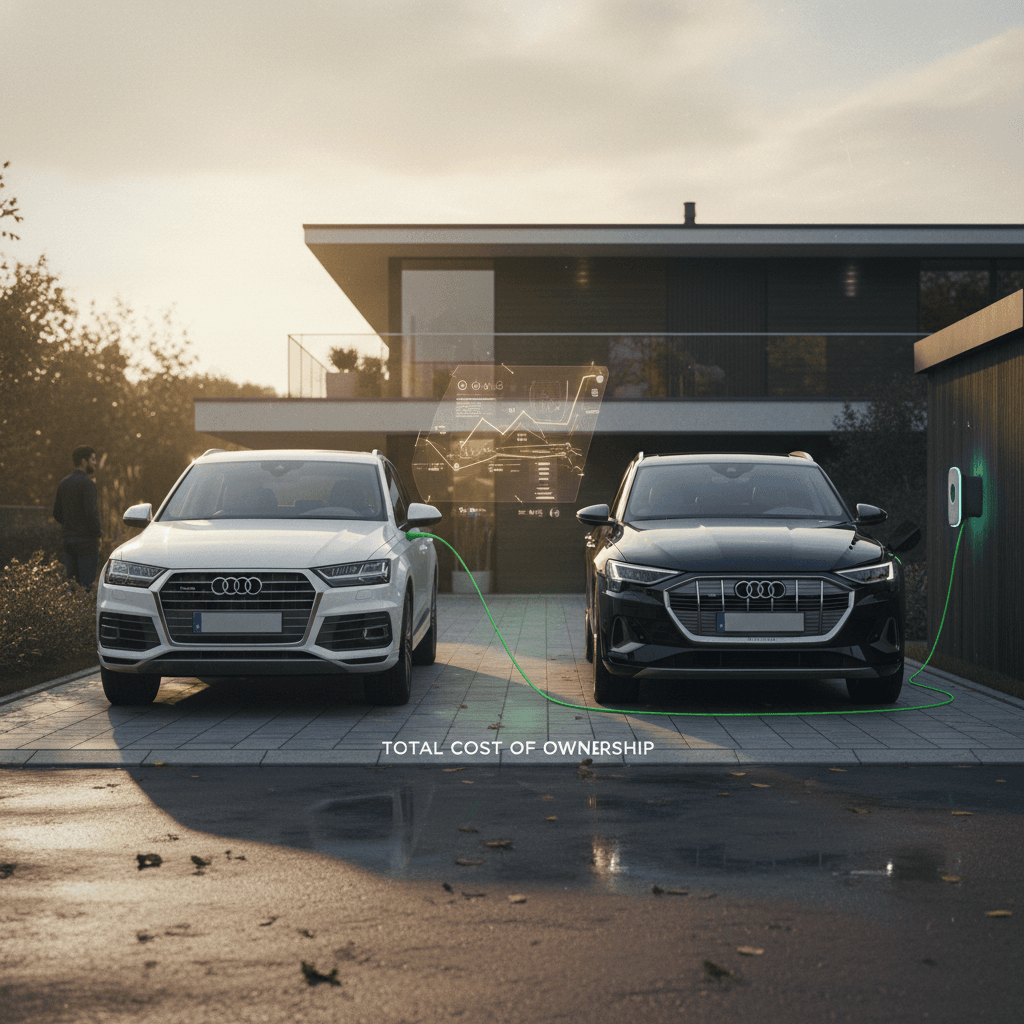
If you’re shopping luxury three-row SUVs, the obvious gas choice is the Audi Q7. If you’re ready to go electric, the Audi Q8 e-tron (formerly just “e-tron”) is the natural alternative. But which one actually costs less to own once you factor in fuel or electricity, maintenance, depreciation, and insurance? This guide walks through the real-world Audi Q7 vs Audi Q8 e-tron total cost of ownership for U.S. drivers, especially if you’re considering a used EV.
About the numbers in this guide
Why Audi Q7 vs Audi Q8 e-tron Total Cost Matters
On paper, the Audi Q7 and Audi Q8 e-tron appeal to the same shopper: someone who wants a quiet, comfortable, all-wheel-drive luxury SUV with strong safety tech and a premium badge. Historically, the Q7 has been the safe, familiar choice. But as electricity prices and gas prices move, and used EV prices normalize, the total cost picture has changed. Today the Q8 e-tron can be the cheaper-to-own SUV in the right use case, especially if you buy used and can charge cheaply at home.
- Both are midsize luxury SUVs with all-wheel drive and high feature content.
- Q7 offers 3-row seating in most trims; Q8 e-tron is a 2-row SUV focused on comfort and tech.
- Q7 runs on premium gasoline; Q8 e-tron is fully electric, with a usable battery around 106 kWh.
- Total cost over 5–8 years is driven more by fuel/electricity, depreciation, and maintenance than by MSRP alone.
Quick take: Which Audi costs less to own?
Audi Q7 vs Q8 e-tron: ownership snapshot (typical U.S. driver)
The short answer
Key specs that drive ownership costs
Core specs: Audi Q7 vs Audi Q8 e-tron (U.S. market, recent model years)
These specs don’t just influence performance; they sit at the heart of total cost of ownership.
| Metric | Audi Q7 55 TFSI (gas) | Audi Q8 e-tron (EV) |
|---|---|---|
| Powertrain | 3.0L turbo V6 + 8‑speed automatic, AWD | Dual-motor electric AWD |
| EPA efficiency | ~21–22 mpg combined (premium) | ≈81 MPGe combined (~41 kWh/100 miles) |
| Fuel/energy source | Premium gasoline | Electricity (AC home + DC fast charging) |
| Rated range | ~450+ miles per tank | Up to ~285 miles per charge (SUV body style) |
| Seats | Up to 7 (3 rows) | 5 (2 rows) |
| Typical new MSRP | Mid‑$60Ks, well‑equipped | Mid‑$70Ks when new, but used prices are often similar to or below Q7 |
| Oil changes | Yes, every ~10k miles | None |
| Brake wear | Conventional | Reduced thanks to regenerative braking |
Always confirm details for the exact model year and trim you’re considering.
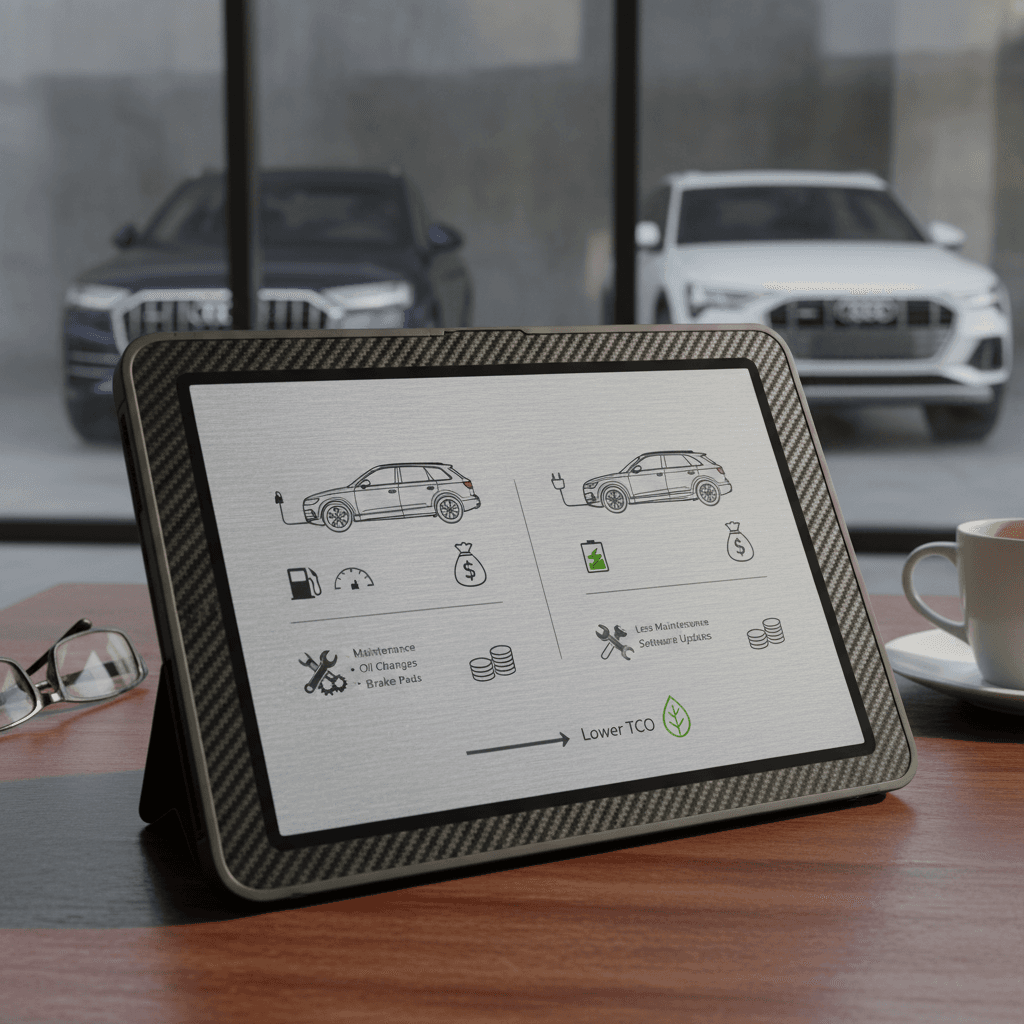
Fuel vs electricity costs: Q7 vs Q8 e-tron
Fuel or electricity is where many drivers feel the difference day to day. To keep things simple, let’s assume 12,000 miles per year, close to the U.S. average, and recent U.S. price averages: around $3.75 per gallon of premium gas and about $0.16–$0.18 per kWh for residential electricity in 2024–2025.
Gasoline cost: Audi Q7
Using ~22 mpg combined on premium:
- 12,000 miles ÷ 22 mpg ≈ 545 gallons/year
- 545 gallons × $3.75 ≈ $2,040 per year
If your local premium price is closer to $5, that rises to roughly $2,725 per year. Over 5 years, fuel alone can easily land in the $10,000–$13,000 range for many Q7 owners.
Electricity cost: Audi Q8 e-tron
Using ~41 kWh/100 miles (≈81 MPGe) and the same 12,000 miles:
- 12,000 miles × 0.41 kWh/mile ≈ 4,920 kWh/year
- At $0.17/kWh home rate: 4,920 × 0.17 ≈ $836/year
Occasional public fast charging is more expensive. If 25% of your miles are on DC fast chargers at an effective ~$.40/kWh and 75% at home, a realistic blended annual cost might be around $1,200–$1,400.
Home charging is the swing factor
Maintenance and repair: Where EVs usually win
Maintenance is where electric SUVs quietly claw back thousands of dollars over time. The Q8 e-tron has no engine oil, spark plugs, timing chains, or exhaust components. Brake wear is lower thanks to regenerative braking. That doesn’t mean EVs are maintenance‑free, but the rhythm and cost structure are different from a Q7.
How maintenance differs: Audi Q7 vs Q8 e-tron
Not just oil changes, think exhaust, coolant, and wear items over 5–8 years.
Audi Q7 (gas)
- Regular oil and filter changes
- Complex exhaust and emissions system
- Transmission fluid service in long‑term ownership
- More frequent brake service (no regen help)
- More moving parts = more potential wear items
Over 5 years / 60,000 miles, it’s reasonable to budget several thousand dollars for routine maintenance and wear items, even before big repairs.
Audi Q8 e-tron (EV)
- No engine oil, spark plugs, fuel system, or exhaust
- Far simpler driveline (no multi‑gear automatic)
- Brake pads often last much longer with regen
- Tire wear can be higher due to weight and torque
- Occasional cabin filters, brake fluid, coolant checks
Many owners see 20–35% lower routine maintenance spend than a comparable gas SUV, though out‑of‑warranty EV‑specific repairs (like air suspension or high‑voltage components) can be expensive.
Don’t ignore battery health
Depreciation and resale value
Depreciation is where the story gets more nuanced. Traditional luxury SUVs like the Q7 depreciate, but demand for three‑row luxury family haulers tends to support values. Early EVs, especially luxury ones, often depreciated faster because technology and incentives moved quickly. That’s bad news for early buyers, but can be great news for used shoppers today.
Q7 depreciation profile
- Steady, predictable curve similar to other German luxury SUVs.
- 3‑row layout and towing ability support demand on the used market.
- Fuel economy is decent for the class but not outstanding, which slightly drags on long‑term desirability as fuel prices rise.
Buying new, a typical 5‑year depreciation hit can easily land in the 45–55% of MSRP range depending on trim and miles. Buying 2–3 years used shifts that curve in your favor.
Q8 e-tron depreciation profile
- Early e-tron models saw faster‑than‑average depreciation as range and charging tech improved quickly.
- That means a 2–4‑year‑old Q8 e-tron can often be found priced similarly to, or even below, a same‑age Q7 despite a much higher original MSRP.
- Future demand is tied to charging infrastructure and battery confidence in the used market.
For used buyers, that steeper early depreciation curve often means you’re getting a lot of luxury EV for the money, which improves your personal total cost of ownership.
How depreciation affects TCO
Insurance, taxes, and fees
Insurance premiums on the Q7 and Q8 e-tron tend to be in the same ballpark: large, expensive, feature‑rich vehicles with advanced driver‑assistance systems. The EV may carry slightly higher comprehensive or collision rates in some markets because of repair complexity and parts costs, but not enough to overturn the fuel and maintenance advantage for most drivers.
- State and local taxes: Some states still offer EV‑specific incentives or reduced registration fees, while others charge EV surcharges to replace lost gas tax revenue.
- Purchase incentives: New federal EV tax credits generally apply to new vehicles that meet assembly and pricing rules; used EV credits may apply to some used purchases through dealers.
- Insurance: Shop quotes for both vehicles using the same driver profile, mileage, and coverage levels. Luxury EV repairs can be costly, but so can high‑tech gasoline SUVs.
Watch for EV registration surcharges
5-year cost scenarios for typical U.S. drivers
Let’s bring this together with simplified 5‑year scenarios. These examples assume 12,000 miles per year, stable prices, and a mix of maintenance and insurance that reflects a typical owner. Your real‑world numbers will differ, but the relative gap is what matters.
Illustrative 5-year total cost estimates (excluding purchase price)
Ballpark comparisons for a typical U.S. driver over 60,000 miles. All numbers are approximate.
| Cost line | Audi Q7 (gas) | Audi Q8 e-tron (home-heavy charging) | Audi Q8 e-tron (fast-charge-heavy) |
|---|---|---|---|
| Fuel / electricity | $10,500–$13,500 | $4,000–$6,000 | $7,000–$8,500 |
| Routine maintenance & wear | $4,000–$6,000 | $3,000–$4,000 (more for tires) | $3,000–$4,000 |
| Repairs out of warranty | Highly variable; budget a cushion | Highly variable; EV driveline simple but battery and air suspension are big-ticket items | Same as home-heavy |
| Insurance (5 years) | $8,000–$10,000 | $8,500–$10,500 | $8,500–$10,500 |
| Estimated 5-year running cost (excl. purchase) | ~$22,500–$29,500 | ~$15,500–$20,500 | ~$19,500–$23,000 |
These scenarios exclude purchase price and financing. Think of them as running‑cost comparisons once you own the vehicle.
What these scenarios suggest
Used market opportunities: Where value tilts to the Q8 e-tron
If you’re cross‑shopping a used Audi Q7 against a used Audi Q8 e-tron, you’re in a sweet spot. The Q7 is a known quantity with predictable resale values. The Q8 e-tron, on the other hand, often lists at surprisingly attainable prices relative to its original MSRP, largely because early EVs depreciated faster than buyers expected.
Why a used Q8 e-tron can be a smart buy
Especially when you can verify battery health and charging history.
Steep early depreciation
Battery health transparency
Lower running costs
How Recharged helps with used Q8 e-tron shopping
How charging habits can flip the math
Two drivers can own the same Q8 e-tron and see very different cost stories. The single biggest variable, after what you paid for the vehicle, is how and where you charge. That’s why it’s important to be honest about your lifestyle before you pencil out total cost of ownership.
Questions to ask yourself before choosing Q7 or Q8 e-tron
1. Can I install reliable home charging?
If you have a garage or dedicated parking and can install a 240‑volt Level 2 charger, the Q8 e-tron’s running‑cost advantage is much stronger. If you’re limited to Level 1 (120‑volt) or no home charging, ownership becomes less convenient and potentially more expensive.
2. What are my local electricity and gas prices?
In regions with low electricity prices and high gasoline prices, the Q8 e-tron is a clear winner. Where electricity is unusually expensive and gas is cheap, the gap narrows.
3. How often do I road-trip?
Occasional road trips are easy to manage with planning. If you do high‑mileage highway driving in areas with sparse or pricey DC fast charging, factor that into your cost math.
4. Do I truly need three rows?
If you regularly use three rows of seating or tow heavy loads, the Q7 may be the better fit on practicality alone, even if it costs more to fuel.
5. How long do I keep vehicles?
If you tend to keep vehicles 7–10 years, the Q8 e-tron’s fuel and maintenance savings compound over time, but you’ll want strong confidence in long‑term battery health.
Public fast charging is like “premium” electricity
How Recharged helps you compare in the real world
Total cost of ownership isn’t just a spreadsheet, it's your budget, your driveway, and your peace of mind. That’s why Recharged is built specifically around used EV ownership, including models like the Audi Q8 e-tron that share showroom space with traditional SUVs like the Q7.
What Recharged brings to your Audi Q7 vs Q8 e-tron decision
Tools and services designed around real-world EV shoppers.
Recharged Score battery health report
Transparent pricing and financing
Nationwide delivery & EV specialists
Charging and ownership coaching
Ready to find your next EV?
Browse VehiclesFAQ: Audi Q7 vs Q8 e-tron ownership costs
Frequently asked questions
Bottom line: Which one is right for you?
If you value familiar fueling, three-row flexibility, and proven resale behavior, the Audi Q7 remains a compelling luxury SUV, with the caveat that you’ll pay more to feed and service it over time. If you can charge at home, are comfortable with two rows, and want to lean into lower running costs and a quieter driving experience, the Audi Q8 e-tron increasingly looks like the smarter long‑term financial play, especially on the used market.
The smart move is to run the numbers for your actual commute, fuel and electricity prices, and ownership horizon. Then, if a Q8 e-tron is on your shortlist, consider shopping it through a platform like Recharged, where every EV includes a verified battery health score, transparent pricing, financing options, and expert EV guidance. That way, your decision between Q7 and Q8 e-tron isn’t just about sticker price, it’s about the total cost of living with the SUV in your driveway for years to come.