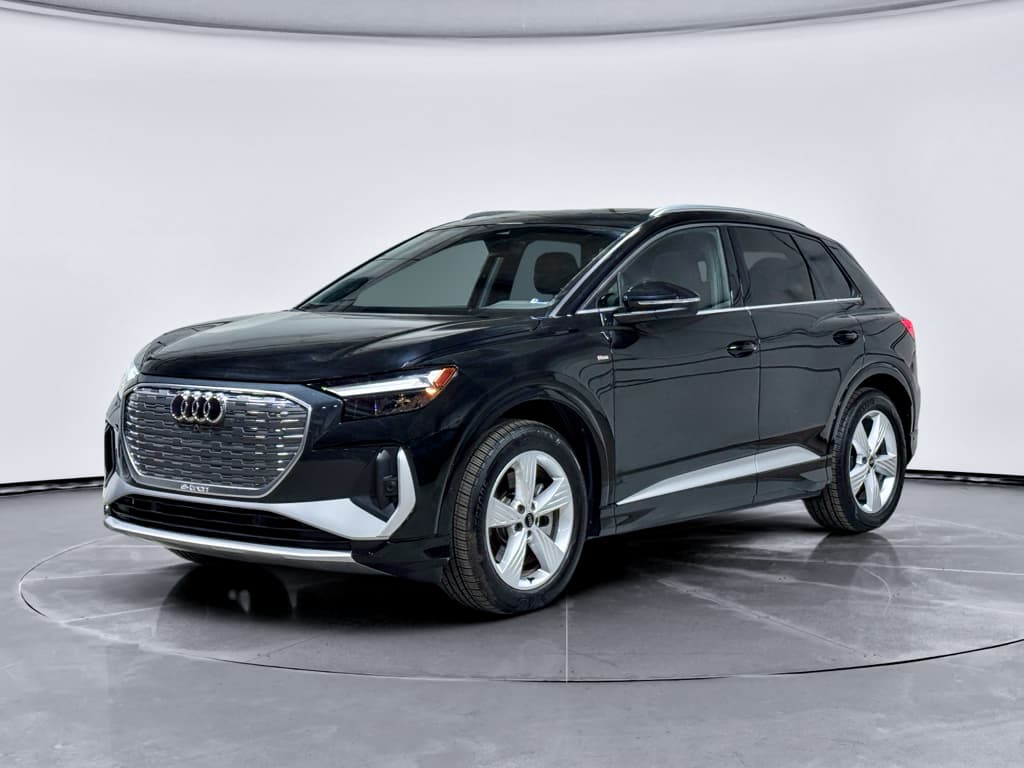
You don’t buy an Audi Q4 e-tron to save the planet all by yourself. You buy it because you want a quiet, premium compact SUV that doesn’t bleed you dry at the pump. The real question is whether the Q4 e-tron’s total cost of ownership actually beats a comparable gas Audi over five years, or if the EV is just moving money from the gas station to your electric bill.
The short answer
Why compare the Audi Q4 e-tron to a gas equivalent?
Luxury EV buyers are savvy. You’re not just asking, “Can I afford the payment?” You’re asking, “What does this thing really cost me once you add fuel, maintenance, insurance, and resale value?” The Audi Q4 e-tron sits right in the heart of the premium compact SUV segment, where its gas siblings, the Audi Q3 and Q5, live. That makes it a perfect test case for understanding EV vs gas SUV total cost in the real world.
Instead of arguing philosophy, we’ll treat this like a household budget decision. Same brand, same size, similar performance, different powertrain. Then we’ll run the numbers across five years, which is about how long many owners keep a vehicle before trading or selling.
The gas benchmark: what counts as a Q4 e-tron “equivalent”?
Audi Q4 e-tron
- Body style: Compact luxury SUV (2-row)
- Power: Dual-motor or single-motor electric, ~201–295 hp
- EPA range: Roughly 250–265 miles depending on trim
- MSRP when new: Typically mid-$50,000s with options
Gas “equivalent” – Audi Q5 45 TFSI
- Body style: Compact luxury SUV (2-row)
- Power: 4-cylinder turbo, ~260 hp
- Combined MPG: Around mid-20s in real-world mixed driving
- MSRP when new: Also typically mid-$50,000s with options
You could also cross-shop BMW X3, Mercedes GLC, Lexus NX, cost dynamics are similar.
To keep this grounded, we’ll mostly use a Q4 e-tron vs Audi Q5 comparison. If you’re looking at a different gas SUV, your exact numbers change, but the pattern, where the money flows, tends to look very similar.
Assumptions for our 5-year cost comparison
Key assumptions
- Time horizon: 5 years of ownership
- Annual mileage: 12,000 miles (U.S. average)
- Location: U.S., mixed city/highway driving
- Gas price: $3.75/gallon blended average over five years
- Home electricity: $0.16 per kWh average; some occasional public charging
- Audi Q5 real-world fuel economy: about 26 mpg combined
- Audi Q4 e-tron real-world efficiency: about 30 kWh/100 miles (0.30 kWh per mile)
- Financing: 5-year loan, 6% APR, small down payment (we’ll focus more on total out-of-pocket than the monthly gymnastics)
Your energy prices may vary
Upfront price, incentives, and financing
The mythology says EVs are always more expensive up front. In this segment, that’s only partly true. A well-equipped new Audi Q4 e-tron and a well-equipped Audi Q5 45 often land in the same zip code once you start checking boxes, mid-$50,000s transaction prices are common for both. Where things really diverge is incentives and the growing used EV market.
Typical upfront economics: new Q4 e-tron vs Q5
Illustrative new-vehicle pricing for similarly equipped models. Numbers are approximate and will vary by dealer, region, and incentives.
| Item | Audi Q4 e-tron (new) | Audi Q5 45 TFSI (new) |
|---|---|---|
| MSRP with common options | $55,000 | $53,000 |
| Potential federal EV tax credit* | Up to $7,500 (if eligible) | $0 |
| Effective net price (if you qualify) | ≈ $47,500 | ≈ $53,000 |
| Used market starting points | Low–mid $30,000s for recent Q4 e-tron | Low–mid $30,000s for recent Q5 |
In practice, dealer discounts, fees, and taxes can move both numbers a few thousand dollars in either direction.
About that tax credit
Financing magnifies these differences. Knock several thousand off the Q4 e-tron’s effective price and your monthly payment gap versus a Q5 can shrink or disappear. On the used side, the market is already doing some of this work for you: early Q4 e-trons have taken their initial depreciation hit, and you can often find them priced very competitively against similar-year Q5s.
How Recharged helps on upfront cost
Ready to find your next EV?
Browse VehiclesFuel vs electricity: where the Q4 e-tron claws back money
5-year fuel vs electricity costs (12,000 miles/year)
On pure energy costs, the Audi Q4 e-tron wins decisively under our assumptions. The Q5 is hauling gasoline at mid-20s mpg; the Q4 e-tron is sipping electrons at roughly 0.30 kWh per mile. Even with some occasional fast charging at higher per-kWh rates, the EV’s fuel bill over five years is dramatically lower.
Cheap charging multiplies your advantage
Maintenance, repairs, and tires: EV simplicity vs gas complexity
The Q5’s 4-cylinder engine is a masterpiece of packaging and turbocharged torque, but it brings along oil changes, filters, spark plugs, timing components, emission systems, and a fully plumbed cooling system. The Q4 e-tron quietly declines all of that. It still has brake fluid, coolant loops, and the usual German-sedan appetite for tires, but routine maintenance is simpler and less frequent.
Where the Q4 e-tron typically saves on upkeep
Five-year, 60,000-mile ownership snapshot
No oil changes
Fewer moving parts
Brakes & tires
In dollar terms, it’s common to see a few hundred dollars per year of maintenance advantage for the Q4 e-tron versus a Q5, especially once the factory free-service windows have passed. Over five years, that’s easily another $1,000–$1,500 in the EV’s favor, not counting the odd unscheduled repair in a complex gas powertrain.
The EV wild card: out-of-warranty repairs
Depreciation and resale value: how the Q4 e-tron holds up
Luxury vehicles shed value faster than economy cars. That’s the cost of playing in this sandbox. Historically, early EVs depreciated harder than their gas counterparts, but the picture is changing as EVs go mainstream and more buyers understand what they’re getting.
- Both a Q4 e-tron and Q5 can easily lose 40–50% of their value in the first 5 years, depending on mileage and condition.
- EV resale is sensitive to range and charging speed. The Q4 e-tron’s competitive range and DC fast-charging capability help it age better than smaller-battery EVs.
- Market perception matters. As more automakers commit to EVs and charging networks expand, late-model electric Audis become less of an experiment and more of a known quantity.
Why battery health matters more than odometer
5-year total cost: Audi Q4 e-tron vs gas SUV
Illustrative 5-year total cost of ownership
Ballpark comparison for an Audi Q4 e-tron vs Audi Q5 over 5 years, 60,000 miles, U.S. averages. These are not quotes, just directional numbers to show where costs diverge.
| Category (5 years) | Audi Q4 e-tron | Audi Q5 45 TFSI |
|---|---|---|
| Energy (fuel/electricity) | ≈ $2,900 | ≈ $8,650 |
| Maintenance & minor repairs | ≈ $2,000–$2,500 | ≈ $3,000–$3,500 |
| Depreciation | Similar range in dollars, slightly higher % for Q4 but off a lower effective purchase price if incentives apply | Similar range in dollars, slightly lower % but off a higher initial price |
| Total out-of-pocket excluding depreciation | Roughly $4,900–$5,400 | Roughly $11,650–$12,150 |
Assumes similar purchase price when new and typical ownership costs. Incentives, local prices, and your driving habits can shift these numbers significantly.
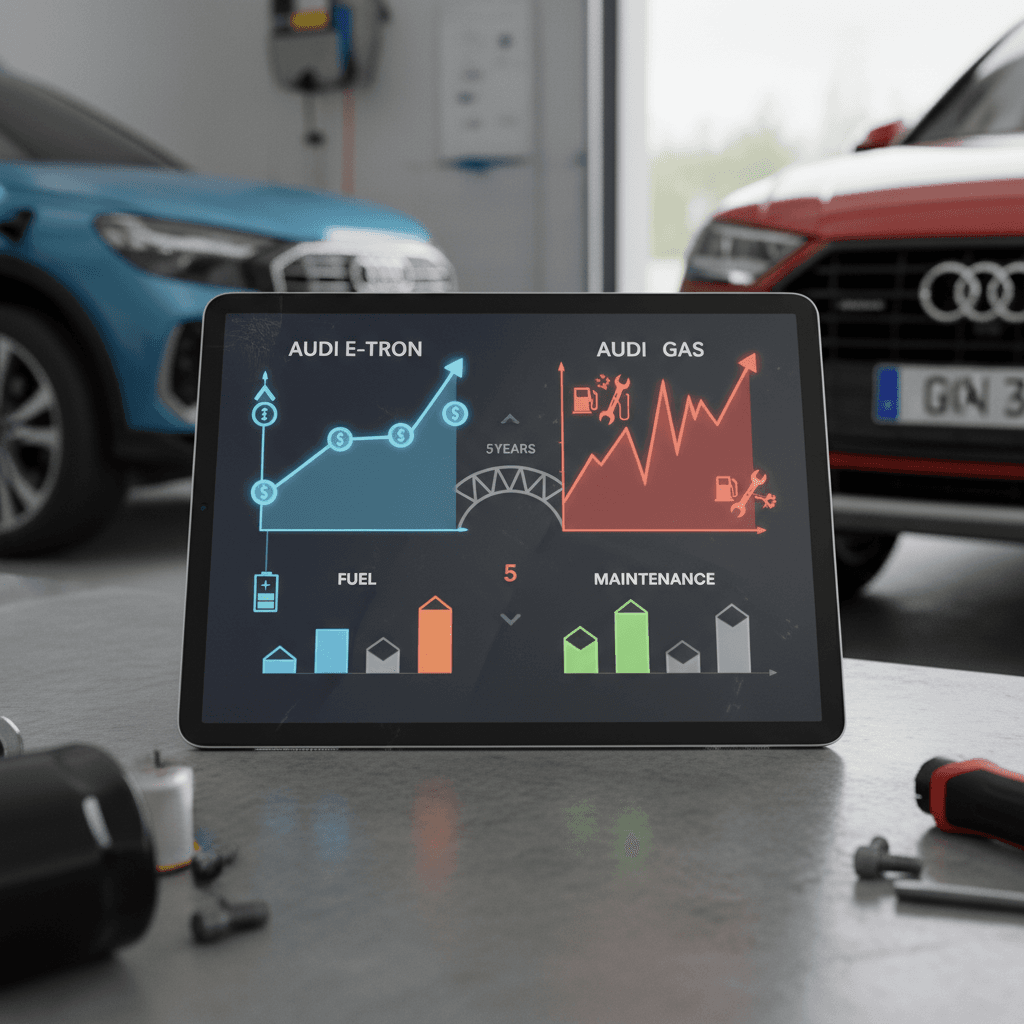
Strip away the complex accounting tricks and you get a simple picture: the Q4 e-tron tends to cost several thousand dollars less to feed and maintain over five years than a comparable gas Audi Q5. Once you factor in potential EV incentives, the total cost can tilt even harder toward the electric side.
Where the EV clearly wins
How your driving and charging habits change the math
Scenario 1: Garage, home charging, suburban life
You have a driveway or garage, a 240V outlet or Level 2 charger, and your daily commute is under 50 miles.
- Home charging dominates; electricity is inexpensive and predictable.
- You rarely see public fast-charging prices.
- Result: The Q4 e-tron’s fuel savings are maximized, and total cost usually beats gas by a comfortable margin.
Scenario 2: Apartment, heavy DC fast charging
You rely heavily on public DC fast chargers, often paying premium per-kWh or per-minute rates.
- Per-mile cost creeps closer to (or even above) gas in some regions.
- You still save on maintenance, but fuel savings may be muted.
- Result: The Q4 e-tron can still compete, but the cost advantage isn’t a slam dunk; convenience and driving feel matter more.
Public charging can erode your savings
New vs used Audi Q4 e-tron: where the value really is
EVs age differently than gas cars. The engine doesn’t slowly grow noisier and leakier; instead, the questions are about software support, charging speeds, and battery health. That’s why the used Q4 e-tron market is particularly interesting right now: early depreciation has already happened, but the technology is still modern, and range is very usable.
What to look for in a used Q4 e-tron vs a used gas SUV
1. Battery health, not just miles
Two Q4 e-trons with similar mileage can have different real-world range if they’ve been treated differently. A proper battery diagnostic tells you if the pack is aging gracefully.
2. Charging history
Cars that lived on DC fast chargers exclusively may show slightly more battery wear. Mixed home and public charging is ideal.
3. Software & feature set
Make sure key features, driver assistance, infotainment, charging controls, are still supported and up to date. EVs age via software as much as hardware.
4. Gas alternative reality check
On the gas side, look for maintenance records: oil changes, fluid services, timing, and any major repairs. A cheap Q5 with spotty history can be a false economy.
Why used EVs shine on Recharged
So… is the Audi Q4 e-tron worth it vs a gas SUV?
If you strip the romance out of it and look purely at money, the Audi Q4 e-tron usually comes out ahead of a similar gas SUV like the Audi Q5 over five years, especially if you qualify for EV incentives and have access to reasonably priced home charging. You pay less to fuel it, less to service it, and you avoid the long tail of gas-car complexity that shows up in repair invoices.
Layer the subjective stuff back in, the instant torque, the quiet, the smoothness, and the Q4 e-tron starts to look like the more complete expression of what a modern Audi is supposed to be. The gas alternative still makes sense if you do constant long-distance driving in regions with sparse charging or if your charging situation is truly difficult. But for a large slice of drivers, the EV isn’t just the cleaner choice; it’s the financially rational one.
If you’re ready to put real numbers to your own situation, browsing used Audi Q4 e-tron listings on Recharged is a smart next step. You’ll see verified battery health, transparent pricing, and financing options laid out clearly, so you can decide, with eyes open, whether your next Audi should sip premium or plug in.