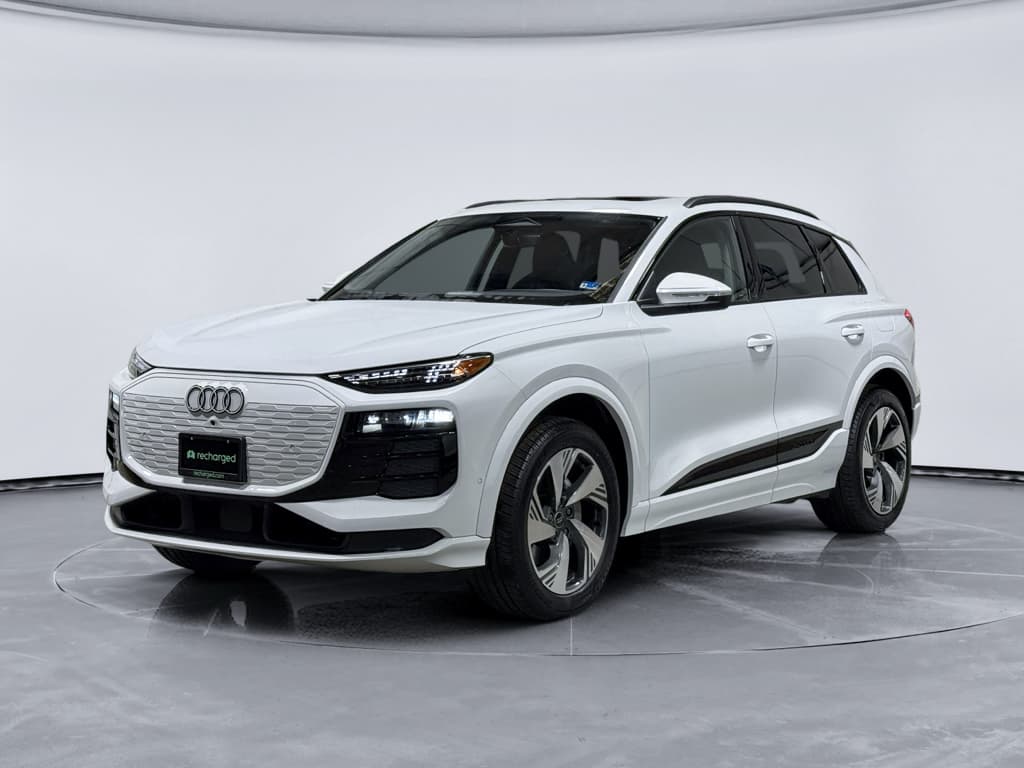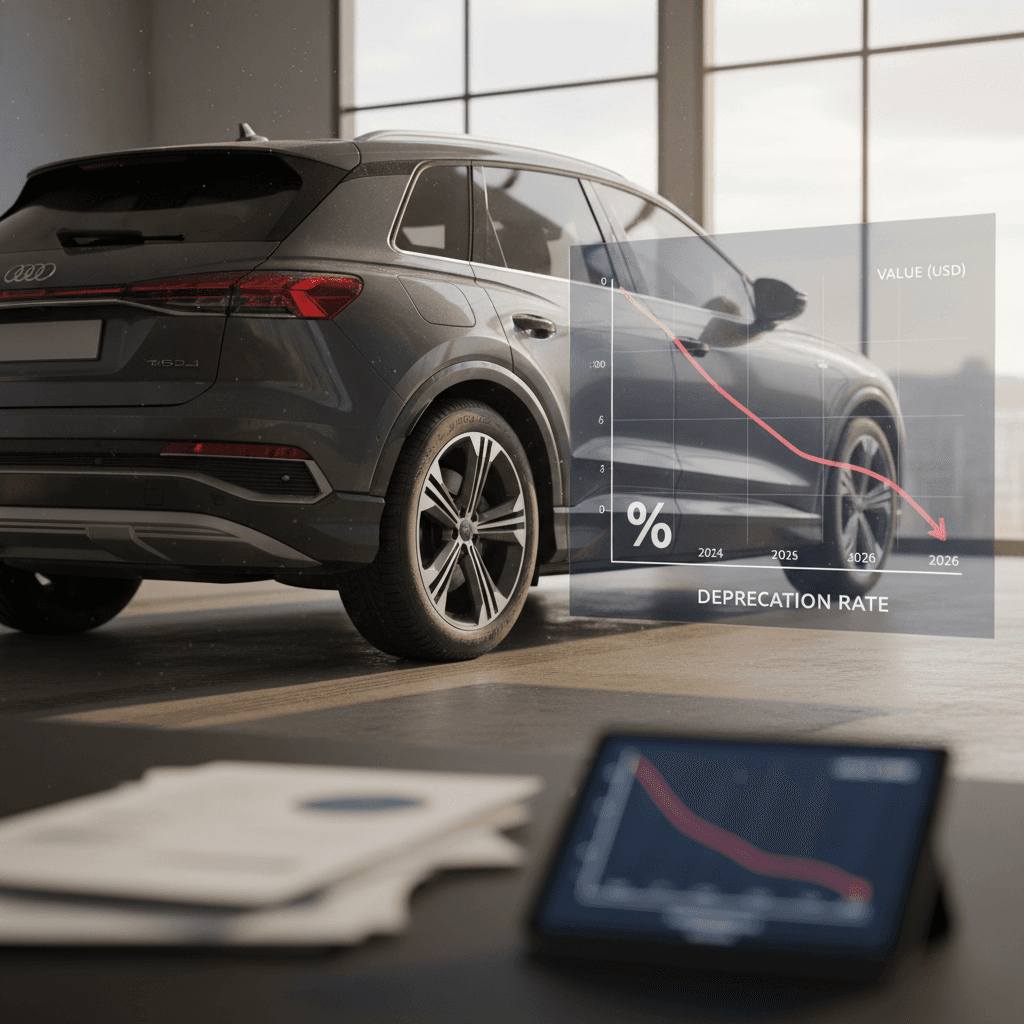
By 2026, the Audi Q4 e-tron depreciation rate has settled into a clear pattern: a sharp drop early on, then a gentler glide. That’s painful if you bought new at full sticker, but it’s exactly why the Q4 e-tron is turning into one of the more interesting values in the used luxury-EV world.
Key context for 2026
Audi Q4 e-tron depreciation rate in 2026: quick overview
Audi Q4 e-tron depreciation snapshot (US, 2026)
Different data providers slice the numbers differently, but most converge on the same story: the Q4 e-tron sheds roughly half its value in about five years, with the biggest bite in the first 24–36 months. That’s consistent with third‑party depreciation curves and what we see in real trade‑in offers and retail listings on Recharged.
Who actually wins here
How fast does an Audi Q4 e-tron depreciate?
The Audi Q4 e-tron is a relatively new nameplate (US sales started for the 2022 model year), so we’re finally getting enough real‑world data to replace guesses with numbers. Zooming out, industry analyses show modern EVs losing close to 59% of value over five years, noticeably worse than the average vehicle. The Q4 e-tron closely tracks that EV curve, with a bit of extra drag because it’s both an EV and a luxury badge.
- Year 1: Roughly 20–25% off MSRP in typical conditions, more if incentives or price cuts hit new cars hard.
- Years 2–3: Depreciation continues but slows, ending around 40–45% total loss by year three for many examples.
- Years 4–5: Values drift toward a roughly 50–56% total loss vs original MSRP, assuming average miles and condition.
CareEdge-style modeling for the Q4 e-tron suggests around 56% depreciation after five years, which lines up almost perfectly with broad EV studies. For a nicely optioned example that left the showroom around $55,000, that implies a five‑year resale value in the mid‑$20Ks, give or take mileage, condition, and incentives the first buyer captured.
Why the early hit feels so brutal
3-year Audi Q4 e-tron depreciation by 2026
By April 2026, the oldest US‑market Q4 e-trons (2022s) are in that key three‑to‑four‑year window. That’s when luxury SUVs traditionally decide who they are in the marketplace: blue‑chip keepers or driveway orphans. The Q4 e-tron has landed squarely in the middle, no catastrophe, but no Toyota 4Runner either.
Example 3-year depreciation paths by 2026
Illustrative, rounded figures based on typical U.S. retail and trade-in ranges for average‑mileage, clean‑title vehicles.
| Model year & scenario | Original MSRP (approx.) | Age in 2026 | Likely 2026 retail price | Approx. total depreciation |
|---|---|---|---|---|
| 2023 Q4 50 e-tron Premium Plus, typical options | $55,000 | 3 years | $30,000–$33,000 | ≈40–45% |
| 2023 Q4 55 e-tron with higher-spec and S line | $60,000 | 3 years | $33,000–$36,000 | ≈40–45% |
| 2022 Q4 40 e-tron (rear-drive), lower spec | $50,000 | 4 years | $25,000–$28,000 | ≈44–50% |
Actual values vary by region, spec, mileage, and incentives. Use this as a directional map, not a gospel.
Those ranges assume mileage in the 30,000–45,000‑mile band, clean Carfax, and no major cosmetic issues. A high‑mileage 2022, say 70,000+ miles, can tumble well into the low‑$20Ks, while a pampered 2023 with 10,000 miles and the right color combo can still stretch higher than the ranges above.
2023–2024 owners get a small break
5-year outlook: Q4 e-tron vs gas SUVs and other EVs
Against mainstream gas crossovers
Think Toyota RAV4 Hybrid, Honda CR‑V, or Subaru Forester. These cars tend to lose low‑40% of their value in five years in normal times. In other words, they do about 10–15 percentage points better than a typical EV on depreciation, and that gap matters if you’re highly resale‑sensitive.
The Audi Q4 e-tron, being German, electric, and a luxury badge, does not play in that league. By five years, it’s more like 50–56% down from MSRP, depending on how ugly the incentives were when it was new.
Against other EVs and luxury metal
Luxury EV crossovers like the Mercedes EQB, Volvo C40, and BMW iX3‑adjacent offerings are broadly in the same depreciation bucket, often losing around half or slightly more of their value in five years. Some mass‑market EVs, like early Nissan Leafs and first‑wave VW ID.4s, fare even worse.
Compared with a Tesla Model Y, which tends to hold slightly more value thanks to brand heat and network effect, the Q4 e-tron usually depreciates a bit faster. That’s bad news for the first owner, good news if you’re picking one up in 2026 for used‑car money.
Where the Q4 e-tron sits in 2026
Real-world Q4 e-tron price examples in 2025–2026
Pull up used listings and instant‑offer tools in early 2026 and you’ll see a consistent band for Q4 e-tron pricing. There are outliers, cars with accident history, tiny miles, or bizarre specs, but most live in a narrow, easily understood corridor.
How depreciation translates into 2026 asking prices
Illustrative retail and trade-in bands for typical U.S. vehicles with clean history.
2022 Q4 50 e-tron Premium
Age: ~4 years, ~45k mi
- Retail asking: high $20Ks–low $30Ks
- Trade-in offers: low–mid $20Ks
- Depreciation: roughly 45–50% off original MSRP
2023 Q4 55 e-tron Premium Plus
Age: ~3 years, ~30k mi
- Retail asking: low–mid $30Ks
- Trade-in offers: high $20Ks–low $30Ks
- Depreciation: roughly 40–45% off MSRP, often softened by original incentives
2024 Q4 e-tron nearly new
Age: 1–2 years, under 15k mi
- Retail asking: often only 10–20% below effective new transaction price
- Trade-in: another few thousand lower
- Depreciation: single‑digit vs what the first buyer actually paid after incentives

Recharged transaction data and offers we see on Q4 e-trons fall comfortably inside those bands. Where we see big deviations, there’s almost always a story: prior damage, unusual fleet history, heavily optioned one‑off specs…or a seller still anchored to what they paid at the peak of the market.
7 factors that really move Q4 e-tron values
What actually pushes your Q4 e-tron up or down in 2026
1. Battery health, not just mileage
For any EV, <strong>state of health (SoH)</strong> is the new odometer. A Q4 e-tron that still shows strong usable capacity and consistent fast‑charging behavior will command a premium over a similar‑mileage car with obvious degradation. This is why a third‑party battery health report, like a Recharged Score, is such a powerful pricing tool.
2. Trim, powertrain, and options
Quattro all‑wheel drive, the more powerful 50/55 variants, and desirable options (S line appearance, driver‑assist packages, upgraded audio) all help shore up resale. Base rear‑drive models and oddball color combos tend to be the softest on the used market.
3. Incentives baked into the original deal
If the first owner stacked tax credits, dealer cash, and subsidized lease money, the <strong>real price paid</strong> was much lower than MSRP. Depreciation still runs off MSRP on paper, but market buyers anchor to what they can get new today, not what you paid, so inflated original stickers don’t help your resale.
4. Charging experience and software updates
As more non‑Tesla EVs gain access to high‑speed networks and NACS adapters, models that integrate smoothly age better. A Q4 e-tron that’s up‑to‑date on software, plays nicely with major networks, and has a documented charging history is easier to sell than one that’s been ignored on updates.
5. Condition and cosmetic honesty
Luxury buyers are picky. Curb rash, interior wear, and mismatched paint can shave thousands off resale, especially on a still‑new‑ish EV. Clean presentation and transparent documentation, photos, service history, battery report, go a long way toward firming up your number.
6. Market timing and EV sentiment
Headlines move metal. When EV sentiment sours, buyers demand bigger discounts and depreciation spikes; when fuel prices spike or incentives improve, used EV demand hardens. The Q4 e-tron rides that emotional roller‑coaster like every other battery‑powered crossover.
7. Local supply and competition
In some metro areas, Q4 e-trons are stacked three deep on every Audi lot. In others, they’re rare enough that a well‑priced example moves quickly. Your ZIP code, and what else a shopper can buy for $30K–$40K that day, quietly dictates a lot of your depreciation story.
How Recharged bakes this into a value
Leasing vs buying when depreciation is this steep
Luxury EVs like the Q4 e-tron are textbook candidates for leasing. Why? Because you’re essentially pre‑paying that predictable front‑loaded depreciation and letting the bank worry about whatever the market looks like in 2028.
How a typical Q4 e-tron lease bakes in depreciation
Illustrative 36‑month numbers based on common residuals and MSRPs; not a quote.
| Scenario | Key numbers | What it really means |
|---|---|---|
| 36‑month lease on a $55,000 Q4 e-tron | Residuals often in the mid‑50% range; say ≈55–59% at 36 months in recent programs | The bank is assuming the car will be worth roughly $30K–$32K after three years, which lines up with real‑world depreciation curves. |
| Buying new and selling after 3 years | You eat the entire 40–45% depreciation yourself if you sell or trade | If you plan to bail early, a lease often lets you walk away cleaner, assuming you don’t wildly exceed mileage or hammer the car. |
| Buying used in 2026 | You’re paying post‑depreciation prices in the $25K–$35K band | Most of the pain is already priced in. If you keep the car longer, your annual depreciation hit shrinks dramatically. |
Exact figures vary by lender, region, incentives, and mileage allowance.
Where leases can backfire
Smart plays if you’re buying a used Q4 e-tron in 2026
In 2026, the savvy move with an Audi Q4 e-tron is usually not to buy new. It’s to buy at the right point on the used curve, once the worst of the drop is over but before the car feels like old tech. Here’s how to do that without turning yourself into the next owner who overpaid.
Four smart strategies for 2026 Q4 e-tron buyers
How to let depreciation work for you, not against you.
Target 2–4 years old
The sweet spot for the Audi Q4 e-tron is usually a 2022–2024 model with 20,000–45,000 miles. You capture 30–45% of MSRP already gone, but still enjoy fresh tech, warranty coverage, and modern range. Five‑year‑old cars are cheaper still, but will feel more behind the curve on charging speed and infotainment.
Insist on battery health proof
Don’t buy an EV blind. Ask for a formal battery health report, not just a screenshot of the dash. On Recharged, every vehicle includes our Recharged Score battery diagnostics, so you can see degradation, fast‑charging behavior, and any anomalies before you commit.
Compare to new after incentives
Before you fall in love with a used price, price out a new Q4 e-tron with current incentives. In some regions and months, aggressive lease or purchase incentives compress the gap so much that a brand‑new car is only marginally more expensive than a used one, changing the value equation.
Shop nationally, not just locally
Q4 e-tron supply and pricing vary wildly by region. It’s not unusual to see a several‑thousand‑dollar spread on similar cars between coasts. Marketplaces like Recharged can arrange nationwide delivery, letting you arbitrage those regional differences instead of just accepting your local dealer’s mood.
Think in total cost, not sticker
Selling or trading your Audi Q4 e-tron in 2026
If you’re on the other side of the table, thinking about selling or trading your Q4 e-tron in 2026, your job is to fight the stereotype that all used EVs are unknown quantities. The more you can defuse buyer anxiety, the closer you get to the top of the value range for your VIN.
- Get a fresh, third‑party battery health report and make it part of your listing or trade‑in folder.
- Document charging habits: mostly Level 2 at home looks better than nothing but DC fast‑charge sessions.
- Fix visible cosmetic issues that sap confidence, windshield cracks, obvious curb rash, yellowed interior trim.
- Service the car on schedule and keep receipts; up‑to‑date maintenance reassures first‑time EV buyers.
- Price against current asking prices in your region, not the number in your head from 2021.
How Recharged can help you exit cleanly
Ready to find your next EV?
Browse VehiclesFAQ: Audi Q4 e-tron depreciation in 2026
Frequently asked questions about Q4 e-tron depreciation
Bottom line: Is the Audi Q4 e-tron a depreciation disaster or opportunity?
By 2026, the Audi Q4 e-tron depreciation rate is no longer a mystery. It’s a pattern: a heavy front‑loaded drop, followed by a more civilized glide path that looks a lot like the rest of the luxury‑EV field. If you paid top dollar new, the numbers can sting. If you’re shopping used, that same curve turns into your friend.
The smart move is to treat depreciation as a design feature, not a defect. Buy in the 2–4‑year window, insist on real battery‑health data, and compare total cost of ownership, not just purchase price, against the gas SUVs you’re cross‑shopping. And if you’re ready to sell or trade, lean on specialists who know how to price EVs by more than just mileage.
On Recharged, every used Audi Q4 e-tron comes with a Recharged Score Report, transparent pricing, and EV‑specialist support from first click to delivery. In a market where depreciation is the loudest headline, that kind of clarity is how you turn a tricky asset class into a smart decision.