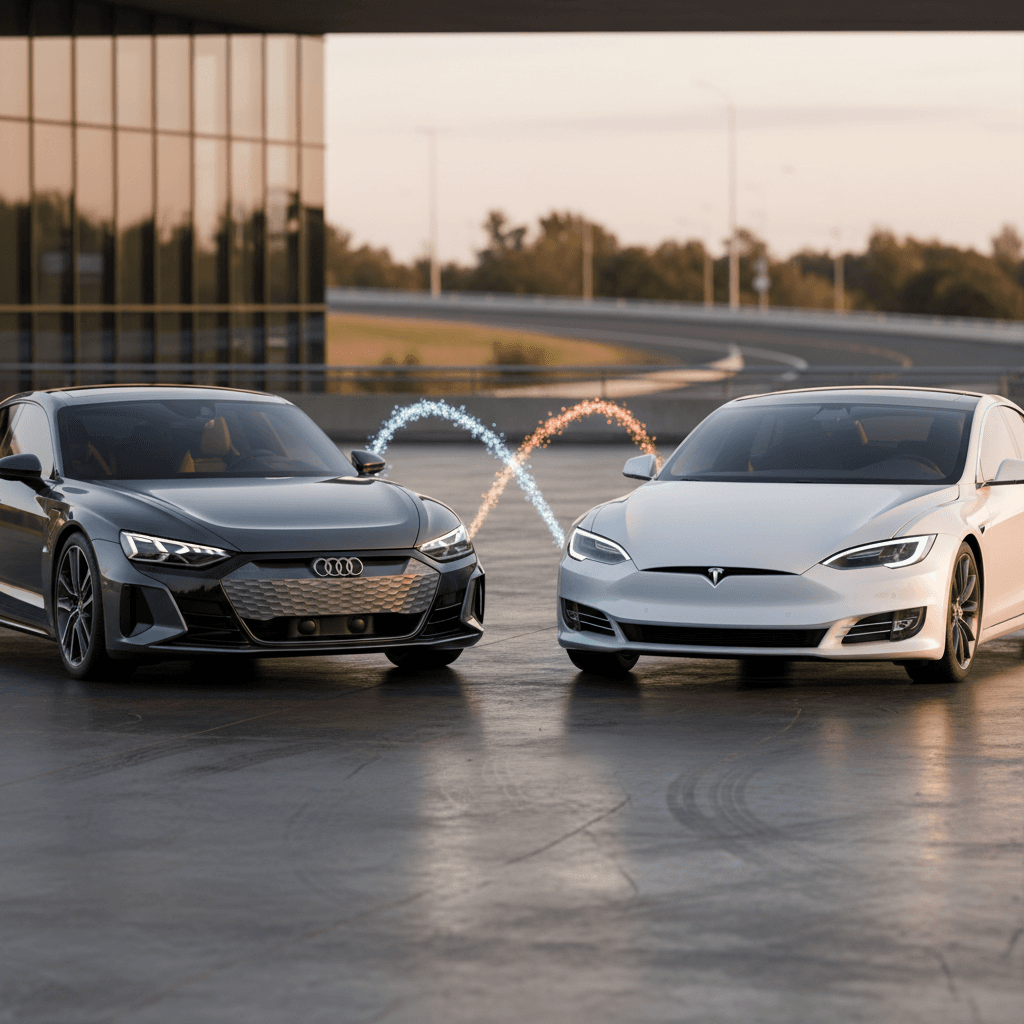
You don’t cross-shop the Audi e-tron GT vs Tesla Model S casually. These are flagship EVs, the kind you buy when you want serious pace, long-distance comfort, and a little driveway theater. The question is less “which is better?” and more “which one fits the way you actually live and drive?” Let’s break that down in plain English.
Two very different takes on the same idea
Overview: Audi e-tron GT vs Tesla Model S
Underneath the badges, these cars are built with different priorities. The Audi e-tron GT (and its S/RS versions) shares its platform with the Porsche Taycan: an 800‑volt architecture, sports-sedan stance, and a cabin that feels familiar if you’ve driven modern German luxury. The Tesla Model S is the long-running disruptor, optimized around range, efficiency, and software, with a massive hatchback and Tesla’s Supercharger network as aces up its sleeve.
Headline numbers at a glance (recent U.S. specs)
Quick specs: range, power, price
Audi e-tron GT vs Tesla Model S: key specs (recent model years)
Representative specs for common trims you’ll see on the U.S. new and used market. Exact numbers vary by year, wheels, and options.
| Model | Typical powertrain | 0–60 mph (approx) | Manufacturer/EPA range* | Typical new MSRP band | Real-world character |
|---|---|---|---|---|---|
| Audi e-tron GT quattro / S e-tron GT | Dual-motor AWD, ~500–600 hp | 3.5–3.9 sec | ~270–300 mi | Mid $120Ks+ new | Quiet, planted grand tourer |
| Audi RS e-tron GT | Dual-motor AWD, 600–900+ hp (overboost) | 2.5–3.1 sec | ~260–290 mi | Higher $130Ks+ new | Serious performance with Audi polish |
| Tesla Model S (Dual Motor / Long Range) | Dual-motor AWD, ~650+ hp | 3.0–3.5 sec | ~350–375 mi | $70K–$80K+ new (varies by year) | Range king with big hatch practicality |
| Tesla Model S Plaid | Tri-motor AWD, ~1,000+ hp | <2.0 sec launch-control | Low–mid 300s mi | $90K–$100K+ new (varies) | Supercar acceleration in a family car shell |
Always verify the exact spec (battery, motor, range) on the specific car you’re considering, especially when buying used.
About the numbers
Range and battery: how far will you really go?
If you road-trip a lot, range anxiety isn’t abstract, it’s that sinking feeling when the kids ask for one more bathroom stop and the state of charge is already lower than you wanted. Here’s how these two stack up in the real world.
Audi e-tron GT range in the real world
- Recent e-tron GT and S e-tron GT models use a ~97 kWh usable battery pack with improved chemistry.
- Depending on trim and wheels, you’re typically looking at roughly 260–310 miles of realistic highway range when new.
- It’s tuned more like a performance grand tourer than a hyper-miler: fantastic stability and repeatable power, at the cost of a little efficiency.
- Older 83–84 kWh cars (2021–2023) will sit closer to the low–mid 200s on the highway, especially on big wheels.
Tesla Model S range in the real world
- Tesla has long chased efficiency, and it shows: Long Range trims can realistically deliver 320–360 miles on the highway in good weather when new.
- Plaid models trade a bit of range for performance but still live in the low–mid 300s for many drivers.
- Software and aero tweaks over the years mean a 4-year-old Model S can still look very strong versus brand-new rivals.
- As always, wheel size, temperature, and how you drive will move those numbers up or down.
Think in hours, not just miles
Charging and road trips: Superchargers vs 800-volt speed
Here’s where philosophy really splits. Tesla built a vertically integrated ecosystem around its Supercharger network. Audi leaned into 800‑volt hardware that can gulp electrons astonishingly quickly at the right stations.
Charging: how they behave in the real world
Both are fast, but they’re fast in different ways.
1. Network access
Tesla Model S owners have native access to Tesla’s Supercharger network, still the most reliable DC fast-charging system across North America. In many areas, you can road-trip with almost no planning.
Audi e-tron GT uses CCS. You’ll rely on networks like Electrify America and others. Coverage on major U.S. corridors is increasingly solid, but station quality can vary by operator.
2. Peak charging speed
The e-tron GT’s 800‑volt system can briefly peak around 270–320 kW on a capable charger, going from roughly 10–80% in well under 25 minutes in ideal conditions.
The Model S also supports very high DC speeds on newer V3/V4 Superchargers, though its charging curve and taper are tuned more around efficiency and pack longevity than headline peaks.
3. Home charging reality
Both cars will spend most of their time on Level 2 home charging. With a 240 V circuit, you’re typically adding 25–35 miles of range per hour overnight.
That means you wake up every morning with a “full tank,” which matters more than shaving 3 minutes off a DC fast-charge stop a few times a year.
Watch your home electrical panel
Performance and driving feel
You can get silly-fast versions of both the Audi e-tron GT and the Tesla Model S. The difference is in how they deliver that speed, and how they feel the other 95% of the time, when you’re just commuting, running errands, or hustling down a back road for fun.
Audi e-tron GT: grand-touring athlete
- Even in its “base” quattro or S forms, the e-tron GT feels like it was tuned by people who love fast, long-distance driving.
- Steering is weighty and precise, the car is low and wide, and optional rear-wheel steering helps it feel smaller in tight corners.
- Adaptive air suspension can float you over broken pavement in Comfort, then plant the car impressively in Dynamic.
- The RS e-tron GT adds a big jump in power and a more serious edge without turning the ride into punishment.
If you miss the feeling of old-school German sport sedans, the Audi will speak your language.
Tesla Model S: effortless thrust, lighter feel
- The dual-motor Model S delivers strong, immediate torque with less of the “hunkered down” feel you get from the Audi.
- Plaid turns that dial to absurd: instant, neck-snapping launches that barely seem possible in a 4-door.
- Steering is lighter and the ride leans more toward comfort, especially on smaller wheels.
- It can feel a bit more softly damped and less talkative through the wheel than the Audi at high speeds.
If you want maximum acceleration bragging rights with space for the family, Plaid is still in a class of its own.
Interior, tech, and comfort
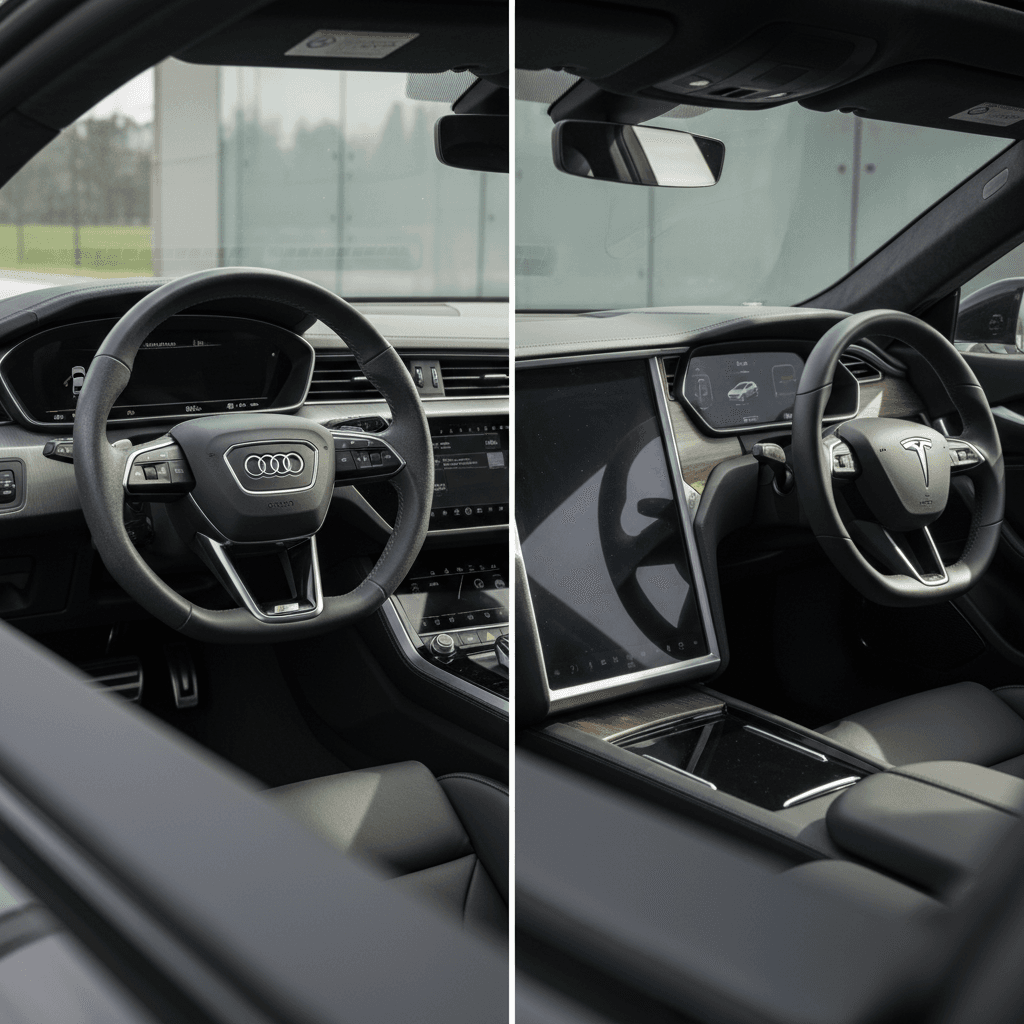
Step inside and you’ll know immediately which camp you’re in: physical buttons and familiar luxury, or near-total minimalism driven by software.
Cabin character: Audi e-tron GT vs Tesla Model S
Both are comfortable; they just take different paths to get there.
Audi e-tron GT: classic luxury cockpit
- High-quality materials, familiar Audi switchgear, and a driver-focused cockpit that feels like a modern RS-car.
- Physical climate controls and conventional stalks for indicators and wipers, easy to live with from day one.
- Infotainment is solid, with digital instruments and a center touchscreen, but not as app-driven as Tesla’s ecosystem.
- Seats are supportive and sporty; road and wind noise are well controlled, especially on smaller wheels.
Tesla Model S: software-first living room
- Dominated by a large central touchscreen and minimal physical controls; you interact with the car through software.
- Frequent over-the-air updates can add features, tweak UI, and occasionally change how core functions work.
- Later cars add extras like rear-seat screens, powerful audio, and playful Easter eggs.
- Cabin materials have improved over the years but may still feel a step behind German rivals at the same price when new.
About Tesla’s steering yoke
Practicality: space and usable storage
Both of these are big EVs, but they don’t use that size the same way. The Audi e-tron GT is more like a low-slung sports sedan; the Tesla Model S behaves like a long-roof hatchback in disguise.
Practical usability comparison
How the space and storage feel day-to-day.
| Practicality factor | Audi e-tron GT | Tesla Model S |
|---|---|---|
| Front trunk (frunk) | Present but modest; enough for a small bag or charging cable | Larger and more usable for day trips or groceries |
| Rear cargo area | Traditional trunk; wide opening but not very tall | Full hatchback opening with fold-flat seats; big win for bulky items |
| Rear seat space | Adequate for adults, but sloping roofline can compromise headroom | More generous rear headroom and legroom; better for tall passengers |
| Car seats and family duty | Works, but you’ll work around the low roof and tighter openings | Easier loading of kids and gear; more family-friendly overall |
| Parking and maneuvering | Feels wide but compact, especially with rear-wheel steering | Long and wide; good visibility but can feel large in tight city spots |
Exact volumes vary by model year, but the character is consistent across generations.
Ownership costs, reliability, and depreciation
Look beyond the window sticker and ask: what will this thing cost you over 5–8 years? That’s where charging habits, warranty coverage, and used-market behavior matter more than 0–60 bragging rights.
Key ownership considerations for both cars
1. Battery and drivetrain warranties
Both Audi and Tesla offer long battery and electric drivetrain warranties (often around 8 years / 100,000+ miles). On a used car, check how much of that coverage remains and whether any major work has already been done.
2. Service network and repair costs
Tesla’s service model is different, more mobile techs and fewer traditional shops. Audi uses its established dealer network. Out-of-warranty parts for either flagship EV can be expensive, so understand where you’ll get it serviced and what labor rates look like locally.
3. Depreciation on the used market
Large luxury EVs typically depreciate faster than smaller, cheaper ones. Early Model S and e-tron GT examples can represent strong value used, but the exact story depends on battery health, software feature sets, and accident history.
4. Insurance premiums
High purchase prices, advanced body structures, and expensive sensors mean higher-than-average insurance in many zip codes. Always get a quote using the VIN of a specific car before you fall in love.
5. Home vs public charging mix
If you can charge at home most nights, both cars become far cheaper to run than an equivalent gas performance sedan. If you’ll rely heavily on public DC fast charging, map out costs and availability on your real routes before you decide.
How Recharged helps de-risk a used flagship EV
Ready to find your next EV?
Browse VehiclesWhich one is better for you? Real-world buyer profiles
Instead of chasing a winner on paper, match each car to the way you actually live. Here are a few common buyer profiles, and which car usually fits best.
Who should buy Audi e-tron GT vs Tesla Model S?
Think about how you drive in a typical week, not just once-a-year road trips.
The design-obsessed weekend driver
Best fit: Audi e-tron GT / RS e-tron GT
- You care deeply about how the car looks and feels, inside and out.
- Your daily mileage is modest, and you drive for pleasure as much as necessity.
- You want a cabin that feels special every time you sit down, with classic controls.
The Audi feels like a proper grand tourer that just happens to be electric.
The high-mileage road-tripper
Best fit: Tesla Model S Long Range
- Multi-state road trips, regular long drives for work, or a dispersed family you visit often.
- You want the least amount of charging anxiety and the best combination of range + charger availability.
- You’re comfortable living in Tesla’s software-first ecosystem.
The combination of big range and Supercharger access is tough to beat.
The busy family hauler
Best fit: Tesla Model S
- Car seats, strollers, sports gear, and Costco runs are your reality.
- You value a big hatch, fold-flat seats, and lots of interior volume.
- You aren’t chasing supercar handling; you just want smooth, quick, quiet family transport.
The Model S’s packaging simply works better as a family appliance, even when it’s wildly fast.
Don’t underestimate your own preferences
Buying used Audi e-tron GT or Tesla Model S with confidence
For many shoppers, the most compelling versions of these cars are used. You can let someone else take the steepest depreciation hit and step into a flagship EV for the price of a new, mid-level crossover, if you choose carefully.
Smart used Audi e-tron GT shopping
- Battery health: Look for cars with documented charging habits and mileage. A vehicle that mostly lived on home Level 2 charging and stayed within 20–80% will usually age more gracefully.
- Wheel and tire packages: Huge wheels look great but can hurt range and ride comfort. If you live in a pothole-prone area, smaller wheels may be a better fit.
- Service history: Prioritize cars with full dealer or specialist service records, especially for any recall or software updates related to the high-voltage system.
On Recharged, the Recharged Score helps you quickly spot e-tron GTs with strong battery and charging behavior before you even schedule a test drive.
Smart used Tesla Model S shopping
- Feature set by year: Tesla changes hardware and software often. Autopilot versions, infotainment computers, and even the steering interface can vary. Make a list of must-have features and match them to specific years.
- Battery and drive unit: Check for past warranty work and any history of rapid DC fast charging; a balanced mix of Supercharging and home charging is ideal.
- Panel and glass repairs: On a big glass-roof EV, high-quality body and glass work matter. Inspect for overspray, panel gaps, and windshield or roof replacements.
Because Recharged focuses only on EVs, our team knows what to look for in older Model S examples and can flag cars that don’t meet our standards.
FAQ: Audi e-tron GT vs Tesla Model S
Frequently asked questions
Bottom line: how to choose your flagship EV
When you line up the Audi e-tron GT vs Tesla Model S, you’re not looking at right vs wrong, you’re deciding which kind of luxury EV experience you want to live with every day. The Audi is the driver’s choice: gorgeous, composed, and deeply satisfying when the road opens up. The Tesla is the pragmatic powerhouse: huge range, huge hatch, and a charging network that turns cross-country trips into something close to routine.
If you’re shopping used, these differences matter even more. A well-chosen Model S can be the only car a family needs, while a carefully selected e-tron GT can feel like a dream garage item you somehow got at a discount. Either way, you want clear answers on battery health, fair pricing, and what ownership will really look like, and that’s where buying through Recharged and leaning on a Recharged Score Report turns a complicated flagship EV purchase into a confident one.
Take a breath, be honest about how you drive, then test-drive both if you can. The spec sheets will get you close. The way you feel after an hour behind the wheel will tell you the rest.