If you’re cross-shopping the Audi e-tron GT and Audi A7, you’re already in rarefied air: both are sleek, four-door luxury grand tourers with serious performance. The big question is whether you want to double down on Audi’s EV future with the e-tron GT or stick with the A7’s proven gas (or plug-in hybrid) powertrains. This guide walks through performance, range and mpg, practicality, and real-world ownership costs so you can decide which you should buy, especially if you’re looking at a used example.
Both are “fastback” luxury sedans
Overview: Audi e-tron GT vs Audi A7
Audi e-tron GT: EV performance flagship
- All-electric, dual-motor all-wheel drive.
- ~522 hp in current U.S. trims, with supercar-like acceleration.
- EPA-rated range roughly in the 235–250 mile band depending on year and wheel choice.
- Very fast DC fast-charging; 5–80% in well under 30 minutes in ideal conditions.
- Lower running costs than a comparable gas Audi, if you can charge at home.
Audi A7 55 TFSI: Versatile luxury fastback
- Turbocharged 3.0L V6 gas engine with a mild-hybrid system (55 TFSI).
- About 335–340 hp, strong but less explosive than the e-tron GT.
- Combined fuel economy in the 22–24 mpg range for recent U.S. models.
- Significantly more cargo space, more rear headroom, and easier long-haul use.
- No charging learning curve; you just fuel up and go.
Start with your use case, not the spec sheet
Quick spec comparison: e-tron GT vs A7 55 TFSI
Core specs at a glance (recent U.S. models)
These are representative figures for typical recent e-tron GT and A7 55 TFSI models sold in the U.S. Exact numbers vary slightly by model year, trim, and wheel/tire choice.
| Spec | Audi e-tron GT (EV) | Audi A7 55 TFSI (gas) |
|---|---|---|
| Powertrain | Dual-motor electric AWD | 3.0L turbo V6 + 48V mild hybrid, quattro AWD |
| Horsepower | ≈ 522 hp (recent U.S. spec) | ≈ 335–340 hp |
| 0–60 mph | Low 3s to high 3s (trim-dependent) | Around 5.0–5.3 seconds |
| EPA range / fuel economy | ~235–250 miles per charge | ~22–24 mpg combined |
| Battery / tank | ≈93 kWh gross battery pack | 19–21 gal fuel tank (approx., trim-dependent) |
| DC fast-charging | Very fast, 5–80% in ~20–25 minutes in ideal conditions | Not applicable |
| Cargo space | ~12 cu ft trunk + small frunk | ≈24–25 cu ft hatch area |
| Curb weight | ~5,100–5,300 lb | ~4,200–4,300 lb |
| Approx. new MSRP band | Well into six figures when new | Well-equipped examples many tens of thousands cheaper new |
Think of this as a reality-check grid, not a brochure, your actual used-car candidate may differ slightly.
Driving experience and performance
How they feel from behind the wheel
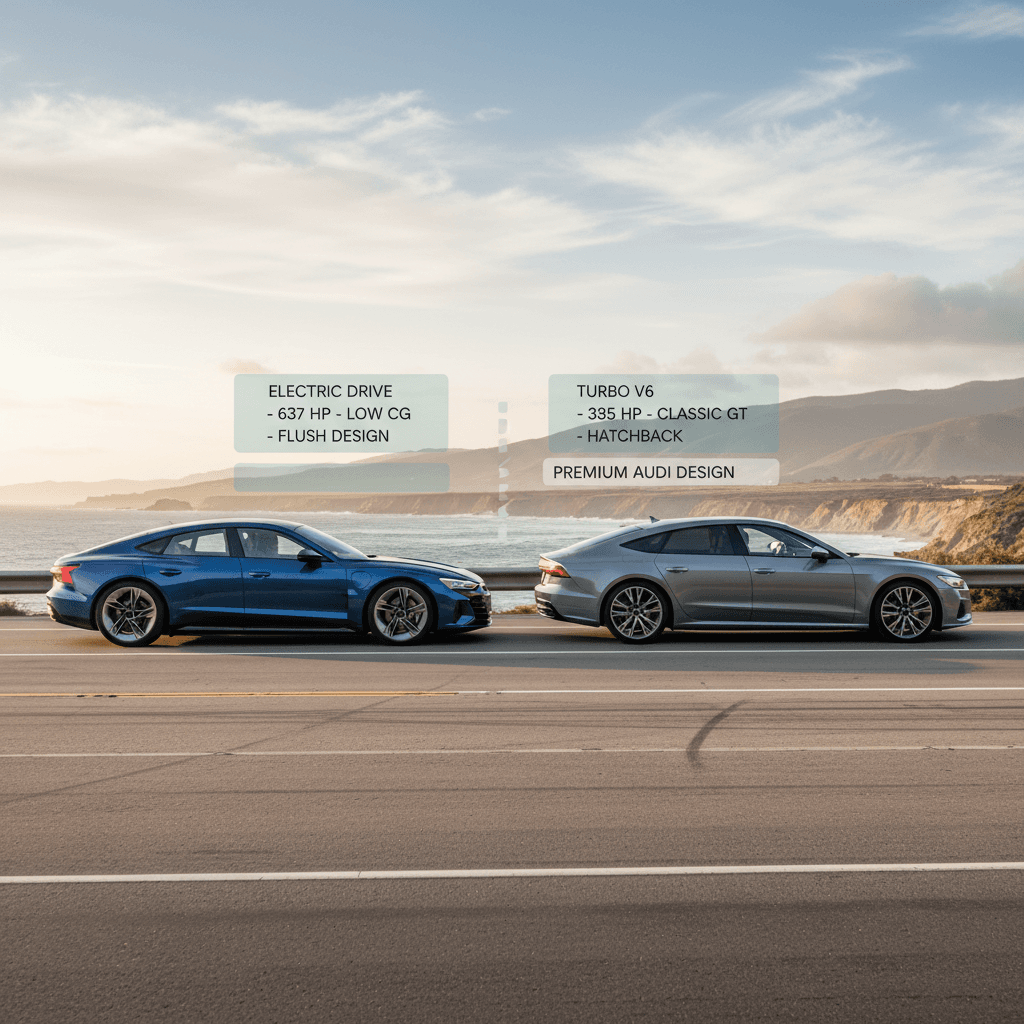
Both are quick luxury cars, but they deliver speed very differently.
Audi e-tron GT: Instant EV shove
The e-tron GT delivers that classic EV party trick: instant torque. Around town it feels effortlessly quick, and on-ramps are frankly addictive. With no gear changes and a very low center of gravity, it feels planted and unflustered at high speeds.
- More of a “mini RS e-tron GT” feel than a typical luxury sedan.
- Steering and chassis tuning are firmly on the sporty side.
- Regenerative braking takes a bit of acclimation if you’re coming from gas.
Audi A7: Classic Audi grand tourer
The A7 55 TFSI is objectively quick but tuned for refined comfort first. The V6’s torque builds smoothly, and the automatic transmission makes it feel familiar if you’re used to gas cars.
- More body roll and less sharp turn-in than the e-tron GT, but also more forgiving.
- Quieter powertrain sound at steady cruise than older V6s, thanks to mild-hybrid tech.
- Still very capable at highway speeds; it just doesn’t feel like a spaceship.
Test-drive them back-to-back
Efficiency, range, and fueling time
Real-world efficiency snapshot
From an efficiency standpoint, the e-tron GT shines in day-to-day use if you have home charging. Plug in at night, wake up with a "full tank" most mornings, and your energy cost per mile is typically well below what premium gas would run in an A7. On the flip side, long road trips still favor the A7’s gas engine for simplicity: you’ll stop more often in the e-tron GT to DC fast-charge, and each stop will be longer than a quick gas fill-up, even though the Audi charges quickly by EV standards.
When the e-tron GT wins
- You drive a predictable daily route under 150 miles.
- You can reliably charge at home or work.
- You care more about per-trip smoothness and silence than stopping on rare road trips.
- You like the idea of skipping gas stations entirely most weeks.
When the A7 wins
- You routinely do very long highway drives in regions with patchy fast-charging.
- You can’t easily install home charging or your parking is street-only.
- You value quick, predictable 5-minute refuels over lower per‑mile energy costs.
- You’re not ready to think about public charging apps and payment systems.
Check your real charging options before committing
Practicality: space, comfort, and usability
Cabin and cargo: the less glamorous but more important stuff
Both cars look like four-door coupes, but they don’t treat passengers and luggage the same way.
Interior space
The e-tron GT’s low roofline and big battery tunnel mean tighter rear-seat space, especially headroom and footroom. Adults fit, but it’s more of an occasional rear seat.
The A7 feels more like a traditional luxury sedan inside. Rear passengers get easier ingress and egress and better overall space.
Cargo & practicality
The A7’s hatchback is one of its superpowers: roughly double the cargo volume of the e-tron GT’s conventional trunk. It’s far better for strollers, sports gear, or airport runs.
The e-tron GT compensates with a small front trunk, but the total volume still can’t touch the A7.
Ride comfort
Both cars can be specced with adaptive air suspension, but the e-tron GT skews sporty-firm by design. Great for handling, less ideal for rough city streets.
The A7 is tuned more for comfort and quiet. If you prioritize a plush ride on broken pavement, it has the edge.
Kids and car seats
Ownership costs: fuel, maintenance, and resale
Key ownership cost differences
Energy costs: electricity vs premium gas
If you charge mostly at home on a decent electricity rate, the e-tron GT will usually beat the A7 on fuel cost per mile. Public fast-charging narrows or even erases that advantage, so your mix matters.
Maintenance: EV simplicity vs ICE complexity
The e-tron GT has no oil changes, spark plugs, or exhaust to worry about. It still needs tires, brakes, coolant, and occasional service, but routine maintenance is generally simpler than a turbo V6. The A7 brings traditional ICE complexity but benefits from a large network of independent shops.
Wear items: heavy EV vs lighter A7
Because the e-tron GT is heavier and very quick, expect to budget a bit more for performance tires and possibly brakes, especially if you drive it hard. The A7 is easier on consumables, but still a heavy luxury car.
Insurance and repairs
On paper, both are premium German cars with aluminum-intensive bodies and lots of tech. Insurance can be higher for the e-tron GT due to performance and repair complexity. Get quotes for your ZIP code; assumptions here can be expensive.
Resale & depreciation
High-end EVs have seen steeper early depreciation than gas equivalents, which makes the e-tron GT <strong>very compelling on the used market</strong> but more of an unknown beyond the 7–10 year mark. A7 resale is steadier and better understood over time.
Battery health is the big swing factor on a used e-tron GT
Charging vs gas: which lifestyle fits you?
Living with the e-tron GT
If you can park near a plug, living with an e-tron GT often feels like an upgrade from gas: you plug in at night, avoid gas stations, and wake up with a warm cabin and full battery on cold mornings. The car is quiet, quick, and stress-free in traffic.
- Best for homeowners or stable long-term renters who can install Level 2 charging.
- Works well if you mostly stay within a predictable radius and take a handful of well‑planned road trips.
- Requires a bit of adjustment around charge planning and public charging apps.
Living with the A7
The A7 fits seamlessly into existing habits: any driver can hop in, fuel at any gas station, and drive cross‑country without thinking about chargers, plug standards, or kilowatts. You pay more per mile for fuel, but the mental overhead is lower.
- Best for apartment dwellers or urban owners without easy home charging.
- Ideal if you frequently drive into remote areas with limited EV charging.
- Still offers light electrification via mild-hybrid tech, but behaves like a traditional gas car.
Hybrid household? Consider one of each
Who should buy which: clear recommendations
Buyer profiles: e-tron GT vs A7
Match yourself to the closest profile below to see which car is a better fit.
You should lean toward the Audi e-tron GT if…
- You want a halo-level EV with dramatic styling and supercar‑adjacent acceleration.
- You have reliable home or workplace charging and your typical daily driving is well under the car’s range.
- You’re ready to engage a bit with planning fast‑charge stops on longer trips.
- You prioritize cutting-edge tech feel over maximum rear-seat space and cargo.
- You’re shopping used and want to capitalize on EV depreciation to get far more performance per dollar, backed by a battery health report.
You should lean toward the Audi A7 if…
- You do frequent long-distance road trips or drive in regions with sparse DC fast charging.
- You can’t easily install home charging, or you change residences often.
- You regularly use the rear seats and cargo area for kids, pets, or bulky gear.
- You value a more compliant ride and quieter cabin over razor-sharp handling.
- You want more predictable long-term behavior around resale and independent repair options.
Still torn? Let total cost of ownership break the tie
How a used e-tron GT or A7 fits into Recharged
If you’re considering a used Audi e-tron GT, the big unknown is the battery. That’s where Recharged is designed to de‑risk the decision. Every EV we list, including performance models like the e-tron GT, comes with a Recharged Score Report that includes verified battery health, real-world range insights, and a transparent view of how the car has been used and charged. You get the thrilling EV without gambling on an invisible component that costs as much as some used cars by itself.
Even if you decide the Audi A7 fits your life better right now, the same fundamentals apply: you want fair pricing, clear condition information, and, ideally, a path to electrification later. Recharged offers financing, trade-in, instant offer or consignment, and nationwide delivery, along with EV‑specialist support if you’re thinking about moving from something like an A7 into an EV on your next trade cycle.
Use your A7 to step into an EV later
Ready to find your next EV?
Browse VehiclesFAQ: Audi e-tron GT vs Audi A7
Frequently asked questions
Choosing between the Audi e-tron GT and Audi A7 ultimately comes down to how, and where, you drive. If you’ve got reliable access to charging, don’t need maximum cargo space, and want an EV that feels genuinely special, the e-tron GT is the more future‑proof and emotionally compelling choice, especially in the used market with verified battery health. If your life revolves around long, charger‑sparse road trips, frequent child‑hauling, or you can’t easily install home charging, the A7 remains a deeply competent, comfortable, and more conventional luxury fastback. Either way, running the numbers and being honest about your daily routine will tell you which one you should buy, and when you’re ready to jump into a used EV, Recharged is built to make that step simpler and more transparent.