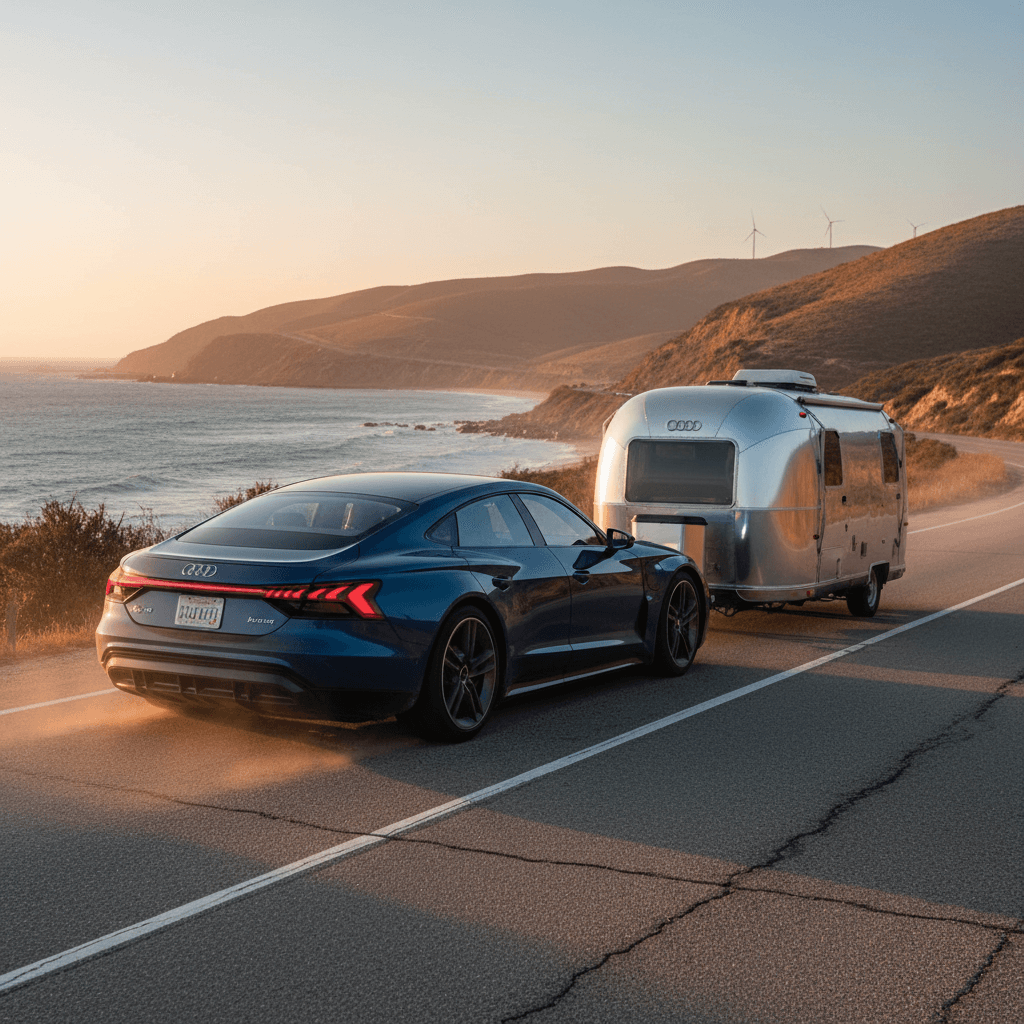
If you’re considering an Audi e-tron GT and you occasionally tow a small trailer, you’re probably wondering about two things: towing capacity and range loss. EVs can be phenomenal tow vehicles for short to medium trips, but they don’t behave like gas sedans when you hang a trailer off the back. In this guide, we’ll look at what the e-tron GT is realistically suited to tow, how much range you can expect to lose, and how to plan trips so you don’t end up white‑knuckling it to the next charger.
Quick takeaway
Can the Audi e-tron GT actually tow?
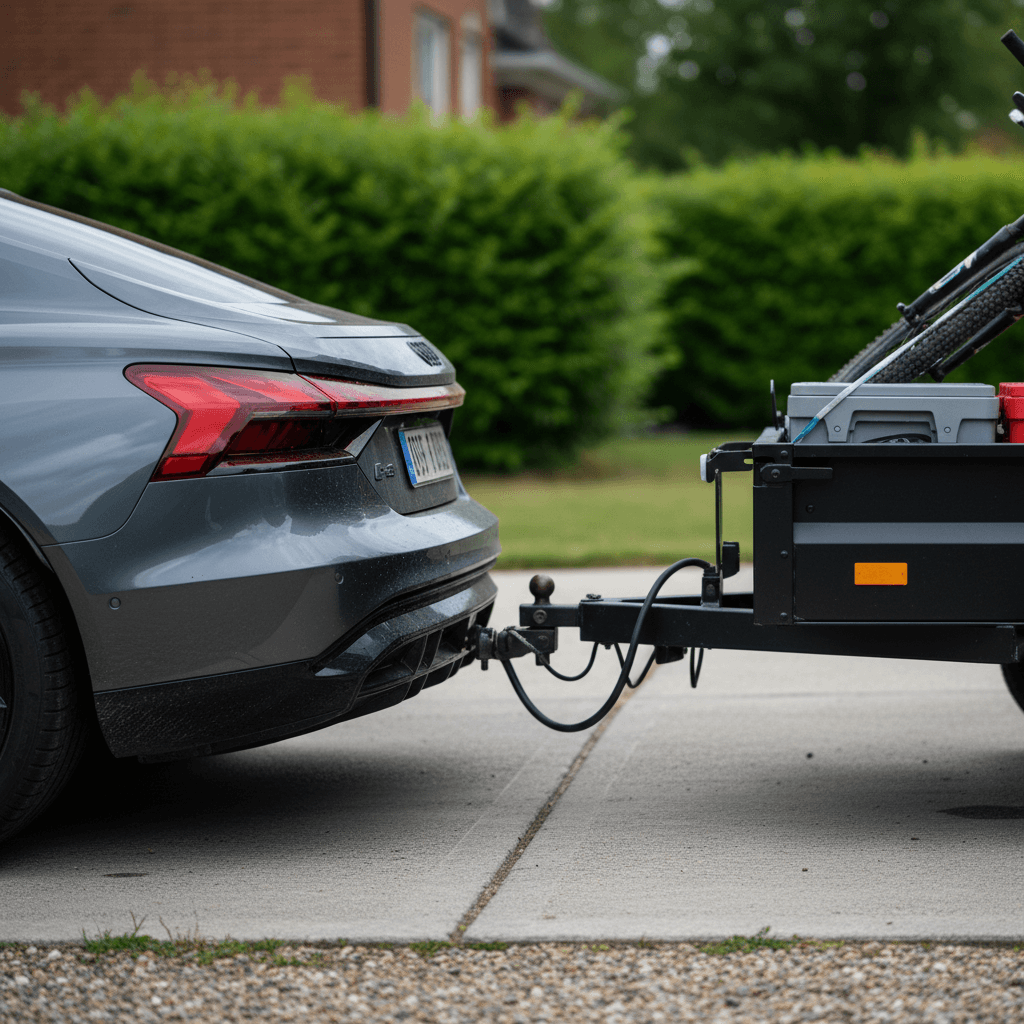
Here’s the first reality check: in many markets, the e-tron GT is sold without an official tow rating. That means Audi hasn’t certified it for towing in those regions, and dealers may not be willing to install or program an OEM hitch. Some owners still add aftermarket hitches for light-duty use, bike racks, very small utility trailers, but that’s technically outside Audi’s intended use in places where no tow rating is published.
In parts of Europe and other markets where towing culture is stronger, model‑year technical guides and independent spec sheets for recent e-tron GT quattro variants show a modest braked towing capacity typically in the few‑hundred‑kilogram range (think small, lightweight trailer, not a full camping caravan). The exact figure depends on market and trim, so you need to check the owner’s manual and local documentation for the specific car you’re looking at.
Important safety note
Audi e-tron GT towing capacity at a glance
Where the e-tron GT fits in the EV towing world
High-level towing picture for Audi e-tron GT
These guidelines summarize how to think about towing with an e-tron GT. Exact capabilities depend on your market, model year, and what Audi lists in the owner’s manual for that specific car.
| Scenario | What it means for you | Suitability for e-tron GT |
|---|---|---|
| No official tow rating (common in U.S.) | Audi does not approve trailer towing for this model in your market. | Treat the car as non‑towing; limit hitch use to bike racks if allowed. |
| Light-duty rating in some markets | Small braked trailer with modest weight limit (often well under 1,500 lbs). | OK for occasional towing of a light, low-profile trailer with careful planning. |
| Heavy camping trailer or boat | High frontal area and weight, especially at highway speed. | Not a good match; range loss and stability become serious concerns. |
| Bike rack or cargo carrier on hitch | Vertical load only, no rolling weight. | Typically fine if tongue-weight limits are respected and sensors are programmed for a hitch. |
Always verify rated towing capacity, tongue weight limits, and hitch requirements in the official documentation for your VIN.
If you’re looking at a used Audi e-tron GT, especially one imported from another region, ask the seller to provide the original owner’s manual and build sheet. If you’re shopping on Recharged, your concierge can help you understand whether a specific car has any approved towing capability and how that fits your needs before you buy.
How towing affects Audi e-tron GT range
Once you attach a trailer, the physics don’t care whether you’re in an Audi e-tron GT, a pickup truck, or a gas crossover. You’re pushing more weight and, in many cases, a much bigger aerodynamic profile through the air. That’s why most EVs lose 40–60% of their solo range when towing in real-world highway use. Recharged’s own towing pieces on electric pickups and SUVs, plus independent testing from fleets and clubs, consistently land in that band for typical loads and speeds.
- Extra weight means the motors need more energy every time you accelerate or climb a hill.
- A tall or boxy trailer destroys the slippery aerodynamics that help the e-tron GT achieve its rated efficiency.
- Higher sustained highway speeds multiply aerodynamic drag, which matters even more when you add a trailer.
- Colder temperatures, headwinds, and heavy cargo inside the car stack additional penalties on top.
Think in percentages, not just miles
Estimating your real-world e-tron GT towing range
The Audi e-tron GT offers an EPA-rated range that varies by trim and wheel choice, but a practical real‑world highway range for a healthy battery is typically 20% or so below the window sticker once you factor in real driving, climate control, and traffic. From there, you layer on towing losses.
Step 1: Find your solo highway range
Start with the car’s EPA rating and trim it to something realistic for highway use.
- Example: EPA rating 249 miles → assume ~200 miles real-world highway range when driving solo.
- If you already own the car, use your own consistent highway trip data instead.
Step 2: Apply a towing factor
For a light, low-profile trailer at moderate speeds, a reasonable planning assumption is a 40–50% range loss. For taller or heavier trailers, use 50–60%.
- Conservative rule of thumb: Multiply your solo range by 0.4–0.6 to estimate your towing range band.
- Plan your route so no leg pushes more than ~70–75% of that towing range.
Worked example for an e-tron GT
Quick checklist for planning an e-tron GT towing trip
1. Confirm your car’s rated towing status
Check the owner’s manual and build data. If your market or VIN shows “0 kg” towing, don’t plan on pulling a trailer, even if aftermarket hitches exist.
2. Establish your solo highway range
Use your own trip data or a conservative estimate below the EPA rating as the baseline for calculations.
3. Choose a realistic towing loss percentage
Use ~40% loss for a very light, low, streamlined trailer at moderate speeds; 50–60% for boxy or heavier setups or faster driving.
4. Map DC fast chargers around 60–80 miles apart
For most e-tron GT towing scenarios, this spacing provides a healthy safety margin, especially in unfamiliar territory.
5. Monitor live efficiency and adjust
Watch your Wh/mi or mi/kWh as soon as you get up to speed. If consumption is worse than planned, shorten your legs and add a backup charger.
What kind of trailer makes sense for an e-tron GT?
Best and worst trailer matches for an Audi e-tron GT
Aerodynamics and weight matter more than you think.
Small utility trailer
A low, open utility trailer carrying lawn equipment, furniture, or household stuff is about as easy as it gets for an EV.
- Low frontal area
- Easy to keep weight modest
- Good candidate for short to medium trips
Bike or kayak trailer
Light gear and toys on a small trailer or hitch rack suit the e-tron GT’s performance character.
- Minimal added weight
- Can still hurt aero, but not like a full camper
- Good use case if your car is actually rated to tow
Tall camping trailer
A boxy travel trailer or large enclosed cargo trailer is a tough match for a sporty sedan.
- Big aero penalty (huge drag)
- High weight versus sedan wheelbase
- Expect very short range and more sway risk
Where to draw the line
Driving and charging strategies to cut range loss
You can’t change physics, but you can stack the deck in your favor. How you drive and charge your Audi e-tron GT makes a noticeable difference in towing efficiency.
- Slow down a notch. Dropping from 75 mph to 65 mph dramatically cuts drag and can claw back a surprising amount of range when towing.
- Use the car’s efficiency data. Watch your Wh/mi in the instrument cluster; if it’s far higher than expected, shorten your legs immediately.
- Precondition the battery before fast charging. Use the navigation to a DC fast charger so the pack is warm and ready to take high power when you arrive.
- Avoid running below ~10–15% state of charge. When towing, leave more buffer than you would when driving solo in case of headwinds, detours, or closures.
- Favor chargers near main corridors. It’s easier to get in and out with a trailer, and you’ll have more backup options if a station is busy or down.
How Recharged can help
Ready to find your next EV?
Browse VehiclesBattery health and warranty considerations
Occasional light towing with an EV, especially within the manufacturer’s published limits, doesn’t automatically doom the battery. Modern packs are designed with significant thermal management and capacity headroom. What towing does do is increase energy throughput and heat, and that contributes to long‑term wear, just like lots of fast highway driving or repeated DC fast charging.
What’s normal
- Gradual capacity loss over years and miles is expected in any EV.
- Occasional towing within rated limits is typically covered by the same warranty assumptions as other heavy use.
- A healthy e-tron GT battery should still deliver solid real-world range after years of mixed driving if it’s charged and stored sensibly.
What to avoid
- Regularly towing beyond any published limits or with no tow rating at all.
- Running the pack very low while towing in hot conditions, then fast charging immediately.
- Ignoring warning messages or abnormal behavior under load, get issues checked promptly.
Warranty fine print
Should you buy an e-tron GT if you plan to tow?
Think of the Audi e-tron GT as a grand-touring EV first and a tow vehicle a distant second. If most of your life is fast commuting, weekend drives, and road trips without a trailer, and a few times a year you’d like to pull a very small, light trailer, then the e-tron GT can work, provided your specific car is rated to tow and you’re comfortable planning conservative charging stops.
On the other hand, if you expect to tow an enclosed trailer or camper multiple times a month, or you want to cover long interstate distances with a trailer at higher speeds, a dedicated EV SUV or pickup with a robust factory tow rating will serve you much better. You’ll still see big range hits when towing, but you’ll start from a configuration designed with that job in mind, longer wheelbase, stronger cooling and brakes, and higher rated capacities.