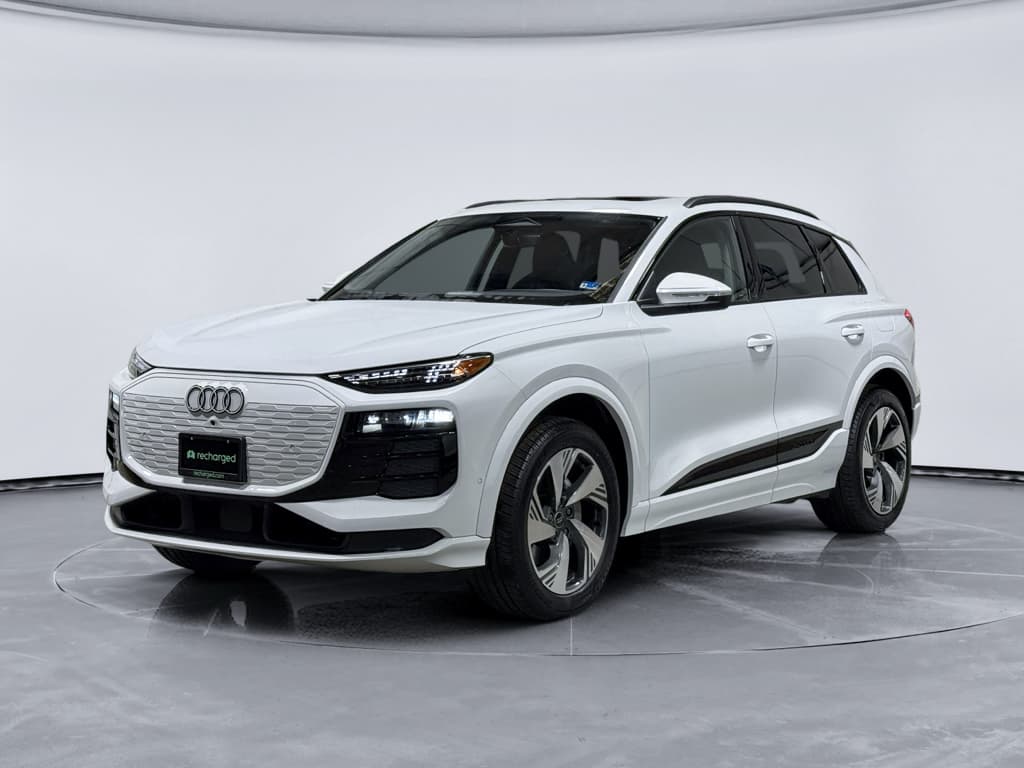
If you’re cross-shopping an Audi A4 against an Audi Q4 e-tron, you’re really asking one question: over the next few years, will a traditional gas luxury sedan or an electric SUV be cheaper to own? This guide walks through the Audi A4 vs Audi Q4 e-tron total cost of ownership (TCO) with real-world energy costs, maintenance expectations, depreciation, and how buying used can tilt the equation in your favor.
What this article covers
Why compare Audi A4 vs Audi Q4 e-tron on total cost?
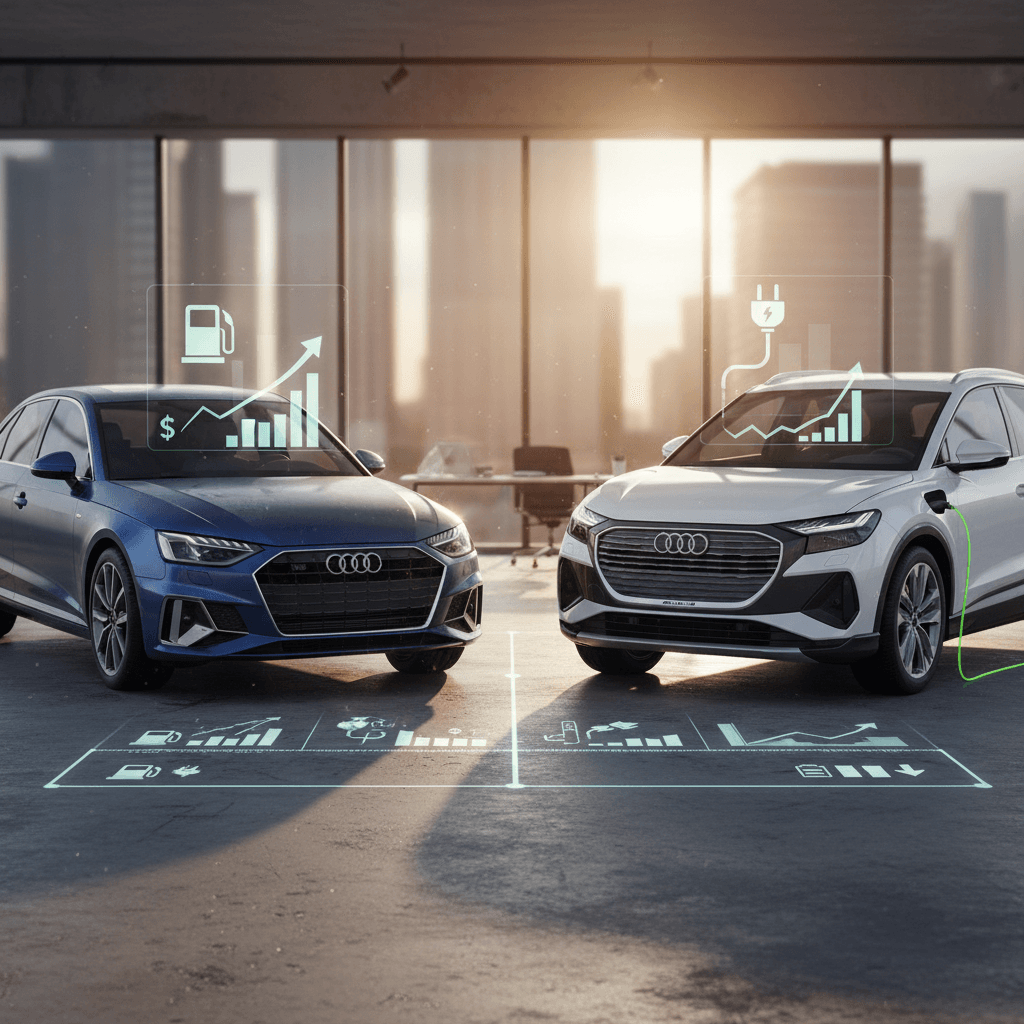
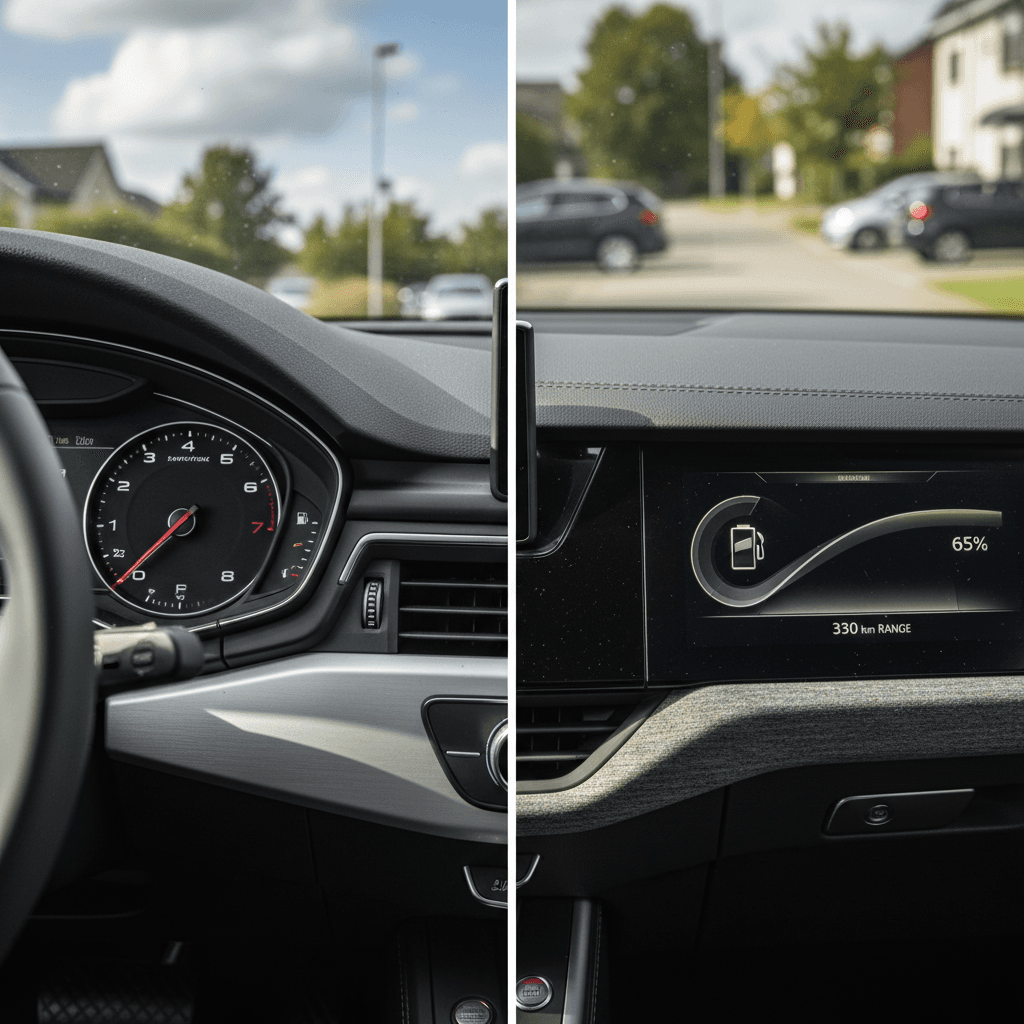
On paper, the Audi A4 and Audi Q4 e-tron don’t look like direct rivals. One is a compact luxury sedan with a gasoline engine; the other is an all-electric compact SUV. But for many shoppers, the choice is exactly this: stick with a familiar, efficient German sedan or jump to a similarly priced electric Audi with more space and radically different running costs. Looking at total cost of ownership instead of just monthly payment can reveal which one is the smarter long-term bet for your driving pattern.
Audi A4 vs Audi Q4 e-tron 5‑year cost snapshot (new, illustrative)
Audi A4 vs Audi Q4 e-tron: quick total cost summary
Illustrative 5‑year total cost of ownership (new, U.S. average)
These are ballpark, educational examples for a typical U.S. driver doing 12,000 miles per year, not personalized quotes. Real numbers will vary by trim, state, driving style, and whether you buy new or used.
| Category (5 yrs) | Audi A4 (gas) | Audi Q4 e-tron (EV) |
|---|---|---|
| Depreciation | $26,000–$32,000 | $27,000–$34,000 |
| Fuel / Electricity | $7,000–$10,000 | $3,000–$4,500 |
| Maintenance & Repairs | $5,500–$7,000 | $3,000–$4,000 |
| Insurance | $4,500–$6,000 | $5,000–$6,500 |
| Taxes, Fees, Finance | $4,000–$6,000 | $4,500–$6,500 |
| 5‑Year TCO (new, before EV incentives) | ~$58,000–$68,000 | ~$56,000–$68,000 |
| Potential EV Incentives | N/A | -$0 to -$7,500 |
| Effective 5‑Year TCO (after incentives) | Same as above | Often a few thousand lower than A4 if you can capture credits |
All numbers are rounded estimates to show directionally how costs compare; use them as a framework, not a final quote.
Treat these as frameworks, not quotes
Assumptions and what “total cost of ownership” really means
When analysts talk about total cost of ownership, they’re bundling every major dollar you’ll spend to own and operate a car over a period of time: depreciation (how much value you lose), fuel or electricity, maintenance, repairs, insurance, taxes and fees, and financing costs. For this article, we’ll use 5 years and 12,000 miles per year as a baseline, because that’s a common ownership window and mileage for U.S. drivers.
- Location: U.S. national averages for gasoline and residential electricity prices in 2024–2025.
- Energy prices: Around $3.25–$3.75 per gallon of gas and roughly $0.16–$0.19 per kWh of home electricity, recognizing that high-cost states can be much more expensive.
- Driving: 12,000 miles per year, mixed city/highway.
- Home charging: Q4 e-tron driver does most charging at home, with some public DC fast charging on road trips.
- Vehicles: Mainstream trims (not the most expensive performance variants) with typical options.
How to adapt these numbers to your life
Purchase price and depreciation: where most of your money goes
For both the Audi A4 and Audi Q4 e-tron, the single largest “cost” you’ll likely face is depreciation, the difference between what you paid and what you can sell or trade the car for later. New luxury vehicles typically lose the most value in the first three years, which is why used buyers often see much better total-cost math than new buyers.
Purchase price and depreciation: A4 vs Q4 e-tron
Both start in similar price territory, but resale and incentives can tilt the scales.
Audi A4 (gas sedan)
The 2024–2025 Audi A4 generally starts in the low‑to‑mid $40,000s when new, with well‑equipped trims moving into the high $40,000s and beyond.
- Strengths: Broad market of used buyers, strong brand recognition, and a long history of A4 resale data.
- Weak spots: Traditional sedans have been losing ground to SUVs, which can soften demand and used values over time.
Audi Q4 e-tron (electric SUV)
The Q4 e-tron is priced similarly or slightly higher than an A4 when new, often landing in the high $40,000s to low $50,000s depending on options and battery configuration.
- Strengths: Compact luxury SUVs are in demand, and EVs can attract tax credits and local incentives that lower your effective purchase price.
- Watchouts: EV values are being reshaped quickly by new models and price cuts; that can mean steeper depreciation in some model years.
Depreciation ranges for planning
Gas vs electricity: Audi A4 fuel costs vs Q4 e-tron charging
Energy is where the Audi Q4 e-tron usually gains its biggest total-cost edge over the A4. You’re trading gasoline for electricity, and over tens of thousands of miles, that difference adds up, especially if you can charge at home most of the time.
Step 1: Understand real-world efficiency
- Audi A4: Many recent A4 trims deliver roughly 28–32 mpg combined in real-world use.
- Audi Q4 e-tron: Typical efficiency falls in the ballpark of 30–35 kWh per 100 miles (about 2.9–3.3 mi/kWh), depending on wheel size, climate, and driving style.
Those aren’t official ratings, but they’re reasonable planning numbers for most drivers.
Step 2: Apply U.S. average energy prices
- Gasoline: Think in the $3.25–$3.75 per gallon range nationally across recent years, knowing your local price could be higher or lower.
- Electricity: Recent national averages place residential power around $0.16–$0.19 per kWh, with higher-cost coastal states well above that and some central states lower.
With those inputs, you can estimate energy cost per mile for each Audi.
Illustrative per‑mile energy cost: Audi A4 vs Audi Q4 e-tron
Example math using mid‑range national prices and typical efficiency. Your numbers will change if you pay notably more or less for gas or electricity.
| Audi A4 (gas) | Audi Q4 e-tron (EV, mostly home charging) | |
|---|---|---|
| Energy use | 30 mpg | 33 kWh / 100 miles |
| Energy price | $3.50 per gallon | $0.18 per kWh |
| Energy cost per mile | ≈ $0.12 | ≈ $0.06 |
| Annual energy cost @ 12,000 miles | ≈ $1,440 | ≈ $720 |
| 5‑year energy cost | ≈ $7,200 | ≈ $3,600 |
Assumes 30 mpg for A4, 33 kWh/100 mi for Q4 e-tron, $3.50/gal gas, and $0.18/kWh electricity.
What if you rely on public fast charging?
Maintenance, repairs, and tires: EV advantage vs German sedan reality
Most owners feel the maintenance difference over time more than they expect. A modern Audi A4 with a turbocharged gas engine has more moving parts, needs regular oil changes, and uses a traditional multi-speed transmission. The Q4 e-tron skips all of that and leans on fewer wear items, though it does add EV‑specific components like the high‑voltage battery and cooling systems.
Where maintenance costs diverge
What you’ll likely spend money on in an Audi A4 vs Audi Q4 e-tron.
Audi A4 maintenance profile
- Regular oil changes, engine air filters, spark plugs, and timing-related service over time.
- Transmission service and possible repairs in higher‑mileage ownership.
- Brake wear: More frequent pad and rotor replacement than in an EV, since there’s no strong regenerative braking to help.
- Typical outcome: Over 5 years, it’s common for a luxury gas sedan like the A4 to accumulate several thousand dollars in maintenance and minor repairs, especially if you follow factory service intervals at a dealer.
Audi Q4 e-tron maintenance profile
- No oil changes or traditional transmission service, the big headline benefit for EVs.
- Regenerative braking often extends brake life, delaying pad and rotor work.
- Tires can wear faster on EVs because of weight and torque, so budgeting for quality tires is smart.
- Battery and high‑voltage system are major components, but outright failures remain rare within warranty for most owners.
Planning numbers for 5‑year maintenance
Insurance, taxes, and fees
Insurance and registration costs don’t swing the Audi A4 vs Audi Q4 e-tron total cost of ownership as dramatically as energy or depreciation, but they still matter. Insurers care about vehicle value, repair complexity, and claim history. EVs can be more expensive to repair in certain types of collisions, and the Q4 e-tron is a relatively new, technology‑heavy model.
Insurance considerations
- Audi A4: Established model with known repair patterns and a wide repair network; premiums tend to reflect its price, performance, and safety tech.
- Audi Q4 e-tron: As an EV SUV with complex electronics and a large battery pack, it can carry slightly higher insurance premiums in some markets, especially for full coverage.
Your driving record, ZIP code, and coverage levels will move the needle more than the model difference for many shoppers.
Taxes, fees, and EV road-use charges
- Both vehicles will incur sales tax and registration fees that scale with purchase price.
- Some states now add extra registration fees for EVs instead of fuel taxes. That can add a few hundred dollars over several years to the Q4 e-tron’s bill.
- Other states partially offset this with local EV incentives or reduced registration fees.
Net effect: these line items usually don’t erase the Q4 e-tron’s energy and maintenance savings, but they do narrow the gap a bit.
Tax credits, incentives, and HOV perks
This is one area where the Audi A4 simply can’t compete: as a gas sedan, it generally doesn’t qualify for modern EV incentives. The Q4 e-tron, depending on model year and where you buy it, may unlock federal tax credits, state rebates, utility incentives, or perks like HOV lane access.
Incentive questions to ask about a Q4 e-tron
1. Is this Q4 e-tron eligible for a federal tax credit?
Eligibility can change by model year, battery sourcing, assembly location, and how you buy (new vs used, lease vs purchase). Ask the seller or your tax professional for up‑to‑date guidance.
2. Are there state or local EV rebates where I live?
Some states, cities, and utilities offer rebates for buying or leasing an EV, installing home charging, or both. These can range from a few hundred to several thousand dollars.
3. Does my utility offer a special EV rate plan?
Time‑of‑use or EV‑specific tariffs can cut your overnight charging costs compared with standard residential rates, improving the Q4 e-tron’s total cost advantage over an A4.
4. Will I get HOV lane or toll benefits?
In some regions, driving an EV unlocks access to carpool lanes or discounted tolls. That doesn’t show up directly as a fuel line item, but it does affect the car’s value to you.
Incentives can flip the script
Used market: how buying pre-owned changes the math
Most shoppers seriously comparing total cost aren’t looking at brand‑new window stickers, they’re looking at 2‑ to 5‑year‑old cars that someone else has already paid the steepest depreciation on. That’s where the Audi A4 vs Audi Q4 e-tron decision gets interesting for used buyers.
Used Audi A4 vs used Audi Q4 e-tron: cost dynamics
Depreciation, battery health, and demand all show up in the used sticker price.
Used Audi A4
- Plenty of supply in most U.S. markets, across trims and years.
- Predictable depreciation: sedans lose value, but the A4 has a large buyer base and a long track record.
- Maintenance risk: As you move past factory warranty, costs for German luxury cars can climb, especially if maintenance has been deferred.
Used Audi Q4 e-tron
- Steeper early depreciation is common in EVs, which can make 2‑ to 3‑year‑old Q4 e-tron models attractive on price.
- Battery health is crucial: range and long‑term value depend heavily on the pack’s condition.
- Lower routine maintenance continues to be a plus, especially if you plan to keep the car well beyond warranty.
The big used-EV question: battery health
This is exactly where platforms focused on used EVs can de‑risk the purchase. Recharged, for example, provides a Recharged Score Report with verified battery health and pricing data on every used EV it sells. That gives you visibility into the very thing traditional used‑car inspections tend to miss.
How Recharged helps if you’re leaning toward the Q4 e-tron (or any used EV)
If the Audi Q4 e-tron’s lower running costs and incentives appeal to you, the next hurdle is buying the right used EV with confidence. That’s precisely the gap Recharged is built to close.
Making used EV ownership simpler and more transparent
What you get when you shop for a used EV like a Q4 e-tron through Recharged.
Recharged Score battery diagnostics
Fair market pricing & financing
Nationwide delivery & EV‑savvy support
Who should choose which car? Decision guide
Audi A4 vs Audi Q4 e-tron: best fit by driver type
You might prefer an Audi A4 if…
You drive <strong>relatively low annual miles</strong> and don’t stand to save as much on fuel by switching to an EV.
You live in an area with <strong>limited home charging options</strong> (no driveway, tricky landlord, or unreliable access to Level 2 charging).
You prefer the <strong>driving feel and packaging of a sedan</strong>, lower seating position, tighter footprint, and a familiar fuel stop routine.
Local EV incentives in your area are modest, and gas prices are relatively low, reducing the Q4 e-tron’s financial edge.
You plan to own the car for a shorter period (2–3 years) where depreciation dominates more than fuel costs.
You might prefer an Audi Q4 e-tron if…
You can install or already have <strong>home charging</strong>, and your local kWh rate is reasonable, this is where the big energy savings live.
You drive <strong>12,000+ miles per year</strong> and keep vehicles for several years, allowing lower running costs to compound.
You value a <strong>higher driving position and SUV practicality</strong> but still want a compact footprint for city use.
Your state, utility, or employer offers <strong>meaningful EV incentives, rebates, or low off‑peak charging rates</strong>.
You’re comfortable with tech and like the idea of <strong>owning something aligned with future regulations and emissions standards</strong>.
Think in 5‑year blocks
FAQ: Audi A4 vs Audi Q4 e-tron ownership costs
Frequently asked questions about Audi A4 vs Audi Q4 e-tron TCO
Bottom line: which Audi is cheaper to own?
If you have reliable home charging and pay a reasonable residential electricity rate, the Audi Q4 e-tron is often the lower total-cost choice over 5 years, despite its higher sticker price. Lower energy and maintenance bills, plus potential incentives, tend to outweigh the A4’s simpler purchase story. If you can’t easily charge at home, drive relatively few miles, or live somewhere with very high electricity costs and low gas prices, a well‑bought Audi A4 may still make more sense on total cost.
Either way, the winning move is to treat total cost of ownership as more than just a monthly payment. Run the numbers on energy, maintenance, depreciation, and incentives for your ZIP code, and if you’re leaning toward an EV like the Q4 e-tron, consider a used example with verified battery health and transparent pricing from a specialist like Recharged. That’s where the EV story stops being a gamble and starts looking like a smart piece of financial planning.