If you’re cross-shopping a 35 mpg hybrid vs an electric car, you’re probably asking one big question: “How much will I actually spend each year to keep it moving?” The answer depends on gas prices, electricity rates, and how far you drive, but we can put real numbers to it so you’re not guessing.
What This Guide Covers
Why a 35 MPG Hybrid vs Electric Car Comparison Matters
For years, the decision was simple: hybrids were the “efficient” choice, EVs were the “future” choice. But now many hybrids get around 35 miles per gallon or better, and used EV prices have become much more approachable. That means the old rule of thumb, that electric always wins on operating cost, isn’t automatically true for every driver.
If you drive modest miles each year or live where electricity is pricey, a 35 mpg hybrid can come surprisingly close to an EV’s annual energy cost. On the other hand, if you rack up highway miles or can charge cheaply at home, an electric car’s cost per mile is tough to beat.
Fast Facts: Hybrid vs EV Cost Per Mile (Typical U.S. Assumptions)
Key Assumptions for a Fair Cost Comparison
To compare a 35 mpg hybrid vs an electric car on annual fuel cost, we need a level playing field. You can always swap in your own numbers later, but here are the baseline assumptions we’ll use for our examples:
- Annual miles: 12,000 miles (roughly the U.S. average for many drivers)
- Hybrid fuel economy: 35 miles per gallon (combined city/highway)
- Gas price: $3.75 per gallon (you may pay more or less locally)
- EV efficiency: 3.0–3.5 miles per kWh (compact to midsize EV driven normally)
- Electricity price at home: 15¢ per kWh (blending peak and off-peak rates)
- Charging behavior: Primarily home charging, with occasional public charging
Your Prices May Vary
Quick Answer: Annual Fuel Cost for a 35 MPG Hybrid vs EV
Using the assumptions above, here’s the headline comparison for 12,000 miles per year:
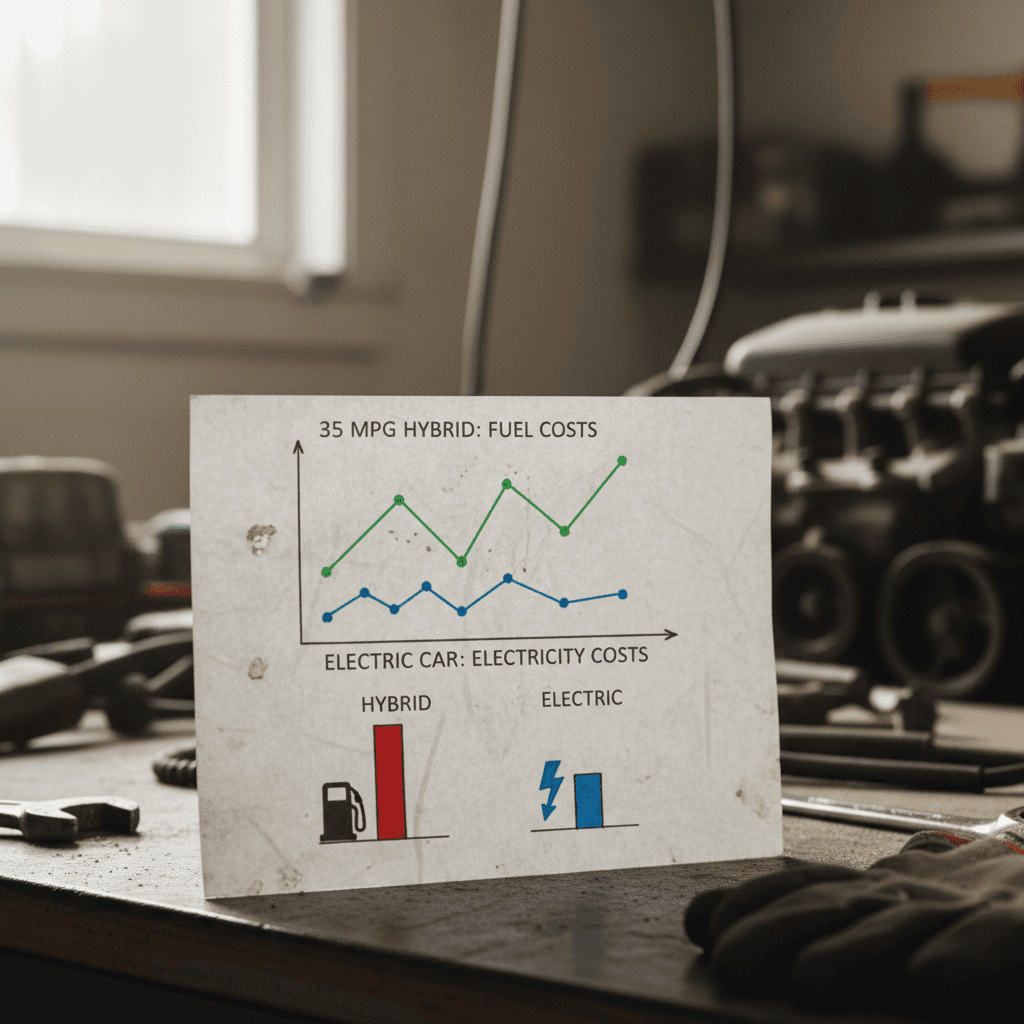
Typical Annual Energy Cost: 35 MPG Hybrid vs Electric Car
Based on 12,000 miles per year, $3.75/gal gas, 15¢/kWh electricity, and 3.5 mi/kWh EV efficiency.
| Vehicle type / assumptions | Energy used per year | Annual fuel or electricity cost | Approx. cost per mile |
|---|---|---|---|
| 35 mpg hybrid, $3.75/gal | 12,000 ÷ 35 = 343 gal | 343 × $3.75 ≈ $1,285 | ≈ 10.7¢/mi |
| EV at 3.5 mi/kWh, 15¢/kWh | 12,000 ÷ 3.5 ≈ 3,430 kWh | 3,430 × $0.15 ≈ $515 | ≈ 4.3¢/mi |
| EV at 3.0 mi/kWh, 15¢/kWh | 12,000 ÷ 3.0 = 4,000 kWh | 4,000 × $0.15 = $600 | = 5.0¢/mi |
These are illustrative averages. Your actual costs will depend on local fuel and electricity prices and your specific vehicle.
Quick Takeaway
Step-by-Step Math: How We Calculate Fuel and Electricity Costs
If you only take one thing from this guide, let it be the formulas. Once you know the basic math, you can answer the 35 mpg hybrid vs electric car annual fuel cost question for any set of assumptions.
1. Annual Fuel Cost for a 35 MPG Hybrid
The core idea is simple: find out how many gallons you’ll burn each year, then multiply by the price of gas.
- Gallons per year = Annual miles ÷ MPG
- Annual fuel cost = Gallons per year × Gas price per gallon
Example (12,000 miles, 35 mpg, $3.75/gal):
- 12,000 ÷ 35 ≈ 343 gallons
- 343 × $3.75 ≈ $1,285 per year
2. Annual Electricity Cost for an EV
Instead of gallons and mpg, you deal with kilowatt-hours (kWh) and miles per kWh.
- kWh per year = Annual miles ÷ Miles per kWh
- Annual electricity cost = kWh per year × Electricity price per kWh
Example (12,000 miles, 3.5 mi/kWh, 15¢/kWh):
- 12,000 ÷ 3.5 ≈ 3,430 kWh
- 3,430 × $0.15 ≈ $515 per year
Shortcut: Cost Per Mile
How Driving Habits Change the Annual Cost
Not everyone drives 12,000 miles per year. Maybe your commute is short, or maybe you live on the highway. The more you drive, the more an EV’s lower per‑mile cost matters, and the faster it can offset a higher purchase price.
Mileage Scenarios: 35 MPG Hybrid vs EV
Three common annual mileages to illustrate how the gap scales.
Light driving: 8,000 mi/yr
35 mpg hybrid
- 8,000 ÷ 35 ≈ 229 gal
- 229 × $3.75 ≈ $860/yr
EV (3.5 mi/kWh, 15¢/kWh)
- 8,000 ÷ 3.5 ≈ 2,285 kWh
- 2,285 × $0.15 ≈ $340/yr
EV advantage: about $520/year
Average driving: 12,000 mi/yr
35 mpg hybrid
- ≈ 343 gal × $3.75 ≈ $1,285/yr
EV
- ≈ 3,430 kWh × $0.15 ≈ $515/yr
EV advantage: about $770/year
Heavy driving: 18,000 mi/yr
35 mpg hybrid
- 18,000 ÷ 35 ≈ 514 gal
- 514 × $3.75 ≈ $1,928/yr
EV
- 18,000 ÷ 3.5 ≈ 5,140 kWh
- 5,140 × $0.15 ≈ $770/yr
EV advantage: about $1,150/year
When a 35 MPG Hybrid Makes Sense
Beyond Fuel: Maintenance and Depreciation Differences
Fuel or electricity may be the biggest line item you see month‑to‑month, but they’re not the only costs that separate a 35 mpg hybrid and an electric car. To understand the full picture, you should factor in maintenance, repairs, and how each vehicle holds its value.
Key Ownership Cost Differences (Hybrid vs EV)
1. Maintenance: Fewer moving parts in EVs
An electric car has no engine oil, spark plugs, or multi‑speed transmission. Over time, many owners spend less on routine maintenance compared with a hybrid, which still has a full gasoline powertrain plus electric components.
2. Brakes: Regenerative braking helps EVs
Both hybrids and EVs use regenerative braking, but EVs often lean on it even more. That can mean longer brake pad life versus a conventional vehicle, and sometimes longer than some hybrids, depending on how they’re tuned and driven.
3. Engine-related repairs
A 35 mpg hybrid still has an engine, fuel system, exhaust, and emissions components. Over 8–12 years, items like water pumps, head gaskets, and catalytic converters can need attention. EVs avoid those systems entirely.
4. Tires and wear items
EVs are heavier and have strong instant torque, so they can wear tires faster if driven aggressively. Hybrids are usually lighter. Budget a bit extra for tires with an EV, especially if you choose a performance‑oriented model.
5. Depreciation and battery health
Historically, hybrids held value well. EV depreciation has been more volatile, heavily influenced by incentives, tech changes, and brand perception. That’s why understanding <strong>battery health</strong> on a used EV is critical.
6. Incentives and perks
Depending on when and where you buy, EVs may qualify for federal, state, or utility incentives, plus perks like HOV lane access or reduced registration fees. Hybrids sometimes qualify for smaller incentives, if any.
Don’t Ignore Battery Health
Used EVs vs New Hybrids: Where Recharged Fits In
Here’s where the 35 mpg hybrid vs electric car conversation gets interesting. Many shoppers compare a brand‑new hybrid at a traditional dealer to a lightly used EV with similar monthly payments. Because EVs often depreciate faster on the front end, a 2–4‑year‑old electric car can be priced competitively with new hybrids, sometimes lower.
At Recharged, every used EV comes with a Recharged Score Report that includes verified battery health and fair‑market pricing. That helps you understand not just how much you’ll save on energy each year, but also how much useful life the pack likely has left. We also offer financing, trade‑ins, consignment, and nationwide delivery, so you can do the entire transaction digitally and focus on the math that matters to you.
Pros and Cons: 35 MPG Hybrid vs Electric Car
Hybrid vs EV: Where Each One Shines
Use this side‑by‑side view to match the powertrain to your lifestyle.
35 MPG Hybrid – Advantages
- Great fuel economy without changing your fueling habits
- Fast refueling on road trips, just use any gas station
- Less range planning compared with many current EVs
- Good fit if home charging is difficult or impossible
- Often lower upfront price than a comparable new EV
Electric Car – Advantages
- Much lower energy cost per mile in most regions
- No gas stops if you can charge at home or work
- Quieter, smoother driving and strong low‑speed acceleration
- Fewer engine‑related maintenance items over time
- Potential incentives, HOV access, and lower local fees
35 MPG Hybrid – Tradeoffs
- Still exposed to gas price volatility
- More moving parts than an EV, with potential long‑term repairs
- Best efficiency often in city driving, less impressive at high speeds
- Some models use complex transmissions that can be costly if they fail
Electric Car – Tradeoffs
- Requires reliable access to charging, ideally at home
- Road‑trip charging takes longer and requires more planning
- Range can drop in very cold or very hot weather
- Battery health is a key consideration on older used EVs
How to Run Your Own 35 MPG Hybrid vs EV Calculation
National averages are useful, but your decision should be based on your commute, your gas station prices, and your electric bill. Here’s a simple process you can follow in about 10 minutes.
DIY: Compare a 35 MPG Hybrid vs Electric Car for Your Situation
1. Gather your current annual mileage
Look at your last two inspection reports, oil‑change records, or connected‑car app. If that’s not available, estimate using your daily commute and typical weekend driving over a year.
2. Find a realistic hybrid MPG
Use the combined EPA rating for the hybrid you’re considering, but if most of your driving is at 75 mph on the highway, be conservative. Many drivers of 35 mpg‑rated hybrids see high‑20s to low‑30s at fast highway speeds.
3. Note your local gas price
Use the price you actually pay at your normal station, not the cheapest number you saw once across town. If prices are volatile, average the last few weeks.
4. Check your electricity rate
Look at your electric bill for the “all‑in” rate including delivery and fees. That final cents‑per‑kWh number is what matters. If your utility offers EV off‑peak rates, write those down too.
5. Estimate EV efficiency
Find the EPA combined efficiency (mi/kWh) for the EV(s) you’re considering. Adjust down slightly if you drive aggressively, live in extreme climates, or plan to do a lot of high‑speed highway miles.
6. Plug everything into the formulas
Use the formulas from earlier: Miles ÷ MPG × gas price for the hybrid; Miles ÷ mi/kWh × ¢/kWh for the EV. Compare annual totals and decide how much the EV’s savings matter to your budget.
Let the Savings Work for You
FAQ: Hybrid vs EV Annual Fuel Cost
Frequently Asked Questions About 35 MPG Hybrids vs EVs
Bottom Line: Which One Saves You More?
When you run the numbers, the pattern is clear: in most scenarios, an electric car has a lower annual energy cost than a 35 mpg hybrid, often by hundreds of dollars per year. The more you drive, and the cheaper your home electricity, the bigger that advantage becomes.
A 35 mpg hybrid can still be the right answer if you can’t easily charge at home, you live in a region with very high electricity rates, or you simply value the convenience of five‑minute gas stops on frequent road trips. But if you have regular access to home charging and plan to put serious miles on your next vehicle, an EV’s lower cost per mile is hard to ignore.
If you’re considering shifting from a gas or hybrid vehicle into a used EV, a marketplace like Recharged can help you compare total cost of ownership, understand battery health through our Recharged Score Report, and line up financing, trade‑in, and delivery from the comfort of your couch. That way, you’re not just buying what looks good on the lot, you’re buying what makes sense on your spreadsheet.