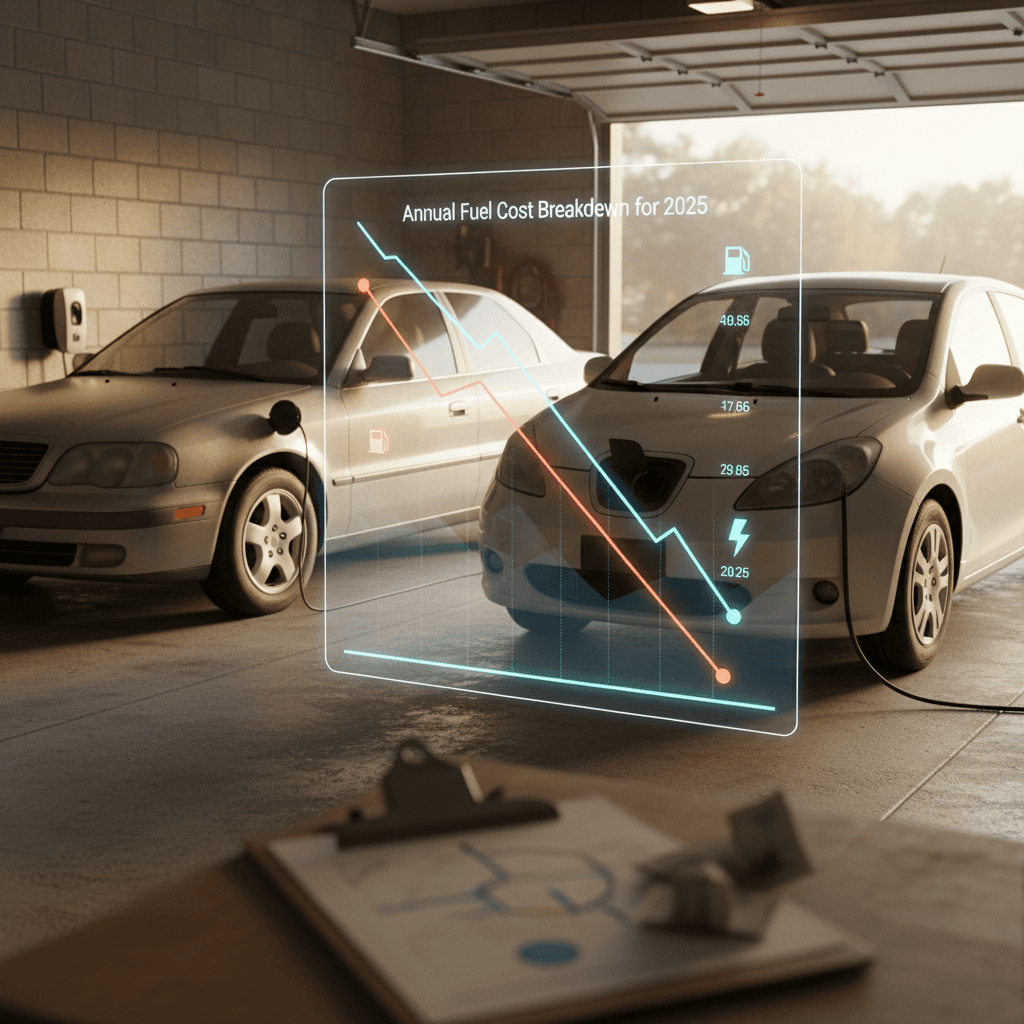
You don’t buy a car just to admire it in the driveway, you buy it to drive. That’s why the question of a 30 mpg car vs used EV annual fuel cost matters so much. If you’re driving a reasonably efficient gas car today, will a used electric vehicle actually save you real money once you factor in gas, electricity, and how much you drive?
Quick answer
Why compare a 30 mpg car vs a used EV?
Plenty of comparisons pit a thirsty SUV against a brand-new EV and pronounce the EV the runaway winner. But many shoppers are more realistic. You might already drive a compact or midsize car that gets around 30 miles per gallon, and you’re wondering if a used EV is enough of an upgrade to justify the switch.
- 30 mpg is a fair benchmark for many late-model compact and midsize gas cars.
- Used EVs have already taken their biggest depreciation hit, so fuel savings matter more to the total picture.
- Electricity and gasoline prices move around, so you want a framework, not just a one-time snapshot.
In this guide, we’ll walk through the math step by step, compare realistic driving scenarios, and then zoom out to look at total ownership costs. Along the way, we’ll also show where a trusted partner like Recharged can simplify the switch to a used EV.
Key assumptions for a fair fuel-cost comparison
To compare a 30 mpg car vs a used EV on annual fuel cost, we need some ground rules. You can plug in your own numbers later, but here are reasonable 2025-style assumptions for a U.S. driver:
Core assumptions used in this guide
You can swap these numbers for your own situation, but this keeps the examples realistic.
Gasoline assumptions
- Gas price: $3.50 per gallon (national average ballpark)
- Gas car efficiency: 30 mpg combined
- Annual miles: 10,000–20,000 (we’ll test a few cases)
Electricity assumptions
- Home electricity: about $0.15/kWh
- Public fast charging: about $0.35–$0.45/kWh (we’ll use $0.40)
- Used EV efficiency: ~3.0–3.5 miles/kWh; we’ll use 3.4 mi/kWh as a realistic average for a 2–5‑year‑old EV.
Your rates may differ
Step‑by‑step math: 30 mpg gas car annual fuel cost
Let’s start with the gasoline side. For a 30 mpg car, annual fuel cost is determined by how many gallons you burn, multiplied by price per gallon.
30 mpg gas car: annual fuel cost at $3.50/gal
Simple math you can adjust using your own mileage and local gas price.
| Annual miles driven | Gallons used (miles ÷ 30 mpg) | Annual fuel cost at $3.50/gal |
|---|---|---|
| 10,000 miles | 333 gallons | $1,165 |
| 12,000 miles | 400 gallons | $1,400 |
| 15,000 miles | 500 gallons | $1,750 |
| 20,000 miles | 667 gallons | $2,335 |
Even a relatively efficient 30 mpg car racks up significant fuel bills when you’re driving 12,000–20,000 miles a year.
How to quickly estimate your own cost
Step‑by‑step math: used EV annual charging cost
Now let’s run the same mileage through a used EV. We’ll assume a car that averages about 3.4 miles per kWh in mixed driving. Your real‑world number might be slightly higher or lower depending on weather, driving style, and the specific EV.
1. All or mostly home charging
If you can charge at home most of the time, your EV’s “fuel” cost is essentially:
Annual kWh used × Home electricity rate
To get annual kWh used:
- Annual miles ÷ miles per kWh = kWh
Example at 15,000 miles/year and 3.4 mi/kWh:
- 15,000 ÷ 3.4 ≈ 4,410 kWh/year
- At $0.15/kWh, that’s about $660 per year
2. Mix of home and public fast charging
Many used‑EV owners do 70–90% of their charging at home and the rest at public stations, especially on road trips.
Example mix (15,000 miles/year):
- 80% home (12,000 miles) at $0.15/kWh
- 20% fast charge (3,000 miles) at $0.40/kWh
Home share: 12,000 ÷ 3.4 ≈ 3,530 kWh × $0.15 ≈ $530
Public DC share: 3,000 ÷ 3.4 ≈ 880 kWh × $0.40 ≈ $350
Total: about $880 per year
Typical annual “fuel” cost: 30 mpg car vs used EV

Side-by-side cost table for common driving scenarios
To make this more tangible, here’s how the annual fuel cost shakes out for several typical driving patterns. Again, these numbers assume a 30 mpg gas car, a used EV at 3.4 mi/kWh, gas at $3.50/gal, home electricity at $0.15/kWh, and public DC fast charging at $0.40/kWh.
Annual fuel cost: 30 mpg gas vs used EV
Approximate annual energy cost for different mileage and charging patterns.
| Driving pattern | Annual miles | 30 mpg gas car | Used EV (mostly home) | Used EV (20% fast charge) |
|---|---|---|---|---|
| Light commuter | 8,000 | ~$935 | ~$350 | ~$470 |
| Average driver | 12,000 | ~$1,400 | ~$530 | ~$700 |
| Heavy commuter | 15,000 | ~$1,750 | ~$660 | ~$880 |
| Road‑warrior | 20,000 | ~$2,335 | ~$880 | ~$1,175 |
Even for lower-mileage drivers, a used EV usually wins on fuel cost, though the payback period depends on your purchase price and incentives.
Rule of thumb
Beyond fuel: maintenance and other running costs
Fuel is only part of what you spend to keep a car on the road. When you compare a 30 mpg gas car vs a used EV, you should also consider maintenance, repairs, and consumables.
Typical running-cost differences: gas vs used EV
Your exact numbers will vary, but the pattern is consistent.
30 mpg gasoline car
- Regular oil changes and filters
- More complex engine and transmission maintenance
- Exhaust system, belts, spark plugs over time
- Brake service (pads/rotors) more often because the car uses friction brakes all the time
Over several years, these items can add up to hundreds of dollars per year on average.
Used EV
- No engine oil or spark plugs
- Far fewer moving parts in the drivetrain
- Brake pads often last much longer thanks to regenerative braking
- Still need tires, cabin filters, wiper blades, just like any car
On average, many EV owners spend meaningfully less on routine maintenance and repairs than owners of similar-age gas cars.
The big EV wild card: battery health
How your driving patterns change the winner
The answer to “Is a used EV cheaper than my 30 mpg car?” isn’t one‑size‑fits‑all. Your driving patterns and energy prices can sway the math.
Questions that tilt the economics one way or the other
1. How many miles do you drive each year?
The more you drive, the more a used EV’s lower cost per mile helps you. At 20,000 miles per year, fuel savings alone can be enormous compared with a 30 mpg gas car.
2. Can you reliably charge at home?
Home charging at typical residential rates is almost always cheaper than gas. If you rely heavily on expensive public fast charging, the savings shrink, but often don’t disappear entirely.
3. What are your local gas and electricity prices?
In regions with high gas and relatively low electricity prices, EV economics look fantastic. In rare cases where electricity is very expensive and gas is cheap, the gap narrows.
4. How long do you plan to keep the car?
If you keep a used EV for several years, the combination of lower fuel and maintenance can more than offset a slightly higher purchase price, especially if you stack available incentives.
5. Do you take frequent road trips?
Lots of long‑distance driving usually means more DC fast charging. That adds cost, but it also means more miles where the EV’s lower per‑mile energy cost has time to compound.
Use your own numbers
What about battery health on a used EV?
Battery health doesn’t change the price of electricity, but it does affect how much range you get per kWh and how long the car stays practical for your needs. That makes it a crucial part of the value equation when considering a used EV vs keeping your 30 mpg car.
How degradation affects real-world costs
- A modestly degraded battery (say, 90% of original capacity) might reduce your range somewhat but doesn’t radically change your cost per mile.
- Severe degradation could mean more frequent charging stops or eventually a costly battery replacement, both of which eat into savings.
The challenge for most shoppers is seeing that battery health clearly before they sign on the dotted line.
How Recharged tackles the battery question
Every vehicle sold through Recharged includes a Recharged Score Report that measures and verifies battery health, along with:
- Objective battery diagnostics, not just a dash gauge
- Context on how that health compares to similar EVs
- Projected impact on range and long‑term usability
That clarity helps you weigh real fuel and maintenance savings against the condition of the car you’re actually buying.
How Recharged helps you run the numbers with confidence
On paper, comparing a 30 mpg car vs a used EV on annual fuel cost seems straightforward. In real life, it’s tangled up with battery health, financing, and finding the right car in the first place. That’s where a purpose‑built used‑EV marketplace can make life easier.
Turn math on a page into a confident purchase
How Recharged supports you from first question to final delivery.
Transparent battery & value data
Financing that fits the savings
Digital buying, real support
From spreadsheet to driveway
Ready to find your next EV?
Browse VehiclesFAQ: 30 mpg car vs used EV fuel costs
Common questions about gas vs used EV costs
Bottom line: should you switch from 30 mpg to a used EV?
When you break it down, a used EV doesn’t just nibble at the fuel bill, it often cuts it in half compared with a 30 mpg gasoline car, especially if you can charge at home and drive at least 10,000–12,000 miles a year. Layer on lower routine maintenance and potential incentives, and the total cost picture tilts even further toward electric.
That said, the right answer for you depends on your miles, your energy prices, and the specific used EV you’re considering, especially its battery health. A transparent marketplace like Recharged, with verified battery diagnostics, fair‑market pricing, financing, and end‑to‑end guidance, can help you turn all this math into a clear decision and a car you’ll be happy to live with every day.