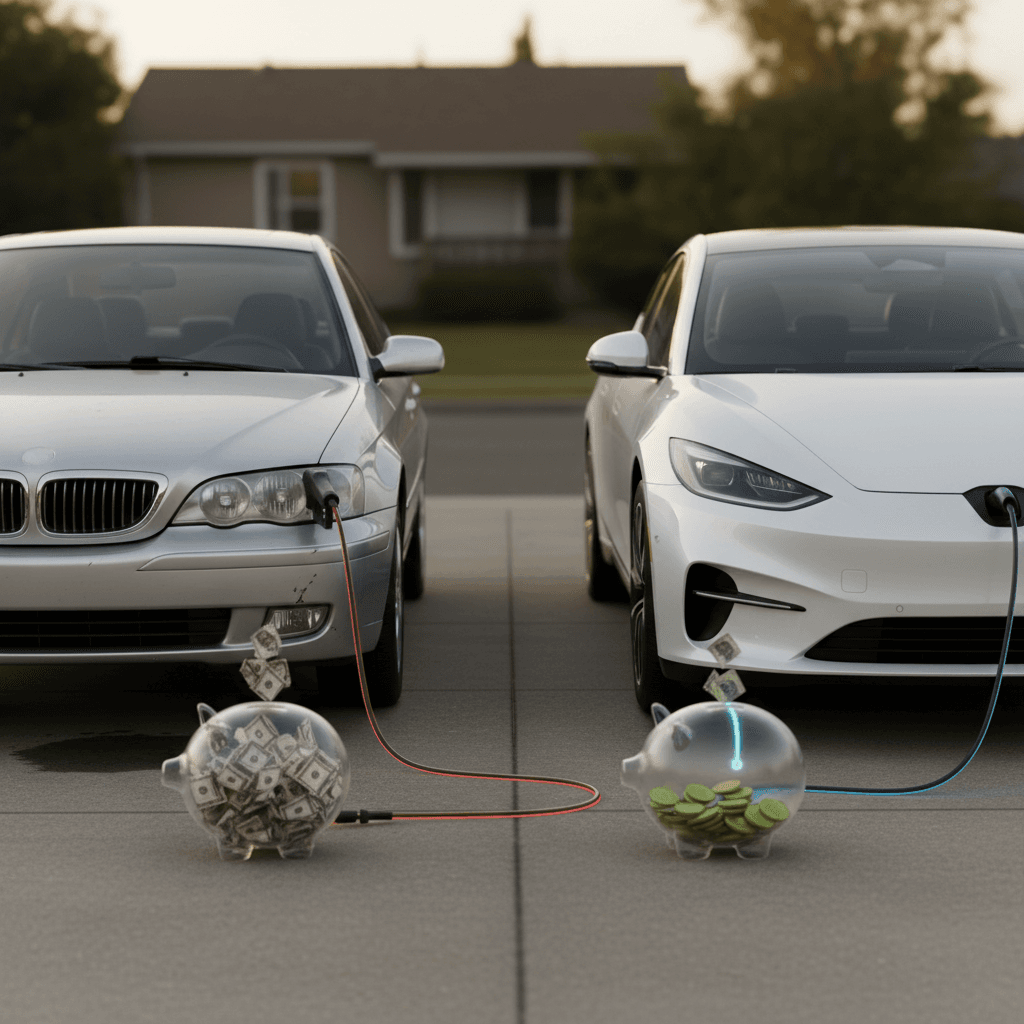
If you’re driving a 25 mpg gas sedan, you’ve probably wondered how its annual fuel cost stacks up against an electric car. With gas prices bouncing around and electricity rates creeping up, the savings aren’t as simple as “EVs are always cheaper”, but the gap is still real in most situations. Let’s run the numbers step by step so you can see what switching (or not switching) would actually do to your yearly budget.
Key takeaway in one sentence
How much does a 25 MPG sedan cost to fuel each year?
We’ll start with the gas car, because those numbers are familiar and easy to visualize. The two inputs that matter most are how many miles you drive and what you pay per gallon.
- Assumed fuel economy: 25 miles per gallon (typical for many non-hybrid sedans)
- Annual mileage scenarios: 10,000 / 12,000 / 15,000 / 20,000 miles
- Gas price scenarios: $3.00 / $3.50 / $4.00 per gallon
Annual gasoline cost for a 25 MPG sedan
Estimated yearly fuel spend at different mileages and pump prices for a 25 mpg car.
| Annual miles | Gallons used (25 mpg) | At $3.00/gal | At $3.50/gal | At $4.00/gal |
|---|---|---|---|---|
| 10,000 | 400 | $1,200 | $1,400 | $1,600 |
| 12,000 | 480 | $1,440 | $1,680 | $1,920 |
| 15,000 | 600 | $1,800 | $2,100 | $2,400 |
| 20,000 | 800 | $2,400 | $2,800 | $3,200 |
These are pure fuel-cost calculations and don’t include maintenance, insurance, or other ownership expenses.
Why your real number may be higher
How much does an electric car cost to charge each year?
For an electric car, you swap gallons and mpg for kilowatt-hours (kWh) and efficiency in miles per kWh. Most modern EV sedans land around 3.0–3.8 miles per kWh in mixed driving. To keep the math clean, we’ll use two efficiency points:
- Conservative: 3.0 mi/kWh (larger or less efficient EVs, more highway, colder climates)
- Typical: 3.5 mi/kWh (many compact and midsize EVs in mixed use)
Electricity cost is the other half of the equation. What you pay per kWh varies widely by state and by whether you’re at home, work, or a DC fast charger. For this comparison, we’ll look at home charging rates that many U.S. drivers see on their bills:
- $0.13/kWh (low-cost markets or off‑peak rates)
- $0.16/kWh (close to recent U.S. residential averages)
- $0.20/kWh (higher-cost markets or time‑of‑use daytime rates)
Annual home-charging cost for an electric car
Estimated yearly electricity cost at different mileages, efficiencies, and home electricity rates.
| Annual miles | Efficiency | kWh used (incl. losses) | At $0.13/kWh | At $0.16/kWh | At $0.20/kWh |
|---|---|---|---|---|---|
| 10,000 | 3.0 mi/kWh | ~3,700 | $480 | $590 | $740 |
| 10,000 | 3.5 mi/kWh | ~3,200 | $420 | $510 | $640 |
| 12,000 | 3.0 mi/kWh | ~4,400 | $570 | $700 | $880 |
| 12,000 | 3.5 mi/kWh | ~3,800 | $490 | $610 | $760 |
| 15,000 | 3.0 mi/kWh | ~5,500 | $715 | $880 | $1,100 |
| 15,000 | 3.5 mi/kWh | ~4,800 | $625 | $770 | $960 |
| 20,000 | 3.0 mi/kWh | ~7,400 | $960 | $1,185 | $1,480 |
| 20,000 | 3.5 mi/kWh | ~6,400 | $830 | $1,025 | $1,280 |
Assumes primarily home Level 2 charging with modest charging losses (about 10%).
Watch your effective rate, not just your bill

Real-world examples: 25 MPG sedan vs EV annual fuel cost
Let’s put those tables into plain language. Here are three common driving patterns and what they look like for a 25 mpg gas sedan versus an electric car, using reasonable mid‑range assumptions.
Three common annual driving scenarios
Each example assumes mostly home charging and realistic efficiency, not perfect lab numbers.
Urban commuter: 10,000 miles/year
Gas sedan (25 mpg, $3.50/gal)
- Gallons: ~400
- Annual fuel: about $1,400
EV (3.5 mi/kWh, $0.16/kWh)
- kWh (incl. losses): ~3,200
- Annual charging: about $510
Difference: EV saves roughly $900 per year on fuel.
Typical driver: 12,000 miles/year
Gas sedan (25 mpg, $3.50/gal)
- Gallons: ~480
- Annual fuel: about $1,680
EV (3.3 mi/kWh, $0.16/kWh)
- kWh (incl. losses): ~3,900
- Annual charging: roughly $625
Difference: EV saves about $1,050 per year.
High-mileage commuter: 20,000 miles/year
Gas sedan (25 mpg, $3.50/gal)
- Gallons: ~800
- Annual fuel: about $2,800
EV (3.0–3.2 mi/kWh, $0.16/kWh)
- kWh (incl. losses): ~6,400–6,900
- Annual charging: $1,025–$1,105
Difference: EV saves roughly $1,700–$1,800 per year.
Quick rule of thumb
Other fuel-cost factors that shift the math
So far we’ve assumed mostly home charging and national‑average prices. In real life, a few variables can push your annual cost up or down on both the gas and electric sides.
When the gas sedan gets more expensive
- Higher pump prices: At $4.00/gal, our 15,000‑mile 25 mpg sedan jumps to $2,400 per year in fuel.
- Lower real‑world mpg: If your commute is mostly stop‑and‑go, that 25 mpg car might actually be closer to 20–22 mpg.
- Lots of idling and short trips: Cold starts and idling burn fuel without adding miles, effectively raising cost per mile.
When the EV’s advantage shrinks
- Expensive electricity: If you’re stuck paying $0.25–$0.30/kWh at home, your per‑mile cost rises quickly.
- Heavy DC fast charging: Relying on public fast chargers at highway‑style rates can put your cost per mile close to, or even above, gasoline, at least for that portion of your driving.
- Inefficient driving or harsh weather: High speeds, extreme cold, and rooftop cargo can drag an EV under 3.0 mi/kWh.
The public fast-charging trap
When does an EV make financial sense?
Fuel is only one piece of total cost of ownership, but it’s a big one, especially if you cover a lot of miles. To decide whether an EV pencils out for you, think in terms of payback period: how long it takes fuel savings to offset any higher purchase price.
How fuel savings translate into payback
Signs an EV is likely to beat your 25 MPG sedan on total cost
1. You drive at least 12,000 miles a year
The higher your annual mileage, the more those per‑mile savings matter. High‑mileage commuters tend to see the quickest payback from switching to an EV.
2. You can charge at home or at work
Access to a garage, driveway outlet, or workplace charging keeps you off expensive public fast chargers and locks in predictable, lower‑cost energy.
3. Your local electricity rate is reasonable
If you can get into the <strong>$0.12–$0.18/kWh</strong> range, often via off‑peak plans, your EV’s fuel costs look very attractive versus a 25 mpg gas sedan.
4. You’re open to buying used
A <strong>used EV</strong> often costs less up front than a new sedan, so you enjoy fuel savings <em>and</em> a smaller loan. That’s where the math really tilts in your favor.
5. You don’t depend on daily fast charging
Occasional road‑trip fast charging is fine; relying on it weekly as your primary energy source is where the cost advantage narrows.
6. You value lower maintenance, too
No oil changes, far fewer moving parts, and reduced brake wear can add hundreds of dollars a year in additional savings beyond fuel alone.
How a used EV through Recharged fits into this picture
The biggest objection many shoppers have is upfront price: “Even if fuel is cheaper, can I actually afford an electric car?” That’s where the used EV market and platforms like Recharged change the story.
Lower entry price, faster payback
Because Recharged focuses on used electric vehicles, you’re not staring at new‑car sticker shock. A fairly priced used EV can sit right alongside, or even below, the cost of a comparable gasoline sedan.
Combine that with the fuel savings we’ve just walked through, and your effective payback window can shrink dramatically, especially if you drive more than 12,000 miles a year.
Clarity on battery health and running costs
Every vehicle on Recharged includes a Recharged Score Report with verified battery health and fair‑market pricing. That helps you understand not just what you’ll pay today, but how the car should perform over the years you own it.
Need help running your own gas‑vs‑electric math? Recharged’s EV specialists can walk you through range, charging, and cost expectations before you commit.
Make your monthly payment behave like your fuel bill
FAQ: 25 MPG sedan vs electric car fuel cost
Common questions about 25 MPG sedans vs EV fuel costs
Bottom line: EV vs 25 MPG sedan fuel costs
When you strip away the hype and do the math, the picture is clear: if you’re replacing a 25 mpg gas sedan and can charge an electric car mostly at home at a reasonable electricity rate, you’re likely to save somewhere between $800 and $1,500 per year on fuel alone. Drive more miles, and the savings grow. Live with very cheap gas or very expensive electricity, and the gap narrows, but it rarely disappears entirely.
The smarter question isn’t “Are EVs always cheaper?” It’s “Given my driving, my utility rates, and my budget, does a used EV make sense for me?” If the answer might be yes, exploring the used EV options on Recharged, backed by transparent battery health reports, fair pricing, and EV‑specialist guidance, can turn rough math on paper into a confident decision in your driveway.