If you’re eyeing a new EV today, it’s smart to think ahead to the 2026 Tesla Model 3 trade-in value. Whether you already own a Model 3 or you’re shopping for one now, what your Tesla is likely to be worth in a few years should shape how you buy, finance, and eventually sell it.
Quick context
How 2026 Tesla Model 3 trade-in value will likely look
When you hear “2026 Tesla Model 3 trade-in value,” there are actually two different scenarios: 1. Trading in a Model 3 that was built before 2026 (for example a 2022–2024 car you own today). 2. Trading in a brand‑new 2026 Model 3 a few years down the road. In both cases, the big themes are the same: depreciation, battery health, mileage, software features, and where you choose to sell or trade.
How Teslas typically hold value
No one can quote a precise dollar amount for a future year, but those patterns give you a practical range for what a 2026 Model 3 trade‑in value could look like. The rest of this guide breaks down what actually moves that number up or down, and how to keep more of your money when it’s time to sell.
What really drives a Tesla Model 3 trade-in value
The 4 biggest levers on your Model 3’s value
Understand these and you’ll understand almost every trade-in quote you see.
1. Mileage & usage
EV shoppers still look at odometer readings first. A Model 3 that’s averaged 10,000 miles per year will usually be worth more than one that’s done 18,000+ per year, even if both feel similar to drive.
Frequent DC fast charging, ride‑share use, or commercial duty can also pull value down if it’s obvious from records or condition.
2. Battery health
For EVs, usable battery capacity is as important as mileage. A pack that’s still around 90% of its original capacity is a major selling point. Significant degradation, or unknown battery health, will depress offers.
More on this below, we’ll show how a verified battery report can add real dollars to your trade‑in value.
3. Software & hardware spec
Buyers pay attention to features like Autopilot / FSD capability, heat pump vs. older HVAC systems, and whether the car has current connectivity subscriptions.
Some software is transferable, some isn’t. Being clear about what stays with the car helps a buyer price it correctly.
4. Condition, history & location
Accident history, paint quality, curb rash on wheels, tire wear, and interior condition all show up in a trade‑in number. So does your zip code: a rear‑wheel‑drive Model 3 typically fetches more in a warm‑weather market than in a snow‑belt region.
Clean documentation and service records build trust and support higher offers.
Don’t ignore software status
Estimated 2026 Tesla Model 3 trade-in value ranges
To talk about numbers, we’ll assume normal market conditions and that Tesla doesn’t radically reprice the Model 3 again. Think of these as directional ranges for a typical trade‑in, not a quote.
Illustrative 2026 trade-in ranges for today’s Model 3s
Assuming normal depreciation, average mileage, clean history, and healthy batteries.
| Model / Age in 2026 | Mileage by 2026 (approx.) | Condition & battery | Illustrative 2026 trade-in range |
|---|---|---|---|
| 2024 Model 3 RWD (2 yrs old) | 20k–30k miles | Clean, strong battery | ~55–65% of original MSRP |
| 2023 Model 3 Long Range (3 yrs old) | 30k–45k miles | Clean, strong battery | ~50–60% of original MSRP |
| 2022 Model 3 Performance (4 yrs old) | 40k–60k miles | Clean, strong battery | ~45–55% of original MSRP |
| Older (2018–2021) Model 3 | 60k–100k+ miles | Battery health is key | Value can vary widely based on degradation and history |
These are generalized ranges, not offers. Real‑world quotes will vary based on incentives, local demand, and battery reports.
A 2024 Model 3 RWD that cost $40,000 new, kept in good shape, and traded in during 2026 might reasonably land in the low‑ to mid‑$20,000s at a traditional dealer, with more or less depending on battery reports, tire condition, and how much reconditioning it needs.
Think in percentages, then in dollars
How battery health can make or break your offer
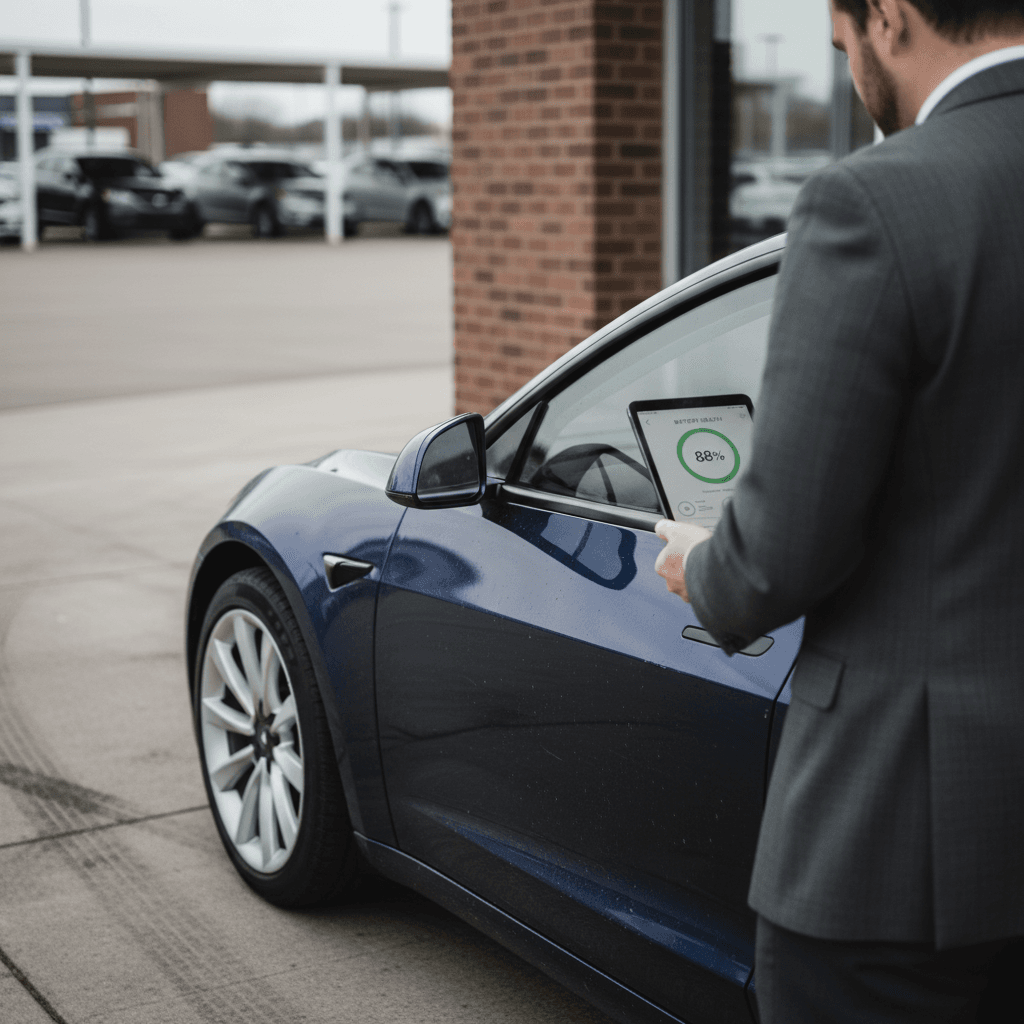
On a gasoline car, an appraiser listens to the engine and looks for leaks. On a Tesla, the centerpiece of the valuation is the high‑voltage battery pack. Two Model 3s can have identical mileage but very different remaining capacity, and very different resale value.
Scenario A: Healthy battery
- 2023 Model 3 Long Range
- 35,000 miles by mid‑2026
- Recent diagnostic shows ~90–92% remaining capacity
- Normal DC fast charging usage
Buyers see this as a strong long‑term daily driver. Appraisers are comfortable stretching toward the top of the range for this trim and mileage.
Scenario B: Question mark battery
- Same year and trim, similar mileage
- No battery report, or signs of accelerated degradation
- Heavy fast‑charging history
Appraisers price in more risk. That typically means shaving thousands off the offer or steering the vehicle toward auction rather than retail.
Where Recharged fits in
Where you trade or sell matters: dealer vs. online vs. EV marketplace
Who you ask for a number can change your 2026 Tesla Model 3 trade‑in value as much as the car itself. Here’s how the main channels typically behave.
Common ways to unload a Tesla Model 3 in 2026
Each option trades convenience for price in different ways.
Franchise or independent dealer
Pros: One‑stop shop when you’re buying another car; easy paperwork; local relationship.
Cons: Many stores still treat EVs like ICE cars. If they don’t retail used Teslas themselves, they’ll price your Model 3 as an auction unit and bid conservatively.
General used‑car platforms
Pros: Quick online quotes, at‑home pickup, no haggling.
Cons: Algorithms may not fully factor Tesla‑specific options or battery details, and final offers can shift after inspection.
EV‑focused marketplaces like Recharged
Pros: Teams that specialize in EVs, battery‑aware pricing, and buyers who are specifically shopping for electric.
Cons: May not have a physical presence in every city, though Recharged offers nationwide digital buying and selling plus an Experience Center in Richmond, VA.
Watch for low-ball “sight unseen” bids
How to maximize your 2026 Tesla Model 3 trade-in value
You can’t control the entire market, but you can absolutely control how your car looks on paper and in person when you go to trade it. Think of this as a multi‑year playbook between now and 2026.
Step-by-step playbook to protect your Model 3’s value
1. Keep mileage in a reasonable band
There’s nothing wrong with driving your car, but adding 25,000 miles a year will push your 2026 trade‑in value down. If you have multiple vehicles, lean on the Tesla for the trips that make the most financial sense.
2. Favor Level 2 charging when you can
Your Model 3 is built for fast charging, but living at Superchargers isn’t ideal. Regular home or workplace Level 2 charging is gentler on the pack and looks better in a battery report over time.
3. Stay current on software and service
Keep up with recommended maintenance items (brake fluid checks, cabin filters, tires) and install software updates. A clean digital record reassures buyers and appraisers that the car’s been cared for.
4. Fix visible wear before you get quotes
Curb‑rashed wheels, bald tires, and obvious interior stains all give an appraiser reasons to walk your offer down. A modest investment in detailing or cosmetic touch‑ups can easily pay for itself in trade‑in value.
5. Gather documentation early
By early 2026, pull together service records, charging history if available, and any previous inspection or battery reports. The more transparent the story, the easier it is for a buyer to justify a strong number.
6. Get a battery health report
If your buyer doesn’t already provide one, consider getting a third‑party EV battery diagnostic. Platforms like Recharged build that into a <strong>Recharged Score Report</strong>, which can help distinguish your car from similar‑looking listings.
Trade-in vs. private sale
Financing and negative equity on a 2026 Model 3
How you finance your Tesla today can create either flexibility or headaches when you’re ready for a 2026 trade‑in. Rapid depreciation in the first couple of years means it’s easy to wind up upside‑down, owing more than the car is worth, if you stretched a long loan term or put very little down.
How negative equity happens
- Very low down payment (or none).
- 72–84 month loans with slow principal pay‑down.
- New‑vehicle rebates or price cuts after purchase.
By 2026, you might be staring at a payoff that’s higher than any trade‑in quote you receive.
Strategies to avoid or manage it
- Aim for a term that matches your ownership horizon. If you plan to trade in 3–4 years, consider a 60‑month loan and higher monthly payment.
- Put more money down up front if you can.
- Watch for lender programs that allow principal‑only payments without penalty.
When you work with Recharged, you can pre‑qualify for financing with no impact to your credit and see how payments and trade‑in timing line up before you commit.
Rolling negative equity into the next loan
How Recharged evaluates used Teslas
Recharged was built around used EVs, which means our team looks at your Tesla Model 3 through a different lens than a traditional gasoline‑first store. Instead of treating every electric car as a risky unknown, we lean on data.
What goes into a Recharged trade-in view
Battery‑centric, EV‑focused, and transparent by design.
1. Recharged Score battery diagnostics
Our in‑house Recharged Score combines battery health diagnostics, charging behavior, and vehicle history to understand how your pack has actually aged. A stronger score supports stronger offers.
2. Condition, history & equipment
We factor in accident history, cosmetic condition, tire and brake status, and whether your 2026 Model 3 still has key options and hardware that shoppers want.
3. Real EV market comparables
Because Recharged focuses on EVs, we’re watching used‑Tesla and broader EV resale trends every day, not just lumping your car in with generic sedan data from last quarter.
4. Multiple ways to sell
Depending on your goals, we can structure an instant offer, a trade‑in toward another EV, or a consignment‑style listing where we help you capture more of the final sale price.
Ready to find your next EV?
Browse VehiclesYou can start the process fully online, or, if you’re near Virginia, visit the Recharged Experience Center in Richmond for in‑person support while still benefiting from the same battery‑driven valuation approach.
Frequently asked questions: 2026 Tesla Model 3 trade-ins
Common questions about 2026 Model 3 trade-in value
Key takeaways for your 2026 Model 3 trade-in plan
You don’t need a crystal ball to plan for your 2026 Tesla Model 3 trade in value. Focus on what you can control: mileage, battery health, condition, and documentation. Think in percentages of original price instead of fixating on a single dollar number years in advance, and be choosy about where you request offers, generalists and EV specialists don’t see your Model 3 the same way.
If you want an EV‑centric perspective, Recharged can help you value, finance, and replace your Tesla through a single, mostly digital experience. Every vehicle on the platform includes a Recharged Score Report with verified battery health, and the same approach can be used to evaluate your trade‑in so you’re not leaving money on the table. Whether you sell outright, trade in, or consign, starting with a clear picture of what your Tesla is really worth puts you firmly in the driver’s seat.