If you bought a 2025 Tesla Model 3 and you’re already thinking about moving on, maybe to a Model Y, a Cybertruck, or a different brand, you’re probably asking the right first question: what’s my 2025 Tesla Model 3 trade‑in value right now? In 2026, Tesla prices, EV incentives, and used‑EV demand have all shifted, and that directly affects what dealers and online buyers will offer you.
Why this matters now
How 2025 Model 3 pricing sets the floor
Every trade‑in calculation starts with what a brand‑new 2025 Tesla Model 3 costs today. Buyers will not pay you near‑new money for a used car when they can order a fresh one online for a known price. So before you estimate your 2025 Tesla Model 3 trade‑in value, you need a rough handle on current MSRPs.
2025 Tesla Model 3 pricing snapshot (MSRP ballpark)
Valuation tools and market data through late 2025 show that a Model 3 often sheds roughly a quarter to a third of its MSRP in the first year, especially in a market where Tesla is aggressively adjusting new‑car prices. That’s your starting point when you think about what a low‑mileage 2025 will bring as a trade‑in in 2026.
Price cuts hurt your trade‑in
What 2025 Tesla Model 3 trade‑in values look like today
No single number fits every 2025 Model 3, but based on how 2023–2024 cars are trading today and how new‑car MSRPs line up, we can outline realistic estimate bands for a one‑year‑old 2025 Tesla Model 3 in good condition as of spring 2026.
Estimated 2025 Tesla Model 3 trade‑in value ranges (spring 2026)
Illustrative ranges for a clean 2025 Model 3 with typical mileage (~12,000–15,000 miles). Real offers vary by market, options, and battery health.
| Trim / configuration | Typical original MSRP | Rough dealer trade‑in range | Private‑party sale range |
|---|---|---|---|
| Model 3 RWD / Standard | $39,000–$43,000 | $26,000–$31,000 | $29,000–$34,000 |
| Model 3 Long Range | $43,000–$48,000 | $30,000–$35,000 | $33,000–$39,000 |
| Model 3 Performance | $52,000–$57,000 | $35,000–$42,000 | $39,000–$47,000 |
| Heavily optioned (FSD, premium paint, wheels) | MSRP +$5,000–$12,000 | Often only +$1,000–$3,000 over same trim | Often +$2,000–$5,000 over same trim |
Use this as a directional guide only; always compare multiple live offers for your specific VIN.
Trade‑in vs private‑party reality
Those numbers may sting if you paid top‑of‑market pricing in early 2025 or loaded your car with software and cosmetic options. On the flip side, falling values also mean buying your next used EV, Model 3 included, can be dramatically cheaper than it looked just a couple of years ago.
How Tesla and dealers calculate your Model 3 trade‑in
It helps to know what’s happening behind the curtain when you plug your VIN into Tesla’s trade‑in tool or visit a local dealer. The math isn’t mysterious, but it is very rational. They’re asking one question: **What can we realistically sell this car for in the next 30–60 days, and what margin do we need to justify taking the risk?**
The trade‑in math behind your 2025 Model 3 offer
What Tesla and other buyers actually look at
1. Market data & comps
Buyers look at:
- What similar 2024–2025 Model 3s are listed for
- What they’re actually selling for at auction and retail
- Regional demand for Teslas vs other EVs
2. Reconditioning costs
They subtract what it will cost to get your car frontline‑ready:
- Tires, glass, wheels, detail
- Software corrections, minor repairs
- Battery or charging diagnostics
3. Margin & risk buffer
Dealers need room for:
- Price cuts if the car sits
- Auction losses if it doesn’t sell
- Overhead and warranty risk
All of that shrinks your offer versus retail.
How Tesla’s own trade‑in offers work
Tesla’s online trade‑in estimate is heavily automated. You enter your VIN, mileage, basic condition, and location; Tesla cross‑references that with auction data, its own used‑inventory sales history, and current new‑car pricing. The offer is typically conservative, and Tesla explicitly notes that added software like Enhanced Autopilot or FSD doesn’t always add dollar‑for‑dollar value to a trade‑in.
On the plus side, trading directly to Tesla is fast and integrates cleanly with your new order.
How other dealers and instant‑offer sites do it
Franchise dealers, independent lots, and national buyers (CarMax, Carvana, etc.) use similar tools, but their appetite for late‑model Teslas can vary wildly. Some stores are eager to stock clean Model 3s; others will wholesale your car immediately, which caps their offer at what they think the car will bring at the next auction, often numbers similar to or below Tesla’s bid.
That’s why it’s critical to gather multiple offers before you accept the first number you see.
Don’t confuse payoff with value
Key factors that move your trade‑in value up or down
Two 2025 Tesla Model 3s built in the same month can be thousands of dollars apart on trade‑in value. Here are the levers that matter most, and which ones matter less than you might think.
Biggest drivers of 2025 Model 3 trade‑in value
Focus on what you can control before you get an offer
Mileage & usage
Buyers still think in miles. A 2025 Model 3 with 8,000 miles will usually be worth more than one with 22,000 miles, even if both have healthy batteries.
High‑mile commuters may see steeper early depreciation, especially on Performance cars.
Battery health & fast‑charging history
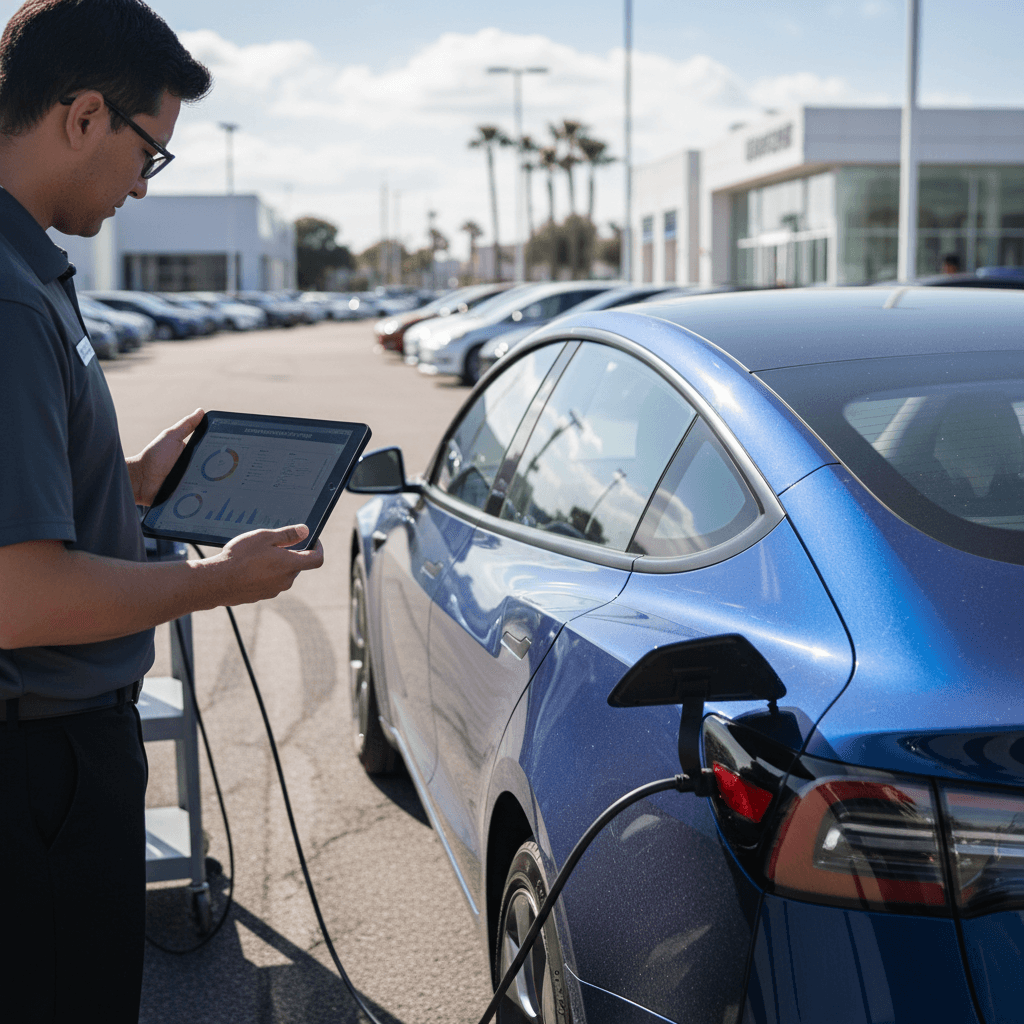
For EVs, the pack is the car. A 2025 Model 3 showing strong usable capacity and normal charging behavior will appraise higher than one with signs of heavy fast‑charging abuse or early degradation.
A third‑party battery health report can be a major plus when you shop your car around.
Condition & cosmetic appeal
Wheel rash, cracked glass, worn tires, and neglected interiors don’t just look bad, they reduce offers.
Many dealers budget $1,000–$2,000 for reconditioning on a late‑model Tesla. The cleaner your car, the less they have to subtract.
Trim & desirability
In most markets:
- Long Range trims command stronger demand
- Performance sells fast but is more price‑sensitive
- Colors like white or gray are safe; niche colors may narrow your buyer pool
Accident history & Carfax
A clean history is worth real money. Even quality repairs after a major accident can knock 10% or more off what buyers are willing to pay.
Small cosmetic repairs done professionally usually hurt less than visible damage left untouched.
Options & software
Extras like premium paint, upgraded wheels, and FSD rarely return their full cost on trade‑in.
They can help your car sell faster, but don’t expect dollar‑for‑dollar value compared with what you paid when ordering.
Battery health is your secret weapon
Should you trade in your 2025 Model 3 or sell it?
When you’re ready to move on from your 2025 Tesla Model 3, you essentially have three paths: trade it in to Tesla, trade or sell it to another dealer/online buyer, or sell it yourself. Each approach has a different mix of convenience, price, and tax implications.
Options for exiting your 2025 Tesla Model 3
Compare the main ways to get out of your 2025 Model 3 in 2026.
| Option | Typical price outcome | Pros | Cons |
|---|---|---|---|
| Trade‑in to Tesla | Often lowest or mid‑pack offer | Fast, fully digital process; easy if you’re buying another Tesla; no strangers test‑driving your car | Less room to negotiate; limited flexibility if you change your mind |
| Trade‑in / sell to non‑Tesla dealer or instant‑offer site | Similar to or slightly above Tesla in many markets | Can be competitive if they want Teslas; sometimes they’ll beat your other written offers | Some buyers will lowball late‑model EVs they don’t understand; more back‑and‑forth |
| Sell private‑party | Highest dollar in many cases | Maximizes price; you control the listing, photos, and story; can target buyers who value EVs | Takes time; you handle test drives, paperwork, and scams; no sales‑tax offset on your next purchase in some states |
Remember to factor in state sales‑tax rules, trade‑ins often reduce the taxable price of your next car.
Use trade‑in value as your safety‑net number
How Recharged values used Tesla Model 3s
Because Recharged specializes in used EVs, we don’t treat a 2025 Tesla Model 3 like just another compact sedan. Our buying, consignment, and marketplace pricing all start with how that specific car will perform for its next owner, especially when it comes to battery health and charging behavior.
What goes into a Recharged offer or list price
Built for EVs, not just gas‑car rules
1. Deep battery diagnostics
Every vehicle listed on Recharged comes with a Recharged Score Report, including verified battery health and charging data. That gives us the confidence to value a strong‑battery 2025 Model 3 more accurately, and often more aggressively, than a generalist dealer.
2. Real‑time EV market data
We track asking and selling prices across Tesla’s own used inventory, auctions, and third‑party marketplaces. That lets us price your car to sell quickly without underpricing it just because it’s an EV.
3. EV‑savvy buyers
Our audience is specifically shopping for used EVs. They understand range, charging networks, and software packages, which can support higher transaction prices than you’d see at a lot that mainly sells gas crossovers.
Ready to find your next EV?
Browse VehiclesIf you decide not to trade your 2025 Tesla Model 3 into a traditional dealer, you can get an instant offer, consign it, or list it on the Recharged marketplace. Our team can help you decide which option best balances your time, risk, and target price.
Checklist: Maximize your 2025 Model 3 trade‑in offer
Before you request quotes on your 2025 Tesla Model 3, spend a weekend tightening up the details. A few hundred dollars in preparation can easily translate into a $1,000–$2,000 swing in offers.
Pre‑trade‑in preparation for your 2025 Model 3
1. Fix cheap cosmetic items
Touch up curbed wheels, address minor dents, replace missing trim caps, and repair minor windshield chips. Anything that screams “project car” will spook both dealers and retail buyers.
2. Get a fresh detail inside and out
A professional detail, interior steam clean, exterior polish, and glass, makes your car present like a much newer vehicle. Clean, odor‑free EVs always appraise better.
3. Gather service and charging records
If you’ve rotated tires on schedule, addressed recalls, or used DC fast‑charging sparingly, document it. For EV shoppers, proof of <strong>gentle charging habits</strong> is worth real money.
4. Pull your own vehicle history report
If you’ve had any repairs, make sure the Carfax or AutoCheck reflects them accurately. Being proactive builds trust and gives you a chance to explain minor incidents.
5. Get a battery health report
Use a trusted diagnostic tool or partner with an EV‑focused buyer like Recharged to generate a professional battery health report. Bring this when you request offers, it signals you’re informed and serious.
6. Shop multiple offers in the same week
Values move quickly in the Tesla world. Collect offers from Tesla, at least one national buyer, and an EV‑focused marketplace like Recharged within a few days so you’re comparing apples to apples.
FAQ: 2025 Tesla Model 3 trade‑in value
Frequently asked questions about 2025 Model 3 trade‑ins
Bottom line on 2025 Model 3 trade‑in values
The 2025 Tesla Model 3 is still one of the most compelling EVs on the road, but its trade‑in value in 2026 reflects a new reality: fast‑moving Tesla prices, a maturing used‑EV market, and buyers who are laser‑focused on battery health and real‑world running costs. If you understand how those forces shape offers, and you do a little prep work before you shop your car, you’re far less likely to be surprised or short‑changed.
Start by getting a feel for current market ranges, then collect at least three real offers, including from EV‑specialist buyers. If you want a data‑driven view of what your car is truly worth, consider leveraging Recharged for a Recharged Score battery health report, instant offer, or consignment listing. In a market where numbers move quickly, the right information, and the right partner, can easily be the difference between a painful trade‑in and a smart step into your next EV.